On days like today, taken up by a frantic effort to prepare for an all-new seminar I’m teaching the usual unexpected crisis, plus wasting time dealing with a partisan troll whom I knew from the start was eventually going to get herself banned (and she did), I am especially grateful for thoughtful Comments of the Day in the inventory to keep the quality content coming. Such is Ryan Harkins’ comment on the post, “How Can We ‘Trust The Science’ When It’s Distorted By Activist Scientists?” —and here it is:
***
I can certainly applaud the desire to mitigate damage to our native fauna that our cities create, but I would think there are several things that any advocacy group should keep in mind.
1. Sensationalism might spur the gullible, but it trashes credibility among anyone who bothers to investigate. Once you’ve lost credibility, it is an enormous uphill battle to regain trust.
2. In the same vein, even accurate numbers need to be placed in context. A billion birds a year sounds like a frighteningly high number. But it gives no context for how severe the problem is. It could be an imminent threat to all bird populations, or it could be a very minor issue. Killing a billion humans would be devastating to the human race. Killing a billion ants doesn’t even make a dent in their overall population. I Googled around and found that estimates put the bird population in the US and Canada at about 7.2 billion. However, that doesn’t mean that in 8 years, there would be no more birds. Yes, since 1970, that number has declined from over 10 billion, but that means 3 billion overall over 50 years. However, even that doesn’t provide the full context, because people need to understand the various causes that impacted bird population loss (which is largely due to loss of habitat), and they need to understand that killing a billion birds a year doesn’t lead to an overall decline of a billion birds in the total population. Instead, many of those birds will have died of predators, disease, old age, or other accidents, and their deaths often mean resources made available to the remaining birds who will then survive and reproduce. The real question is how quickly the overall bird population is declining, and whether that decline is accelerating or leveling off.
3. Solutions should not simply target the problem, but provide a better alternative. If new windows are needed, then there should be an offer for patterned windows that are also better insulators, so that people who sign on reap the benefit of HVAC savings as well the moral pat-on-the-back. People who are motivated by the problem alone, especially if it requires sacrifices to mitigate, are not sufficiently prevalent to spur the changes needed to truly impact the problem. However, everyone needs to replace things at some point in time, and if the needed replacement is already better than what they had, and has the added bonus of some ecological friendliness, that makes it an obvious choice.
4. Back on the theme of trust, I think we as a society aren’t afraid to admit that everyone falls short of perfection, and that everyone’s life story is complicated. I think it is fair to offer a full picture of a society’s founder, but trashing the founder has problems that a society has to consider. If the founder were such a depraved individual, how much of his philosophy infects the society? Why should the society be trusted if its founder was so untrustworthy? Moreover, when a society decides its founder has to be denigrated, it faces a dilemma of whether to keep the founder’s name, and have it tarnish all efforts going forward, or abandon the founder’s name, and risk losing name recognition. Instead of stepping into that ethical trap, it seems far more prudent to simply say applaud the good things the founder did, and perhaps add a statement that the complications in the founders’ life do not diminish his contributions. And remember that a wise man once said that nothing before the word “but” really counts.
 Ethics Alarms
Insightful COTD!
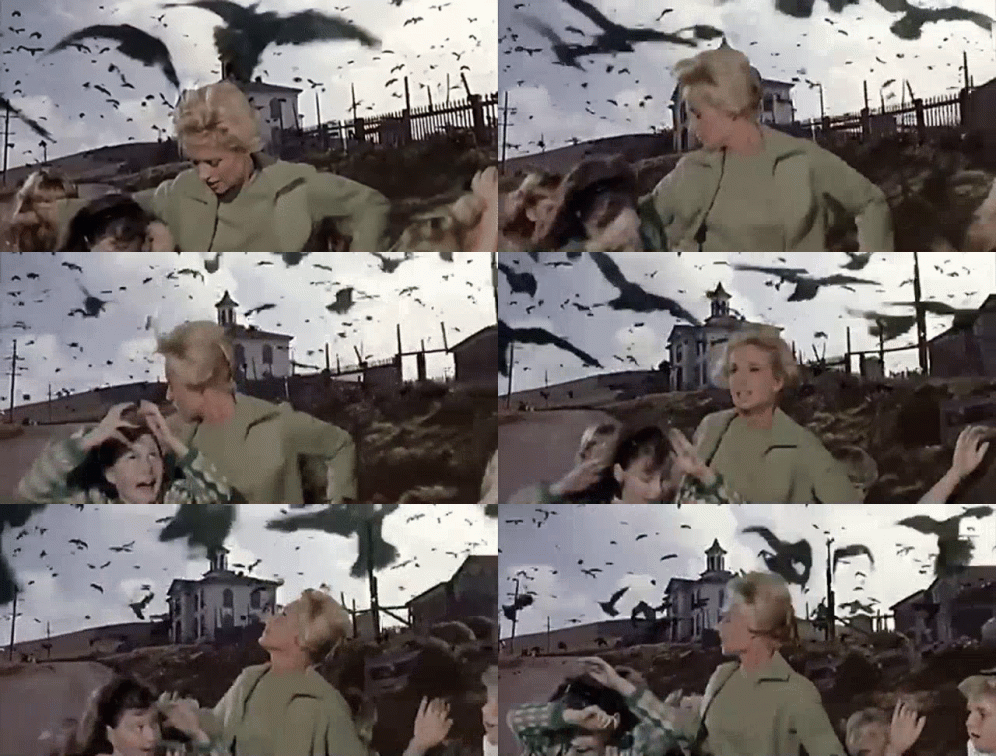
And obviously there was a shortage of shotguns and/or shotgun ammo in Bodega Bay.
“And obviously there was a shortage of shotguns and/or shotgun ammo in Bodega Bay.”
Recall watching The Birds recently (in its entirety for the 1st time!) and seeing a comely young actress and a stern-faced older (older than the young one, leastways) one who both looked curiously familiar.
The former turned out to be Suzanne Pleshette, and Jessica Tandy the other.
I read the novella, but never saw the movie. Wow, that was all the way back in 9th grade, maybe spring semester of ’96. We did a number of other interesting short stories in that segment, such as “The Lottery” and “A Cask of Amontillado”. I may need to go back and re-read those with an ethics-eye (though what there could be ethical about walling someone up in your basement because of some perceived insult, I can’t fathom…). But what can one say about a backwater town in (I think) Eastern Europe that held a lottery to see who would be sacrificed to the gods so that crops would be plentiful that year? What ethical situations could we discuss where the death of one means life for the many?
Isn’t that a common theme in a lot of stories and religions? I don’t know, but wouldn’t be surprised if the Aztec sacrifices originated from the idea of appeasing the gods and ensuring good fortune for the community.
We all remember the Star Trek movie where Spock sacrifices himself to save the Enterprise. I’ve read more than one science fiction or fantasy stories where one of the requirements for becoming the leader was that you were willing to make a sacrifice, up to and including your life, if required to save your village/tribe/country. The willing sacrifice part of it is what makes the gods agree to intervene on your behalf.
On the other hand the scapegoat, the unwilling sacrifice, which is what ‘The Lottery’ describes (wasn’t that story by Shirley Jackson?), posits that the sacrifice itself, the blood price is what counts. It’s utilitarian but I don’t think it would be an ethical process.