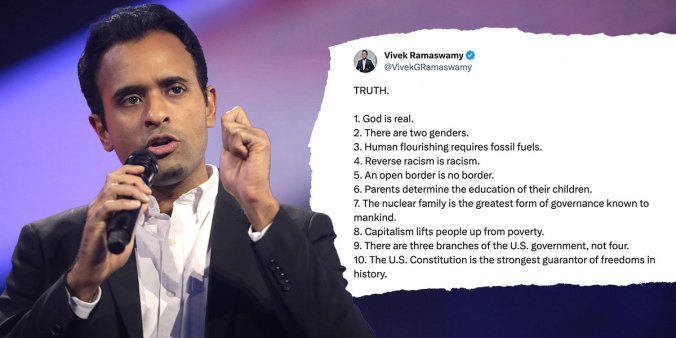
At last week’s Trumpless GOP candidates debate, wild card provocateur Vivek Ramaswamy announced his list of “10 campaign commandments:”
1. God is real.
2. There are two genders.
3. Human flourishing requires fossil fuels.
4. Reverse racism is racism.
5. An open border is no border.
6. Parents determine the education of their children.
7. The nuclear family is the greatest form of governance known to mankind.
8. Capitalism lifts people up from poverty.
9. There are three branches of the U.S. government, not four.
10. The U.S. Constitution is the strongest guarantor of freedoms in history.
Ethics-related observations:
1. Smart move, at least in theory. He gets honesty and competence points for making a straightforward statement that defines his political and personal orientation. Ramaswamy doesn’t get as many competence points as he might have (or should have), because the list is haphazard and careless.
2. His #1 doesn’t belong in a Presidential campaign, and it is irresponsible to put it in this one. The President has no say in the religious beliefs of Americans, and should not be campaigning on any religious point of view. It is fine for Ramaswamy to let the public know about his personal beliefs, but campaigning on the belief that “God is real” should have as much relevance to how citizens vote as campaigning on the belief that pineapple doesn’t belong on a pizza. Putting “God is real” first on the list is pandering to the religious right, and, frankly, an assault on his own #10, “The U.S. Constitution is the strongest guarantor of freedoms in history.” One of the ways the Constitution helps guarantee freedom is that it holds that religion is none of the government’s business, besides ensuring that Americans can believe as they choose without penalties or interference.
3. Those aren’t all “truths.” #2, #4, #5 and #9 are facts, though there are still plenty of ideologues and “its isn’t what it is” addicts who will deny them. #1 is a belief, and beliefs are opinions. #7, #8 and #10 are also opinions. #3 is sloppy: it’s true now, and may always be true, but we don’t know that. This is an example of Ramaswamy’s careless drafting, and if you are running for President and planning on making your manifesto the campaign’s centerpiece, you should be more precise in your wording. The same criticism applies to #6, which is also a gross over-generalization of a complex issue. I assume the candidate means that parents should determine the education of their children, but even that is an over-generalization. If parents have complete authority over the education of their children, a lot of children will grow up without the necessary skills, knowledge and perspective required to have a productive, successful and happy life. #7 is naked grandstanding; I’m not even sure what it means. A family isn’t “governance.” A family may be a fractal of government, but a family isn’t “great” government or even necessarily good government by being nuclear.
4. There are ten of the campaign commandments; Ramaswamy calls them commandments, and thus it is fair to conclude that he deliberately was evoking the Ten Commandments. But none of them, unlike what was on Moses’ tablets, command anything. These are statements. Because the candidate calls them commandments, the implication is that one must accept them. The classic American response to being told by a potential leader what one must believe is “Bite me.”
5. Far left website Mother Jones accuses Vivek Ramaswamy of deliberately mocking the obnoxious “In this House…” lawn signs that pollute progressive neighborhoods like mine in a post called “Vivek Ramaswamy’s Campaign Slogan Is a Reverse “In This House, We Believe” Yard Sign.” You know, this slop…
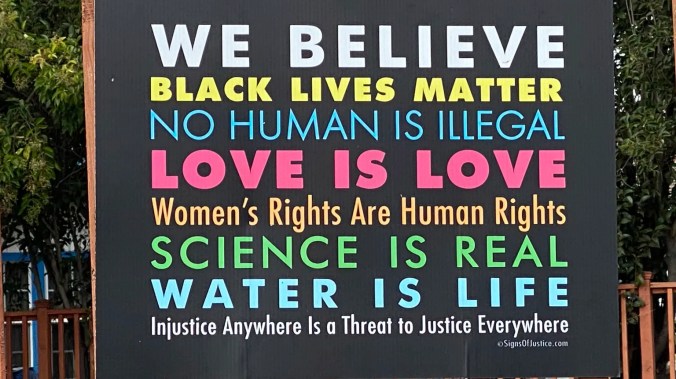
I admit that this was the first thing I though of when he announced his “commandments,” especially since “God is real” seemed to deliberately counter “Science is real.” To the extent that Ramaswamy is mocking those signs, good: they deserve to be mocked. At least “God is real” is a clear statement; “Science is real” is moronic: who doesn’t think science is real? The rest of the Mother Jones piece is self-indicting, and a snap-shot of the muddled thinking of the extreme left. The indignant authors writes, “Commandment number 4 is the inverse of “Black Lives Matter”[So BLM is a racist organization then. I thought so…] number 5 is the response to “No human is illegal” [Wait: I thought the claim that progressives want open borders was a conspiracy theory!] ; the supremacy of the nuclear family counters “Love is love” [“Love is love” is too fatuous and vague to counter]; “There are two genders” responds to “women’s rights are human rights” [ Huh?] ; “Human flourishing requires fossil fuels” answers “Water is life” [How?]; and the Constitution’s protection of freedoms negates the assertion that “Injustice anywhere is a threat to justice everywhere” [I’m afraid to ask what that’s supposed to mean.]
 Ethics Alarms
I pretty much agree with your analysis here.
A few thoughts:
#1 is annoying for exactly the reasons you say. However, would it be relevant to some people if a candidate declared oneself to be an atheist? I think it could be for two reasons. First, it is a question of just general values. Whether the person is part of my religion or not, to know that someone believes in God helps me judge the person’s values. Now, if I know the person’s actual denomination, it may be even more informative (unless they are a Catholic Democrat. Secondly, it speak to something more fundamental. Besides pandering to the Religious Right, there is a strain of thought that emphasizes that the State is not the ultimate authority on matters. By saying that God is real, he could be saying that there is a higher power than government. In other words, our rights do not come from the State (or, at least, certain rights do not come from the State). That is not necessarily a bad thing.
Number 7 is pretty odd. He says, “The nuclear family is the greatest form of governance known to mankind.” My most charitable reading is that Aristotle observed that the family is the most fundamental unit of government. Our family provides a governing structure; then, you group families together and get cities; you group cities together and you get the State. Plato (and many leftists) wanted to undermine the family, as the integrity of the family unit is an impediment to State control.
-Jut
Our founding document and mission statement, the Declaration, makes it clear that certain rights are inate and do not come from government, so a vaguely supportive statement isn’t a bad thing, but its’ not particularly helpful either. Besides, Jefferson and the gang were deliberately careful about saying exactly what “creator” means—is it God, god, the universe, “Providence” or something else? Reducing this to “God” is a step too far.
No doubt, knowing a potential leader is an atheist would influence popularity and support, but what significance it really has is open to debate and subject to distortion. I’d estimate that at least half of our Presidents were essentially agnostics who decided to keep that under their hats.
It is of note that Vivek is Hindu. I don’t know that this makes much material difference, and I don’t pretend to know that much about the Hindu concept of God as such, but it does hit a bit different to know that he is not talking about the Judeo-Christian god so much as a broader context.
On the Third Hand(tm). At least he provided something concrete for the voters to begin pondering, without having to parse paragraph long Mission Statements or Planks in a Platform. He isn’t a professional politician, that is one of the ways he is setting himself apart. That he is evoking Trumpian memes is something to consider as the actual Day of Decision, or week, whatever it turns out to be is an important factor to me.
This is an example of Ramaswamy’s careless drafting, and if you are running for President and planning on making your manifesto the campaign’s centerpiece, you should be more precise in your wording.
I wonder if you actually think that Vivek is running for president, or if you’re just writing like he is because he’s in the Republican presidential primary, and ethically you probably shouldn’t be there unless you’re actually running for president.
Because if it’s the former, I’d like to present the possibility that he’s running for VP.
I believe, fervently, that anyone who wants to be Vice-President should prove themselves fit and qualified to be President. Let’s see…the last VP who reached that standard was…Al Gore, sort of?
How does Cheney fit in there?
He seems politically savvy but not especially ambitious. Did he know he was not able to get elected President? Or he just did not want that?
Smarter than Gore, Biden, Pence, Quayle, Mondale?
He seems unique among VPs who did not seek the top job (Biden is not analogous because the fix was in for Clinton in 2016–I can think of no other reason why he did not run in 2016).
-Jut
I was hoping somebody would ask that. He’s a special case, qualified but un-electable as President (looks, manner, etc.) Yes, smarter than the rest.
I’m sympathetic to your point, and frankly, I think that if Vivek managed to somehow Magoo his way into the presidency he would probably be the first to soil himself in surprise.
But there’s a difference, and you touch on it later, between “fit and qualified” and “electable”, and I’d like to add “best in this field” to the mix.
Someone could be fit and qualified, but not electable or best in field, we have a couple of those. Christie could do the job. So could Pence. Probably even Haley. None of them are going to be president. Of those, two are deluded and one is running out of pure spite. Someone could be electable, but not fit or qualified but *cough* I can’t *Trump* think of anyone *cough* like that. DeSantis is fit, qualified, and electable, but is he best in a field where he’s polling less than 20%?
LBJ was an example of someone who was arguably “best in the field” but unelectable (too Texas, too homely, too many skeletons. And not to be a broken record, but electable usually means capable of “playing President” in presence and manner, as well as traditional images and assumptions. Obama could do that. It’s one feature that works against women like Hillary.
Not to be obtuse, but isn’t running in the presidential primary running for president? Whatever his ulterior motives, he’s publicly saying he should be president and this is an amateurish attempt. A quick stab by a non-politician:
Ten Campaign Tenets
1) Freedom of religion is a core right of the constitution
2) Parents have the right to decide what is best for their children medically
3) Environmental policy must be informed by what is best for the whole country in both the short and long term.
4) We hold these truths to be self evident, that all men are created equal
5) Our borders must be protected to protect our national sovereignty
6) Parents have the right to decide what is best for their children educationally
7) The nuclear family is the ideal foundation for our society
8) Capitalism gives the greatest financial benefits to our society
9) The 3 branches of government are distinct and not under the authority of any other branch
10) We must protect and guarantee all our Constitutional rights
I would also re-order them to something like 4, 1, 10, 7, 2, 6, 9, 8, 3, 5
Maybe not obtuse, but at least naïve. There are a great number of people throughout history that polled at less than 2% who ended up getting tapped for VP or a cabinet position, and that was the best they could ever hope for. Don’t get me wrong, there are people out there who are just hopeful and deluded, thinking they’re a break-away performance away from surging, but Vivek isn’t there. He’s fighting Kerri Lake for Trump’s VP position.