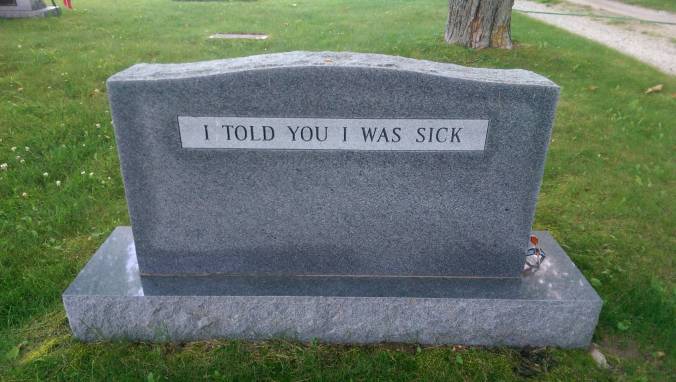
My mind’s made up on this one, and I disagree with “The Ethicist’s” answer, but I have a strong bias, and I want to see what EA readers think. “Name Withheld,” who for some reasons sends The Ethicist (Kwame Anthony Appiah) a lot of questions, asked in part,
I am 76 and have lived a full and interesting life. My doctor recently gave me the news that the cancer I was treated for last year has returned and metastasized. I have started a course of immunotherapy treatments that, hopefully, should keep the cancer at bay for roughly the next two years.
I have not told my wife, my son or any of my friends about this. I don’t want to have to endure two years of pity. I would rather enjoy life with everyone as I have always done — and then break the news only when the time comes….Am I wrong to keep this from the people I love?
The Ethicist replies that he is wrong. “By depriving your loved ones of the facts, you deprive them of the chance to face the future together with you,” he concludes. “Because your diagnosis affects their lives as well, I hope you’ll let them come to terms with this important truth.”
Your Ethics Alarms Labor Day Weekend Ethics Quiz is…
Is “The Ethicist” right?
Obviously, it depends on the situation. There are cases in which hiding imminent death from family and friends is impossible. Here, the assumption is that the inquirer can do it successfully until the end is near. I am also assuming that he will be responsible, and make the necessary personal arrangements.
My father, Jack Marshall, Sr., died in his sleep after closing his eyes for a mid-day nap on my birthday in 2009. When I asked his physician what the cause of death was, his answer surprised me. “Oh,” he said,”there are too many possibilities to count. Your father had cancer, he had a bad heart, he had other serious health issues, and he was, after all, 89. Any of them could have killed him, and he knew he wasn’t long for this world. But he didn’t want to worry your mother.”
That was so typical of my father. He hadn’t slowed down at all in his last year, although looking back on it, I realized he was quietly wrapping things up. Dad believed that every day you wake up alive is a gift, and that worrying about bad things that might happen, especially death, ruined good days. As a wounded survivor of World War II, including the Battle of the Bulge, my father’s philosophy was essentially the same as Teddy Roosevelt’s, one of my father’s heroes. You live life as well and as hard as you can for as long as you can, without looking back in regret or forward in dread. He was ready for death whenever it came, but he knew even the thought of him dying would devastate my mother. As with everything else, my father did the right thing in keeping his approaching demise from the family. And my mother wasn’t at all upset that he had kept his health decline from her.
She was furious at him, however, for dying at all.
 Ethics Alarms
Mrs. OB gets furious with me when I don’t advise her of medical (potential) scares (which have never eventuated, fortunately), sometimes even after they are ruled nonevents. So, I’m a little conflicted on this but if it’s a terminal diagnosis, I think he should tell his wife. And tell everyone else who is given the news not to pity him. But it’s really a moot point: wives know everything. His wife will figure it out in a New York minute.
Lyric from a Ry Cooder cover of an old blues song. Wife says, “You’ve been doin’ somethin’ wrong. I can tell … by the way you smell.”
Generally, I would agree with the Ethicist for the reasons he stated.
That is not to say there are not exceptions and your father might have been one.
But, I think there are circumstances in which you are obliged to share that information.
Right now, I have two young children that I am responsible for. I have an obligation to them to try to stay healthy. That means going to the doctor and addressing my health needs.
Now, that does not mean I would necessarily have to share everything with them at their current ages. However, my wife, who shares the same obligations to them should be told about anything that may impact their well-being and her own responsibilities towards them.
And, of course, those obligations can change over time. At 89, anything can happen. My dad died last year (almost 1 year ago).It was not his Type II diabetes that did him in (he disclosed that diagnosis 25 years ago). It was not the myriad of undisclosed health issues either. He had a stroke and that was kind of the beginning of the end. At 86, I can’t say I was surprised.
-Jut
I think it is difficult to define exact rules or guidelines for the ethics around the death of a loved one. There are a lot of competing emotions. Who’s emotions take precedence? The person dying or the surviving loved ones? In such situations I think you have to put the feelings of the person dying in front of your own. Losing someone is horrible, but the person who is actually afflicted with the condition should be able to choose how to live what remains of their lifespan.
I’ve had conversations with my parents about these things, and it is hard to face. The difficulty doesn’t make it any less necessary. I know exactly what my parents want because they have told me what they want. At least at the end I will know I did what they wanted even if I am upset about it or don’t necessarily agree with their preferences. My mother has a similar position, she would rather live like normal until the end comes. I think the ethical thing to do is to accede to her wishes even if I don’t like it.
Good work, N.P. Burying one’s parents is tough duty and has to be done. Surprisingly, I’ve found having my only sibling older brother die has been almost harder. A bit of a shock. Good luck.
The dying man better know for sure just what the hell he is doing. I never would deprive my wife of important medical knowledge about me; we are a team and we support each other. If not, what is the point of marriage. Secrets have a way of sneaking out, sometimes at most inopportune moments. When the wife learns, and she will, it will destroy or severely damage whatever trust their was, and when that is gone, so, too, is the marriage.
Within my family, there was a secret involving a child of (when I was a kid) uncertain origin. When I and other family members learned that this was a half-sister of mine, a close family member chose to not tell his wife. Just imagine, once she knows, as she surely will eventually, what will happen to the trust she had in him.
No different for someone concealing a deadly diagnosis from a wife; she will learn, and when she does, the marriage is over, in fact, if not in practice. Is that what he wants?
I will give him credit for good intentions.
Second.
His wife needs to know that the clock is ticking and that she doesn’t have as much time as she may hope for. If she is constitutionally incapable of keeping that information close, he might need to tell her in a time and place where she would have time to get used to the idea before she would have any chance to leak the information.
No one else needs to know. He’s 76. His relatives and those who care for him should appreciate that his time on this planet is limited and plan accordingly, but he has no obligation to convey specifics.
This is surely a case where the Ethicist might have tread more lightly. Death and family dynamics are extremely personal. Some people want to be surrounded by family preferring to enjoy the warmth and comfort of their presence. Some prefer to be alone, to experience that final moment as the candle flame burns slower and slower until…smoke.
Which experience is more ethical?
NW’s 76. He has every right to pass with dignity. He already knows what its like having family fawn over his previous bout with the disease and he’s decided not to relive it.
Does the calculus change when you’re middle age with minor children? Perhaps.
For what it’s worth, both health privacy laws and health ethics guidelines state that diagnosis information is not to be revealed to spouses or other family.