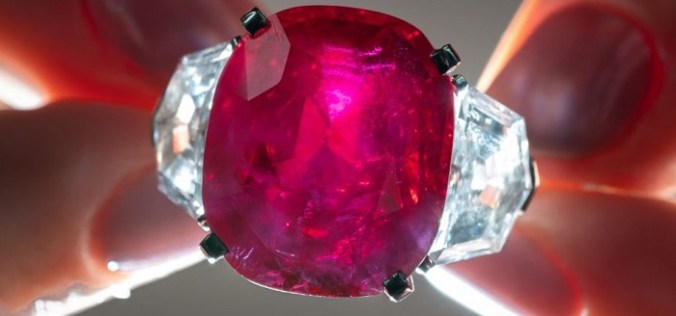
Once again, we encounter the conundrum of so-called “dirty money.”
In May, the auction house Christie’s sold a collection of jewels and jewelry from the estate of Heidi Horten, an Austrian philanthropist. The auction earned $202 million, establishing the Horten sale as the biggest precious gem sale ever. There was, however, an ethics controversy: all that jewelry had been bought with a fortune amassed by Horten’s husband Helmut, a Nazi who bought up Jewish businesses in forced sales during the Holocaust.
The Holocaust Educational Trust called the May auction a “true insult to victims of the Holocaust.” Yoram Dvash, president of the World Federation of Diamond Bourses, wrote, “In a time of Holocaust denial and the resurgence of antisemitism around the world, we find it especially appalling that a world-renowned auction house would engage in such a sale.” David Schaecter, president of Holocaust Survivors’ Foundation USA, which represents support groups for victims’ families in the U.S., called the sale “appalling” and said it had perpetuated “a disgraceful pattern of whitewashing Holocaust profiteers.” But Christie’s officials argued that the proceeds of the sale would go to the Heidi Horten Foundation, which supports medical research and a museum containing her art collection. The auction house also pledged to donate some of its own profits arising from the sale to Holocaust research and education.
Since May, however, attacks on the collection, Chistie’s, and the money paid for the jewels at auction have escalated. Christie’s announced this week that a scheduled November sale of more lots of jewelry from the Heidi Horten collection would be canceled, citing the “intense scrutiny” from Jewish organizations and some critics. The Jerusalem Post reported that other Jewish groups had rejected Christie’s donations from the May auction.
As with all controversies involving so-called “dirty money,” this one represents a triumph of emotion over reason, and grandstanding over responsible behavior. It is a classic example of confusing the “Ick Factor” with ethics. Money is money; it is also fungible. Rejecting funds that will do unquestioned good because those funds in one way or another come from evil deeds and evil-doers cannot be justified by any valid ethical analysis. The ends achieved are harmful, and the means, boycotting resources because of past factors that cannot be changed and harm that cannot be remedied, is driven by unethical motives like the desire for revenge, personal satisfaction and spite..
Helmut Horten is beyond punishment, and so his is wife. The fate of the fruits of his Holocaust profiteering won’t discourage any future crimes against humanity. The sale of the Horten estate produced fund that in some small way mitigated the harm done to society by Horten and others like him.
Schaecter, the Holocasut survivor who is president of Holocaust Survivors’ Foundation USA, praised Christie’s decision as sending a signal to all auction houses about the consequences of selling “tainted goods.” “We are glad that they recognized the great pain additional sales of Horten art and jewelry would cause Holocaust survivors,” he said. So instead of using the Hortens’ ill-gotten gains to finally achieve beneficent results, society must suffer to avoid causing psychic pain to those who don’t want anything positive to be associated with a long-dead Nazi.
Brilliant. Even justifiable bias can make us stupid.
_______________
Sources: NYT 1, 2; Jewish Chronicle
 Ethics Alarms
Somehow, I get the feeling if all of the proceeds from this auction had gone directly into establishment Jewish hands, there would have been no problem with the sale. Not a word would have been uttered or a fuss made. Everything would have been hunky-dory. Never mind the families that were originally cheated out of their wealth, which is where the proceeds should have ended up.
Once again, even sweet, upright Melanie took Belle’s money for “The Cause”…
I hate this rationale:
“We are glad that they recognized the great pain additional sales of Horten art and jewelry would cause Holocaust survivors,” he said.
Does that mean that, once all of the survivors die, it will be okay to sell these items?
-Jut
Once when I was working for a youth center, a person arrived at the center wanting to donate several hundred dollars in cash. The non-profit who ran the center had directed that any donations over $20 must be made at the office and not at the youth center itself. This is for accounting reasons and to avoid the impression that large amounts of cash might be found in the youth center building. The person wanted a tour of the facility, but I recognized him from the Megan’s list and stated that he would need to drop by the office to make arrangements for his donation and ask about a tour. I gave him a flyer with the organizations contact and office information. He never did go to the office. Several months later the people/group who sent the money (a local marijuana growers group) apologized for sending a sexual predator as their messenger and asked if the organization ever got the money. I let them know that they could check with the office but as far as I knew we had not. In this instance, it seemed that the delivery person chosen had an ulterior motive for how and when he attempted entry at the center. This is a very small town and as the only staff member of the center, I could not spend time giving a tour to a predator while the youth activities were interrupted. For safety reasons I couldn’t allow him in to see the youth. Later the group implied that we had refused the money because of its source. So, sometimes donations aren’t truly without some sort of strings or motives to entrap. Non-profits have to avoid the appearance of violating the laws non-profits must go by and avoiding the appearance of under the table money that isn’t properly tracked. Not knowing the details of why the money was ‘turned down’ I don’t know if any other factors influenced the refusals.
Sorry, the last sentences were supposed to refer to I don’t know why in the case of the jewelry auction donation they were refused by the various Jewish organizations. Not knowing the particular orgs or their stand on things it would be mere speculation.
So it’s wrong to have the auction at all according to…somebody.
What then should properly happen to all the jewels? Bottom of the ocean, I guess.