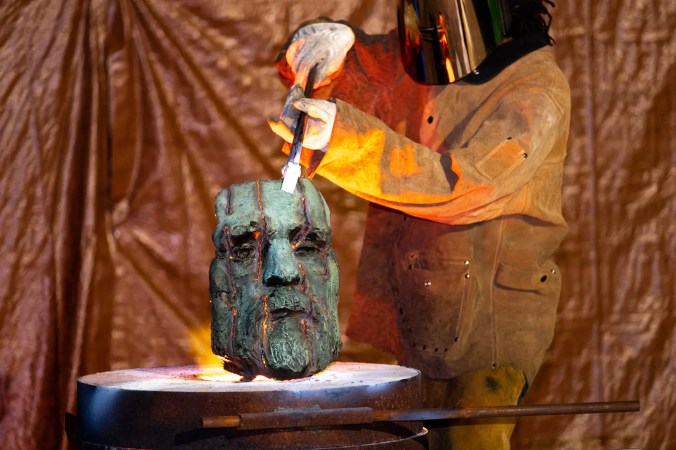
The New York Times turned to a biased art historian to discuss the melting down of the Charlottesville statue of Robert E. Lee that was the focal point of the infamous 2017 riot. Ethics Alarms has spilled too much metaphorical ink over statue-toppling and historical airbrushing already—you can find most of them under this tag or this one. I can summarize them all easily: tearing down statues betrays a totalitarian-mentality and undemocratic values, an intolerance of unpopular beliefs and ideas, and a favorable attitude toward thought-control and censoring history. I hate it, it’s unethical, and I’m not even a fan of Robert E. Lee.
Rigging the commentary (what were the chances that an African-American art historian would object to destroying a Lee statue?), the Times got what it evidently wanted: an almost obscenely gleeful account of Lee’s symbolic melting down. “Acrid fumes penetrated the respirators we had been issued,” Erin Thompson writes. “When the foundryman finally turned off his torch and tapped at the head with a mallet, Lee’s face fell clattering to the floor.” She quotes a founder of the statue-toppling group that helped accomplish the destruction as saying, “It feels like witnessing a public execution.” Clearly, it was a good feeling. You know, like the “reform Communists” felt when they tore down Stalin’s statue and threw his mummified corpse in a hole. “Stalin? Who’s Stalin?” Now the same people who helped the dictator murder millions could pretend it all never happened. It is traditions like this that ensure that Russians never learn from its history, because they don’t like to acknowledge history.
Robert E. Lee is not within the Webb telescope’s view of Stalin as a villain, indeed he’s not a villain at all, though Thompson seems incapable of understanding that. She also indicates that the motives behind art should determine the way art is valued, an easily rebutted fallacy. Shakespeare wrote his plays as contemporary public entertainment, no more significant than a minstrel show. So what? Art often evolves in its message, significance and public appreciation over time.
Thompson also embraces the unethical belief that the attitudes, motives and character of the artist should be attributed to the art. This is also a silly fallacy. It doesn’t matter why an artist made a Robert E. Lee statue, or whether those who commissioned and erected it did so because they were racists or because they wished the Confederacy had won the Civil War. What matters is whether future citizens of the United States of American can become better citizens and better human beings by knowing about Robert E. Lee—his achievements, his character, his mistakes, his flaws, his historical significance, his tragedy, and his ethical significance.
The answer is that they can and should. Doctrinaire scholars like Douglas and the leftist totalitarians who pulled down this and thousands of other statues believe that a better civilization emerges from ignorance and carefully managed information rather than wisdom acquired from knowledge and the consideration of complex stories. They, like Lee when he chose Virginia over the U.S., have taken an unethical course, and a destructive one.
“Unexpectedly,” as Prof. Reynolds would say, tongue firmly in cheek, Thompson gratefully attributes the desecration of Lee’s monument to the national “racial reckoning” triggered by a non-racial incident in Minnesota where an over-dosing perp resisting arrest died under the knee of a negligent cop. That’s her standard for historical justice: artwork honoring George Floyd, whose lifetime accomplishments (if any) are dust compared to Robert E. Lee’s, will be around for decades, deceiving future Americans into thinking that he did anything constructive in his life other than saying, “I can’t breath!”
“Dr. Douglas, Swords Into Plowshares’ other co-founder, apologized that the [melting down] ceremony could not be public,” writes Thompson, approvingly. “She thanked those in attendance, telling us we were witnessing it on behalf of Charlottesville’s residents, including those long gone who lived under slavery. Someday, she said, when we think of Civil War heroes, we will imagine not Lee but, instead, those who fought for their freedom against him.”
Yes, let’s make sure that future Americans all think about the same things, the same way, or else. That’s how the statue-topplers view democracy.
 Ethics Alarms
I believe this mentality is why so many want to do away with the electoral college and rely on majoritarian rule.
These people have no understanding that the United States is comprised of 50 sovereign states that have joined together as a group for the benefit of all members in that group.
Had majoritarian rule been the case from the country’s inception there might have been no civil war and blacks would still be treated as 2nd class citizens. The whole concept of America as a melting pot might be reserved only to the degree that Europeans would be allowed entrance Our republic preserves minority rights that majoritarian rule will not.
Majoritarian rule creates the impetus for factionalized insurgencies to emerge against the rule makers. Which is why the Middle East is always fighting among themselves for centuries. Every faction wants autonomy to set rules for themselves and others.
After rereading what I wrote above I realized that I did not adequately relate the context of the Lee post to my response.
Far too many of our citizens have such limited understanding of our history because they are taught to analyze events by hearing talking points and sound bites.
These ignorant citizens have no understanding that a man or woman born in time where people had little understanding of a national psyche would see their first allegiance would be to their state. They cannot fathom that Lee who was born only 35 years after we declared our independence and only 18 years after the ratification of the Constitution how he could be torn between the fledgling union and the soil of his birth.
We should be demanding that these statue toppers defend their rationale and be willing to castigate the African kings who sold their people into slavery. We should be asking why they are not protesting the ongoing slave trade in Asia and Africa. If they are unwilling to do the most basic of work to understand the issues then we have no obligation to give them credence.
The vast majority of people living in the US in the early years of our country were woefully ignorant about political issues. If providence prevailed at all it was because the leadership then was focused on issues and not on gaining power to enhance their wealth. That is not so today
The people then understood certain principles that included personal choices and responsibilities. They understood government was needed but not to the extent that it ruled them. These citizens would have never allowed ratification of the Constitution if they believed that they would give the more populous states would dominate and rule over their state.
Today’s ignorant populace believes majorities should rule yet fail to entertain the potential of tyranny of the majority. This is due to the unrestrained growth of federal authority. States have abdicated their responsibilities to their citizens because they have grown fat and lazy by promoting the suckling on the teat of of the federal budget. It is no wonder that so many do not understand why we have a republic and not a democracy.
Oh, yes. This art historian:
In June 2020, during the protests following the murder of George Floyd, Thompson publicly commented on a video showing protesters preparing to tear down a Minneapolis statue of Christopher Columbus, saying that, “I’m a professor who studies the deliberate destruction of cultural heritage and I just have to say… use chain instead of rope and it’ll go faster.”
https://en.m.wikipedia.org/wiki/Erin_L._Thompson
Yes, this is how the NYT seeks an objective, measured analysis.
I thought that this statue toppling frenzy had sort of burned itself out. Pulling down a statue or removing it from public view because it is no longer the flavor of the month or is now considered offensive is one thing. Melting it down is another, but I can see that being done if in fact it is going to be repurposed.
What is being described here, where a ceremony is specifically done to destroy the statue, but where it is hidden from the public and not even revealed after it is already done, presumably because the destroyers know that this destruction would the opposed by at least some people, is hard to really describe.
I do not know whether to compare it to strutting or to spiking the football or to licking your finger and making a sizzling sound, but it is an act in the same spirit. I thought they still taught children sportsmanship, which includes keeping your pride under in victory and not mocking or laughing in the face of the other side and essentially saying “nyaaah nyaaah, one, you lost, and now we’re going to destroy your thing right before your eyes and there’s not going to be a damn thing you can do about it.”
This isn’t even the end of it. What do you bet they will now recast it into a statue of George Floyd and replace it in the same park with a whole lot of triumphalism signage talking about what it used to be and how it was pulled down and now it is this, and congratulating the people who did all of this as heroes of a new more inclusive nation, and also telling everyone who views this display that they should leave this sacred space remembering the injustice done to a man named George Floyd and how it brought much greater justice to this nation, maybe ending with an all caps shout of black lives matter.
There was a man of the South who wanted to be an engineer. He wanted to build things. He couldn’t be an engineer, however, because he was a gentleman and engineering was for commoners. So, he became a military officer, like his father. That WAS allowed for a Southern Gentleman and he became a military engineer. When tensions ran high and the US declared war on Mexico, it was no a cake walk. I believe the European bookmakers were giving 6:1 or 7:1 odds, in favor of Mexico. The US was not a large or powerful nation. Our military was laughably small, and Mexico was an aristocracy, not a rabble democracy. How could we win. Well, this young military engineer was working for Gen. Winfield Scott and he managed to navigate some really difficult terrain to outflank the Mexican army and position artillery where the Mexicans didn’t believe it could go (the early US military was know for superb use of artillery). Winfield Scott promoted that man from Captain to full Colonel during that campaign. He came back to the US to a lot of admiring people and married the great-granddaughter of Martha Washington. That was Robert E. Lee. That is why Abraham Lincoln offered him a command in the Army of the US.
Now on to the Civil War. The post Civil War era was pretty bad, with the KKK calls for retribution, etc. How bad would it have been had Lee heeded the advice to let the army melt into the hills and continue fighting? How bad would it have been if he had not been an unwavering supporter of reconciliation? Lee was widely admired and respected. His views held a lot of weight. He wrote Southern leaders incessantly, telling them to stop agitating against the North, to let the war die and work together for reconciliation. Contrast this with Jubal Early.
“So far from engaging in a war to perpetuate slavery, I am rejoiced that slavery is abolished. I believe it will be greatly for the interests of the South.” -Robert E. Lee
Arlington House, his home, is now a national monument and its grounds are Arlington National Cemetery. This was originally done to ensure that he could never return ‘home’. He was stripped of his citizenship and denied amnesty when he requested it.
Lee was an important and interesting figure in American History. It is easy to see how the American Civil War and its aftermath could have turned out a lot worse without Robert E. Lee. Imagine if there wasn’t such a stigma surrounding manual labor? How would this story have turned out differently? I am not saying he needs to be enshrined as an American hero, but I think there is little cause to label him a villain. Only a monster would take glee in destroying the statue of such a man.