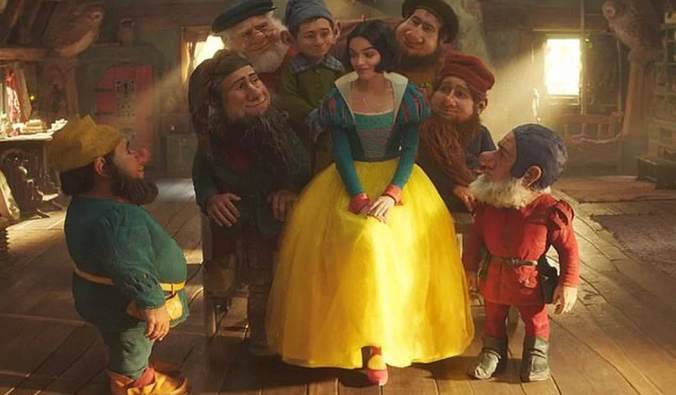
Disney, which has completely lost its way as a cultural icon, story-teller, entertainment source and exemplar, recently announced that it will be delaying its release of the live-action “Snow White” for at least a year after terrible publicity and a big-mouthed star made its $300,000,000 plus investment look shaky at best. Initially, the thinking was that the studio, recently the victim of one high-budget bomb after another, was just hoping to let all the controversy fade away, but no. The plan, it turns out, is to spend as much as another 100 million dollars to add CGI dwarfs, modeled on the animated originals, to the film and to remove whatever the hell these were…
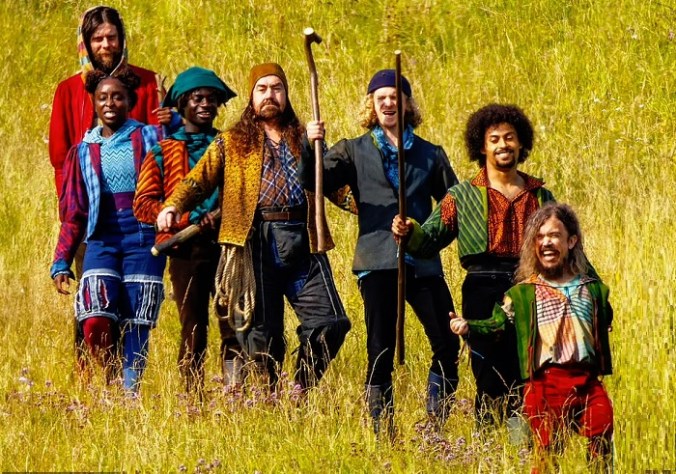
…which was the DEI-driven, uber-woke Disney replacement for the iconic little fellas after a single short actor had complained that keeping that feature of the classic fairy tale would be uncool. The company really made an artistic decision this way. It really did. Morons. Walt would have rolled in his grave if he weren’t frozen stiff.
The ethics value defied here is competence, and what we are seeing is the classic sunk costs fallacy in its classic form. The Vietnam War was the most painful example of this breach of life competence and common sense, which holds that devoting a lot of time and/or resources to a failed project argues for devoting more of the same, lest those “sunk costs” go to waste. In reality however, what is being missed is that fact that whether or not one has invested a great deal in a lost cause, its status as a project that has proven itself unworthy of investment is unaltered. Doing what Disney is doing with the “Snow White” project is called “throwing good money after bad.” It is bad business—incompetent, wasteful, and irresponsible.
The latest in the saga of this misbegotten film is especially satsifying because of the smug, obnoxious pronouncements of its Snow White of Color, Rachel Ziegler, who decided on her own that trashing Walt Disney’s brilliant and transformative original film was a wise way to publicize her certain to be inferior version. Now she’s looking down into the abyss of the kind of big budget bomb that has short-circuited many a young actress’s prospects for stardom, a fate that befell, for example, Elizabeth Berkley in “Showgirls,” and Ziegler is complicit in her likely fate, along with the executives who botched this production. Schadenfreude has seldom been more deserved, and so with this post I officially launch “The Nelson,” named after the constantly mocking lad on “The Simpsons,” Nelson Muntz. The distinction will be lurking for all those who blindly make stupid, destructive and irresponsible choices despite ample warnings and reasons to do otherwise.
Here’s Nelson:
 Ethics Alarms
Disney needs to replace the entire leadership team. It’s one thing to make a decision that does not pan out or go down a path that ultimately leads nowhere ONCE.
This year has been failure after failure and this is headed for being the biggest failure of them all and a potential brand killer. Disney used to be thought of as invincible and untouchable. No one could touch the House of Mouse. Disney was the king of wholesome entertainment, whether it be in the theater, on its own channel, or on partner networks that needed Saturday morning or weekday afternoon cartoon blocks. Do you remember the days when the Wonderful World of Disney was Sunday evening appointment television? Unfortunately, the image of Sleeping Beauty’s castle as the credits rolled was the signal that the weekend was over and tomorrow morning you would have to get up for school.
I haven’t done anything associated with the brand since my niece outgrew the princess stage. Thankfully, she did so before she could press her parents into giving her the Disney experience. Disney really started to lose its luster when they let the prices go through the roof, assuming that if people wanted to experience the happiest place on earth, they would pay for it, whatever it took, especially to satisfy clamoring children.
Where Disney completely lost me, and completely lost the majority, is when they started to get into all this woke and DEI stuff. They were selling an escape from the ordinary world into a world of magic where stuffed bears hug their owners back, animals talk, princesses live happily ever after, and heroes achieve great things, all while being all American. At least for a while, Disney World actually did a flag raising at the beginning of the day and a flag lowering at the end of the day sometimes with military bands and things like that. That would almost look out of place now.
At this point Disney has become all about gender-bending and being angry at the country but gave it birth. They believe they know better than the parents and that it is their job to shove this agenda down their customers’ throats every chance they get. Well, too much of anything gets to be too much after a while, and I think woke fatigue is setting in in this country. You can only take so many rebukes before you say that enough is enough and you just don’t want to hear any more of it. You certainly don’t want to pay through the nose to be subjected to this. That’s why Disney’s last few woke remakes have proven to be disappointments and park attendance is not what it used to be. They also made the mistake of taking on a powerful and popular governor who is not going to kiss their rings and do whatever they wanted because they were too big to fail.
Rachel Ziegler’s foolishness is just the latest outrage on top of multiple other outrages. Yes, it could be a career killer for her the way Showgirls prevented Elizabeth Berkeley from ever rising above playing tiresome, in some cases even bitchy feminist Jessie Spano on the living cartoon Saved by the Bell, but it could also be a brand killer for Disney. When a name that was previously associated with fun becomes associated with grim militancy, that name not only stops being fun, it stops being profitable. Once that happens, how long will that name survive? Congratulations to the current leadership team. You did something that no one else could pull off in the better part of a century, destroying one of America’s biggest and most iconic brands. But hey, maybe the wokesters hate you a little less, so that’s something.
Those “Sunday nights” were gold. We tried to watch as much of whatever Disney was playing until the folks dragged us out the door for evening church. I remember watching “The Headless Horseman” for the first time and laughing until I could barely breathe.
Now I just laugh at Disney’s utter stupidity.
Didn’t do evening church, but we usually weren’t finished with supper quite yet, so we only usually saw part of the show.
That one is my all-time favorite, with Bing at top form, and the best comic sequence—the chase—in cartoon history in my view. No wonder Tim Burton did an homage to it in “Sleepy Hollow.” When we subscribed briefly to Disney+ to see the “Get Back” Beatles tapes, watching “The Wind in the Willows”/”Legend of Sleepy Hollow” classic was the very first thing I did.
Who’s that coming down the lane, feet like a shovel, nose like a crane…?
It blows my mind too. My best friend and I did a double family vacation to Disney world in 2016 or 2017. I don’t quite recall. We did some quick napkin math to guess how much revenue the one park brought in daily.
Unfathomable to think that was one park of a half dozen. And one complex of several across the world. And the movies. And the toys.
We marveled at how Disney got there and all the business decisions. How the 2nd place in its genre was a distant second.
We basically guessed there was little Disney could do to lose its essential monopoly in the business.
And here we are.
Even the greatest army in the world can lose if it is badly led. See the Battle of the Teutoberg Forest. See Fredericksburg, See New Orleans, which they later called “lions led by donkeys.” I think the model applies to business as well.
Reading this post and Steve’s comment made me nostalgic for the Disney of old, both the one I experienced through TV and film as a child and Disney World as it used to be. I’m glad my daughter got to experience the park in it’s original incarnation and development up through the Animal Kingdom stage. We have most of the Disney classics on DVD for our grandkids.
Disney’s management has failed both as faithful stewards of valuable business assets, as well as guardians of the cultural legacy that Walt’s life work represents. Morons.
Perhaps someone at Disney listened to you, Jack. I heard that at least a few in their management ranks are recommending that no more money be spent on a futile attempt to try to fix this abomination and that it be permanently shelved. However, wokeism, DEI, ESG, and all the other crap is well entrenched at Disney, so they’ll likely spend the money anyway.
But those CGI characters aren’t even diverse!
The dollar auction is a game-theoretical way of portraying real-world instances where people have invested so much into something that they can’t bring themselves to cut their losses. (If people already know about the dollar auction, I’m sorry for the expose!)
The game proceeds as follows. A dollar is being auctioned off. Anyone bidding on the dollar has to deposit their bid, and cannot get it back. So if I bid 25 cents on the dollar, and I don’t get the dollar, I’m out 25 cents. Suppose then I’m bidding against one other opponent. As long as the bids are under $1.00, whoever wins the dollar gets his money back and a little extra. What is interesting is what happens when the bids are at $0.98 and $0.99. If I’m the one who bid $0.98, I reason that if I push the bid to $1.00, at least I’ll break even if I win. I walk away no worse than I started. But my opponent would be out $0.99. He reasons that if he pushes the bid to $1.01, if he wins, he’ll only be out a penny, as opposed to 99 cents. And so the bidding continues. At each step, the rationale has become, “If I at least win the bid, I won’t be out as much as I would if I don’t win.” At some point, the bidding ends with someone giving up, because the losses overall are substantial either way. Rumors have it that when certain mathematicians and their wives played this game, the dollar auctioned off each time for $4-$5 and some change. And some of the couples rode home in separate taxis because of it.
The real world applications apply to situations like waiting on hold, or even relationships that aren’t working out. When you call up a company and are put on hold, without any indication of when someone will take your call, you have the option to either stay on the line or hang up and try again later. But if you hang up now, you might have to devote all that time you’ve already spent on hold all over again, and the analysis says that in the current moment, because you’ve invested all that time on hold, it will be over all loss of time to hang up and try again later. For relationships, people tend to remain in dead-end relationships for longer than they should because they have invested so much time and energy into that relationship, and starting over would require investing all that time and energy all over again without any guarantee of better results.
I would guess that Disney is analyzing the Snow Off-White debacle from a similar perspective. They’ve invested $300 million into the effort so far. If they axe the project altogether, they are $300 million in the hole. If they spend another $100 million to fix it up enough that it might gross $200 million, then they would only be $200 million in the hole. As long as the projections convince them that the immediate analysis shows a better outcome from finishing the project than abandoning it, they would press onto finish it.
Thus ignoring the massive collateral damage to the brand and the company’s legacy, which will cost more in the long-term than that calculation acknowledges.
And probably put a bunch of people out of work.
That’s the irony: a woke little person actor attacks Disney for not being politically correct, and as a direct result of his mouthing off, other less successful actors of his stature lose their jobs.
I’ve been there and done that on eBay. Sometimes I win,and get something for a bargain or even a steal, but as often as not the price goes over what I’d like to pay. The discipline is in knowing when to walk away and accept that losing the bid isn’t that big of a deal. Then again, I have no wife to stop me and no kids to worry about paying tuition for.
Jack and Steve,
The problem with comparing the dollar auction with eBay is that only the winner pays money on eBay. Walking away with nothing but paying nothing except time is much more psychologically easy than walking away with nothing AND paying your losing bid.
While both require you to know when to walk away, it is much harder to walk away out money and still the loser as compared to walking away without money with your prize or walking away a loser with your money.
The answer is still the same, walk away before you pay more than you can afford, but in the actual dollar auction math problem, which is better? Walk away having paid $1 and receiving nothing, so finding yourself $1 in the hole, or paying $1.02 and getting a buck, so only being $0.02 in the hole? This is harder even at higher numbers.
Bean counters especially have the problem of the loss/profit calculation in a dollar auction, and I’m convinced that bean counters are running Disney right now, rather than idealistic creatives who love and respect children and families. Whatever may or may not follow from the Snow White decision is not easily quantifiable, especially in the messed up culture we are in. That makes bean counters focus on the knowns, not the unknowns, which in my opinion leads many companies to make STUPID choices.
I’ve been in a lot of eBay auctions, generally trying to buy inventory (books) for resale.
It’s always a crapshoot for me, win or lose — I’ll look at the description and try to guesstimate how much I’d list them for, add all that up, then figure what percentage of the total items would actually sell (20%, 25%, 40%) to get to the final, scientific rock solid number of what my revenue would be.
From there I have to decide how much I am willing to spend to make that much money, and that’s my limit on the auction. Or, if it’s a buy it now item, what I could make an offer for.
I go through most of that exercise mentally, but it’s still a challenge to stick to it. ‘Just one more bid will win it’ is a siren call……
The “dollar auction” is the model for various “penny auction” websites, some advertised on network TV. One person wins, usually at a bargain price, but everyone bidding pays for each bid, resulting in a huge net per item.
https://www.doughroller.net/personal-finance/penny-auctions-are-scams/
One thing I *really* appreciate out of the Daily Wire is their ability to perfectly mock woke initiatives coming out of corporate America and capitalize on it. From chocolate bars (He/His (With Nuts) and She/Hers (Nutless)) following Hershey’s Her/She campaign to exactly the iteration of Snow White we’re talking about:
Never underestimate the religiosity of the woke. They have been groomed for years after all. Plus, it is much easier and certainly more convenient to express that zeal with other people’s money. That is what woke-cupcakes do. Wokeism is an evil scourge that defiles everything it touches. The woke are ugly bullies who rapidly become less sanctimonious after a metaphorical punch in the nose.