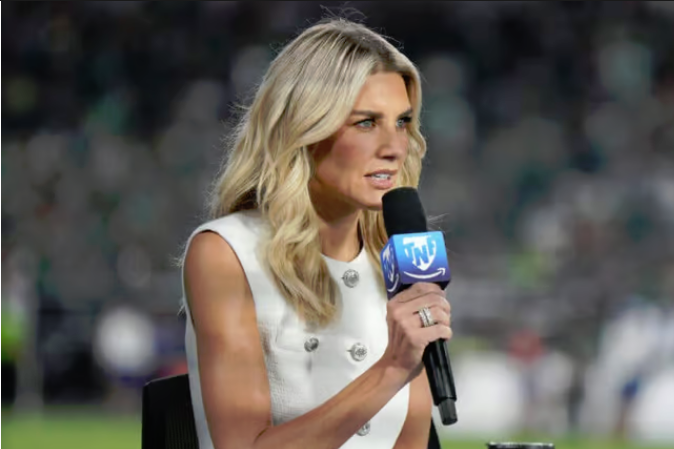
On a recent episode of the “Pardon My Take” podcast, the Fox Sports and NFL on Prime Video host Charissa Thompson blurted out that when she was a sideline reporter in the late 2000s, some of her football halftime reports were just made up on the spot. “I’ve said this before, so I haven’t been fired for saying it, but I’ll say it again,” she began. “I would make up the report sometimes, because … the coach wouldn’t come out at halftime, or it was too late and I didn’t want to screw up the report. So I was like, ‘I’m just gonna make this up.’ Because first of all, no coach is gonna get mad if I say, ‘Hey, we need to stop hurting ourselves, we need to be better on third down, we need to stop turning the ball over … and do a better job of getting off the field.’ They’re not gonna correct me on that. So I’m like, ‘It’s fine, I’ll just make up the report.’”
[Sidebar: This alleged professional sports reporter said “I was like” and “I’m like” in one short statement. She should be fired for that.]
The confession, as well as her casual manner of making it has, predictably, attracted furious backlash from other sideline reporters, who are lashing out on social media and elsewhere. In “The Althetic,” the New York Times’ sports news website, Richard Deitsch explains that Thompson’s remarks are especially damaging because TV sideline reporters are already held in low esteem by many sports fans and others who regard them as eye-candy for male viewers. He weighs in on the matter, saying,
What you see from sideline reporters on the air is a fraction of what they provide the booth announcers before, during and after a game. They are on the talk-back with the production truck all game long. They provide eyes on the field. During production meetings with players and coaches, they often prompt answers that turn into graphics or on-air storylines. That information almost always isn’t credited to them. It’s an accepted practice that if the telecast benefits from the information, everyone looks good.
OK, I’ll buy that: they perform a legitimate function during games. AND they are eye-candy. I’ll believe otherwise when I see more men taking on the roles in local and national TV broadcasts, or when I see a middle-aged, fat or plain female reporter in a single one.
Meanwhile, Thompson decided she was like, “Oopsie! My bad!” and posted this on Instagram:
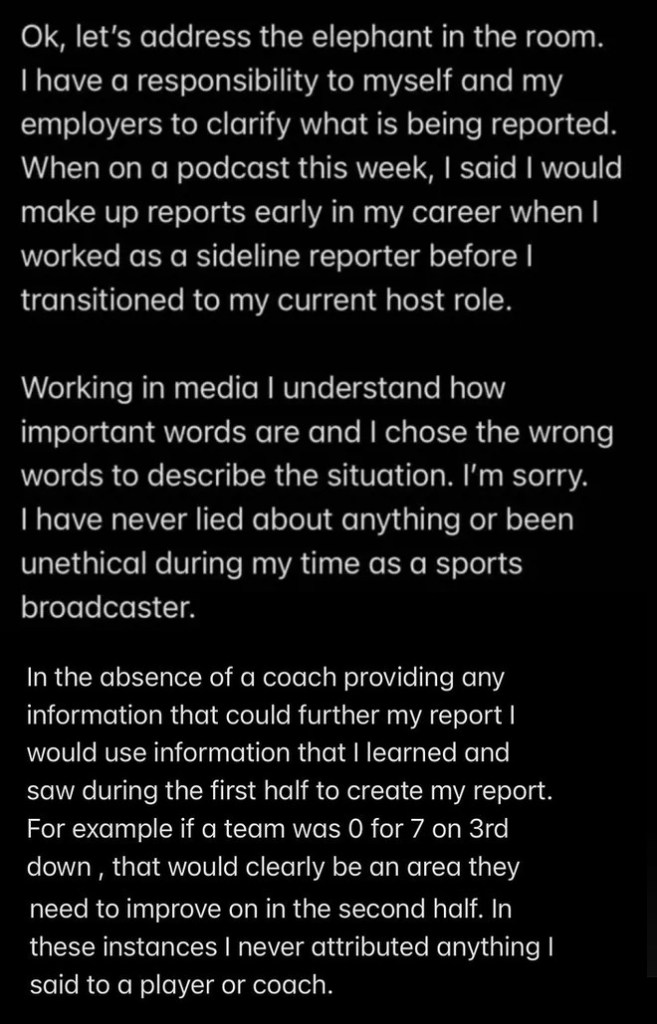
Oh. Well, that explains…wait, what? If I had Thompson in the witness chair, I would ask, “So were you lying then, or are you lying now?” Another question, “Do you understand what being unethical means?” If she misled viewers into believing her half-time comments were the result of talking to members of the team or the coach, that was unethical, and that’s exactly what she said she did. “I chose the wrong words” is a deceitful way of saying, “I lied in the podcast.” Now, in her Instagram “clarifiction,” she’s lying by claiming what she described in the podcast wasn’t unethical.
Never mind, Clarissa, most of your fans weren’t watching you for the information you reported anyway, and after this, they’ll definitely not be watching you for that.
 Ethics Alarms
She is a classic beauty!
Jack: “ I’ll believe otherwise when I see more men taking on the roles in local and national TV broadcasts, or when I see a middle-aged, fat or plain female reporter in a single one.”
I liked Michele Tafoya:
https://en.m.wikipedia.org/wiki/Michele_Tafoya
-Jut
She’s not exactly hideous...
Boys! Boys! Boys! Behave.
True. I was going to get into the “fat,” “middle-aged” and “plain” criteria specifically, but I got stuck on “plain.” She certainly is not fat, definitely is middle-aged and, as far as being photogenic, while not really being eye-candy, finds no competition among the likes of Terry Bradshaw, Al Michaels and Cris Collinsworth.
And, from what I knew of her, she seems smart.
-Jut
“There are two kinds of women who do this job: women who want to be on television and end up in sports, and women who love sports and end up in television.” Leslie Visser
PWS
I confess I stopped watching professional sports of any kind for two reasons. I object to the immoral salaries they receive and they hired bimbos to explain the game. I particularly do not watch football or gladiatorial MMA because of the high incidence of TBI