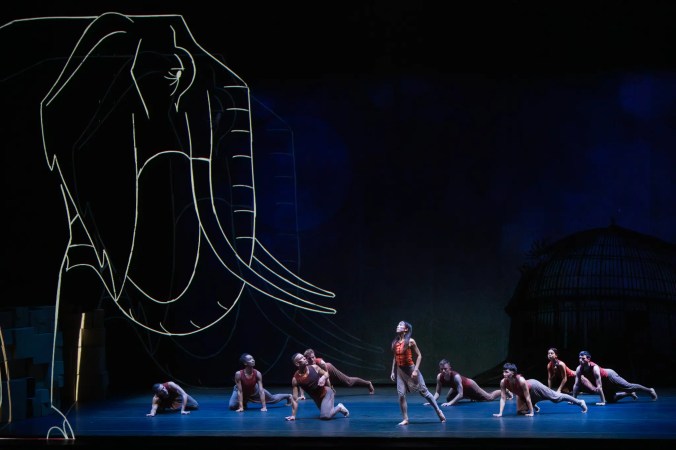
Surely there are still some live theater production that are not arm-twusting agitprop and woke propaganda. Surely.
The production is described on the Lincoln Center website as a “rethinking of the Rudyard Kipling classic ‘The Jungle Book'” that “updates the original’s colonizer-centric perspective.” More specifically, the New York Times review tells us,
“Instead of a boy raised by wolves, Mowgli is a refugee girl separated from her family as sea levels surge. She is adopted by animals who have formed a peaceable kingdom in a city that humans have left behind. Many familiar characters appear, slightly altered. Baloo the bear is now a bear who was forced to dance by humans before escaping the humiliation. The Bandar-log monkeys are now former lab specimens, still traumatized by being experimented on but longing to replace their former masters. Kaa the python is dangerous and hypnotizing but also hung up on memories of captivity in a zoo.”
Gee-what-fun. Can a Disney version be far behind?
 Ethics Alarms
According the the website, the price for each of the performances is “choose what you pay”. Perhaps that’s because they couldn’t decide on a price that was low enough to actually bring in an audience?
No Palestinians?
“updates the original’s colonizer-centric perspective.”
What is there to “update”? The perspective is what it is. It is a perspective of a particular person in a particular place at a particular time. It’s his perspective. There is nothing to update. “Updating” it means negating it.
Orwell provided a “colonizer-centric perspective” in a lot of his essays; it was not particularly favorable to the “colonizers.” Does that need updating?
Gandhi wrote from a “colonized-centric perspective.” Does that need updating?
History does not need updating. If it is updated, it is no longer history.
-Jut
“History does not need updating. If it is updated, it is no longer history.”
The comment speaks for itself.
We have always been at war with east asia
Although it shouldn’t be surprising these days, I feel worse for even knowing this particular bit of tripe exists. Thanks a lot, Jack 😉
What? Are none of the characters trans, or at least some variation of LGBTQ++-x? !!LMNOP**. The horror!
I’m being forced to go to the attic and retrieve my VCR versions of the Disney classics. Now all I have left to do is find a VCR player.
As an aside, while stationed in Italy we made an effort to see the famed version of Aida played annually in the Roman Amphitheater in Verona. Part of its fame was the presence of live African creatures in the grand march. UNBEKNOWNSTTO THE AUDIENCE, The production substituted LEGO animals, rather than the live breathing roaring ones that year. There was a stampede to the exits with the Italians shouting “Bruttismo. Brutissimo! [Ungliness, Ugliness)
The more I think about this, the more annoyed I am.
Granted, I have not read The Jungle Book; I may have seen the Disney Animated version long ago, but I saw the “live-action” one from a few years back many times (strongly recommended).
And, I have not seen this version.
So, my reaction is kind of a knee-jerk reaction.
Having said that, I understand the basic concept of Mowgli interacting with a variety of anthropomorphized animals that are allegories for various things. In this version, the animals are just animals that have been abused by humans in a variety of ways. It is still a morality story, but seemingly less subtle and far less creative.
As a work of art, I doubt that this version could stand up to the original, much less the two Disney adaptations.
-Jut
You should read the book. It’s a blast.
It’s on my list.
This post inspired me to pull up Disney’s 1967 version.
-Jut
Disney wasn’t completely true to the source material either, portraying Kaa the python as a villain, rather than one of Mowgli’s main allies, as in the book. (And I find Sterling Holloway’s voice acting extremely off-putting).
He want on to be Pooh later. Holloway had a trick voice, like Andy Devine and Chill Wills, and it was his stock in trade. He even showed up in “It’s a Mad, Mad, Mad, Mad World” for a cameo.
You are free to avoid this production, and indeed to criticize a play you have neither seen nor read, provided only that you allow other people to decide if they want to see it, a stipulation I’m sure you’d allow, Jack.
More to the point, theatre has been political since at least the time of Aeschylus in the mid-5th century BCE. And whereas we can argue about whether the changes he made in the stories he inherited from Homer were significant or not, the same cannot be said for Euripides, who, a generation or two later, changed essential plot elements in several of the myths he staged, and even overtly ridiculed a famous scene from Aeschylus’s Oresteia.
I’m currently working on an article about two adaptations of Greek tragedies by the contemporary Irish playwright Marina Carr. One of those plays, Ariel, bears enough resemblance to the plots of plays by Euripides and Aeschylus that no one familiar with those Greek tragedies could miss the connections. But she transforms the House of Atreus story to one of a present-day amoral and megalomaniacal Irish politician. Is it as good a play as the ones on which it’s based? Well, that’s a matter of opinion. I think not, but it is unquestionably an interesting work.
What’s more relevant for the topic at hand is that Ariel has been widely interpreted as an indictment of the Catholic Church, corruption in Irish politics (and the willful ignorance of the electorate), and Celtic Tiger era capitalistic greed. Is it? Well, sort of, but reducing it to those elements does take something away from the whole.
More often than not, such re-workings don’t measure up to the original, but there are exceptions: Racine’s Phaedra, Orson Welles’s Caesar, Ian McKellen’s film version of Richard III, etc. One of my favorite moments in theatre history was when Jean-Paul Sartre wrote his version of the Orestes story, The Flies, and sought to have it performed in occupied Paris. I don’t how accurate this account is, but if it isn’t true, it should be: the Nazis wanted to shut down the play, but to censor it would be to acknowledge that it was about them, and they believed that the play would have less impact than would the news of its suppression. (They were probably right.)
Finally, it’s possible to admire the dramaturgy without adhering to a play’s politics or philosophies. I think Hamlet, Matsukaze, and The Caucasian Chalk Circle are all great plays; I am not a monarchist, a Buddhist, or a communist. If Jungle Book Reimagined has something to say beyond trite political sloganeering, it will pass into the mainstream, just as the once-radical plays of Henrik Ibsen and Samuel Beckett did. If not, it will soon be forgotten. (Its limited run at Lincoln Center has already closed.)
One other thought: having at least a few “pay what you can” performances with a suggested ticket price is standard practice at a lot of theatre companies. My experience is that people will pay the suggested price if they can, but for some people, $35 a ticket is a real hardship: let them see the show for less this time, develop a relationship with them, and they’ll be more likely to come back next year when they can pay the suggested price. (The irony of my suggesting a capitalistic motivation for the practice is not lost on me.)
Here’s the problem, Curmie: The Jungle Book is a children’s story, and that woke adaptation was aimed at kids who don’t know about its source and who are being indoctrinated under the guise of entertainment without possessing the sophistication or knowledge to understand what’s going on. And the “Pay-What-You-Can” bit is aimed at hooking as many kids as possible.
Incidentally, the American Century Theater I ran for 20 years admitted children under 18 free for the last 10, if they were accompanied by a paying adult.
Maybe, but to describe the Kipling version as “colonizer-centric” is also accurate; we just don’t think of it that way because that’s “normal.” Just because it was the original doesn’t mean it’s devoid of “indoctrination.”
Oh, come on. What kid reads “The Jungle Book” and comes away thinking about the joys of colonization? This is just more anti-Kipling agitprop, isn’t it? Like Winston Churchill and Teddy Roosevelt of that era, the author believed in white supremacy and the duty of GB and the USA to civilize the world. It doesn’t devalue Kipling’s genius as a story-teller, or devalue his works to the point that they need to be “updated” or “improved.” Sure, adaptations of literature to the stage can work, and even open up that work to deeper understanding. But reducing great stories to political ponies at the expense of entertainment is nauseating practice. Orson’s “Voodoo MacBeth” was designed to entertain, not preach. My advice in the case of Shakespeare usually is “Write your own damn play, don’t ruin the work of someone better than you.” Welles’ MacBeth was more Welles than the Bard.
Curmie: “More often than not, such re-workings don’t measure up to the original, but there are exceptions”
You forgot to mention the movie, Zero Hour, which got re-worked to make the movie, Airplane! I was recently able to view them back-to-back and the similarities are quite enjoyable.
As for the re-imagined Jungle Book, the two Disney animations never really explain the underlying significance of the various animals, certainly nothing to the degree of the exposition provided by the New York Times. Such a description by the Times makes it seem a little preachy as compared to the movies.
Maybe Kipling’s work is as obviously preachy. I have not read it yet, but, based upon Baby Jack-Jack’s (my son) enjoyment of the recent film version, I got him the original book.
(I may have to borrow it from him….)
-Jut
“Zero Hour” is amazingly similar to “Airplane!’ And that makes it much more enjoyable than the original junk would have been before the parody.
Yes. The similarities between the two movies really show how well thought-out Airplane! was.
-Jut