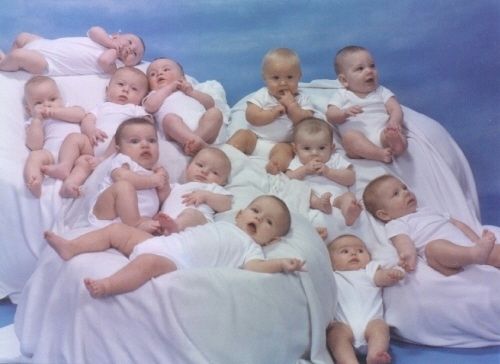
How does one make an ethics case that this is a bad thing?
A new study by economists at Georgia Tech and Middlebury College, published by the nonprofit Institute of Labor Economic, indicates that in states with significant limits on abortions or outright bans, births have increased. One of the study’s researchers, Caitlin Myers, went on NPR’s “All Things Considered” to discuss the results as if they were describing the Johnstown flood.
I found this genuinely mind-boggling. The exchange demonstrates how ethics rot can set in so decisively that even the most hard-wired and socially beneficial ethics alarms don’t work at all. Abortion supporters are so vehement in their love of the [procedure that prematurely ends nascent life in the womb that they are apparently willing to ignore all other issues in order to (try to follow, now…) punish Republicans who were responsible for getting a President elected who appointed Justices to the Supreme Court who were finally willing to over-rule a decision, Roe v. Wade, that most legal scholars, even those who defend abortion, conceded was poorly reasoned and wrongly decided.
Myers says at the end of the interview,
“I do think it’s important to have evidence and to have information about how these abortion bans are impacting people on the ground. We had heard a lot of speculation around the time that the bans were beginning to be enforced that people who wanted abortions were all still going to find a way. They were going to travel. They were going to mail-order medications. They would find a way. I think it’s important to understand that there is a large minority of people, probably around a fifth of people living in banned states who have been trapped, meaning they haven’t found a way. They’ve been trapped by distance or poverty or other factors in their lives. And as a result, there’s an increase in births that are occurring for a particularly poor and vulnerable population. And I hope that evidence is relevant to the public and policymakers as we think about how to support women and children.”
The entire interview (the interviewer is Ari Shapiro) never mentions the impact of the abortion restrictions on the 30,000 Americans who are now alive with the chance to pursue happiness, make a difference in the world, have careers and families, and, in short live when without the Dobbs decision they would have ended up in a medical waste bin somewhere. The researcher’s appeal to emotion is that the largest number of additional live births probably occurred in “poor and vulnerable” populations. A competent, unbiased interviewer in a non-woke propaganda news source might have asked, “So are you saying that it is best for all if the lives of children in these populations are nipped in the bud? Why not kill the children who are born, then? What are you implying?” An interviewer who really wanted to highlight the anti-abortion position rather than obscure it might have asked, “Weren’t unborn children under Roe a particularly vulnerable population, perhaps the most vulnerable of all?”
These issues were not considered on “All Things Considered.”
It seems likely that these researchers set out to estimate how many babies were born under Dobbs that would have been aborted under Roe in order to provide ammunition for the pro-abortion, anti-Dobbs, anti-Supreme Court, anti-GOP activists. It is essential that they, as well as those activists and the politicians now pandering to them, be confronted with a basic ethics question: How do you reach the position that 30,000 living human beings who would not have been given an opportunity to live under Dobbs is an unethical result?
 Ethics Alarms
Exactly. According to abortion enthusiasts, little black lives definitely don’t matter. It’s just the black lives that managed to get born and live to childbearing age who matter. And they certainly can’t take care of themselves.
I was wondering the other day why birth control isn’t the solution to unwanted pregnancies rather than abortion. Wasn’t birth control supposed to free women from having to have children? Wasn’t the pill the magic wand? And why are women even having sex with men? Aren’t men despicable? Don’t they tend to be cisgendered? At least the one who want to have sex with women.
Playing Devil’s advocate, a case could be made that some of these births would have been better off not happening, but you need more information than this. With this we just know a grand total.
To analyze this particular question you would have to know how many were to underage mothers, how many were to mothers unwilling or unable to shoulder parenthood, how many were into poverty and to what degree, how many were born with fathers absent, how many were to mothers with criminal records, how many were to those employed versus unemployed, and so on.
You also need to know how many were high-risk pregnancies, how many were the result of rape or incest, and how many were just inconvenient for someone. Just giving the grand total presents a distorted picture. I’m guessing if you asked those questions, that original number would be winnowed down quite a bit.
A case can beade that it’s better not to have more children born into poverty or into broken homes or to mothers who just don’t want them, because there is a greater chance that later on those children will become a burden to the rest of us. Despite Roman Catholic theology on the subject, there really only are so many places that can be set at the banquet of life before everyone starts to suffer. A case can be made that the rest of us should not suffer because of the carelessness or thoughtlessness of someone else. However, I wonder if anyone has done a study that shows how many children born who would have otherwise been aborted due in fact become a burden to society.
The bottom line, which no one wants to talk about and no one wants to admit, is the easiest and most certain way to prevent unwanted children from being born is to govern your own impulses and those of whoever you’re with. For a while there was a PSA promoting condom use that ended with the slogan, “if you forgot it, then forget it.” There have been endless educational publications and what have you encouraging women not to let themselves be cajoled into sex they really don’t want because they are afraid someone won’t like them or will abandon them. There are probably just as many making the point in no uncertain terms to young men that no means no, and, although applying a little pressure (WELL short of rape) makes the chances of getting what you want go up quite a bit, it’s wrong to do that. I’m betting that low level pressure is what makes a lot of the sex women don’t want or are iffy about happen. I’m also betting that trying to eliminate that completely is next to impossible. It’s asking humans not to be human.
However, part of being human is stepping up and taking responsibility and accountability when you take a chance and it goes bad or you decide that pleasure in the moment is more important than the long-term future. You shouldn’t be shielded from the foreseeable future consequences of simple bad choices.
See: Ray Charles, Christy Brown, Ben Franklin (the youngest of 15 sons) and Olivia (Mariska Hargitay) on Law and Order SVU, the child of a rape victim, to name 4 of millions.
A case could be made, but not a good or ethical case. It’s pure consequentialism. We never know which new humans will prove to be a benefit to society until we give them the chance to find out.
Well, putting Olivia Benson aside since she’s a fictional character (the use of fictional characters in the real world was a pet peeve of my parents) Andrea Bocelli ‘s mom was also told to abort, and refused to do so. I get it, we never know what contribution anyone will make until adulthood. Still, I think it would be a tough sell to an unmarried pregnant woman in poverty that she has to assume the difficulty and expense of bearing and raising a child because that child might turn out to be a great artist or musical talent. Who’s going to pay for diapers or when she has to take the kid to the doctor?
It might even be a tough sell to a perfectly respectable married couple of 21 years who already have a 20-year-old and an 18 year old and who now find themselves expecting again. They thought they had their kids, they’re done, once these two kids are done with college four years from now they’re going to start traveling and enjoying life before they retire, starting with a huge silver anniversary cruise to Italy and the Greek Islands. Now you’re telling them they have to upend everything including their kids’ education and more importantly, their retirement plans, because this child might turn out to be a tremendous talent that they can’t deprive the world of? Tough sell.
Only a “tough sell” to those who haven’t absorbed the primacy of human life in the ethical hierarchy. It’s a tough sell because bias makes us unethical, and non-ethical considerations are more appealing than ethical ones. The choice is nicely defined by John Rawls’ formula for making ethical choices: pretend you don’t know which party you are. If you could be either the inconvenienced mother facing financial and career setback or the unborn human whose life will be snuffed out an don’t know which, it should be an easy sell.
“They’re better off dead,” is eugenics.
Possibly the shortest comment of the day yet
Steve, I appreciate your respectful consideration of the perspectives of people in favor of allowing abortion. Playing Devil’s advocate is one of the most valuable skills for resolving disagreements. Thank you for showing how it is done.
Speaking as someone who believes abortion should be permitted, I’m not particularly in favor of casual sex, because of the risks, habits, and misplaced trust involved. However, I would prefer that people in committed relationships be able to have sex while also refraining from having children if they so choose. Unfortunately, it seems that there are few if any reliable ways of preventing sex from resulting in a pregnancy, and the ones there are seem to be invasive and/or expensive. As that changes, I would have people use these reliable alternatives instead of abortion, so that the stakes to this argument fade away.
In the meantime, if I believed that a developing human organism constituted a person, I would consider abortion to be something to avoid at nearly any cost. However, I believe that it is not the human body that is a person, nor even the human brain, but the mind that a human brain develops and hosts.
Arguing about a mind’s level of personhood seems to be a dangerous proposal for humans, who often try to diminish or revoke the personhood of their enemies. That said, there should be some bright lines in the development of a human organism before which we can say that it definitely does not have a mind. I would not consider abortion to be unethical before a person could possibly be present in the organism.
In the current absence of reliable and affordable birth control, we can empirically determine when the latest bright line is in a human’s pre-birth development, and then if that line is not reliably late enough in a pregnancy to make abortion before that line a feasible practice, then people may want to start figuring out the timeline of pre-birth human brain activity and how it relates to personhood. More straightforwardly, people may want to make the early detection and abortion of a pregnancy faster and more efficient.
We get closer to resolving the issue when we identify and build on the common ground that exists for the majority of people on both sides of the issue.
That kind of common ground argument is what led to the Missouri Compromise and the 1850 compromise regarding slavery. Slavery remains an almost perfect analogy for abortion, an accepted unethical practice based on the denial of the humanity of living human beings based on the lack of the sufficient “mind level” possessed by the humans whose rights were being discounted.
My ethical position on abortion was substantially influenced by two people, one an anti-abortion absolutist, the other a Nobel Prize-winning biologist who supported abortion. The first met with me at the US Chamber, and pointed out that most abortion foes were hypocrites because they supported exceptions for rape and incest. “The quality of the life of the unborn child isn’t changed one iota by how he or she was conceived,” he said. That was and is obviously correct. The biologist was my professor first year at college, George Wald, the best teacher I ever had. A philosopher and a humanist, he said the biologically there were just two points where stating that human life begins were not arbitrary: conception, and birth. He said that he had settled on birth because the policy and legal implications of making the point conception were too challenging. So in order to find a justification for abortion, he reached the monstrous conclusion that as long as a fully developed child hadn’t been born, it could be aborted. He couldn’t reconcile his bias with facts and truth, so he defaulted to fiction.
Bias even makes geniuses stupid.
The first person is right that the circumstances of conception can’t change the ethical value of the human organism.
The second person is wrong that conception and birth are the only two non-arbitrary points in human development. If we understand that a human person is a mind which is housed in a human brain and thus requires a human brain to exist, then the development of nerve cells and a central nervous system count as non-arbitrary milestones in human development of personhood.
I did say that humans often try to diminish or revoke the personhood of their enemies. The difference is that abortion advocates see abortion as preventing the event of a person coming into existence, while slavery advocates tried to prevent existing people from developing and exercising their personhood.
What do you think about humans killing animals for food, defense, or pest control? Is that ethical? If so, is that because the animals’ mind level is less than that of humans, or because people don’t have ethical obligations to other species regardless of how intelligent those species may be?
Nope, I reject that invitation to use animal life as an analogy for human life, unless you want to discuss the ethics of eating fetuses, since by your standards they aren’t human.
In reverse order:
Third, I never said fetuses weren’t “human.” I’m making the point that “human” is an existentially distinct and independent concept from “person.”
Second, the concept of cannibalism is irrelevant to a discussion of abortion. The idea of eating an organism that is already dead, regardless of what species it is, has much lower stakes than the idea of killing an organism that is already alive. (Unless, that is, the organism intended to be restored to life from a preserved brain.) Broadly speaking, cannibalism became taboo in most human cultures for sanitary reasons, and because it creates an incentive for murder, and because it leads people to see each other as nutritional resources. I would think hardly anyone supports abortion because they intend to eat fetuses for any reason.
First, humans are, biologically speaking, animals. Humans have much in common physically and behaviorally with many other animals. Despite these similarities, humans have reasons for regarding other animals as having less ethical value than humans do. It is important to acknowledge those reasons, because they inform our answers to other ethical questions.
If you’re concerned that the human lack of ethical regard for other animals will lead to unethical answers to ethical questions about other humans, that’s a reason to reevaluate our ethical reasoning about humans and/or other animals, not a cause to reject consideration of those issues. If an idea really is unethical, then it is possible to establish as much within a consistent and constructive ethical framework.
Oooh, you’re ducking the issues. Not typical, and a bad habit.
3. The argument that a living being can be human but not qualify as a person is just sophistry. The law doesn’t acknowledge such a distinction, and shouldn’t. We’ve been on this merry-go-round before: your argument argues for euthanizing anyone in a coma, or late-stage Alzheimer patients.
2. My point exactly, and why your question about PETA-style ethics was irrelevant to the issue.
1. Humans have ethics priorities that put the lives of humans first. That’s not only ethical and zoologically reasonable, it also protects the species. I’m sure rabbits put rabbit lives first in their ethics systems, and I support that.
I didn’t duck anything. I addressed cannibalism even though it was a distraction from the issue under discussion.
3. Not sophistry in the slightest. Humans make laws for the public benefit (in theory), and we are arguing about what the law should be. Whether the law already reflects what the law should be is irrelevant. If a person’s mind is gone and cannot be brought back, I do hold that there is no ethical obligation to keep their empty body alive. However, we may still want to keep the body alive anyway because we cannot know whether the person might recover, or because we care about the aspects of their mind that may remain intact, or for sentimental reasons. We might also be afraid of who we might become if we develop a habit of writing people off as lost and gone. I know I have that fear, but that’s not the same as having an ethical obligation to someone who really is lost and gone.
2. I don’t have PETA-style ethics. I’m asserting that if I refuse to draw an ethical line between a healthy adult human and a zygote, I can’t then draw an ethical line between a healthy adult human and a parrot. The parrot is mentally closer to an adult human than the zygote is. I myself draw both those lines.
1. If each species is ethically obligated to put its own members first, does that principle also apply to nations? Ethnic groups? I reject this principle. I’d like to think that if I was a member of a species that survived by preying upon healthy members of an equally sapient species, I would be advocating the voluntary extinction of my own species, assuming there was no risk of overpopulation for the other species. I value sapience over species. Also, I don’t think we should be taking ethical cues from other animals. Ethics is about being better than nature.
3. No, we’re discussing what is ethical, presumably, and what calculations will lead to an ethical law, which includes one that rational people will accept. “However, we may still want to keep the body alive anyway because we cannot know whether the person might recover, or because we care about the aspects of their mind that may remain intact” is the reason the distinction between humanity and personhood you posit is sham. With the comatose patient (that is, not brain dead, which means “dead”) there is a cahnce that the individual will regain brain
function (or “a mind”), so we continue to respect his or her “personhood.” With the unborn, it is CERTAIN that if allowed to exist, that human will proceed to “personhood” as you define it. If it is wrong to kill the comatose human, it is more wrong to kill the fetus. It is like pre-crime: let’s take meaures to make sure what will happen doesn’t have a chance to, except that in this case, it’s not a crime being prevented from occurring, but natural growth.
2.You asked if I thought it was unethical to kill and eat lower forms of life. I do not regard an unborn human as a lower form of life on par with a chicken or cow. If I did, or if anyone did, the argument against killing and eating them would be tough to make except on the basis of “taboo.”
1. “If each species is ethically obligated to put its own members first, does that principle also apply to nations? Ethnic groups?” In varying degrees and to varying extents, of course. You should have included “family.” Loyalty is an ethical values.
And what’s the exact, determinable moment that the brain development signifies “Human”? Wald is right: the beginng and the end of human gestation are distinct: anything else is drawing lines to draw lines.
Here is one of many online bios of Wald. (He was a trip.)
EC,
You know my Catholic bent, and I’m sure you’ve seen my fairly absolutist position on abortion. That being said, could you follow up on some of your statements?
However, I would prefer that people in committed relationships be able to have sex while also refraining from having children if they so choose.
The Catholic perspective is one that assigns great value to the unitive aspect of sex, but also believes that trying to divorce sex from its procreative aspect is harmful on several levels. First, sex is ordered to procreation, so to deliberately block sex from being procreative works against what sex is for. Second, by trying to divorce sex from the procreative aspect, the unitive aspect is also wounded, because it reduces the sexual act from self-giving and life-giving to mere enjoyment, which temps us to treat our partners not as equals but as objects of gratification. (As a note, the Catholic Church does not say couples have to keep having children endlessly, but that a couple should only have as many children as they can responsibly rear. The practice of abstinence when additional children cannot be responsibly raised is the preferred method.)
My question here is: what are your reasons for saying people, even limited to committed relationships, should be able to have sex without having children?
Unfortunately, it seems that there are few if any reliable ways of preventing sex from resulting in a pregnancy, and the ones there are seem to be invasive and/or expensive.
Natural Family Planning (NFP) analyzes a women’s cycle and determines when she is likely fertile and likely infertile. By refraining from sex during fertile periods, couples can achieve effective rates of avoiding pregnancy comparable with the best of artificial contraceptives. And NFP just requires a spreadsheet and a thermometer, which is not very expensive at all.
My question here is: how are you defining reliable? I will agree that the only reliable way of avoiding pregnancy is not having sex, though I will also agree that a hysterectomy is probably also 100% effective. So, do you mean 100% as reliable, or are you thinking of a lower threshold?
However, I believe that it is not the human body that is a person, nor even the human brain, but the mind that a human brain develops and hosts.
I hear this argument a lot, and I think it is probably one of the strongest argument in favor of abortion. The Catholic position is that once there is an immortal soul present in this unique human organism, there is a human person, and of course that differs from your definition. It is of interest to note that the Catholic Church has never defined when an immortal soul is present, just in case you were interested in that tidbit. But it also goes without saying that positing the existence of an immortal soul is not terribly persuasive to secular or atheistic points of view.
What I really would like to know is the following. What do you mean by mind? I’ve heard some argue that once there is sufficient neurological activity, which occurs around 24 weeks in a pregnancy, there is sufficient human-like cognition that the fetus can be considered a person. I’ve also heard that even an infant, perhaps even a toddler, has such a rudimentary cognitive state that he is less developed cognitively than a pig. I’ve heard arguments that would make it acceptable to “abort” a child up to the age of 2.
A follow-up on this also stems from the Catholic view of the human person, which holds that the body is an integral part of the person. This is so much so that the dead (who are separated from their bodies) are not considered to be persons, and will not be persons until the resurrection at the end of time. Could you address why you would divorce the mind from the body as integral to personhood?
We get closer to resolving the issue when we identify and build on the common ground that exists for the majority of people on both sides of the issue.
I want to preface my question with the understanding that we desire to be loved and cherished, and that we see sexual intercourse as one means of expressing being loved and cherished. It is also true that the drive to have sex is one of the most powerful impulses in human experience, probably third only to eating and sleeping. (At least, I think it is true that a man dying from a gunshot wound would still choose to have sex before he bled out…) However, my greatest struggle in understanding the opposition in the abortion debate is that if people refrained from sex when they didn’t want babies, this problem would be moot. While I will agree that no matter what laws or social norms are in place, people will still have sex, what does it say that we default to “People will have sex, so we have to have means to sterilize it”? If people cannot refrain from sex, what does that say about us? What does it say about those people whom we relegate as monsters, who rape or seek sex with children? How does it make sense that we would insist they practice continence, but everyone else gets a free pass, and has government-funded assistance if their excess has an unintended (but definitely foreseen) side-effects?
I found this message in spam, though it eventually went up anyway. Same with an earlier comment. I’m sorry. Both are up now.
I have yet to figure out what the right/wrong combination is for getting a comment to post. It has something to do with WordPress, AVG, and maybe CovenantEyes, and whatever they do in the background with cookies and settings and what all. If I navigate to EA directly and post a comment, WordPress always asks me to sign in (so something is not remembering me). About half the time the comment will post. If it doesn’t post, I can go to WordPress and find EA within its framework, and then about half the time my comment will post. So there’s possibly times where you’ll find a dozen or so version of my comment caught in spam. I just keep trying until it finally posts… or I walk away, 2000 words quietly resigned to the trash bin.
Thank you for the thoughtful questions, Ryan!
“First, sex is ordered to procreation, so to deliberately block sex from being procreative works against what sex is for.”
From an existentialist atheist perspective, sex is an evolutionary adaptation. It evolved because it results in procreation, but that’s not the same thing as it being designed for the purpose of procreation. One might as well say that hair evolved as a thermal insulation adaptation, so shaving hair and wearing clothing to keep warm deliberately blocks hair from its original purpose. That doesn’t make shaving hair and wearing clothes wrong; it’s just that the desires that humans developed (partially through evolution, partially through randomness, and partially through experience) lead them to want to do different things from what human bodies evolved to do on their own.
“Second, by trying to divorce sex from the procreative aspect, the unitive aspect is also wounded, because it reduces the sexual act from self-giving and life-giving to mere enjoyment, which temps us to treat our partners not as equals but as objects of gratification.”
I would argue that it is fairly common in human history to treat a partner as an object of procreation. It is also fairly common for couples who avoid procreation to treat each other as equals and to seek to give each other enjoyment.
Why should humans create art? Why should they make music? Why should they cook delicious food? Why should they play sports, or write and read books? Because it pleases them. Does there need to be another reason? It is certainly true that any pleasure can become a danger of stagnation if there is no challenge, but couples can challenge each other to be better people, and express their love, encouragement, and pride through sex as well as through other means. I see nothing morally or ethically wrong with this. Does that answer your question?
I was hoping for 100% reliability. I have high standards for addressing risk, but also considering how many humans there are, a failure rate on the order of a tenth of a percent still puts many people in a bad position.
I greatly respect the intellectual honesty of Augustine of Hippo in saying that a human fetus did not receive a soul immediately at conception, but at some point between conception and birth. As an opponent of abortion, he could have said that a soul appeared at conception if he wanted to maximize his anti-abortion argument.
A mind is a bit complicated to define; I’m still working on the finer points. Generally speaking, a mind has motivations (which describe the goals it adopts) and mindsets (which describe how it solves problems and develops skills). It doesn’t have a scalar value of intelligence because there are multiple aspects to intelligence. A distorted mind could have prodigious operational skills but no analytical skills to speak of, or vice versa.
From an existential standpoint, I consider minds relevant to ethics because I define ethics as the constructive principle that deals with the liability of conflict (unpredictable motivational interference). Theoretically, anything with a distinguishable motivation can have an ethical value that we can respect. In practice, we might only treat as equals those entities that can comprehend promises and abide by those promises. That means our ethical equals must have both motivations and the mindsets that let them comprehend laws and contracts. Anything not meeting those criteria, we might strive to treat humanely, and we would likely want to support it and encourage it to develop more advanced consciousness so that the world can be a richer place.
If there’s any reason to do otherwise, it would be either that absolutely nobody is willing and able to properly care for an entity that can’t care for itself, or that the entity would be doomed to a tortured existence in some way. That’s a discussion for another time that I haven’t got any clear answers for at the moment.
I do expect people to abstain from sex when the consequences of sex would be harmful, unethical, or otherwise unacceptable. If there was a miniscule and unavoidable chance that sex resulted in the spontaneous creation of a human baby, or perhaps even a dog, I might be inclined to expect everyone to either accept the risk or do without. However, I still believe that a prompt abortion is not unethical, so I don’t think people should be forced to avoid sex on that account.
Does that answer your questions?
This partially answers my questions, which I don’t think could be satisfied short of a 10-volume set, but there are few more thoughts I would like to explore.
From an existentialist atheist perspective, sex is an evolutionary adaptation. It evolved because it results in procreation, but that’s not the same thing as it being designed for the purpose of procreation.
From an evolutionary perspective, gills evolved as an adaptation that allow fish to live underwater. While that does not entail gills being designed (implying a designer) for the purpose of breathing underwater, further evolution has made it so that a certain type of fish depends on those gills to the extent that we can confidently say that gills are part of that fish’s nature, and is ordered toward breathing underwater.
More generally, the origin of the function is less relevant than the integral role that function plays in an organism or collection of organisms. Human sexuality obviously plays the vital role of reproduction, and it is also obvious that human sexuality has a unitive aspect to it that. To clarify my understanding of human sexuality and sexual ethics, let me propose this statement.
As humankind stands today, however it reached this point, the roles of reproduction and bonding within human sexuality are so integral that the divorcing of the two cannot but cause harm.
So while you do point out that it is fairly common in human history to treat a partner as an object of procreation, I would offer that treating another human merely as a means of procreation, divorced from the bonding, is likewise harmful. The ethical analysis of human sexuality then has to build on what it understands of the human person, and how the different uses of human sexuality cause flourishing or harm, and to what degree.
I think, and please correct me if I am mischaracterizing this, that your argument is that because any particular human function is an accident of evolution, not designed toward a purpose, then whatever additional use we can find for that human function is permissible. Thus with hair, which we utilize almost exclusively for adornment in some fashion, rather than insulation (for which it does a terrible job if we’re not in the tropics). Thus with art, and recreation. But there is a qualitative difference between those activities and human sexuality, and it lies in the procreative aspect of sexuality. We don’t accidentally have a baby by painting a picture or playing Monopoly.
I have to break off here, but let me end with a direct question. What would you find to be unsatisfactory about my proposition, that human evolution has led us to a place where taking a human function out of a narrow context causes such harm that it should be deemed unethical? My direction of thought here is that we could probably agree that taking a function outside its context causes harm, but that the degree of harm and any potential benefits have to be weighed in an ethical analysis.
(I apologize for the delayed response; I’m juggling a few things right now and haven’t had much time to slow down. I’ll reply to Jack as well when I can.)
“I think, and please correct me if I am mischaracterizing this, that your argument is that because any particular human function is an accident of evolution, not designed toward a purpose, then whatever additional use we can find for that human function is permissible.”
Mostly yes. Not automatically permissible, but not immoral or unethical simply by virtue of being different from how the function was used in nature.
The most closely matching example I could come up with for a human function that is completely divorced from the situation for which it was adapted is confectionery; dessert; candy. Humans invented ways to combine ingredients such that the results contain a maximum of what many human gustatory instincts evolved to pursue, while containing a minimal amount of actual nutrients.
Does this disconnect between the eating experience and the function of eating make candy dangerous? Absolutely, even if it had zero calories. Does it mean candy shouldn’t exist? I don’t think so. I think the world is better for having candy in it, and it’s our responsibility to moderate ourselves.
Even if there were a 100% effective method of birth control, sex without the intention of procreation would be dangerous for the same reason that zero-calorie candy would be dangerous: used carelessly, it can lead to addiction. However, every form of experience or influence can lead to addiction, depending on who indulges in it, and it’s up to us to practice discipline and build good habits.
At least sex and the romance associated with it encourage people to challenge themselves and each other to put more effort into themselves. Nobody cleans up their apartment or learns how to dance to impress a Hershey bar. (…Now that I think of it, it might be worse if they did.)
Does that make sense?
Jack: “ The researcher’s appeal to emotion is that the largest number of additional live births probably occurred in “poor and vulnerable” populations.”
Do we know that those additional births were in those populations? Or is that just his throwaway inference?
And, why could it not be inferred that those additional births were not from people who were lukewarm on the issue, but would have gotten abortions BECAUSE it was easy?
-Jut
Jut, the entire abortion industrial complex operates on the assumption that abortion keeps already destitute single mothers from having even more children they will be unable to care for without rendering the mothers even more destitute. And of course, these women are all assumed to be of color. It’s the paternalistic, racist underbelly of the mostly white women demographic that is so enthused about abortion. They don’t need no stinkin’ statistics.
I just find it SO ironic that abortion is basically a black genocide.
Except that it is also part of the Left’s arguments that the rich will always be able to get abortions.
There seems to be a lot of double-talk there.
-Jut