
Well that was certainly a short-lived ray of hope! Just as some states are realizing that one idiotic woke education policy is ruinous and needs to be reversed, Denver has come up with something infinitely worse.
Get ready for “language justice.”
The Denver school district is adopting a “language justice” policy as a “long term goal.” This astoundingly stupid movement encourages non-English speaking conceivably to the extent of allowing students to use their native language in school. Teaching English to non-English speakers, you see, is oppressive and rooted in racism.
Among Denver’s 90,250 students in 2022 were an estimated 35,000 with home languages other than English, including about 200 different dialects, though Spanish as the native language for the majority of those. The district draft of a new DEI mission statement includes a provision endorsing “language justice,” defined as “respecting every individual’s fundamental language rights – to be able to communicate, understand, and be understood in the language in which they prefer and feel most articulate and powerful.”
There is no such thing as “fundamental language rights.” May I interject here that if you feel most articulate and powerful using the language of your native land, you should consider staying in that native land?
The Denver school system’s aspirations are astoundingly foolish and destructive, rejecting the central concept of assimilation that has been crucial to America’s success. As I mentioned in the previous post, the renowned futurist Herman Kahn once observed that societies periodically forget why certain practices, traditions and policies exist because they have been around so long, causing societies to temporarily abandon them, only to learn to their sorrow why the jettisoned practices had endured. They endured because they worked.
The truth that cultures and civilizations need a common language to function has been understood since the Sumarian civilization that flourished during the Chalcolithic and early Bronze Ages between the sixth and fifth millennium BC. That’s where the Tower of Babel story came from. It’s not really a difficult concept to grasp: if everyone speaks a different language and members of society can’t understand each other, then society falls apart. Never mind, though: the woke revolutionaries know better than what mankind had learned almost from the beginnings of speech. Our schools can’t teach children effectively in one language, and Denver wants to allow everyone to use whatever tongue they choose to. Good plan!
I have seen the modern Left adopt many positions that defy logic, common sense, history and basic human nature, but what Denver is contemplating may win the all-time Great Stupid Sweepstakes.
Forget the optimism I expressed in the last post. The Great Stupid isn’t slowing down. It may even be accelerating.
Added: To be fair, the language of the policy goals are infuriatingly abstract, and could mean almost anything. But unlike commenter Bob Ghery below, I read the “equity” objectives as being far broader than just pareny-teacher meetings. “We will continue to work with school leaders and staff to help provide knowledge of these policies and strategies to accomplish language justice in every classroom and school.” What could “language justice” in every class mean, other than allowing students to communicated in and be spoken to in their own language.
From the article:
The Community Language Cooperative, which provides translation services, explained in a post on The Colorado Trust’s website how language justice could be implemented.
“Here’s how it works: When somebody speaks in English, [interpreter Luis] Gomez simultaneously whispers the Spanish interpretation into his mic, which feeds the headsets of everyone in the room. There’s another person whispering the English interpretation when somebody speaks Spanish,” the post read.
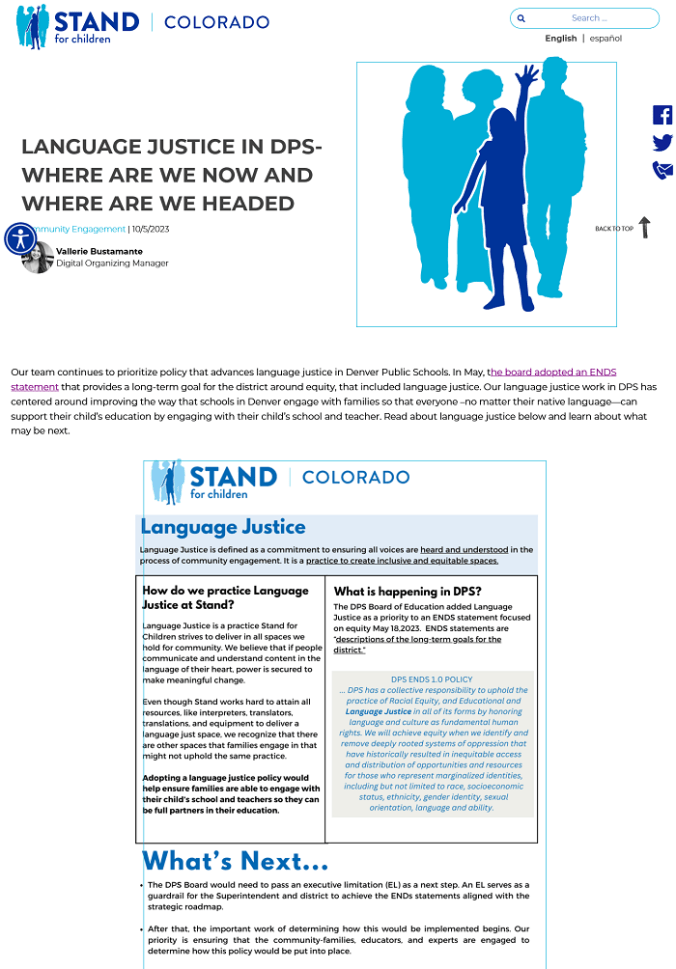
Here is the page describing (sort of) “language justice”:
 Ethics Alarms
Sorry but did you read the Denver Public School agenda?
It doesn’t say or even imply that they would encourage non-English speaking students to be able to use their native language to learn as opposed to being educated in English.
The article just made that up.
From my understanding, “language Justice” in this context has to do with parents being able to communicate in their own language with teachers, school personal, school board meetings etc.
That’s it.
Did you read the website? It is full of language that implies much more than that, and in broad enough terms to certainly include the article’s interpretation of “language justice.” “We will continue to work with school leaders and staff to help provide knowledge of these policies and strategies to accomplish language justice in every classroom and school.” In every classroom? That implies a lot more more than just parents.
I have added that section to the post, as I should have originally. The statement of the term is infuriatingly vague, and could encompass almost anything. You’re right that the interpretation given by the news report is extreme, but to assume that all it’s pushing for is translators for teacher-parent meetings seems excessively naive.
I revised the essay slightly to address your concerns. However, re-reading the website’s description of the policy, I can’t credit your conclusion that all the policy means is providing interpreters for non-English-speaking parents. The interpretation made by the source article is certainly not “made up.” When descriptions are that vague and specifics are avoided, what is being sought is a route to extreme measures, not narrow ones.
I did. First of all, that website isn’t the Denver School agenda and my analysis still stays. Nowhere does it say or imply kids will learn in another language on the Denver school agenda.
Second, where does it say “accomplish language justice in every classroom and school.”
The site clearly states what language Justice means in this context:
Our language justice work in DPS has centered around improving the way that schools in Denver engage with families so that everyone –no matter their native language—can support their child’s education by engaging with their child’s school and teacher
This article’s main point is ”fake news” meant to stir people up. It’s essentially click bait.
So you see no significance at all to the definition of “language justice” as “respecting every individual’s fundamental language rights – to be able to communicate, understand, and be understood in the language in which they prefer and feel most articulate and powerful”? Assuming children have such (non-existant) rights, how would that translate into the classroom?
As for the quite you reference, I can only assume that it was stealth edited out of the document after multiple publications quoted it. The school system so far has not responded to any of the media inquiries, at least that I can find. However, the definition of “language justice” remains.
I think the definition, in this context, means exactly what they say it means.
“Language Justice is defined as a commitment to ensuring all voices are heard and understood in the process of community engagement. It is more than having access to translators and interpreters, it is a practice to create inclusive and equitable spaces so that community, families, students, and staff can participate in the language of their heart. “
Is the language they use annoying liberal crap? Sure.
Does it mean students will be taught in non-English? Not at all.
This has to do with families attending school board meetings or something similar.
And again, you do not address “Language justice” defined as “respecting every individual’s fundamental language rights – to be able to communicate, understand, and be understood in the language in which they prefer and feel most articulate and powerful.”
I mean it’s essentially social Justice gibberish but I told you what it specifically means.
It means families will be able to communicate during parent-teacher conferences or school board meetings etc.
It doesn’t meant kids will be taught in non-English.
Also…yes it’s click bait. And yes, all the other articles that stole from the original article are also click bait.
I dont know why you thinking linking to other untrustworthy sites means anything.
You need to be able to discern real news from fake news, especially if you’re basing your blog around ethics.
How can Jack Marshall be a trusted source if he’s basing articles and analysis on false information?
This story is a total fabrication.
Kids aren’t being taught in non-English in Denver.
Wake up.
1. Wake up Bite me. Order me to do anything in that tone again, and you can cover for woke assaults on democracy someplace else.
2. What’s an “untrustworthy site”? I don’t know of any other than those I’ve flagged for deliberate misinformation, like The Gateway Pundit and Rolling Stone. The Washington Examiner, on these issues, is more trustworthy than the New York Times. Are the publications that revealed the sexual harassment complaints.
regarding Joe Biden trustworthy, or is it publications like the New York Times, which intentionally buried the story?
3. I’m not a reporter, and don’t want to be. Except for a very few stories (like the scandalous near-promotion of Listerine as a drink of choice for alcoholics) I cannot perform extensive field research. I based my conclusion that making “language justice” a cornerstone of public school education is, as the articles suggest, the objective of the Denver school district’s resolution, and the website, which was not invented by “untrustworthy” sources, demonstrates that to my satisfaction.
4. Nowhere did I write anything that contradicts “Kids aren’t being taught in non-English in Denver.” Now THAT’S a straw man. It takes some brass to try that trick in a comment accusing me of using “straw men.”
5. “This story is a total fabrication” is a fabrication itself. The essay begins,
Get ready for “language justice.”
The Denver school district is adopting a “language justice” policy as a “long term goal.” This astoundingly stupid movement encourages non-English speaking conceivably to the extent of allowing students to use their native language in school. Teaching English to non-English speakers, you see, is oppressive and rooted in racism.
100% accurate.
Good for business if you’re in the translator business.
I’m going to remain skeptical of this reasoning. People that write these things generally pore over language and use precise word-smithing so the meaning is absolutely clear. When the language is in any way vague, it’s usually because there is an ulterior motive or agenda that is set to be dropped right into that imprecise language. It happens an awful lot.
It is perfectly ok to interpret the text to a natural – or even extreme – conclusion…because that may be the writers’ ultimate intent.
But they tell you exactly what it means, and it doesn’t mean “kids will be taught in non-English”
I guess if you want to make up what you think it means, that’s fine, but it’s inaccurate.
Bob, if kids have a “right” to communicate in whatever language they choose, then obviously this means they would have to be taught in non-English languages. You continue to ignore the implications of that “definition.”
I’m not ignoring the implications because they tell us exactly what they mean by it when it comes to actual policy.
You’re reading something more into it than what it actually means, and I’m not sure why.
Do you not believe them when they tell us exactly what they mean how this relates to policy?
It doesn’t mean kids will be taught in non-English in schools.
Bob, what your minimalist interpretation would require is a single sentence about facilitating parent-teacher communications involving non-native English speakers. Why the fancy wokism “Language Justice,” the fill page of foggy rhetoric, and, again, the definition of the term that is so expansive it encompasses students as well as parents? I’ll accept Curmie’s typically reasonable conclusions: “The language is, as Jack has suggested, infuriatingly vague, and that is in itself cause for concern…. If the article and Jack’s interpretation of it are accurate, then the proposal is insane… I think that Jack is likely over-reacting, but I can’t state with confidence, let alone certainty, that he is doing so.”
That you, in contrast, seem so certain is puzzling.
This is so weird.
I’m certain what language Justice means because they l tell us exactly what language Justice means regarding the school policy.
The language that describes “language Justice” may be nebulous or vague to you, and you’re free to interpret it however you want… but the school district is literally telling us how they’re interpreting it…and it involves families being able to communicate better with the school and leaders in the community.
And remember, the quote that claimed students will be taught in non-English is totally fabricated.
It’s clickbait.
The fact that you think a totally fabricated policy may possibly exist, all because of a vague definition, even after the policy makers clarify exactly how language justice is informing their policy…is honestly baffling.
Well, your mind’s made up, but the website, which also says it describes what is to come, and the langiage contradicts your minimalist (and naive?) interpretation. “respecting every individual’s fundamental language rights – to be able to communicate, understand, and be understood in the language in which they prefer and feel most articulate and powerful” implies far more than just interpreters at parent teacher meetings.
If it’s clickbait, its odd that so many publications and news sources happened to devise the same clickbait simultaneously. Here’s some more “clickbait”: https://www.fox44news.com/news/local-news/mclennan-county/hln-waco-provides-translators-and-interpreters-to-remove-language-barriers/
You’re argument (I dont even know what you’re really arguing) is a strawman.
Do you want to discuss the nebulous definition of language Justice?
Or if kids are going to be taught in non-English?
Because they’re not. And I already Told you what language Justice means, because they told us what it means.
But you keep arguing that the definition they give is vague.
Okay? It’s vague. If your argument is that the definition they give is vague, then fine, I agree.
But the polcy isn’t vague. Since they tell us what the policy is.
Do you actually still think kids will be taught in non-English?
Yes, I absolutely believe that the mission as stated goes far beyond what what you for some reason want to diminish it to. The definition I have cited repeatedly extends to “all,” including students. That mission opens the door to extreme and damaging policies, and the requirement that children be taught in their own language flows directly from it. Not only that, it is clear from recent experience that this is how these insane woke theories work. They never stop at the first irresponsible and and impractical point. Never, So being compassionate at the Mexican border became agitating for voting rights for illegals with divers licenses being a stop on the way. Etc. The analysis in all the articles is correct. You are naive
Was the second paragraph that states activists feel having to learn in English is “rooted in racism and oppression” made up? That paragraph specifically states that language justice requires children learning in their native languages.
Even if you are correct and the reporter is misleading how do you achieve justice by taking resources from one group simply to ameliorate the downside costs of choices made by another. Could this be extended to include special considerations or even money payments to the incarcerated minority because of the choices they made?
I read the agenda and it assumes facts not proven such as remediating policies “designed to oppress marginalized groups”. We have had 3 generations of Federal academic remediation programs to offset prior policies – specifically Head Start. If a family crossed the border and has kids in school none of these people were ever subject to racial discrimination from past policies.
The agenda also defines discrimination only when it affects those identifying as BIPOC or LGBTQIA. I want to understand the logic behind the legality of “protected classes” if it was unconstitutional to have laws that created a situation in which whites were a “protected class” in the eyes of the law.
The authors of the posted policy need a course in rhetoric, logic, and common sense. At this moment I am enjoying a cruise populated by members of many language groups. Amazingly the lingua Franca is English. No one is walking heads down in permanent persecution mode.
Ugh. Seriously. Guys. The *original* purpose of public schools wasn’t some grand visionary goal of “bringing education to all”. The original purpose was to give everyone a baseline ability to *be a citizen* of the United States.
And speaking English was one of the key tenets of this.
More and more progressive ideas seem to be designed to keep people down, wrapped in colorful decorations to look like it’s good and empowering.
So a bureaucratic class can grow infinitely to cater to their every need in perpetuity.
Whether it is Jack’s interpretation or Bob Ghery’s interpretation I have to ask will this include having textbooks in every language? How can a parent assist the child if the text he or she uses is in English? Perhaps the better use of the resources would be to create ESL classes for the parents so they can participate equitably in the American society.
You don’t have to look far to see how unworkable providing information in multiple languages would be in schools. If you get a statement from your health insurer you will get 8 pages of translations from two English paragraphs into languages including Hindi, Tagalog and Vietnamese as well as Spanish.
This is a case of harming the majority to help a minority that chose to enter into a society in which they are not competent in language skills. How can we say this is justice if resources are reallocated from those intended to those who should be responsible for assimilating into the new homeland?
If we apply the concept of distributed justice to this, how can we say it is equitable to take from one group in order to alleviate the burden of others who would otherwise not have been burdened had they not made the choice to come to the United States when they seem unwilling to reallocate their own resources to ameliorate that very burden?
All that doggerel just to convey that they’re going to make translators available? I wonder how many translators they could afford if they weren’t paying people to produce word salad like this.
I have no doubt a lobbyist for some translator service has been spreading paper bags of money around among the school board members.
“[I]f everyone speaks a different language and members of society can’t understand each other, then society falls apart.” Correctamundo, as Bart Simpson would say. Society falling apart is the objective. Destroying society is a feature not a bug of modern-day lefties.
And isn’t it funny that a person can go almost anywhere in the world and get by perfectly well speaking English.
Herewith a series of occasionally self-contradictory responses.
1. I’d never heard of The Heartlander, but a quick tour through their site reveals them to be yet another right-wing publication that distorts the news in precisely the same way they accuse the leftist press of doing, just in the other direction. I’d rank their journalistic integrity about on a par with the Drudge Report. Bob’s description of this article as “essentially click bait” seems apt.
2. The draft is specifically labeled “confidential.” Who leaked it?
3. The language is, as Jack has suggested, infuriatingly vague, and that is in itself cause for concern.
4. Some of the material supposedly coming from the school system appears instead to be generated by an advocacy group, with no action from the school district except to listen.
5. If the article and Jack’s interpretation of it are accurate, then the proposal is insane.
6. I think that Jack is likely over-reacting, but I can’t state with confidence, let alone certainty, that he is doing so.
7. I know a lot of people, many but not all of them my former students, for whom English is a second or even third language. English was not spoken in their homes growing up. They’re active and engaged members of society because their English is at least as good as that of a lot of monolingual English speakers. (One former student–Facebook tells me today is her birthday!–was able to get her job at the American Embassy in her native Honduras because she became fluent in English *because she had to* in order to make it through school in the US.)
8. It is true that in certain kinds of jobs in certain parts of the country, English is unnecessary. That doesn’t mean it shouldn’t be the language of instruction in public schools.
9. Supplying translators for every kid whose native language isn’t English would be outrageously cost-prohibitive, even if it were a good idea. So would textbooks in scores of different languages, even if they were available.
10. A goodly proportion of the English-as-official-language movement is indeed grounded in racism and variations on that theme. That doesn’t mean that having a standard means of communication is a bad idea.
11. ESL courses are great if there are enough students, but if there are only one or two families in an area that would benefit from them, logistics and money become issues.
12. I find it weird to get radio (not tv, *radio*) ads in Spanish when listening to a non-musical program in English. Why advertise in that way on that program?
13. There are different definitions of “helping one’s kids.” I think the sum total of direct help-with-homework assistance I ever received from my parents was asking my dad. a biologist, whether what I was putting in a lab report for high school biology made any sense. (He told me to report what I’d found, whether it was what I was supposed to have found or not.) Having parents understand what’s happening in a parent-teacher conference is a different matter.
14. I find myself in the uncomfortable position of largely agreeing with Chris Marschner. (Sorry, Chris, I could resist.)
Not a problem,
I often agree with you on pedagogical issues. I do disagree that much of the efforts to make English the official language is rooted in racism. My mother a lifelong Democrat and English teacher for over 40 years would disagree as well. Simply because some non-policy making bigots latch on to a worthwhile goal does not make the policy based on racism. The argument that it is rooted in racism fails because we do not make the same arguments for Germans, French, Italians or any other European nations that do not speak English in the home.
According to UNESCO there are over 8300 recognized languages worldwide. Having a common language irrespective of which one is chosen facilitates efficient economic and social development in that nation. Secondly, English has been dubbed the common language of business internationally.
Imagine the lawsuits that will result if we determine that everyone must be communicated to in their native language by government or business.
I’d like to point out that, if you want to be helpful to those with a shaky grasp of your language, the last thing you should do is throw a prolix lump of jargon and verbage at them, without any concrete meaning behind it. Even if they have a professional translator whispering in their ear, they will always be left wondering what was lost in translation.