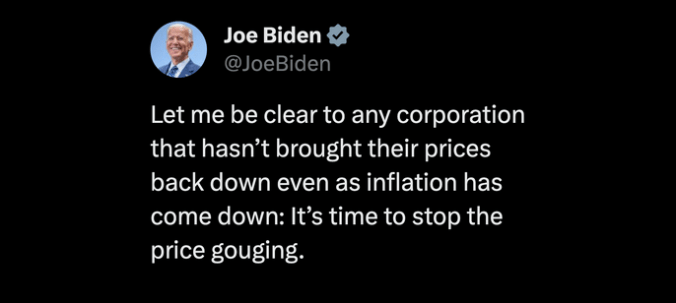
I saw “Biden’s” idiotic tweet about corporations and inflation last week and I decided it was so obviously dishonest that it wasn’t worth writing about. (That, and the fact that anyone who thinks the President actually tweets anything himself would buy the Brooklyn Bridge twice.) Then the Atlantic said, “Hold my beer…”
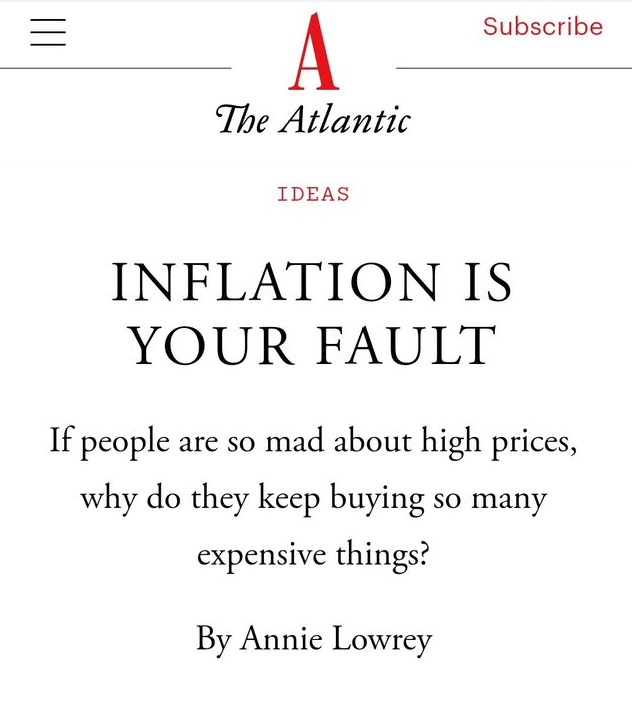
From the article, which is behind a paywall and I would have paid NOT to see what is available for free:
You would think, with prices as high as they are, that Americans would have tempered their enthusiasm for shopping of late; that they would have pulled back spending on luxury items; that they would have sought out budget and basic options, bought smaller packages, fewer things.
This is not what has happened. Consumer spending rose 0.2 percent, after accounting for higher prices, in October, the most recent month for which the government has data. Online shopping jumped 7.8 percent over the Thanksgiving long weekend, more than analysts had anticipated. The sales of new cars, dishwashers, cruise vacations, jewelry — all things people tend to give up when they are watching their budget — remain strong. Consultants keep anticipating a recession precipitated by the “death of the consumer.” Thus far, the consumer is staying alive.
People hate inflation, just not enough to spend less: This is one of the central tensions of today’s economy, in which things are going great yet everyone is miserable. And in some ways, Americans have nobody to blame but themselves.
That garbage elevates “blame the victim” to a fine art. It is insulting to be expected to be persuaded by such an argument, but apparently the Left’s propagandists are desperate, they really think Americans are idiots, or both.
 Ethics Alarms
Carter said some of the same nonsense about stopping people from buying yachts and things like that. Okay, you can stop people from buying yachts, but what do you tell the people who sell them, who make them, who maintain them, who fuel them, and who sell the supporting goods? What do we tell the auto manufacturers and sellers, the jewelers, and the travel industry at this point? The travel industry got decimated during COVID, do we want to put them back out of business completely? I thought the idea was to keep Detroit alive, not put the auto industry out of business. Squeeze the jewelry industry and all you’re going to do is put all the small jewelers out of business and create an industry populated only by the big box stores and prestige outfits.
People lose jobs or go out of business, people buy less of everything, people sell investments to keep afloat, people sometimes cut back spending to almost nothing. Tell me, do you think that people spending less and less to the point of austerity is good or bad for the economy? Do you think that people pulling their money out of investments is likely to result in more or less economic growth and wealth generation? You don’t need an MBA to answer these questions.
I’m honestly not interested in living in a world where everything is dictated to and issued to me by a few bossy visionaries who can dictate whether I advance or fail, cut off my access to power at will, strip me of every right except the right to ask permission, and then tell me it’s my fault and I should be grateful that they allow me what they allow me. Government is supposed to be the people’s servant and sometimes protector, who picks up the trash, makes sure roads and bridges are maintained, fights fires, enforces the law, and if necessary fights the enemies of the country. As it is now it is everyone’s personal 800 lb gorilla that sits wherever it wants, who decides how much of your income you are allowed to keep, determines how many of a lot of things you can possess, or if you can possess them at all, and imposes all kinds of rules on how you do business, whether they make sense or not.
It is not supposed to become everyone’s nightmare of an abusive spouse, who scrutinizes everything you do, demands you ask permission for almost everything and rarely grants it, keeps you on a very short leash with regard to resources, and punishes often and harshly for any reason or no reason.
Steve-O’s well-done comment to this Post is deserving of a COTD.
The article really understands nothing, which makes me think the author knows neither history, economics or human behavior. In an inflationary cycle, consumers tend to buy more because they know that shortly the same items are going to cost more, so they buy now while the price is relatively low and their money is worth more. It makes perfect sense.
Funny, isn’t it? When gas was rising like mad, I filled the tank as often as possible. Clearly, I was causing inflation, or something…
Biden says inflation has come down and accuses business of price gouging because they haven’t brought their prices down. Inflation hasn’t come down at all, the rate of inflation has slowed a bit, but prices continue to rise. Is biden a complete idiot of does he believe the American people are gullible idiots? I suspect the answer is: both.
By printing so much money during the pandemic, the money supply has been greatly increased. Because of that, the normal printing of trillions of dollars/year has a smaller percentage increase in the total money supply and therefore, the rate of inflation decreases! See, if you make inflation worse for long enough, you make it better!
Generally speaking, prices increase because the cost of production increases, because consumer demand is inelastic, or because the suppliers have a monopoly or oligopoly.
Sure, I suppose one approach to reducing prices is to make demand more elastic (or rather, more inelastic in the consumers’ favor) by encouraging consumers to collectively bargain by going on strike from shopping until prices decrease. However, that’s a) more difficult to organize, b) more painful for the consumers, c) likely to result in yet another form of centralized power, which someone will certainly seize control of to the detriment of consumers and small businesses alike, and d) unlikely to address the root cause of the problem.
If the government finds itself asking businesses to lower prices, I think it’s far more likely that either the cost of production makes lowering prices unrealistic and the request is presumptuous, or the government is failing to enforce anti-monopoly policies and the request is feeble.
As long as consumers know about the competitors’ prices and are comfortable changing their buying habits to save money, they will reward businesses who can keep prices affordable for similar quality products. The average American consumer is famously motivated to save money by waiting for and finding sales, bargains, and the cheapest versions of a product possible, leaving aside the question of whether they need the product in the first place. (They’re saving money so they can buy more stuff, you know!) I find price-inelastic demand highly unlikely to be a significant cause of inflation.
“If the government finds itself asking businesses to lower prices, I think it’s far more likely that either the cost of production makes lowering prices unrealistic and the request is presumptuous, or the government is failing to enforce anti-monopoly policies and the request is feeble.”
Bingo. Other alternative: the government is desperately trying to shift blame to someone else so it can duck responsibility.
Oh, it’s ducking responsibility either way.
Not surprising. Peruse various other discussions, TwitteX, & etc. and see how many people still rail against “greedy corporations and rich people” as the cause of their economic woes, and are convinced that SloJo and the dems are their champions in the fight against those oppressors.