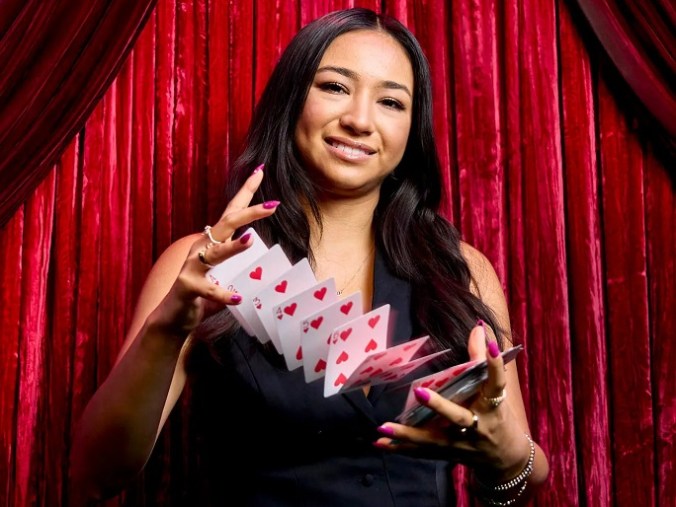
I was not a bit surprised to learn that only around 8% of professional magicians are women, as yesterday’s New York Times feature informed me. Magic was one of my main hobbies well into high school, and I even put on a few magic shows. (I still have a trunk full of magic apparatus under my bed.) It was clear early on that while boys were suckers for magic tricks, girls were mostly bored by them. It is one of those pursuits like fast cars, baseball, ventriloquism, juggling, playing soldier, and poker that somehow tend to be hot-wired into male genes while being mostly absent from the females of the species. I don’t know why, and I don’t care why, frankly.
But that’s not the message the Times wants to convey. Focusing on a few female professional magicians (one of whom is performing because her late husband, Harry Blackstone, Jr, did), it tells us that the dearth of female wand-wavers is due to “sexism, wardrobe limitations and the enduring stereotype that women best serve as the audience’s distraction.”
Yes, it’s the disparate impact fallacy again. “I think for many years, no one really thought of the need for women to be the magician,” Gay Blackstone told the Times. “But now, as we’re coming up with different roles and different things we want to be doing, then there’s no reason why women can’t be just as great as men.”
Huh? I didn’t get interested in magic because I saw a “need” for male magicians. I was interested because I found magic fun and challenging. My sister went along with me and my father to the magic shops in Boston; she just didn’t care about it. (She wasn’t much fun to do tricks for, either.) Of course there’s “no reason why women can’t be just as great as men,” or at least no decisive reasons. Men tend to have bigger hands, which is an advantage in sleight of hand illusions with cards and coins. Male clothing is more adaptable to the needs of a magician, with more room for pockets and long sleeves.
As the article keeps reminding us, the few female professional magicians around now had few role models in the field, but that’s a chicken-and-egg issue. Are females less prone to get interested in magic because there have been few notable woman magicians, or have there been few notable woman magicians because girls tend to be less impressed by magic tricks?
A black female magician who drags race into the conversation (there aren’t many black magicians either), says, “We have to get into the role of who is allowed, historically, to be magical, supernatural.” What? The sorceress in the King Arthur stories was a woman. The magical fairies in “Cinderella” and “Sleeping Beauty” were female. The Good Witch in “The Wizard of Oz”…Hermione in the “Harry Potter” books. They were “allowed.”
Magicians are not judged on their gender, they are judged on how skilled they are at appearing to do the impossible. The Times relies on a single research study with unimpressive results to state that “research on gender bias supports that assertion; a 2019 study published in The Social Psychological Bulletin found that male magicians were judged to be more impressive than women, even when performing identical tricks.” Well, yes, slightly better, and after reading about the methodology, I surmise many polluting factors could have intervened, since the researchers tell us that they expected to find gender bias. I’m certain that the pronounced lack of enthusiasm for magic tricks and illusions among their peer groups discourages even the small number of girls who are drawn to the hobby, so they move on to something else. Nobody’s stopping women from becoming magicians except themselves.
Gay Blackstone predicts “an explosion” of women pursuing magic in the next five to 10 years. I’ll take that bet.
 Ethics Alarms
I find the notion that women cannot be inspired by men as sexist as the notion that blacks cannot be inspired by whites (or vice versa on both counts) to be racist.
Individuals are inspired by other individuals, regardless of skin color or sex. It’s only the Hive Mind that insists on proportional tribal representation.
Basketball is sexist because the NBA All-Star team was judged to be more talented than the WNBA All-Star team, even when shooting the same shots.
“even when shooting the same shots.”
Should without the SAME SIZE BALL be factored in…?
PWS
It probably doesn’t matter. The point was to mock people who don’t understand that just because 2 people do the same thing, one can do it more skillfully. Maybe playing a musical instrument is a better example. I can play an instrument. I can hit the notes correctly. There are a bunch of people who play the instrument more skillfully, however. Even though we are hitting the same notes for the same amount of time and playing the same composition, one will be more skillful than another (and the skillful one probably won’t be me).
“The Social Psychological Bulletin found that male magicians were judged to be more impressive than women, even when performing identical tricks.”
I am no magician, but I would bet that a great deal of the appeal of any given magician is the presentation. (I am a lawyer and I think I have a fairly well-developed courtroom demeanor is particularly suited to my personality (for better or worse).)
Take 10 different magicians and you will probably get 10 different takes on an “identical” trick. Okay, maybe there would not be 10 different takes, but to say that the tricks are “identical” creates a huge question.
It made me think of comedians. Henny Youngman, Rodney Dangerfield, and Steven Wright all kind of relied on one-liners. But, they probably could not tell each other’s jokes, because part of their joke was the delivery.
Then, that got me thinking about the joke, The Aristocrats, https://en.wikipedia.org/wiki/The_Aristocrats which is pretty much an “identical” joke, even though it varies depending on the comedian delivering it. So, even when the point of the joke is always the same, it relies on the personality of the specific comedian delivering it.
Another comparison could be made with the theater or movies. Is Olivier’s movie, Henry V, identical to Kenneth Branaugh’s Henry V.
I guess that, when I read that line, it seemed quite implausible that two magicians perform “identical” tricks. It may be the same trick, but it is not the same performance.
-Jut
That point was immediately obvious to everyone who read the post except for the psychologists whose profession requires that they don’t recognize such things. Psychologists, in contrast to those who understood the issue, are highly trained observers of human nature and behavior.
Your comment on hand sizes seems logical to me. I love the idea of magic tricks, but I can’t shuffle cards with a bridge because my hands are too small. I have to shuffle cards differently than most people to accommodate my grasp. Similarly, I think that I play piano fairly well, but I can’t play Mendelssohn correctly with his emphasis on tenths, since my hands get pretty sore with lots of octaves.
I find the underrepresentation of women as coal miners to be of far greater importance since coal (despite the “green” agenda) forms the foundation of many, if not most, economies of the world. Are women being prevented from participating in this important economic activity? Are there barriers to entry that affect only women in the coal mining industry? Who knows? The most probable answer, however, is the one that psychologists, and anyone else in the “soft sciences” refuse to discuss – women avoid coal mining because they hate getting their hands dirty, dislike backbreaking work, do not find it “glamourous” and see it as a poor effort vs reward fit.
Great point. I have only seen a single female sanitation worker among the hundreds I have watched over the years. Those are easy ones, though: magic is puzzling. What about it appeals to boys rather than girls (and that the age that matters: nobody suddenly decided to be a magician when they are 30)?
Perhaps males are more hardwired to see “not real” as entertainment rather than a threat. That would also account for being generally more accepting of insulting banter (not actual bullying), horror movies, sci-fi, etc.
That’s a good theory!
Reply below was meant to go here.
I’d like to see stats on what groups most claim to feel “microaggressions” and/or need of a “safe space”.