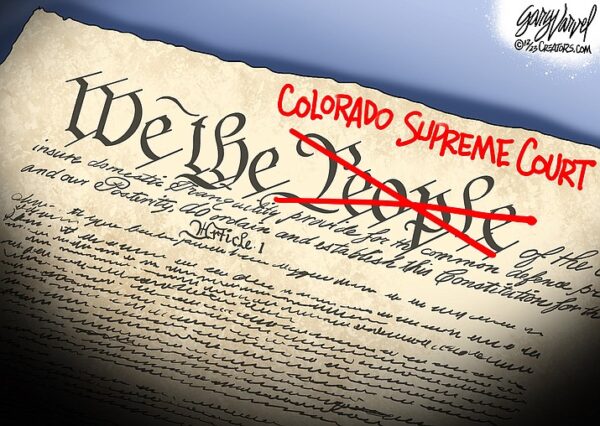
Over at the Volokh Conspiracy on Reason’s website, where constitutional law experts hang out and opine and then mostly inarticulate readers pile on, Steve Cabrizzi has pretty much slam-dunked the position that the 14th Amendment’s prohibition against those who supported the Confederacy in the Civil War holding office in the re-united United States of America can’t be used against Donald Trump. Unlike the convoluted and boot-strapping decision of the Colorado Supreme Court and the transparently partisan decision by Maine’s Secretary of State (both part of the now eight year-old effort by Democrats to use extra-legal means to destroy an adversary they fear and loathe), Bacrizzi’s brief is clear and straightforward.
First he explains the technical reasons why “Donald Trump is obviously not disqualified from seeking re-election under Section 3 of the 14th Amendment,” writing in part,
The words “President or Vice President” were deliberately edited out of the final version of Section 3 of the Fourteenth Amendment. This, together with the disqualification of presidential electors and vice-presidential elector who have engaged in “insurrection or rebellion” makes it clear that the Framers’ of Section 3 did not intend for it to apply to presidents or vice presidents who engaged in insurrection. This impression is augmented by the fact that Section 3 methodically applies in order from the highest office to the lowest office. Section 3 first disqualifies insurrectionist Senators and then Representatives. It then disqualifies all appointed civil or military officers; it then disqualifies insurrectionists from serving as a member of any State legislature, and it finally disqualifies in insurrectionists from serving as State executive or judicial officers. This careful hierarchy suggests that the phrase “or hold any office, civil or military, under the United States” does not apply to the President or Vice President, but applies only to appointed federal officers…
This fact is further confirmed by the Appointments Clause of Article II, Section 2, which says [The President shall nominate, by and with the advice and consent of the Senate shall appoint Ambassadors, other public Ministers and Consuls, Judges of the Supreme Court, and all other Officers of the United States.” The President does not appoint himself so obviously he is not an Officer of the United States under the Appointments Clause. Moreover, the Commission clause of Article II, Section 3 says that “[T he President] shall” i.e. must, “Commission all the Officers of the United States.” No President has EVER commissioned himself or his Vice President either before or after the adoption of the Fourteenth Amendment. The President is obviously not an Officer of the United States for the purposes of the Commission clause.
Since Trump beat Hillary Clinton in 2016 and upset the Democrats’ confident plans to transform the nation, the Axis of Unethical Conduct has pored over the Constitution to come up with some way to get rid of him, even if it required tortured or fanciful interpretations of the text and the Founders’ intent. The defunct and never used Emoluments Clause impeachment argument (Plan C) is analogous to the Section 3 plot. Showing how this ambiguous and obviously moot provision is a dead letter and was never meant to apply to the circumstances in Trump’s case is the easiest route SCOTUS could take to end this sinister nonsense once and for all. Well, at least the “insurrection” chapter, anyway.
Then, for good measure, Cabrizzi explains how the January 6 riot cannot be defined as an insurrection. “No-one would contend they were a rebellion, which requires the use of armed paramilitary force to overturn the election,” he begins. After reviewing the formal definitions of “insurrection” and “riot,” he concludes,
The events of January 6, 2021 occurred for three and one-half hours in one city only in the United States, Washington D.C., and not as an overall insurgency in multiple cities across the United States. The crowd was not carrying firearms and it dispersed when then President Trump asked for it to disperse. While the interruption of the counting of electoral votes is inexcusable as is the death that day of five persons and the injury of dozens of others, the fact of the matter is that the events of January 6, 2021 were more akin to a riot than they were to a systematic planned out “insurrection or rebellion.”
If the U.S. is going to do something as unprecedented, divisive and undemocratic as to block a former President and the leading candidate in an upcoming election from running, it must have the facts and law squarely and indisputably supporting that extreme action. It doesn’t.
Two additional points:
- Cabrizzi undermines his argument by including the kinds of typos I make, like my least favorite, saying the opposite of what he obviously means by leaving out a “not.” Boy, that’s irritating. Apparently neither VC nor Reason have an editor. I’ve had two voluntary editors, Fred Davidson and Pennagain, and I wore them both out, I guess.
- In related news, a former TV journalist who announced she would challenge President Putin in Russia’s spring election has been declared disqualified from running. Don’t you think it’s generous of Putin to show that he approves of the U.S.’s Democratic Party’s tactics?
 Ethics Alarms
I would also add that no rioter has ever been convicted of insurrection. I have not heard of any prosecutor ever demanding, for example, that the rioters in 1992 Los Angeles be tried for insurrection.
The rioters who interrupted Kavanah’s confirmation were not charged with insurrection.
They also weren’t charged with the interfering with governmental proceedings and they stopped the business of the Senate several times.
And how many people died? I know if only 1 person (an unarmed protester killed by a Capitol police officer) killed that day.
That bothered me too. The various sources attributing later deaths to the rioting, like a couple of suicides, are untrustworthy.
I think there were a couple of heart attacks (ruled “natural causes”), and 1 drug overdose. Only the one murder, whose killer is still unpunished.
The “drug overdose” wasn’t a drug overdose. The person was crushed to death when the police started shooting tear gas and rubber bullets into a crowd of people. The individual had taken a prescribed dose of adderall that day, so they are calling it a drug overdose but it is much more likely that the person died as a result of being trampled by dozens of people. The media coverage of the riot is appalling.
The two men that died from heart attacks never made it into the Capitol. The police had been firing ‘less lethal’ munitions from an elevated platform, and those munitions were fired into the crowd at the front, allegedly to disperse them. The people at the front had nowhere to disperse to due to the crowds behind them…
Here is a comment on the article.
https://reason.com/volokh/2023/12/31/donald-trump-and-section-3-of-the-14th-amendment/?comments=true#comment-10378904
You should participate in the comments section in the Reason.com article.
Here is another comment on the article.
https://reason.com/volokh/2023/12/31/donald-trump-and-section-3-of-the-14th-amendment/?comments=true#comment-10378982
They have to take these cases and overturn these decisions. Anything else would just invite more chaos.
I pray that they can craft a decision that will be unanimous. Surely that is not too big an ask for the Supreme Court?
There is a small part of me, no matter how disgusted I am by the Colorado/Maine rulings, that does wish for a 2024 where the Courts say “OK, Trump can’t be on the ballot. And by the same measure, neither can Biden.” I know it would make mess of the future elections, but it would have the advantage of helping fix THIS one. It’s just a shame that in order to do so, the courts become the ones who decide who is president, instead of the voters.