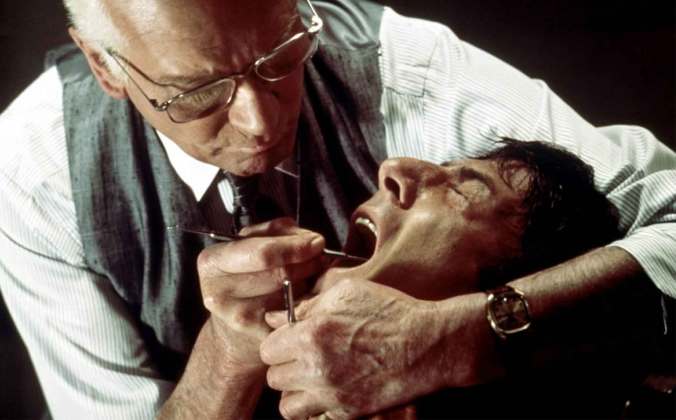
This is a bridge from the previous post, since it also involves Minnesota, and gives some teeth to my argument that the Land o’ Lakes is facing a brush with ethics decay. At the root of our tale some yawning cavities in the ethical hygiene of a dental professional. (Note my generous restraint in leaving quite a few potential puns for you to add in the comments. Consider the challenge a moment of tooth, er, truth.)
But I digress. Dr. Kevin Molldrem and Molldrem Family Dentistry face a lawsuit from a disgruntled patient, Kathleen Wilson, who claims the Eden Prairie dentist harmed her in the process of performing over 30 dental procedures in a single five hour appointment. Molldrem, she alleges, put in eight crowns, did four root canals and filled the cavities in 20 teeth during a single visit in July 2020. In the process, according to the lawsuit, Molldrem used anesthesia “well in excess of (the) recommended dosage” and engaged in “falsifying medical records” regarding the amount administered.
Update 1: I finally have the complaint (thanks to JutGory). The news reports did not accurately convey the sense of the lawsuit, concentrating excessively on the sensational feature of all that dental work at a single session. The complaint’s complaints are:
—“Plaintiff has incurred and will continue to incur medical costs for the dental care required to address the harms caused by Dr. Molldrem’s negligence.”
—“Plaintiff has incurred and will continue to incur lost income and loss of earning capacity as a direct result of Dr. Molldrem’s negligence.”
—“Plaintiff has endured and will continue to endure pain and suffering, embarrassment, emotional distress, and disfigurement as a direct result of Dr. Molldrem’s negligence.”
Update 2: The complaint also accuses the dentist of failing “to create a care plan that would effectively address decay and tooth dissolution” and “failing to control gingival inflammation and bleeding” during the lengthy visit. That’s the harm alleged, as well as damage that required repair by other dentists. Based on what was revealed about the suit in the media and the fact that the expert report for the plaintiff mentions “trauma,” discomfort” and “anxiety,” I assumed that pain and suffering were also alleged in the suit, as they virtually always are when medical negligence is involved. And sure enough, they were. However, my statement in the original post that the suit claims the dentist’s marathon session “caused great pain and suffering” was speculation stated as fact, so I’ve removed it.
***
The dentistry expert retained by Wilson’s attorney agreed with the dentist’s diagnosis that “virtually every tooth” in Wilson’s mouth was in bad shape, but concluded that Molledrem’s treatment for Wilson was improper. For Wilson “required a slow, thoughtful, careful and measured response to her disease.” Trying to fix everything at once in a single nightmarish sitting was, the expert ruled, inhumane.
***
UPDATE 3: I confess to have been led astray and confused by the way every news report I read on this (I first learned about on a “Believe it or not!” themed site that reports weird news). Since the lede in every report was that a dentist performed over 30 dental procedures on a patient at a single sitting and she subsequently sued, I concluded that the suit focused on that, and the natural consequences of the dentist subjecting the woman to such an unimaginable ordeal. However, the law suit complains about the unsatisfactory results of the appointment. In other words, if the dental work done in those five hours-plus had been effective and satisfactory, there might have been no law suit. I did not get that sense from the news reports, and I checked several. My fault. I should know by now that the news media often distorts legal stories by emphasizing the most sensational and unusual facts.
***
The ethics codes for the dental profession do not specifically address this unusual set of facts. Under “Emergency Care,” the American College of Dentists Ethics Handbook states,
A person with an emergent dental condition should be examined and either treated or referred for treatment. In such situations, the patient’s health and comfort must be the dentist’s primary concern, not compensation or convenience. If a dentist cannot accommodate the patient’s emergent needs, a reasonable effort should be made to have the patient seen in a
timely manner by someone capable of treating the condition.
It seems self-evident that doing all of these procedures at one time might be convenient for the dentist but is hardly an approach that shows proper concern for the patient’s comfort. The handbook advises under “Best Interests of the Patient,”
The “best interests” of our patients means that professional decisions by the dentist must consider patients’ values and personal preferences. This requires that dentists carefully communicate with their patients, and listening is of paramount importance. Sometimes patient desires conflict with professional recommendations. Patients must be informed of possible
complications, alternative treatments, advantages and disadvantages of each, costs of each, and expected outcomes. Together, the risks, benefits, and burdens can be balanced. It is only after such consideration that the “best interests” of patients can be assured.
As questionable as this dentist’s treatment seems to have been, I must confess that I don’t understand this story at all. Unless Kathleen Wilson was being held down in the dentist’s chair against her will like Dustin Hoffman while Laurence Olivier was asking, “Is it safe?” in “Marathon Man’s” most harrowing scene, nothing stopped her from saying, “OK, that’s all I can stand right now. I’ll make appointments to finish the rest.” I’ve told dentists to stop and finish up later. Haven’t you?
That aspect of the case should make the lawsuit a tough sell, since the victim of a tort usually has a duty to mitigate damages if possible. In addition, it is impossible for a dentist to install new crowns in one sitting because a mold has to be taken of each tooth and the crown has to be manufactured before it can be installed. There is important information missing here.
Update 4: See Update 3. Furthermore, the patient couldn’t mitigate damages here because the harm was the result of how the procedures were executed, not the fact that they were all done at the same time. If they had all been successful, there would not have been a lawsuit, presumably. Also, I subsequently learned that the patient was subjected to an IV sedative. I did not surmise this initially (maybe I should have) because none of the procedures mentioned usually require that. If she was unconscious or otherwise seriously impaired, she might not have sensed the passage of time or been in any condition to stop the dentist and say, “That’s it for today!”
***
Nonetheless, I seldom get the chance to ponder dentistry ethics, and this story brought back fond memories of my only dentistry ethics program, which I presented at a national convention. It was a very lively two hours: the dentists proved to be very opinionated and passionate, and several of my hypotheticals triggered intense debate.
***
Update 5: A clarification: the long multi-procedure ordeal is the reason this is a dentistry ethics post, and why the post exists at all. The fact that the dentist may have botched the work is a malpractice issue. Malpractice is usually not the focus of EA.
Update 6: The expert report can be read here. It clarifies a lot that the news reports (and my post derived from them) left unclear. The patient saw Dr. Molledrem two more times after the initial visit before seeking the advice and treatment of other dentists. Regarding that visit, the expert’s central conclusion is that Dr. Molldrem “attempted to restore all of her teeth in one visit. In so doing, he breached the standard of care in several ways,” primarily that “providing 8 crowns, 4 root canals and 20 restorations in a single visit is impossible to achieve if each of these procedures is done properly.“
The expert report also notes that the 8 crowns, 20 fillings and 4 root canal treatments were “performed under IV sedation” along with the local anesthetic. I presume from this that the patient was unconscious, which, if true, addresses the issue of whether she could have ended the session herself.
A patient can’t be blamed for accepting the recommendations of a medical professional, though this story stands as one more cautionary tale. When a recommended procedure or course of treatment seems illogical or extreme, patients need to be prepared to seek second opinions.
***
Much gratitude to JutGory for tracking down the expert report.
 Ethics Alarms
Jack:
“ In addition, it is impossible for a dentist to install new crowns in one sitting because a mold has to be taken of each tooth and the crown has to be manufactured before it can be installed. There is important information missing here.”
Not necessarily true. Early in my practice, I represented a dentist and crowns had to be molded, sent to the lab, then installed (?) at a later date.
More recently, the last 8 years (?), I had to get a crown because an old filling had cracked one of my teeth. The dentist did a laser scan of my tooth and sent it to some machine to fabricate the crown while he ground out my tooth. 45 minutes later, the crown was ready and he put it in.
I’m at that point where I can look back and say, “wow, that’s a change.” I can fondly turn my back on the times where everything had to be served and filed on paper, with affidavits of service. Stacks of copies mailed to 8 different parties and the Court that were manually filed.
Same appears to be true of dentistry. Digital Crown fabricators are probably very common these days.
At the very least, they do exist. I suspect this occurred in this case.
-Jut
I did not know that! And now I want to know why my supposed “state of the art” dentist couldn’t do that too. I actually had a crown that didn’t fit, and had to have the installation postponed.
I don’t know. Maybe they are not as prevalent. My realm of first-hand experience is one dentist on one tooth.
But, now that I think about it. Eight crowns in one sitting would not be pleasant. Just having one ground down was unpleasant. Not exactly torture, but certainly not pleasant. My mouth was so shot full of Novocain, the grinding sound fills your head. I certainly would not want to sit through 8 crowns in one sitting unless they put me under. At the same time, I am not sure I would want to sit through 8 such appointments either, especially when you throw in the root canals.
And, there could be concerns about such heavy repeated doses of Novocain. I am not sure where I fall on this issue.
-Jut
The possibility was raised that the patient was unconscious for the whole visit. That would at least explain why she didn’t say, “OK, that’s enough for today!”
You know, if I knew I was going to have that many procedures performed on me — I’d say, knock me out and wake me up next week. Seriously.
What I don’t see mentioned anywhere is the bill for all this. My suspicion is that that is where the real problem arose.
My parents went to a practice that had its own lab. The practice has at least three locations, but only one had the same day crown service. My guess is the machinery is still expensive, and qualified technicians to operate it are still rare. This practice advertizes statewide (otherwise I’d have never heard of same day crowns either), but other dentists do seem to offer this as well.
My father had one of those toys in his office during his later years (yes, my dad was my dentist).
If I might drill to the heart of the matter, it does seem the dentist here bit off more than he could chew, if it’s true that the patient had to have other dentists fix his work. I’m also not sure how responsible a medical patient is to say “no” when they are putting their trust in a professional who knows more than they do. Perhaps at the time she bit the bullet and assumed he knew what he was doing. I realize this potentially enamels (I mean “enables”) abuse, but the alternative is tort happy people baring their fangs at the slightest inconvenience. In short, I think this lawsuit is worth a lawyer sinking his teeth into.
By the way, Happy New Year to all!
I see what you did there 😉
>>it is impossible for a dentist to install new crowns in one sitting because a mold has to be taken of each tooth and the crown has to be manufactured before it can be installed.
In Connecticut, there is a practice that advertizes its own lab to provide same day crowns. That is perhaps what happened here.
Then, once all the original tooth enamel was removed and the moulds taken, the patient would have a mouth full of exposed dentine stubs, and be stuck in the dental chair for several hours as she waited for the new crowns to be ready and installed.
My husband and I both switched this fall to the dentist our adult son has been seeing, partly because between this dentist and his partners, they can handle all aspects of dental care in the same building. My husband’s teeth were in better shape, and he wanted to preserve as many of his natural teeth as possible, so he had a deep cleaning last month. My teeth, on the other hand, were in worse shape, and I was given a choice between dentures or implants (with a strong recommendation against attempting to preserve my remaining natural teeth). I opted for traditional dentures, as implants, though with impressive advantages vs. dentures, also cost 8 times as much as dentures. The preparations were split up over several appointments these past few months, and there are still 3 more to go: a “pre-operative” visit with my primary care physician, the tooth extraction appointment the following week (at which time the dentures will finally be placed in my mouh), and a followup appointment with the dentist (or oral surgeon?) the next day, to refine the fit of the new dentures. No difference in price for spreading out the work over that many appointments, and splitting the steps over 2 calendar years allows 2 years’ worth of dental insurance to help pay for it. It’s certainly more tedious that way, but easier on me as the patient, especially as this dentist & oral surgeon team have been very good thus far about explaining things.
Certainly no dentist in my part of Illinois would attempt doing as much work in a single visit as the Minnesota dentist is described as having done. And agreed that there are probably additional details about the situation that we haven’t yet heard.
“nothing stopped her from saying…”
Probably the fact that she was under anesthesia. She would also have no idea if the procedures were excessive or not, since ya know, she’s not a dentist.
It’s not the responsibility of a patient to know if having a bunch of procedures at once would cause great pain and suffering.
This falls solely on the dentist, obviously.
Not obvious, and you are assuming she was out cold. That would be very unusual. Every patient has a responsibility to take charge of their own treatment. If she was fully informed and gave consent, then she can’t blame the dentist for doing what she agreed to. Is she an idiot? Can a court not take judicial notice that any adult knows that 5 hours of drilling and root canals will be painful? This sure looks like consent and assumption of the risk, if she wasn’t unconscious.
It’s very obvious that medical negligence would never fall on the patient.
Since they’re not performing on themselves.
Again, that’s obvious.
“If she was fully informed and gave consent, then she can’t blame the dentist for doing what she agreed to.”
Sure she can. Since again, she’s not a licensed medical professional and the dentist is.
It’s not her responsibility to know if the medical procedure she wanted, agreed to, or asked for is not best practice and negligent.
This all falls on the dentist.
Also, I noticed you do this a lot, where you represent legal arguments as strawmen…
She’s not suing the dentist because it was “painful” and it’s not illegal to be an idiot.
She was left deformed and had to go to another dentist to have things fixed.
Having had a chance to review more details about the incident with the considerable assistance of the plaintiff’s expert’s report, I’ve supplemented and revised the post to address your points, Bob.