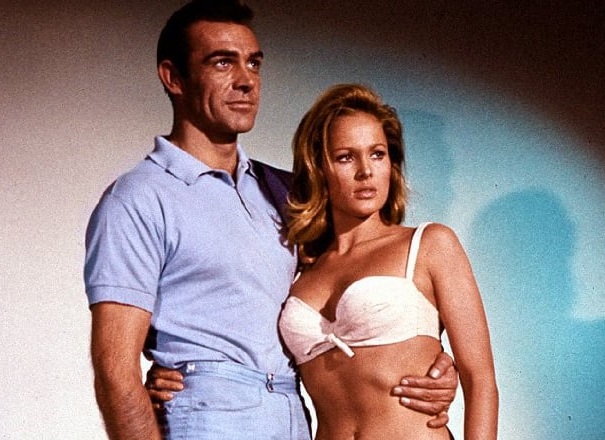
And now for something completely stupid…The British Film Institute, which screens classic films in its Southbank location in London and has the mission of preserving British cinema, has slapped a ridiculous trigger warning on the early James Bond movies, along with some others from the same period. It reads,
“Please note that many of these films contain language, images or other content that reflect views prevalent in its time, but will cause offence today (as they did then). The titles are included here for historical, cultural or aesthetic reasons and these views are in no way endorsed by the BFI or its partners.“
The “Look out! You’re going to be offended if you are right-thinking Brit!” is offensive itself for many reasons, as that description might suggest. The BFI is for adults, not children; there’s no need to warn grown-ups about characters smoking, naughty bits, violence and the terminology of the time. The date should be enough: “Oh, right, this film is six decades old! Things were different then!” The BFI is treating viewers like idiots, as well as imposing its woke, nanny sensibilities on others.
The warning also constitutes arrogant presentism. Simply because today’s various mental and cultural aberrations have infected society doesn’t mean our current standards and tastes are superior to what audiences wanted then. Films designed as entertainment for audiences of the Sixties were only made for those audiences; they shouldn’t be sneered at now if they haven’t aged well.
That’s the part of the warning that has attracted the most criticism in Great Britain, the movies “will cause offence today (as they did then).” To what offended parties is this referring? If the films were considered “offensive” when they were first released, why are they being treated as classics now? The James Bond films starring Sean Connery were, I assure you, considered fun, cheeky, exciting, and good (though some were better than others).
Yes, it’s hard to enjoy some of those films as much now except as time capsule content. My main problem with them is that many seem slow and clunky after all the advances in film editing, not to mention cinema combat. If you’re offended by James Bond acting like James Bond, well, why are you watching a James Bond movie?
My wife was apparently always offended by James Bond. I remember taking her to “The Spy Who Loved Me,” and her nearly walking out on the campy graphics during the Carly Simon theme showing small naked women doing gymnastics on gun barrels like they were uneven parallel bars. (Incidentally, I found all the Roger Moore Bond films offensive because Roger Moore was playing James Bond) And yes, Connery’s Bond’s response to Honor Blackmon’s femme fatale in “Goldfinger”—“My name is Pussy Galore!” “I must be dreaming…”— made my Eternal Boy Scout father cranky, but I thought it was funny, and, frankly, I still do. The BFI can bite me. Incidentally, 007 had an encore of sorts when Natalie Wood’s little sister introduced herself in “Diamonds Are Forever”….
To repeat what others have said often (like Bill Maher), people need to stop looking for reasons to be offended, and organizations like the BFI encouraging that reaction is adding to unhealthy cultural trends. What I assume is an effort to give a pass to the original audiences by assuring everyone that they were offended too is presumptuous and dishonest.
I know I am always fascinated by the “Beach Party” movies with Annette and Frankie. They are, viewed today, almost like movies made on another planet about how they thought human teenagers behaved. I find it amazing that teens in the Sixties didn’t find them too dumb, weird and insulting to sit through, but they were popular and made money, which is why there were so many of them. I don’t need to be warned that the plots and character portrayals are astoundingly ridiculous, the songs are terrible and that the girls especially appear to have the IQ’s of salt-water taffy.
Other films and plays work with modern audiences in completely different ways than they did originally, but still work. One play my theater company revived was “The Effect of Gamma Rays on Man-in-the Moon Marigolds,” which I had seen as a college student. It played as dark comedy originally, and was written to be tartly amusing. But after a few decades, the story of a depressed and alcoholic mother with a biting wit raising two daughters no longer seemed like a comedy of any kind: it played as a straight drama…but it still worked. In contrast to that was our company’s experience reviving “A Thousand Clowns,” the much-acclaimed movie of which was once frequent fare on TV. Neither the play nor the movie are fun to watch today: the story’s non-conformist hero, played by Jason Robards in the film, no longer seems like a charming proto-hippie. He just seems like self-absorbed asshole who is a terrible father.
The worst aspect of the BFI warnings is that they “poison the well.” Any work of art deserves to be given a chance, and audiences should be allowed to make up their own minds while watching a movie for the first time. That’s why, long ago, I stopped reading movie reviews until after I had seen a film. It is also why my respect for reviewers in all genres is as low as it is. An introduction to a film that says it’s offensive (and worse, that it has always been offensive) is the epitome of “poisoning the well,” a named fallacy as well as an unethical practice, whether it is used on a person, a piece of music, or “You Only Live Twice.”
Allow us make up our own minds about what we find offensive.
 Ethics Alarms
I agree with this sentiment. I watched the opening scene of Gone with the Wind, and it had such a disclaimer (haven’t found 3 hours to actually watch it yet). The only useful part of the disclaimer is that it clarifies the movie hasn’t been edited in any way to remove the purported offensive content.
The GWTW disclaimer, like Disney’s disclaimers, is superfluous and insulting.
Lucky you, to have a first time experience of that amazing movie ahead of you.
In the olden days, the only “offensive content” edited out was Rhett using the word “damn”—in the movie’s most famous line.
I really dislike these trigger warnings because film is especially susceptible to them.
In video, you can’t avoid them. In the written form, it is difficult to impossible.
You can’t put a trigger warning on the Iliad. You can put it in the Introduction, but I will likely skip that, anyway.
You can put a Trigger Warning on the movie Troy, but I expect that the trigger warning will have less to do with the Toxic Masculinity of a bunch of dudes fighting over ownership of some chick, than it will have to do with the casting choices involving Brad Pitt.
And, as far as that goes, the casting for the movie Alexander is far more objectionable than Troy (casting wise, at least).
But, do you see Trigger Warnings for Brad Pitt or Angelina Jolie movies, especially when they would not do it for works that are 3000 years old?
They don’t do it because it is so far removed from our current sensibility that they can’t complain it. It is too foreign to be subject to presentism.
Another problem with this is that the bias toward presentism is not capable of comprehending difficult humor. (Example: There are regular complaints about the Jim Crows in Disney’s “Dumbo.”. I have seen the movie, so I believe I have seen that scene (Years ago). The current censors find that reference to be egregious, without even considering how that might be clever or inoffensive. I would expect that critics of Jim Crow in “Dumbo” do not know the history of the character of Jim Crow and that Disney probably took the name, slapped it on a Crow, and thought it was being clever with words. Yes, they used a stereotype to punch the meaning, but how else could they do that? if they did not portray Jim Crow like the stereotypical minstrel character, the joke would have fallen flat.)
[Brief interlude: Someone named Grace Marshall recently commented that the problem with stereotypes is not that they are inaccurate, but that they are incomplete. (Attribution deliberately omitted; though process stolen.).
Humor needs to be met on its own terms. I think I found one of the most distilled (refined? Indisputable?) examples of humor with the following joke:
Why do so many Polish names end in “ski”?
Because they can’t spell “toboggan.”
This is a Pollack joke (the funny thing about Pollacks is they are so dumb, they don’t know they should not be called Pollacks) that is not transferable to any other “stupid stereotype” jokes. You can’t translate it into a Blonde joke, or an Iowa joke (yes, I am from Minnesota: that is a group we make fun of).
The ski/tobaggon joke is a uniquely Pollack joke, much to the chagrin of a high school classmate of mine, who was regularly, amongst our group of friends, referred to as “David Polantobaggon.” I also made this point to my Polish business partner (he passed the bar in Poland and immediately came to the states and went to Law School) and he appreciated the joke.
(Actually, they refer to themselves as Pollacks because that is what they have always called themselves. They don’t seem to care what they ware called.)
Anyway, the people who find Jim Crow in “Dumbo” to be irredeemably racist would be incapable of finding the humor in the term to be, if nothing else, a play on words or a double-entendre.
That is too bad for them, because they are unable to understand the complexity of things they see.
It’s even worse for us because we have to deal with them.
-Jut
I believe you must be thinking of the crows in Dumbo although the lead crow was initially named “Jim”, and the same actor voiced Jiminy Cricket.
https://disney.fandom.com/wiki/The_Crows
I’m fixing that for Jut.
I wonder if future audiences won’t view this sort of pearl clutching in the same way we now consider earlier concerns over such things as the “damn” in GWTW as quaint relics of the times.
This past season, at Halloween, the Atlanta Opera ran a screening of the 1931 movie Frankenstein (the Karloff version), with an orchestral accompaniment. (It was a talkie, but at the time, they didn’t have the technology to add a soundtrack). It opens with a warning that the movie might be too much for some in the audience. Lest you think this might be the sort of gimmick employed in advertising later B-movies, they also removed several filmed scenes from the release, such as the accidental death of the young girl who befriends the monster, thinking they might be too troubling. Ironically, this left the audience to imagine events worse than what was depicted in the cut scenes,
The Wikipedia on the film is pretty interesting.
NB The Atlanta Opera is another fixture no longer in Atlanta, and actually in suburban Cobb county, to the city’s north and a few blocks from the similarly relocated Braves field.
That scene with the little girl is also one hilariously parodied in Mel Brook’s “Young Frankenstein.” Presumably hat scene is also “offensive” to some viewers. “You know…morons.”
“Lest you think this might be the sort of gimmick employed in advertising later B-movies”
Why yes, you have reminded me of a film in particular that came out when I was a kid, “Mark of The Devil”, that advertised barf bags to be handed out to all movie goers! Nice gimmick there! It was rated V for violence or something too.
I can tell you to this day I have never seen it. But then again horror movies are not my “bag”.
What nonsense.
It is possible that EVERY MOVIE EVER MADE has something that could be considered offensive to someone!
Movies are a reflection of the society and culture in which they are created, and different people have different perspectives and values.
What one person finds funny or entertaining, another person might find offensive or inappropriate.
It’s up to me to decide, not Big Brother, not the govt, not the Church and certainly not the BFI.