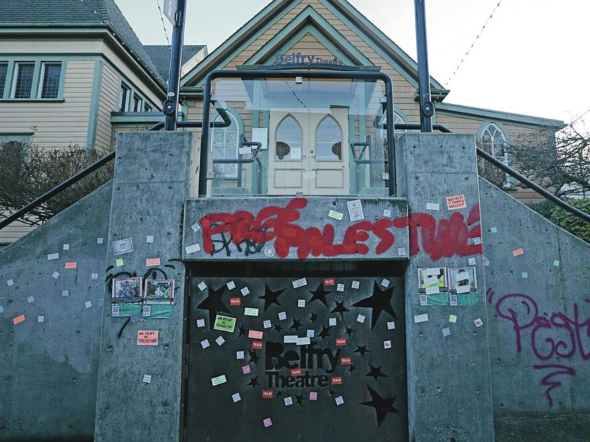
by Curmie
[ JM here: I want to let Curmie’s Conjectures stand on their own, so I apologize at the outset by intruding with a brief introduction. Lest anyone be dissuaded from reading the whole post because the author’s scholarly tone and apparent focus at the start suggests that this will be a narrow discourse on topics rather more relished by Curmie and me than by the majority of EA readers—theater and the performing arts—fear not. The tags on the article will be “Canada, censorship, the Hamas-Israel War Ethics Train Wreck, and political theater.” The post also involves some of the same considerations as one of mine two days ago. ]
There is a theory, one to which I subscribe, which suggests that the Dionysian Festival of classical Athens began not really as a religious observance in honor of a demi-god but rather as a means of consolidating the political power of the tyrant Peisistratus. Whether or not this is true, there is no doubt that by 458 BCE Aeschylus’ Oresteia, widely acclaimed as “the world’s first dramatic masterpiece,” offers commentary on the reforms of the Areopagus enacted by the strategos Ephialtes some three years earlier.
There is no question that since that time the theatre has often—not always, but often—been political. The 20th century offered more than a few examples of playwrights and production companies who, often at personal risk, critiqued the power structures around them: Jean-Paul Sartre took on the Nazis; Lorraine Hansberry, racism in the US; Athol Fugard, apartheid; Václav Havel, communism in Eastern Europe.
Not all such efforts were for causes most of us would endorse, of course. Socialist Realism was a Stalinist policy under which all art had to support The Revolution: not just avoid criticism of the regime, but actively and explicitly endorse it. More recently, the Freedom Theatre of Jenin (on the occupied West Bank) has been in the news. A few weeks ago, one of the student organizations at my university posted an encomium to the company, which they described as “an example of creating liberating theatre and serving communities through theatrical pedagogy and profound performance.” I remembered having written about that theatre a dozen or so years ago. If I might quote myself for a moment: “Turns out that the Freedom Theatre was pretty damned proud of having turned out alumni who engaged in armed insurrection, and at least one of whom, a suicide bomber, richly merited description as a terrorist.”
So no, propagandistic theatre isn’t always a good thing… but engaging with the world is. Even subtle messages matter. Under normal circumstances, Aunt Eller’s wish that “the farmer and the cowman can be friends” doesn’t amount to much. But Oklahoma! hit Broadway after the declaration of war against the Axis powers and before D-Day. “Territory folks” need to put aside their petty grievances when there’s a guy with a funny mustache who’s far worse than any of your neighbors will ever be.
And now we come to what this little essay is really about. The Belfry Theatre in Victoria, British Columbia, announced this week that they were not going forward with the production of The Runner, a one-man show written and performed by Canadian playwright/actor Christopher Morris. The theatre’s management says the decision to cancel the performance was “not easy,” but they believed that “Given the current conflict in the Middle East, this is not the time for a play which may further tensions among our community.”
The play has won numerous awards, and was booked last year for a performance at the Spark Festival this March. I don’t know the play (it’s available on Kindle. An article in the National Post summarizes thus summarizes thus: “The one-man play focuses on the moral dilemma faced by a volunteer of ZAKA, an Israeli group of mostly Orthodox Jewish men who provide emergency medical rescues. The character ‘grapples with the political and moral fallout after saving a Palestinian woman’s life — and leaving a fatally wounded Israeli soldier behind,’ Belfry wrote in a description of the play on its website.” Other articles suggest that the woman was probably the person responsible for killing the soldier. The central character, then, chooses to administer aid to an enemy whose life can be saved rather than an ally who is beyond physical salvation.
Exactly what stance the play takes is unclear. The playwright says that he had hoped to provide “the opportunity to come together in a theatre to explore their common humanity, share their grief and perhaps discover a flicker of solace and hope.” His other statements suggest a sort of naïve pacifism, but that’s a position that needs to be examined critically, as well.
It appears that supporters of Israel were more interested in having the production move forward than were supporters of the Palestinian cause. The collection of letters published last week in the Times Colonist show a wide range of responses. The play is “a period piece replete with colonialist stereotypes” according to one writer. Another claims that “the sole reason [for the play’s cancellation] is that it is set in Israel. It does not take sides and concerns the human condition in extremity. Some people hate Israel so much that they object to any cultural production that comes from Israel or deals with its issues.” Yet another writes that “proponents of the cancellation have crossed a line from anti-Zionism to a form of outright anti-Semitism that seeks to hold all Jews collectively responsible for the appalling behaviour of the Israeli government.”
I noted above that scholars are unanimous that the Eumenides, the third play of Aeschylus’s Oresteia trilogy, references the reforms of Ephialtes. What they can’t agree on, as I learned while researching a paper for a grad seminar 40-ish years ago, is whether Aeschylus approved or disapproved of those changes to the status quo ante. And there is absolutely nothing wrong with that ambiguity.
More to the point, who cares if the play has a particular point of view? Many years ago, the great English theatre critic Kenneth Tynan dismissed the relevance of complaints that the plays of Bertolt Brecht were “unfair” to capitalism: “Henry V is unfair to the French; Everyman is unfair to the Devil.”
There seems to be little support for the Belfry’s decision to cancel the production: it’s called “a lamentable act of cowardice” by one correspondent and “an affront to Canadian’s rights and freedoms” by another. As both a theatre practitioner and a free speech advocate, of course, I agree that the show should go on as scheduled. It strikes me that right now is precisely the time to stage of play of this nature. Provide opportunities for actual discussion before and/or after performances. Get people talking and, hopefully, listening. Sing “Kumbaya” together. (OK, maybe not that last part.)
If the basis for the cancellation was to avoid “tensions,” well, that horse has left the stable and is halfway to Omaha. I strongly suspect that the cancellation will enflame more passions than the production would have. It’s possible, of course, that the theatre feared that the vandalism you see in the photograph above might escalate into something physically threatening to the production staff or audience members, in which case caution is certainly appropriate. That seems rather a stretch, though.
“Hold[ing] the mirror up to nature” is one of the principal attributes of theatre production, and live theatre’s effect cannot be duplicated by technologically mediated forms like film and television. Cancelling a production purely for political efficacy is deeply problematic if not inexcusable. The Belfry Theatre faced a crisis of nerve, and they failed.
Of course, I’m not the guy who has to figure out how to get that graffiti off the front of my building.
 Ethics Alarms
“That’s art. And art is not nice.” –MacHeath, better known as Mack the Knife, in “The Threepenny Opera”. (The director of a 20th Century production of the musical at Springfield Community Theater — some guy named Jack — may remember my putting that quote on the cast and crew’s t-shirts.)
I still have that shirt, Greg. 3PO, the Blitzstein translation, is a perfect example of an inflammatory political work that promotes highly questionable ideas (often incoherently), but is still a terrific piece of theater. One of my top five favorite musical productions.
Seems like they’ve got bats in the belfry.😏
But seriously, while I can sympathize with concerns for the theatre’s safety, the unhinged nature of the opposition is all the more to move forward. Cave into the mob and you only encourage it.
As a theater geek – which also puts me in the minority of EA readers (is it just the three of us?)- I appreciate the time and thought you put into this post, Curmie. Of course it frustrates me no end when theaters pull this kind of thing. I’m a firm believer that live theater, along with stand up comedy and the like, should be upheld as sacrosanct.
Fellow theatre geek here!
I think, as Curmie says, the decision to cancel the play can be defensible on safety/financial/practical grounds, but the company has to say more to defend their position. As things stand, it reeks of capitulating to a mob.