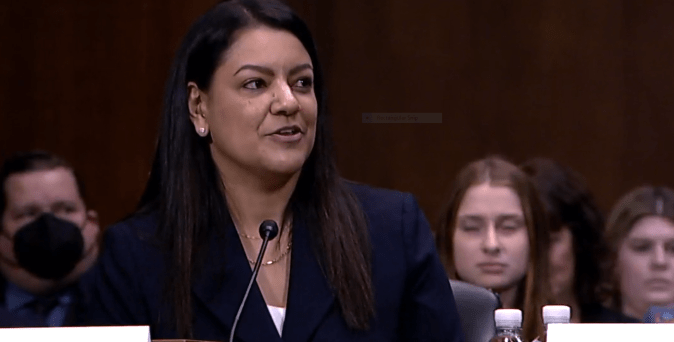
Last March, Ethics Alarms reported on the stunning lack of ability and expertise being demonstrated by some of President Biden’s appointments to federal judgeships. At least Sen. John Kennedy (R-La.) had some fun exposing their incompetence, though Democrats and pundits in the mainstream media mocked him for what they termed his “gotcha!” questions….you know, horribly unfair queries like “What’s a Brady motion?,” which any first year law student should know.
The worst of Biden’s dim legal bulbs was probably Judge Charnelle Bjelkengren, nominated to serve as a U.S. District Court Judge in the Eastern District of Washington. Kennedy’s questioning revealed her to be almost completely unfamiliar with the U.S. Constitution. Kennedy asked her, “Judge, tell me what article V of the Constitution does?” “Article V is not coming to mind at the moment, she replied. “How about article II?” he asked, Her response: “Neither is Article II.” I wrote of the judge’s performance a year ago,
This is more than evidence of incompetence, it shows arrogance. The woman is going to be vetted in a Senate hearing; wouldn’t you think she would at least do a little bit of preparation? Nah…she knows she’s assured of being confirmed, because no Democrat would dare vote against a female nominee “of color” no matter how unqualified she appeared to be, After all, as Senator Murray said, Murray said, what matters most is “a judiciary that reflects the diversity of this country.”
And indeed, Sen. Murray really did say she was very qualified for the job and “truly exceptional”—as in exceptionally not-white and exceptionably female. Well, it turns out that Murray was wrong, and so was I. Bjelkengren was informed that she wasn’t going to make it after all, and is one of five nominees whose nominations to the bench expired at the end of 2023 who was not among 18 nominees the White House resubmitted to the Senate this week.
Good.
Not so good is that that U.S. Magistrate Judge S. Kato Crews, the nominee who never heard of the landmark Supreme Court case Brady v. Maryland, was confirmed, with every Democratic Senator plus weak woke GOP Senator Susan Collins of Maine voting for him. “Goodness gracious,” Senate Minority Leader Mitch McConnell, R-Ky., lamented last year as he watched this depressing spectacle unfold, “Is this the caliber of legal expert with which President Biden is filling the federal bench for lifetime appointments? Is the bar for merit and excellence really set this low?”
Yes, Mitch, it is: as I wrote in March,”…because skill, experience, and demonstrated qualifications are no more the Biden administration’s priorities in naming federal judges than they were in Joe’s choice of Vice-President, Cabinet members or White House press secretary.”
Judge Bjelkengren may still land on her feet, though. I hear Harvard is looking for a new president…
***
[WordPress’s crack AI bot suggests that this post deserves a “Donald Trump” tag.]
 Ethics Alarms
How could you not know the first 3 articles (legislative, executive, judicial)?
But, I did stumble on 5. Full faith and credit? (No, 4). Supremacy clause? (No, 6).
Of course, I was not nominated. Had I been, I would have done something to refresh my knowledge of Con Law (and even read a few cases).
-Jut
I’ll grant that not knowing what a Brady motion is suggests a problem with a nominee for a federal judgeship. Hell, I knew that, and I changed my major from a de factopre-law program almost 50 years ago.
The Article 5/Article 2 questions, however, are indeed of the “gotcha” variety. Knowing the Constitution and knowing what number an Article is are different things, especially if there have been no relevant cases of late pertaining to it. “What does Article 5 say about amending the Constitution?” is a fair question. (Yes, I had to look up the topic of Article 5.) “What’s in Article 5?” is not.
A corollary: I claim to know dramatic literature pretty well. But if you ask me what happens in the fourth act of The Wild Duck, I’ll stare at you blankly if I’m not prepared for that specific question. For one thing, I can’t remember if that’s a 4-act play or a 5-act play, especially since today it’s almost always performed in two acts. But if the question is “What does Hjalmar suspect after a revelation in Act IV?”, I’m good. I can tell you what the revelation was, who made it, why, its significance to at least three members of the family in question, what ultimately happens in Act V because of it, and how all this relates to the theme of the play.
I’m also going to refresh my memory if I’m giving a lecture on the play, critiquing a performance of it, or sitting on a thesis committee for a student writing about that play in particular. But I quite likely wouldn’t do so if the thesis was about Ibsen’s complete works (or even his prose plays), just as Bielkengren didn’t when she could be asked literally anything about the entirety of the Constitution, both what it says and how it has been interpreted. Kennedy’s questions are a test of memory, not competence. Kennedy was acting as a partisan hack, looking to score political points and get his name in the papers rather than to determine her fitness for the position.
I am not arguing that Judge Bjelkengren is or was a qualified judge, but her inability to answer those particular questions proves nothing.
And yet—the judge who missed the Brady case was confirmed, and the judge who couldn’t identify the Articles of the Constitution was dumped. As long as it appears that the President is nominating judges based on factors not relevant to being a competent judge—like color and gender—baseline questioning like Kennedy’s is fair. And as I said in both of the linked posts, the nominees should expect such questions, and do the work to be ready for them. No?
I think you make some valid points regarding the Article 2/5 questions. I will say that I need to look up stuff from the Constitution before I quote it. On the other hand I have a copy of it bookmarked in my browser so I can. Let’s say that going forward, judicial nominees who cannot answer those questions are ipso facto too arrogant and entitled to be confirmed.
I am pretty sure that I would have know what Brady was in connection with a judicial appointment. My law degree comes from watching Sam Waterston in Law and Order — I am certain he knows what Brady is and just how close he can go in skirting it. That one was mind boggling.
I hearken back to Allen Drury’s “Advise and Consent” novel from about 60 years ago. It used to be that even a Senate controlled by the other party would routinely confirm most of a President’s nominees unless there really was some major failing that both parties likely could agree on (somewhat akin to Nixon’s prospective impeachment). That consensus has been thoroughly trashed and our unifier-in-chief Joe Biden played a pivotal role in initiating said trashing.
While this atmosphere can sometimes lead to a revealing result like the nominee who didn’t know Brady, it also leads to stories like the one in Breitbart Jack references today about Nikki Haley and her confirmation hearings. Nominees in general tend to sound more like Claudine Gay than a real human being. I don’t think that’s a good thing, it exacerbates half the Senators and half the public, but it is unfortunately where we are. (now I should say that many of these ‘gotcha’ questions tend not to have as cleancut a possible answer as the ones asked of Gay, but nominees are doubtless advised not to give any answers of substance).
We are living in the era of diversity hires/appointments. DEI is the law of the land and the competent need not apply, because actual competence has been declared a tenet of systemic racism.