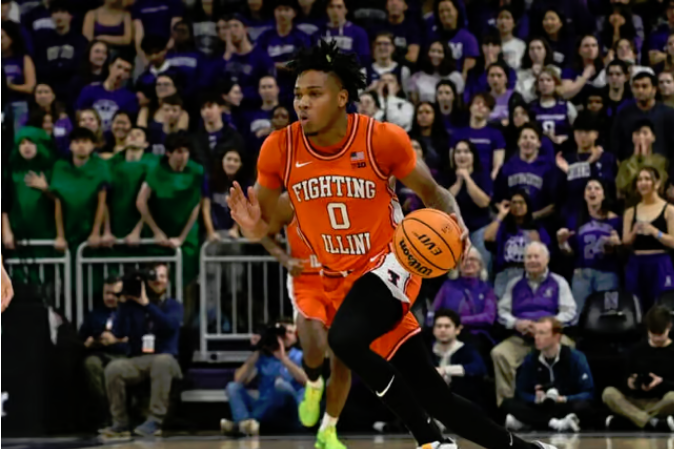
Illinois guard Terrence Shannon Jr. 23, was arrested in Lawrence, Kansas on Dec. 28 and charged with rape. While he visited Lawrence last September, he grabbed a woman and sexually assaulted her at a bar, or so the woman claimed to police. The Illini suspended Shannon following his arrest, but the player’s attorney requested a temporary restraining order against the school this month to force Illinois to let him resume playing basketball. A federal judge granted the request on January 19.
Shannon has been playing with the basketball team ever since. Last week, playing against Northwestern in his first road game since the arrest, he was taunted by fans chanting “No means no!” and “Guilty!”
Your Ethics Alarms Ethics Quiz of the Day is this:
Should a student charged with a serious crime be permitted to represent his college in sports competitions until the matter is resolved?
My perspective on this question was initially skewed by my experience with Major League Baseball. Baseball will automatically suspend a player charged with a felony before any trial, and sometimes even after charges have been dropped. I wrote last year about Trevor Bauer, the star starting pitcher who has been prevented from playing ever since he was accused of domestic abuse by a sex partner. Even after the accusation was found to be dubious at beat, no charges were ever filed and the suspension was lifted, Bauer is still viewed a persona non grata in the sport. Baseball doesn’t want the sport to be identified with criminals, or even players accused of crimes, and I agree with that stance. The game creates heroes and role models: that’s one of its jobs.
The reaction of college basketball fans to this story, however, is nearly unanimous: Shannon is innocent until proven guilty, and that’s that. Obviously I agree with that principle of jurisprudence, but charges of serious crimes still mean something. Most workplaces will at least place an executive on paid leave if he or she has been charged with murder, rape, child molestation, armed robbery, arson, embezzlement, drug trafficking and domestic abuse. Why? Such organizations don’t want the public to associate their business with crimes and people who are charged with crimes. That seems completely fair and reasonable to me. So it seems strange that institutions of higher learning would operate, or be expected to operate, under more forgiving standards.
To me, allowing a player charged with rape continue to play intercollegiate sports and if nothing is amiss sends the message that the charge is no big deal, and that games matter more than law, character and conduct.
What’s your reaction?
__________________
Pointer: Curmie
 Ethics Alarms
I am torn here. On the one hand, I understand professional and college organisation’s have images to maintain, want to present role models for people to look up to and want to maintain a wholesome reputation and those victimized getting an opportunity for justice. On the other hand, unless there are serious consequences for false accusations, there is no potential downside for the accuser and only bad choices for the falsely accused. Until that is rectified especially as more false accusations come to light, accusations will be met in some circles with skepticism and cynicism.
“ On the other hand, unless there are serious consequences for false accusations …”
Excellent point.
There never are, even when the accusations are blatantly false. Never mind Dr. Ford, several women made grotesque charges against (then) Judge Kavanaugh.
Did they face any consequences?
Crystal Magnum?
Perpetrators of the UV gang rape hoax?
A complaint alone is usually not enough to sustain an arrest warrant. Presumably a police investigation uncovered more than just a “he said-she said” dispute.
In this day and age of Fani Willis and Leticia James, Marilyn Moseby, the DA recalled in San Fran, the LA DAs office of late, or any other DA with an axe to grind or an agenda to sharpen, I’m not that sure, and college towns tend to be liberal.
The issue isn’t an arrest warrant, but rather severe reputational, and often real, damage from false accusations. That damage is *always* the result of widespread presumption of guilt.
That doesn’t make the dilemma go away, because there are real problems associated with presuming innocence until proven otherwise. (IMHO, those problems are less consequential than those resulting from false accusations.)
However, while there is no making false accusations disappear, punishing the false accusers must go some way to reducing that behavior.
SFAIK, false accusers are never, or near as darnnit, punished.
That’s a major ethical conundrum, though. If “false accusers” are punished, then genuine accusers will be reluctant to complain, for fear of not just not being believed, but by facing penalties if they aren’t believed. Watch “Unbelievable.”
That’s an awful story — I had read about it previously.
However, not being believed is a far different situation than abundant evidence of false accusation.
(Also, Unbelievable is a powerful argument against Qualified Immunity.)
“However, not being believed is a far different situation than abundant evidence of false accusation.”
Is it, though? In the story behind “Unbelievable” the abundant evidence was the poor young woman’s own admission that she was lying, after being bullied and undermined by the police interviewers. And they charged her!
The issue may need a bright-line rule one way or the other. It would be hard to say “it depends on the case.” That lets in discretion; schools would have to weigh evidence; they would have to come up with some kind of hierarchy of crimes. That would be a recipe for disaster.
On the other hand, evidence can vary. I would be a lot more inclined to suspend a student arrested in a bar fight or arrested for DWI than someone who is simply accused of sexual assault, even though sexual assault is a more serious crime. But, what is it is reported right away? What if there is DNA evidence? What if there is video evidence?
See how easy it gets to be forced into weighing the evidence?
The counter-argument, of course, would be the incentive to lie. If I know that the mere allegation would automatically get a star player on a rival team suspended, an incentive to lie could be created. And, the problem is: false sexual assault charges are easier to fake than fake DWI or bar fight charges. The former can come months or years after the fact. DWI and bar fights usually come immediately because police are called and people are arrested immediately; by contrast, if someone accused me of driving while intoxicated 6 months ago, the police would likely not touch that case because it is so seriously weak.
Unless we trust schools to be prudent, deliberate, and fair, they should not wade into this.
Putting it that way, the question answers itself. (Still divided on cases where someone is “caught red-handed.”)
-Jut
I would agree, but the limited time that college athletes have is a factor in my opinion that they should be allowed to keep playing, at least until trial.
This is where I’m at. It’s one thing to be suspended without pay. A college player isn’t paid and to have them sit out is punishing them. From what I understand some of these cases can take months and if we err on the side of guilt, then we are hurting the player without due process and without compensation. I’m not a lawyer so I could be wrong here.
If they can play, then presumably they have to be allowed to go to class, etc. And if a co-ed says that having to face an indicted rapist every day makes the college campus a hostile environment?
My answer to that is that accusations of sexual assault should not be sufficient to get someone blocked from classes, but evidence that’s part of the assult accusation may be sufficient (e.g. evidence of the assult or physical injury, harassing correspondence, interactions with witnesses, etc.) Those can be presented independently of the assault case as evidence of a need for protection. If those don’t exist and the case is only “he said, she said,” there’s also no evidence of a toxic environment, but it also makes it unlikely that the case would lead to an indictment.
(Obviously this can still be false or manipulated, but I’ll allow that from a campus perspective the fact that the accuser can present it is enough for them to err on the accuser’s side pending legal judgement.)
I’m torn on this one, too.
A few things struck me about this case, apart from those noted by Jack and previous commenters.
1. The alleged rape supposedly took place in the bar, so the presence or absence of witnesses is really significant. Witnesses => he’s almost certainly guilty. No witnesses => he’s almost certainly innocent. Having lived in Lawrence for seven years, I can say that the police there are unlikely to make a felony arrest without a pretty good reason to do so, but the lack of further information (the existence of corroborating witnesses, for example) is troubling.
2. Speaking of Lawrence, KS: Arterio Morris, a star basketball player, transferred to KU from Texas over the summer and had been on campus for a very short while when he was arrested for a sexual assault alleged to have taken place in the team dorm. One or more of his new teammates appear to have been witnesses. He was gone in an instant, and few Kansas fans were sorry to see him go, although he would have filled the biggest hole in the team’s lineup this season. (I say this as a KU fan.)
3. Universities also have a responsibility for the safety of their other students. I understand the objections to the assumption of guilt, but jocks have been given a free ride for their behavior–often for sexual assault–for too long. Off the top of my head, there have been cases at Florida State, Stanford, Montana, Auburn, Wisconsin-Stout, Baylor, and (yes) Kansas. And those are just the one I heard about. This is yet another difficult balancing act.
4. The decision to suspend him came from the university, i.e., the folks giving him free tuition, room and board, books, tutoring… The whole basis for creating NIL (name, image, likeness) deals was that such athletes are de facto employees. Employees can be fired for a lot less than an arrest for a violent felony. And the “well, he’s going to lose a lot of future money” argument is both probably untrue and irrelevant.
5. And speaking of NIL, there’s no little irony to the fact that Shannon could afford to hire a squadron of lawyers because of NIL deals arranged by the very university he’s suing.
6. The judge’s decision seems to be largely on procedural grounds–that Shannon was suspended without “affording him the protections of the [Office of Student Conflict Resolution] Policy.” That matters, although it’s certainly reasonable to claim that this situation demanded immediate action while the investigation continued. Defendants in felony cases are sometimes jailed (not just suspended from the basketball team) while awaiting trial, after all.
7. It appears that the university did not, in fact, “rush to judgment.” They had information about the case as soon as the allegation was made, but took no official action until the arrest per se, roughly three months later.
I guess I come down, somewhat reluctantly, on the side of the university’s ability to have control over who represents it. But I also agree with the argument that false allegations in cases like this one need to be punished severely.
You comments sum up where I am on this situation..
jvb
Me as well. I will point out that I had a student who was on trial for murder in a class at a major state university. It is likely Shannon would still be allowed to go to class and be on campus. Since the potential victim was in a state far away, there is little chance he is going to interact with her. I would DEFINITELY not let him travel to Kansas for a game, obviously. With the number of fake allegations of sexual assault and the time it takes courts to resolve things, I lean on letting him play. It isn’t like we haven’t seen prosecutors do things for political purposes lately.
https://helpsaveoursons.com/looking-back-campus-rape-hoaxes-false-accusations-how-many/
The above link shows that quite a few of these fake reports resulted in charges being filed and even trials.
“games matter more than law, character and conduct.”
I think that is exactly what universities have shown us where their values lie over the past 30 years. They allegiance is solely to the money their teams can bring in — the hell with the fans, alumni, students, and traditions. I am actually mildly surprised that they suspended him at all — perhaps they thought their ratings might take a hit if he played.
Yes, that’s pretty cynical but it is what colleges have shoved in our faces over and over again. Regarding Curmie’s point about NIL — yes, I think the whole point of that is that the athletes are either employees or independent contractors. Either way, the organization that hired them can have legitimate concerns about their image, but again I think that modern colleges have demonstrated they care nothing about that unless it impacts their TV contracts.
Now should they care? Well, yes, I think MLB has a better approach to this subject.
Innocent until proven guilty is 100% a legal stance.
But communities work a lot differently – the vast majority of people in life are so disassociated with the circumstances that even lead to an accusation of impropriety that they’ll never have to worry about a mistaken accusation.
Mistaken accusations certainly occur – but the vast majority of THOSE accusations occur with people who are involved in circumstances and found in contexts that are already not savory to the rest of the community.
So, while legally innocent of the charges – no one needs people in influential positions whose legal but foolish conduct comes to the surface.