
Well this was certainly refreshing and unexpected!
Donald Trump-knockoff billionaire Mark Cuban stated in gratuitous tweet that he has “never hired anyone based exclusively on race, gender, religion,” but that “race and gender can be part of the equation” because he believes “diversity is a competitive advantage.”
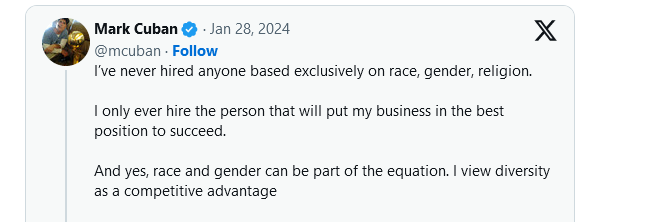 What virtue-signaling claptrap! What does that last part even mean? Does Harvard consider that its acceptance of diversity as a substitute for genuine credentials and ability has given the university a “competitive advantage” as it competes for the best students, faculty and donors? Yesterday, in addition to having it revealed that its top DEI officer is a DEI hire herself who rose to predominance with the assistance of bogus scholarship, a wealthy donor who last year gave the university $300,000,000 dollars announced that he was through. “Will America’s elite university get back to their roots of educating American children – young adults – to be the future leaders of our country or are they going to maintain being lost in the wilderness of microaggressions [and]a DEI agenda that seems to have no real endgame…?” Ken Griffin asked in response to being asked if he could be lured back as a donor.
Cuban was slapped down by the last person I’d expect: one of the EEOC’s five commissioners in an administration that has championed hiring practices based on skin shade, race, religion, ethnic background and sexual proclivities affecting many of the most powerful agencies and posts in the nation. Andrea Lucas “pounced”…
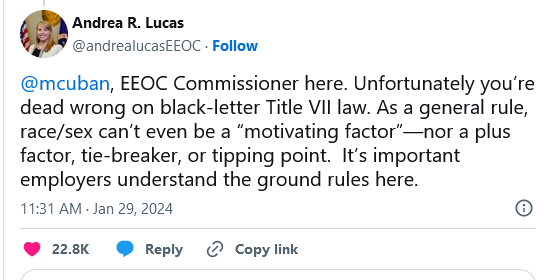
Good to know, don’t you think, Mark? Now somebody please ask Lucas how she squares her statement with having colleagues like Kamala Harris, Alejandro Mayorkas, Karine Jean-Pierre, Pete Buttigeig and others too depressing to list.
Lucas doubled down too, going on hated Fox to expand on her declaration. “The law’s crystal clear. There’s no legitimate business reason that justifies discrimination based on race or sex. Mr. Cuban is conflating the idea that someone’s race and sex can be part of the complete package,” Equal Employment Opportunity Commission (EEOC) she told FOX Business’ Lydia Hu. “But that’s not provided for under the law,” she continued. “And if he’s using it as a factor, even if it’s not the only factor or the dispositive factor, if it’s any part of the decision, then it’s a motivating factor, and that’s illegal.”
Is there any doubt that furious meetings have been held in the White House in the last few days with someone pounding the table and asking, “How in hell did we end up with such a white woman as a commissioner at the U.S. Equal Employment Opportunity Commission?”
Get that CV in order, Andrea.
 Ethics Alarms
I’m not sure where the line is drawn. For example, around here there are a lot of Spanish-speakers whose English isn’t very good. If you’re hiring someone whose job would require communicating with those people, you might legitimately want at least one person in the office who’s fluent in Spanish. It’s not a specific job requirement, but it would be a tipping point.
Things get more complicated if you already have one Spanish speaker, but maybe a second one to take the load off the first one on rare occasions would be a good idea.
Or… since those clients/customers are more likely to feel comfortable talking to Rosa Hernandez than to Sally Williams (even though Sally speaks perfect Spanish), is that a consideration?
And does Hooters have to start hiring male waitstaff?
Curmie,
You kind of beat me to it.
My firm deals with a lot of immigrants. A couple of our lawyers speak Polish and Russian (my Ancient Greek is a bit rusty, but INS has not granted Temporary Protective Status to refugees of the Peloponnesian War, so there has not been much call for it lately) , but there are so many Spanish-speaking clients that that almost everyone else in the office speaks Spanish. However, to fill that requirement, we have hired men and women from the U.S., as well as other countries. We have also hired white people fluent in Spanish. So, the skill itself does not directly translate to a minority hire.
But, it is a skill we look for.
On a related point, we were recently looking to fill an entry level hire in an administrative position. We received an application from a Hmong woman who spoke no Spanish. We have a handful of Hmong clients, one I have had for almost 20 years. He has emphasized to me that the Hmong are a very insular group that does not really like going outside the community; he came to me because he knew that he needed a native lawyer if he was going to fight legal battles in the U.S. system. I figured that hiring her would give us an advantage in providing services to that community, as Hmong people may come to us through her.
We ended up hiring a Spanish speaker for the position, but I don’t think that hiring the Hmong person would have been particularly “less” qualified, particularly if I were to frame it as: “having a Hmong speaker could help us expand our client base and provide services to another segment of the population.”
-Jut
“And does Hooters have to start hiring male waitstaff?”
This is such an open invitation to grotesque satire and worse that I wouldn’t touch it with a ten-foot transsexual Czech.
If not a Czech, whaddabout a Polak?
Ability to speak a foreign language isn’t an ethnicity…
Employment litigator here. These are the issues that our clients have grappled with for decades. The EEOC director is, unfortunately, incorrect when she says that ANY consideration of race is improper. If that were true, then any knowledge of an individual’s race could be used as the basis for a discrimination claim. Most courts find that race has to be a motivating factor in an adverse employment action before a discrimination case becomes valid. There are other ways of phrasing it, but generally protected factors such as race, gender, religion, etc. can be acknowledged as long as the employer can prove that it would have made the same decision for a similarly situated person outside the protected class.
These protected factors have different weights in terms of their being used as a bona fide occupational qualification. For example, gender can be a legitimate basis for job discrimination if operating in a same-sex environment such as a prison. Race is almost never a legitimate job qualification, although race-linked attributes, such as foreign language capacity, certainly can be. And as a general rule, the preference of your customers is not a justification for making a race-based decision. For Curmie’s example, above, assuming Sally is otherwise qualified, she has to be given equal consideration because the key skill set- speaking Spanish- is equal between her and the Hispanic applicant.
Hooters has male servers now, although it had a very funny ad protesting the EEOC’s attempt to make it hire men.
I find these lines confounding. For example, I do workplace ethics seminars using a group of professional actors, “The Ethical Arts Players.” I have had companies ask me to make sure that among the four performers, at least one is A-A, because of perceived reactions and expectations of the company’s employees. Is that a valid EEOC reason to make race a determinative factor? It literally meant that I would choose, rather than my most talented set of actors, my three most talented actors and my most talented black performer, taking the place (theoretically) of the next most talented actor who happened to be Asian.
And that is why I will always have a job. 🙂
Zoomie
I disagree. When the law say you cannot discriminate using race, gender age etc., this does not create “protected” classes.
Using language that does not define who is “protected” then all are protected from discrimination.
The example of differentiation based on language skills does not require someone with a Spanish surname who speaks Spanish to be more qualified than a linguist that is fluent in other languages but not of the same ethnicity. It may be more common to find one of that particular ethnic background but ultimately the issue turns on skill sets not race or ethnicity.
Based on common use of the phrase “protected class” the intent of the law has been bastardized. Using race as any part of the decision process that is not a bona-fide occupational qualification is illegal discrimination. I commend the commissioner for attempting to adhere to the letter and spirit of the act.
You cannot have Equal Employment Opportunity if some people have special protections.
Chris, I don’t have time and space here to give a primer on employment discrimination law. Suffice it to say that the term “protected class” is used to denote characteristics that may not be used to make employment decisions because statutes prohibit the practice. So, race, gender, ethnicity, skin color, religion, age, pregnancy status, military status, disability status, and citizenship are examples of characteristics that may not generally be used for employment decisions such as hiring, firing, promotion, or other tangible employer decisions. Contrast these with things like clothing choice, appearance, height, shoe size, current drug use, etc. which are not defined as protected classes and may be used legally to discriminate by an employer. There’s a fair amount of imprecision in the discussion of these terms and how protected classes affect employment decisions. You can see this in the comment from the Commissioner, who simultaneously says any use of race or sex in an employment decision is illegal because it’s a “motivating factor.” That’s incorrect, and there are a host of court decisions that say so.
Determining what is a “motivating factor” can be very difficult. One of the reasons that this area of the law is hard to encapsulate is that employment decisions tend to be very fact-specific–each decision stands on its own because there are so many idiosyncratic factors being considered by the employer. Virtually every employment discrimination statute was written on the assumption that we were working towards a colorblind, gender-blind culture that would simply look at the merits of each individual and make decisions on that basis. It’s one of the reasons that those of us in the business consider DEI, with its emphasis on segregating people by category and forcing outcomes based on those categories rather than by merit, to be so pernicious.
Zoomie
I appreciate your clarification. I misunderstood your original post because my bias kicked in after reading the first paragraph about having to be a motivating factor in employment. I should have read more carefully in the latter paragraphs.
However, short of having something in writing saying one of those characteristics is a job requirement proving motivation is impossible short of some other hard evidence. Disparate impact is often used as prima facie evidence of discrimination by the grievance industry. Whether or not EEOC investigators use it I cannot say with certainty.
I do believe that the concept of protected class has been abused in such a way that only those with histories of past discrimination are to be “protected”. This not what the law intended.
When I read the phrase “protected class” I unfortunately jump to a conclusion that in this case was inaccurate. That particular phrase is offensive to those of us who are summarily judged to be somehow privileged in employment and life and who need to be taken down a peg or two.
Minor point Jack, you’re about 270 million off on that donation.
Fixed. 300,000 seems like so much to me that I choked at the extra zeros. Thanks.
Reading this post and comments gave me flashbacks to my last decade of work before I retired; I am so glad to be out of the game and no longer dealing with these employment issues with their Byzantine language, rules, interpretations and constructs.
For many years I was a member of the American Society for Public Administration, but I dropped out of the organization in 1994 when they changed their stance away from equal opportunity and merit in employment and adopted “equity” as their new watchword.
Any emphasis other than merit is slow-motion suicide for an effective organization. Ethnic, racial and gender diversity are demographic realities to be accepted -and often compensated for. Diversity is not a “strength” to be cultivated for its own sake.
Correction: She is 1 of 5 EEOC Commissioners and she is neither the Chair or the Vice-Chair of the Commission. Is she a part of the head? Yes. Is she “the head”? No.
The 20% head? I’ll fix that.
It looks like she threw several sources with “EEOC Commissioner here!” That’s technically correct, and I guess “one of five EEOC commissioners here” wouldn’t have the same thwack.
EEOC commissioners are appointed for five-year terms. According to Ms. Lucas’s bio on the commission website, she’s a Trump appointee confirmed in 2020, so she’ll outlast at least the current administration.
That aside – I still struggle with this concept. What is a manager supposed to base their decision on when they have 1 job opening and 70 well-qualified candidates? At that point, isn’t it the manager’s job to subvert expectations? Like, if the manager knows that he has a team of 15 white guys, does filling the 16th spot with another white guy show a systemic trend of only hiring white guys? I get that race shouldn’t be even a tipping point factor – but if you’re going to get sued because you only hire white guys – isn’t race already a factor that has been introduced by the government?
Exactly. Me too. And I’ve been in many hiring positions where race has been a factor. I was directing “Nuts” for a local community theater that was Old Virginee to the core and racist. The judge as written is a white male; it’s not a very tough role, and I cast a black woman in the part—she was good enough, it was a deliberately edgy production, I thought a black judge would be an interesting feature—and I knew the casting would drive the old biddies running the place crazy. And it did.