Once again, Ethics Alarms visits the thorny issue of what kind of conduct permanently disqualifies someone from being a trusted lawyer—and in the law, if you can’t be trusted, you can’t be a lawyer. Last October, I wrote about “the rest of the story” concerning Shon Hopwood, who served more than a decade in federal prison for bank robbery, became a “jailhouse lawyer,” went to law school after his release, passed the D.C. bar exam, was admitted to practice, and became a professor at my old alma mater, Georgetown Law Center. In 2017, I had written that he should not have been trusted sufficiently to receive a law license, as such a serious felony committed as an adult is ominous signature significance for someone whom society may choose to trust as a citizen after serving his prison sentence, but not for one trusted to administer and advise regarding the law. The second post was prompted after Hopwood was arrested for multiple counts of domestic battery, and relieved of his teaching duties.
True, Hopwood didn’t steal a client’s money or commit a breach of the legal ethics rules (other than breaking the law, which is a breach of the ethics rules that doesn’t involve the unethical practice of law). I was sorely tempted to say “I told you so!” to the vast majority of my colleagues who disagree with my bias against bank-robbing lawyers, but I resisted the temptation.
As far as I can determine, Hopwood has not been tried or convicted, and maybe that explains why he is still listed among GULC’s faculty. His Wikipedia entry does not mention his latest arrest, but it does mention that he hired Tiffany Trump as a research assistant.
I’m sure this is all her father’s fault, somehow.
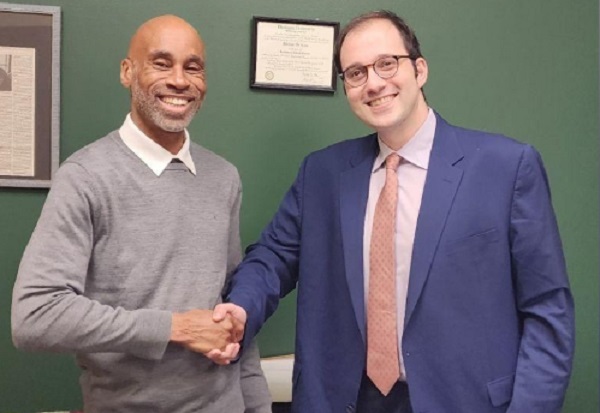
Today, I learned that Michael Braham (on the left above), who recently completed serving a 25 year sentence for murder at Cheshire Correctional Institution in Connecticut, is applying to law schools and has at least one acceptance. He was a “jailhouse lawyer” while incarcerated, became employed as a paralegal upon release, and says all the kinds of things you would expect him to say, such as, “For most of the time that I was incarcerated, I strove to better myself in preparation for the period after my release…I did so in two ways mainly: education (while there, I earned an associate’s and two bachelor’s degrees) and through pro se litigation.”
Hey, that’s good enough for me! Well, no, not really.
Your Ethics Alarms Ethics Quiz of the Day is…
Is it responsible to allow a convicted murderer ever be permitted to practice law?
Two quick points: first, murder is a crime of violence but not “moral turpitude” under current definitions followed by bar associations.
Second is this: while checking to see whether there have been any developments in Hopwood’s case, I stumbled upon a comment about him by a family friend, who wrote in part,
“Shon’s sociopathic tendencies have been visible since high school. His story has been well-curated to sell the beloved ‘come back kid’ narrative. The problem with his come back story is that there was nothing to come back from. He came from privilege. He had supportive parents. He had a full- ride, athletic scholarship to college that he wasted. He squandered opportunity with the U.S. Navy. He was cruel to his siblings. He was cruel to friends and schoolmates. He was cruel to animals. He got off on seeing others afraid. I witnessed his reckless behavior endanger the lives of others on multiple occasions, all while he laughed, maniacally. I wasn’t a bit surprised to learn of the bank robberies; Shon seemed to derive sheer joy from seeing others truly terrified. It’s sad that the Bill & Melinda Gates Foundation didn’t work to find a more deserving candidate to send to law school – perhaps someone who never got a first chance, as opposed to someone who pissed away several…. Shon is a narcissist. Everything is always about him. He tends to leave out major portions of his story. I voiced concern for Annie and the kids, years ago. They deserve better.“
But he never killed anybody.
[Note: WordPress’s bot tells me to tag this post “artificial intelligence.”]
 Ethics Alarms
I had a recent opportunity to argue to my state Court of Appeals that a real estate agent had engaged in the unauthorized practice of law by representing a builder and my client in a transaction to build a house for my client. I am not sure how well it went.
However, in my research, the Minnesota Supreme Court saw fit to outline some of the history of the regulation of the legal profession. Specifically, the Court traced the history back as far as Edward I (of Braveheart fame) in England. There, the Courts were to select worthy and promising individuals to appear before the Courts.
Of course, while we in the States pride ourselves on our momentous rejection of the English Crown, we have certainly retained significant aspects of its culture, not the least of which is a general philosophy of jurisprudence. Knowing my profession has a history of more than 700 years is humbling in some sense. Being a member of the profession is a privilege I am granted, not one to which I can make a claim by right.
From that perspective, Mr. Braham should not be admitted to practice.
On the other hand, as stated above, we have rejected many things English. One of those things is the Noble Class. The Constitution specifically provides that: “ No Title of Nobility shall be granted by the United States: And no Person holding any Office of Profit or Trust under them, shall, without the Consent of the Congress, accept of any present, Emolument, Office, or Title, of any kind whatever, from any King, Prince, or foreign State.“. We are far more egalitarian than the English, and more so than we were at the Country’s founding. I have little doubt that lawyers were likely part of the privileged class.
It is a good thing that the U.S. allows people to progress as far as their talents will take them. It is a good thing that we allow second chances. It is a good thing that class is not a barrier to self-improvement.
But, the bottom line is that we regulate lawyers to protect the public, a public that we expect to be unsophisticated enough not to be able to distinguish good lawyers from bad lawyers. because of this, we try to keep bad lawyers out of the practice before they can even get in. Part of that means keeping out people with serious problems in their personal background. Because it is a trust placed in us by the public, the protection of the public should be the central focus, not the aspirations of the individual (as impressive as those may be).
A jurisdiction that admits Mr. Braham to the practice of law would, in my opinion, breach the trust placed in it by the public.
He should not be admitted to the practice of law.
-Jut
Agreed. While they may have redeemed themselves to become productive members of society, the practice of law should demand more in terms of personal character.
jvb
I graduated law school in 1995. Next year it’s going to be thirty years in practice. During these years I have fended off at least three ethics complaints that were complete and utter garbage, and not even over anything major, but each time I was understandably fearful. At least one colleague of mine was not so lucky, and ended up being suspended from the practice of law for a year because his client chose to second-guess him. I remember threatening another lawyer who talked to one of my principles without me being present with ethics charges if she ever did such a thing again. It turns out I did not need to bother, as she was subsequently disbarred for stealing client money due to a drug addiction.
There is absolutely no room in a profession where severe consequences can result from the slightest misstep for a felon, and that goes triple and quadruple for a murderer. This isn’t even worth discussing.
I guess I am torn by this one.
(1) They are not trusted to vote in most states, how can they be trusted officers of the court?
(2) So many of our attorneys seem to do unethical or illegal things, does it matter?
I think my ambivalence is due to the fact that the law profession is almost as broken as our educational system, and for the same reason. Our legal education and regulation system was allowed to become partisan because all monopolies become essentially 100% Democrat due to their cult-like partisanship. Once the law schools became partisan, it became difficult for non-partisans, much less people from the other 50% of the political aisle to become attorneys and judges. Now, we see that anyone who dares to prepresent someone like Donald Trump is likely to have their law office raided and be charged criminally for practicing law. If they aren’t criminally charged, they will face disciplinary action from their monopoly. Any Republican Attorney General risks their law license for being a Republican Attorney General. Once it becomes partisan, partisanship become the most important quality in its member, not competence and definitely not ethics.
When the attorney in town on the state’s child abuse task force covers up child abuse from her clients and when the drug court judge in town drives back to court drunk from lunch every day, it is hard to really care about a legal system that is imposed on us, but isn’t for us. Don’t even get me started on the incompetence of attorneys who don’t know that a binding contract can’t be changed by one party without the knowledge of the other or who write things like “It is firmly established in tradition and case law that academic freedom only belongs to a University administration, not to individual faculty members”. Education was the first to fall, law seems pretty much there at this point, medicine is close behind, and science is trying to ‘catch up’ with medicine.
A final part is, why should the common people care? More and more, the legal system is something imposed on the common people, not something that serves them. The common people were shut out of the courts system when it was ruled that we could be forced into private courts in New York City run by the corporations. Then, the courts ruled that our property could be taken from us as long as the government gave it to people richer than us. When common people are wronged, it usually is to an amount less than $10,000. However, it will cost us $10,000 or more to get it back in the courts, making it profitable for people to do. In places where they have tried to fix this by allowing attorney’s fees to be granted in the judgement, many judges have refused to award attorney’s fees in excess of the judgement, resulting in attorneys not taking such cases. We see this and know it, but just like with education, we don’t want to do anything about it because of the monumental change that would be required. We just resign ourselves to a lawless future full of homelessness, poverty, and despair. Detroit, Chicago, and San Francisco are the results and it will be everywhere soon.
As evidence of how bad the education part is, look at Boeing. Look at how many problems their new 737 is having. Several parts have been found to be manufactured wrong and their assembly process is being falsified by the workers. They have been through this plane and its assembly over and over but the managers don’t understand anything about the actual product, they don’t have enough engineers and those they do have are too poorly educated to understand more than a miniscule part of the aircraft. There just aren’t people left who can understand the big picture and we have destroyed the values of hard work and integrity that came with Protestantism with the values of multiculturalism and equity that come from the new state religion. We just are not capable of designing and building a new aircraft anymore, we don’t have the people anymore and we have no way of producing new people who can.
Where is all our talent going? Who is John Galt?
One of the questions I have in this case is whether or not it matters that the law degree is attained after a criminal conviction, rather than before. On the one hand, many people find being charged, convicted, and sentenced a sobering experience that does put them back on the straight and narrow. Certainly someone who is dedicated enough to work through a law degree while serving a prison term shows, at least on the surface, the willingness to improve one’s life. That is commendable.
On the other hand, we do want our legal professionals to be trustworthy. Similarly to how Catholic priests need to be trustworthy so that penitents can believe the seal of the confessional will never be violated, so must lawyers be trusted to keep client information privileged, to work in the best interest of the client, and be capable of doing. Someone who has already broken trust with society faces an enormous challenge of regaining that trust. How can one successfully practice law with the handicap already present?
Then there is the issue of what happens when such a lawyer as Michael Braham might become commits another crime. The outcry against giving someone with such a background a chance to violate the public trust again will be (and has been) harsh. What is entirely frustrating with such examples is that often public policy and sentiment is based upon a very tiny few, but very notable, cases. I have no idea how many practicing lawyers earned their law degrees during or after incarceration. I also have no idea how many recidivate. But let us suppose for a moment that lawyers commit crimes at a 3% rate. Would it matter if post-conviction lawyers recidivate at 1.5%? 2%? 3%? 5%? It would seem to me that if the case can be shown that post-conviction lawyers commit new crimes at a comparable rate as other lawyers, then I think Michael Braham deserves the benefit of the doubt (where that doubt could be further allayed via risk assessment, which surely would have caught Shon Hopwood?). On the other hand, if post-conviction lawyers commit new crimes at statistically significant higher rate than other lawyers, then that would suggest to me that the legal profession unfortunately should be a profession barred to anyone with a felony conviction.