
John Hammond, as every fan of Michael Crichton, “Jurassic Park” and dinosaurs knows, built an aspirational cloned dinosaur park on a Costa Rican island, and thanks to chaos theory and “Newman,” it turned out to be a deadly disaster. But the InGen founder wasn’t too far off; he just chose the wrong species. In Costa Rica’s Central Valley and its surrounding highlands, a woman named Lya Battle has been presiding over a farm inherited from her dog-loving father (who shot her mother, but that’s another story) known locally as Territorio de Zaguates (“kingdom of strays”). She and her staff take care of, feed and love nearly 1000 stray dogs, which Costa Rica, like most non-affluent countries has far more of than it does pet dogs. (There are an estimated one million strays.) Lya boasts that she knows the name of every one of them on her farm. Here’s another photo:
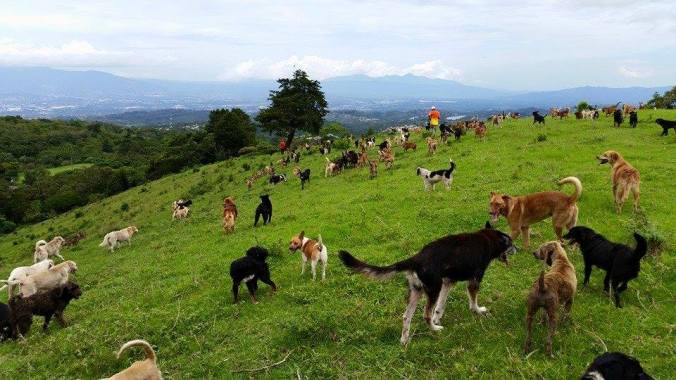
Netflix featured the Lya and the Territorio in the second episode of its series “Dogs;” National Geographic has featured her story, and I learned about the amazing dog haven from an old episode of Jack Hanna’s nature series.
Lya’s Territorio takes responsibility for spaying and neutering every new dog arrival. It operates like a typical shelter, providing food and medical attention, except that the dogs run free. The most stunning scene is when all 900-plus dogs “go for a walk,” with staff leading them into the hills and forests in a noisy, barking pack.
You can get a sense of what this is like from this video…
 Ethics Alarms
Maybe someone more informed about dog behavior can teach me, but how is there not severe danger of dog pack mentality taking over and attacks occurring?
Spaying and neutering helps curb aggression, plus I would hope that they monitor the dogs’ behavior and either isolate or remove the overly aggressive ones.
It’s also worth noting that, contrary to popular belief, domestic dogs aren’t obsessed with “dominance”, and don’t form packs the way wolves do, and even wolf packs aren’t structured on who’s the biggest bully, but instead on family relationships. House dogs form loose social bonds which don’t have a strict structure. From https://blog.whyanimalsdothething.com/post/128129286662/are-dogs-pack-animals:
<blockquote>
A guy named Ray Coppinger did lot of research on free-roaming feral dogs (the “natural” state of how dogs probably evolved) and found that they don’t actually have a pack dynamic at all.
Instead, they move in very loose fission and fusion based patterns. A dog might hang out with ten for a day or two, then wander off on his own for a while, and then spend the next night with just two other dogs. There’s no static social grouping or loyalty to each other whatsoever. Some dogs appeared to show social preferences for certain individuals, but nothing that fits any definition of pack.
</blockquote>
As a missionary I once lived for a while in a neighborhood where several residents let their dog run loose, and from what I observed these dogs got along quite well. When their respective owners let them out, they would visit each other’s houses like kids getting together after school.
I have lived in the country before. On numerous occasions, hunting parties were required to kill packs of strays that were taking down cattle and horses at night. Yeah, we had ‘neighborhood dogs’ that were longterm, friendly communal dogs that people took care of, and most strays were friendly, but the number of strays dumped sometimes resulted in packs forming to kill livestock. Because of stray dumping, I didn’t know anyone who ever actually paid money for a dog until I got to college. I thought you just waited until you saw a stray you really liked and kept it. I really miss that greyhound mix.
Several years ago, a woman was killed by a pack of dachsunds.
https://kfor.com/news/oklahoma-woman-killed-by-pack-of-mixed-dachshunds/
I remember the dachshunds story. What a terrible way to die—and everyone laughs when they hear about it.
This is what is meant when we claim we have dominion over the animals. It means we have responsibility for their welfare