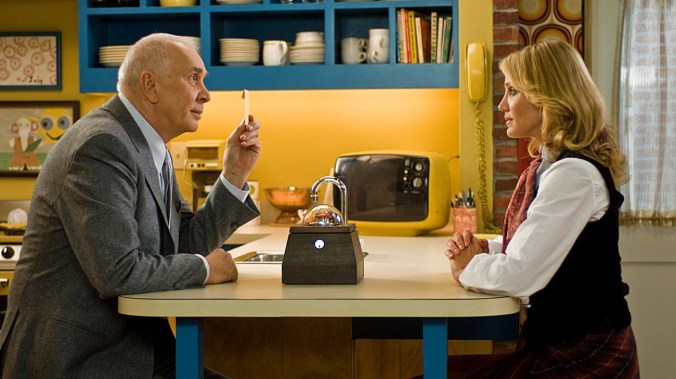
I recently re-watched “The Box,” which my wife and I had first seen more than a decade ago. It is a horror movie based on the 1970 short story “Button, Button” by Richard Matheson, one of the writers of the original “Twilight Zone,” and Matheson’s conceit, a mash-up of science fiction and ethics as his work often was, had been turned into an episode of one of the reboots of Rod Serling’s creation.
If I recall, I didn’t make it to the end of the film the first time, because the set-up was so annoying. A strange, disfigured man shows up at a couple’s door with a strange box in his hands. It consists of a red button under a locked glass dome that must be opened with a key. The man explains to the stunned wife (her husband is at work, getting bad news about his job) that they have been chosen to be the recipients of a gift. All they have to do is push the red button, and the man will return to hand over a brief case filled with a million dollars, which will be tax free. However, when the button is pushed, someone, somewhere in the world, will die. He assures the wife that they won’t know the doomed individual. They have only 24 hours to consider the offer, at the conclusion of which the man will return and take the box away to offer to someone else.
It is, obviously, an ethics hypothetical that has been posed in many different ways through the years. What bothered me originally, and worries me now, is that anyone I would care to have in my community would ever push the button. (As you can guess, one of the couple does—“Why not? It’s just a box…” and a chain reaction is launched that causes havoc.)
If you think the whole idea is preposterous, you don’t push the button because there is always a tiny chance that it will do what you were told it will do. If you think the button might kill someone, you let the man take the thing away. There is no persuasive ethical defense for taking a million dollars at the cost of a human life.
You can spin out the rationalizations as well as I can, I’m sure. What if the person you kill was old, sick, or dying? What if he or she were evil, and the death stops future calamities to innocents? What if the victim of the button is an unborn child, whom half the country doesn’t regard as a human life anyway, and will happily off for the convenience and autonomy of the mother, never mind getting a million dollars as a reward?
The dilemma is the old question of whether you would commit a terrible crime that would benefit you, your loved ones, or others if there was no chance you could ever be held accountable for it. In a Jack Lemmon movie comedy, “How to Murder Your Wife,” Lemmon, a playboy who got married drunk and does not want to be married, is tried for killing his vanished wife, whose body hasn’t been found. He represents himself in the trial and is acquitted after drawing a button on the jury box rail and asking the all male jury if, by pushing it, they could make one person disappear without the act ever being traced to them, would they push it. All the men eagerly push the button.
Blogging criminal defense lawyer Scott Greenfield explored the same ethics territory in a terrific 2013 post. Asking, “If you could commit any crime and get away with it, what would it be?” he concluded that the the only ethical answer possible is “none.” “Just because we can get away with it isn’t a reason to do wrong,” he wrote. And if we can get away with it AND get a million dollars (or five million, or a billion)?
No difference. Yet I find myself wondering how many Americans, untaught in ethics and operating on emotion, impulses, selfishness, rationalizations and greed, could be persuaded to push the button on the box.
And I’m afraid of the answer…
 Ethics Alarms
My question is why the people that were offered the box didn’t choose the option that wasn’t offered and physically DESTROY the box so it couldn’t be used by anyone? Wouldn’t that be the only ethical and moral thing to do?
In today’s age, people would assume this was a YouTube prank or an episode of “What Would You Do?”.
Steve,
That is some good constructive thinking outside the box.
It’s sort of a variation on the classic story of the monkey’s paw. I myself said here once that if the greatest assassin in the world owed me a favor that he would repay by eliminating whoever I chose, with it never being traced to me, that a certain person was the one I would pick. I bet a lot of people would put Trump at the top of the list. Jack said the only right answer to the question of who would you pick is no one, since assassination is unethical by definition. It’s not for nothing that First Edition Dungeons and Dragons said that assassins had to be evil, perforce, since the killing of sentient beings for profit is “held to be the antithesis of weal.” (Gary Gygax’s words, not mine. He could have benefited from a good editor, who would have written the much clearer “killing for profit is by nature evil.”)
“If you could commit any crime and get away with it, what would it be?”
I think we would have to consider what we mean by “get away with it.” If we mean “suffer no consequences whatsoever,” then I would argue that such a thing is impossible. And while my Catholic viewpoint would argue that “of course, God will hold you accountable,” I will not try to stress that point. But, of course, God will hold you accountable. Just saying.
Rather, I’d focus on the fact that even just committing that crime leaves a mark on you, external punishments or no. Every time we do something wrong, it marks us. We have given in to some temptation, and either we end up horrified by the choice or we celebrate our successful execution of the unethical act. Either way, our ability to resist making further unethical choices in the future has been wounded. Once we’ve chosen to do something wrong, and especially if we think we’ve gotten away with it, we have that precedent lingering around forever. When confronted with a similar situation later on, we have to fight not only the pressures and temptations of the moment, but that nagging whisper that says, “You’ve done it before and got away with it, so you can definitely do it again.” To fight against this, we have to rebuild our ethical walls higher and stronger, and often we find we don’t have the incentive or the willpower to do so.
Once that is understood, then lesser interpretations of “get away with it” suffer the same general analysis. Even if I could escape detection from all earthly authorities, I would still suffer knowing that I had given into the perfect temptation: I could commit the crime, whatever it is, and no one else would ever know. But then, wouldn’t I find myself reacting like Lady MacBeth, who could never clean the blood off her hands? Wouldn’t I find myself horrified that I found myself tested, and thus had failed? It is bad enough that I already do things I wish I wouldn’t do, and I know I could get caught for those things.
“In a Jack Lemmon movie comedy, “How to Murder Your Wife,” Lemmon, a playboy who got married drunk and does not want to be married, is tried for killing his vanished wife, whose body hasn’t been found.”
A legal question; if someone gets married while drunk, then is that a legal marriage? Then isn’t the solution an annulment rather than a divorce?
Yes, annulment may be possible if either party was so under the influence of drugs or alcohol at the time of the marriage that their consent can be effectively challenged. Of course, the movie didn’t want to get into that…the kicker at the end is that the wife (gorgeous Verna Lisi) turns up after the trial having missed framing Jack for her own murder. He then points out that since he’s been acquitted for murdering her, he can’t be tried if he really murders her because of double jeopardy. (I doubt that it would work that way, but the situation has never happened in real life.)
Reminds me of a joke I heard awhile back:
Man: Would you sleep with me for $1 million?
Woman: Okay.
Man: How about $10?
Woman: What kind of woman do you think I am?
Man: We’ve already established what kind of woman you are, now were just negotiating price.
Principles don’t mean much if they can be bought.
” It is a horror movie based on the 1970 short story “Button, Button” by Richard Matheson, one of the writers of the original “Twilight Zone,” and Matheson’s conceit, a mash-up of science fiction and ethics as his work often was, had been turned into an episode of one of the reboots of Rod Serling’s creation.”
And I watched that episode when it aired. It was the first time I’d seen the story and it creeped me out. The end probably could have been seen a mile away but not by 14-year old me.
The only thing I’m doing if someone shows up at my front door saying they have a button that pays a million dollars to kill a random person is calling the cops. The person is clearly either crazy or a fed trying to frame me for weird nonsense, and either way I want them off my front porch.
But…it’s Frank Langella! “Oooh! I loved you in “Dracula” and as William Paley in “Good Night and Good Luck”!” Sure, come on in and tell me about your box…”
this is like the Ring of Gyges from Plato’s Republic.
it would make you invisible so you could commit a crime without fear of being caught.
-Jut
Here is how it might work: The Button (youtube.com)