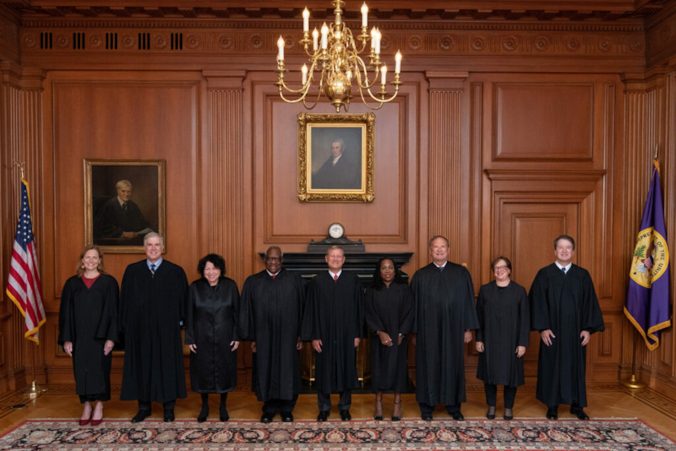
I’m proud of them.
In its decision in Trump v. Anderson, just announced, the Court reversed the the Colorado Supreme Court’s indefensible decision to remove former President Donald Trump from the state’s primary ballot on the grounds that he participated in an “insurrection.” “Because the Constitution makes Congress, rather than the States, responsible for enforcing Section 3 against federal officeholders and candidates, we reverse.” That’s all that needed to be said, and if simplicity and pure law was what the Court needed to ensure a unanimous decision, then so be it. Ethics Alarms had previously stated that the SCOTUS ruling striking down the “lawfare”-inspired crack-brain theory (that a provision created specifically to deal with former participants in the Confederacy was properly applicable to Donald Trump because a mob of idiots stormed the U.S. Capitol in a tantrum over his loss in the 2020 election) should be unanimous, and mirabile dictu, it was. This ends all state efforts to keep Trump off the ballot.
Good. That should (but won’t) shut up the pundits who have been grousing all week that the Supreme Court’s conservatives are involved in a dark conspiracy to save Trump from the consequences of his actions. Even poor, simple Sonia agreed that the 14th Amendment plot was based on bunk. Those complaining that SCOTUS is stalling the Trump Train to Prison by reviewing such cases should look in the mirror: the Justices shouldn’t have had to waste one second on the disqualification theory. It was that bad.
Legal Insurrection has details.
 Ethics Alarms
Outstanding!!!
I can’t hardly wait for the left’s usual attack dogs to line up and start spewing their usual anti-Democratic bull shit vitriol against the ruling.
They’re all for democracy until it doesn’t work in their favor.
Sure does seem like that’s the new and improved 21st century political left.
Bullseye. Because if it doesn’t work in their favor, then it’s not democracy.
I think the left truly believes that their way of thinking cannot possibly be wrong, ever. The temper tantrum that ensues when they are told “no” reminds me of my 4 year old grandson. It is inconceivable to them, that they aren’t going to get their way.
Maybe the DOJ should prosecute all the people in each state that tried this for intentional election interference, or something like that.
Nah. The DOJ has already moved on, and now they’re trying to get states voter ID laws removed. Their primary argument being that black people find these requirements difficult and beyond their ability to comprehend, even though White people have no problems with these same requirements. Why black people don’t find this insulting escapes me.
Amy Coney Barrett’s concurrence is perfect. States can’t do that. ‘Nuff said.
Yeah, I thought her response was very succinct and to the point. On the other hand, I was confused by the concurrence of Justices Sotomayor, Kagan, and Jackson. It seems they are arguing that, while Colorado doesn’t have the ability to remove a candidate from the ballot based on the 14th Amendment, that power should lie in the hands of entities other than (or in addition to) Congress. If that’s the case, whose hands would those be if not the States?
I have a hard time understanding the language, so maybe I’m in error, but what are they suggesting?
I think they’re trying to tee up a court challenge to Trump’s election, without the bother of an actual criminal trial for insurrection.
It seems that they don’t necessarily disagree the majority conclusion, just that it was not necessary to resolve the case. Rather than set a precedent on a hypothetical non-congressional section 3 disability, but only address such a issue if it were ever to arise.
Thus, rather stating that only Congress could bar a candidate for federal office from the ballot, they would rather leave that question unaddressed, as it was not pertinent to unilateral action by a state.
The majority may foresee an attempt to bar Trump from the ballot by presidential action, either directly by executive order, or by the attorney general seeking an injunction in Federal Court. By clarifying only Congress can disqualify a candidate (based on the enforcement provision of section 5), such non-congressional actions are forestalled.
Congress, of course, could not muster such votes in its current configuration (nor should it, but the Democrats would certainly try if they could).
Theyre suggesting:
I’ve seen Sotomayer fall across these possibilities several times. Kagan made very good points about judicial neutrality regarding this case mid-February, so I don’t regard her as being among these possibilities regarding this case.
Inside sources report that a large number of the more zealous dems in positions of power/influence are feverishly brainstorming to figure out a way to blame Clarence Thomas for this ruling.
(sound of basketball being slam-dunked)
I wouldn’t be so sure. I could see several states banning Trump from the ballot in November by stating that this ruling was for a primary. Then, they can have the election without Trump on the ballot and then what do you do? The election is over. You can’t have a do-over for cheating.
What actually stops Colorado from doubling down? SCOTUS and what army?
The whingeing in the Sotomayor/Kagan/Jackson concurrence is… something:
https://www.supremecourt.gov/opinions/23pdf/23-719_19m2.pdf
page 15:
In this case, the Court must decide whether Colorado may keep a Presidential candidate off the ballot on the ground that he is an oathbreaking insurrectionist and thus disqualified from holding federal office under Section 3 of the Fourteenth Amendment. Allowing Colorado to do so would, we agree, create a chaotic state-by-state patchwork,
at odds with our Nation’s federalism principles. That is enough to resolve this case.
On one hand, I appreciate that they found a way to concur in what might have been the most obvious case before the court in American history, on the other… Did you have to?
Of course they did.
Yeah but—its a sop to the Faithful. Concurrences literally are insignificant—maybe some language becomes memorable, but how many times in history? 10? Less than five? The fact is that the idea that the 14th can be politically weaponized is deader than Jefferson Davis after this decision. For Congress to ever meet the requirement will take an actual insurrection, not a Big Lie-christened one. The Court didn’t have to get into defining what would be a real insurrection, so they didn’t. I’m happy that I’ll still have it as a tool for asshole detection: if someone calls Jan. 6 and insurrection, I know they either don’t know what they are talking about, or are untrustworthy.
head-nodding MSNBC commentators exploding my head. “Supreme Court majority is thinking about every possible way they can support Trump. First, this decision — unanimous but with majority writing in a way that will make it impossible to apply the insurrection exclusion — and second, delaying the immunity decision”. Nodding heads all around. Mine exploding.
Prof. Reynolds has a nice, curt piece about how the supposed experts who couldn’t see this results a mile off beclowned themselves. The pundit-types moaning now should check history: how many times has a unanimous SCOTUS opinion not been viewed as clearly correct on the law?
The exposure of the empty suits trotted out as “experts” by media outlets would be a lot more satisfying, were it not for the near-certainly that those same outlets will bring out those same experts the next time around, without a hint of self-consciousness or shame.
I will suggest one example from Law School: RAV vs. St. Paul, I believe.
It was a cross-burning First Amendment case.
Unanimous decision.
5 conservatives Justices, I believe, joined in the decision to strike down the law.
4 liberal Justices, I believe, concurred in striking down the law in question.
The decision and the concurrence had, if I recall, completely different bases for striking down the law.
My professor remarked that it read like a 5-4 decision, except that they all agreed the law was unconstitutional; they just could not agree why.
-Jut
But it doesn’t matter WHY the various members thought the law was unconstitutional, except as an intellectual exercise. It was still a bad law, and they all agreed on that. And that’s what matters in the end.
“But it doesn’t matter WHY the various members thought the law was unconstitutional, except as an intellectual exercise.”
Well, it WAS Law School. So, when analyzing jurisprudence, differing arguments and analysis is relevant, particularly considering that decisions are not made in a vacuum.
-Jut
An interesting factoid — I looked at that picture above and was noticing the height of the various justices. So I googled how tall are the Supreme Court justices? There’s an amazing dearth of information to be found without spending a whole lot more time than I’m going to.