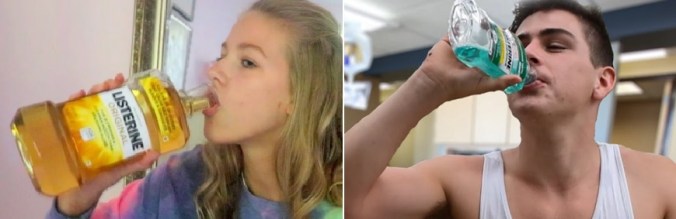
When I last re-posted this early Ethics Alarms entry from 2010, I called it, “Since Ethics Alarms Appears To Be The Only Source Trying To Publicize This Problem, Here, For The Third Time.” Not much has changed since then, except that my wife is dead. Listerine played a major role in killing her: Grace’s last major relapse—she battled alcoholism her entire adult life—occurred right before the pandemic when she impulsively drank down an entire jumbo bottle of the vile stuff and shortly thereafter took a nearly fatal fall off a curb outside our home. She never fully recovered from the effects of that fall, though other, less catastrophic relapses involving the mouthwash occurred at regular intervals.
As I explained in an earlier introduction, the original post “raised an important and shamefully under-reported topic, one that despite my exhortations then has yet to be adequately examined in the media.” In 2016, when I googled various combinations of “mouthwash,” “Listerine,”‘alcoholism,” and “alcoholic,” the first result was still my post. [UPDATE: The Ethics Alarms post is now about 100 deep, behind such links as “Should I switch to alcohol-free mouthwash?” Note that since 2016, Google’s algorithm buries EA in its searches because it is insufficiently in tune with the Axis.]
“Most people who are not afflicted with the disease of alcoholism have no idea that mouthwash is a popular stand-in for liquor, or that is used to deceive family members who think an addict is no longer using or intoxicated,” I wrote in the 2016 intro. First I was prompted to re-post the essay after I had been shocked to hear a physician friend who treated alcoholics plead complete ignorance of the links between mouthwash and alcoholism. The last time, it was the surprising reaction of my own physician, who is usually up-to-date on all medical research, and had treated alcoholism sufferers at the VA. He had never heard anything about the problem.
I’m re-posting this time because of Grace. The quote from my 2016 intro is still valid:
“Despite my frustration that what I regard as a true exposé that should have sparked an equivalent article in a more widely read forum has remained relatively unknown, I am encouraged by the effect it has had. Most Ethics Alarms posts have their greatest traffic around the time they are posted, but since 2010, the page views of this article have increased steadily…More importantly, it has drawn comments like this one:
‘Am looking after my twin sister who is a chronic alcoholic. She has been three days sober and then she just walked in and I couldn’t work out what the hell happened. She was in a stupor , but there was no alcohol and I am dispensing the Valium for detox period and she smelt like mint!! Found three bottles of it !!! This is my last big push to help her and she pleaded innocent and no idea it had alcohol in it! Hasn’t had a shower for two days but keeps her mouth fresh and sweet !! Thanks for the information. Much appreciated XXX’
“Most of all, I am revolted that what I increasingly have come to believe is an intentional, profit-motivated deception by manufacturers continues, despite their knowledge that their product is killing alcoholics and destroying families. I know proof would be difficult, but there have been successful class action lawsuits with millions in punitive damage settlements for less despicable conduct. Somewhere, there must be an employee or executive who acknowledges that the makers of mouthwash with alcohol know their product is being swallowed rather than swished, and are happy to profit from it….People are killing themselves right under our noses, and we are being thrown of by the minty smell of their breath.”
Here again is “The Amazing Mouthwash Deception: Helping Alcoholics Relapse For Profit.” Maybe this time it will help someone to avoid Grace’s pain and her ultimate fate.
I’m so, so sorry, my darling, that I couldn’t give you the peace you needed to fight this curse.
***
It has been with us for centuries, as long as man has been fermenting vegetable matter to produce alcohol, and it is a plague on the human race. Virtually every one of us has friends, relatives or close associates with the disease, or we battle the addiction ourselves. Although accurate figures don’t exist, estimates of the prevalence of alcohol addiction in the U.S. range between 5 and 12%. Whatever the real figure is, it is a lot, and the disease causes a wide range of problems. For example, close to 50% of all automobile fatalities involve alcohol. Yet the public remains shockingly ignorant about alcoholism, to the detriment and convenience of alcoholics, and the devastation of their families
The ignorance is also profitable to some corporations that are not even officially in the beverage business. The ethics question whether those corporations knowingly and intentionally encourage and facilitate that ignorance? If so, they have a lot to answer for, and so do government consumer agencies and the media. This ignorance kills.
The corporations in question are those that manufacture mouthwash, specifically mouthwash containing ethyl alcohol. Most Americans don’t know or suspect that mouthwash containing alcohol is a primary tool of the alcoholic’s craft, which is deception. Keeping the progressive disease, a debilitating addiction with genetic roots, hidden from fellow workers and family is a full time occupation, and popular mouthwashes like Listerine, a Johnson and Johnson product, are a godsend. Original formula Listerine is 26.9 percent alcohol, making it approximately 54 proof , though other flavors contain less. This means it is more potent than beer or wine, and comparable to some varieties of hard liquor.
But, you may ask, aren’t Listerine and similar mouthwashes poison? I always thought so, because I read the labels, a typical example of which reads:
“Do not swallow. In case of accidental ingestion, seek professional assistance or contact a Poison Control Center immediately.”
This is effective, all right: effective at putting those who live and work around alcoholics off the scent—literally. The breath of an alcoholic who is drinking mouthwash will smell “minty fresh,” and in the morning, when liquor on the breath is a warning sign even the most trusting associate will notice with alarm, this is wonderful subterfuge. It just never occurs to a non-alcoholic that drinking Listerine or other mouthwashes is a possibility, because the bottle suggests it is poison.
It isn’t, and alcoholics know it isn’t. Drinking mouthwash is openly discussed and joked about at AA meetings, which are, for good reasons, confidential. Occasionally an endorsement of mouthwash drinking appears on the web. Here’s a typical example, from a British website:
“Been drinking Listerine on the streets for ages now, gets you mashed good and proper. Best bit, it’s cheap and makes you smell great. With 4 different colours and flavours, you just can’t get bored with it. Nothing beats going down the park on a Friday night with a bottle of Listerine and getting mashed with your mates. It even comes with that cap which doubles as a shot-glass. My favourite though is Listerine on the rocks you can’t beat that, add an umbrella and your south of the border.”
If you are surprised that anyone could actually drink the mouthwash “for ages” and still be active on the internet, it means one thing: you’re probably not an alcoholic.
There are other benefits of mouthwash for the secret drinker besides the convenient shot glass and the variety of flavors—and, of course, the misleading warning:
- The bottles come in small sizes that can be stored in purses and pockets.
- Mouthwash with alcohol continues to be sold at supermarkets and convenience stores, 24 hours a day, after sales of liquor are prohibited. “Watch the mouthwash aisles on a Saturday night some time,” an alcoholic friend suggested. She was right. There was a run on the shelves, and the purchasers looked like the cast of “Barfly.”
- Most people find the taste of mouthwashes so strong and medicinal that they can’t imagine anyone wanting to drink them. Of course, they aren’t thinking like alcoholic, who do not drink for taste.
- Mouthwash is relatively cheap, and
- If you are under age, you can still buy a jumbo bottle of Listerine without raising a store clerk’s eyebrow.
As I stated at the beginning, the consequences of the mouthwash deception are devastating. Alcoholism is a progressive disease that destroys families, businesses and lives, and recovery is difficult, intermittent, and never-ending. Families of alcoholics have to be vigilant for a recovering family member to have a fighting chance of surviving the illness. The existence of a secret back-door to intoxication, aided and abetted by a false warning that assists secret drinking by deluding non-drinkers, undoubtedly impedes the recovery of thousands and perhaps millions of desperately sick individuals. For many alcoholics, the alternative to recovery is death.
Do mouthwash manufacturers know this? I do not know for certain, but how could they not? They see the sales figures, and presumably they know the market; selling mouthwash is, after all, their business. Figures don’t exist, but it seems reasonable to assume that sales to drunks hiding their addiction must account for a significant percentage of profits, meaning that assisting alcoholics in sabotaging their recoveries and fooling their co-workers and families is worth millions of dollars. Would millions of dollars a year in sales motivate a corporation to keep the public in the dark about a widespread and destructive use of its product? Even if families are torn apart, businesses destroyed, and people killed as a result? We know it could, because we have seen other corporations do worse. We can’t know, at this point, if that is what is going on.
If it isn’t, however, then the naivete of mouthwash manufacturers is mind-boggling. They know that their mouthwashes are not poison, but place misleading labels on their products which only convince the consumers who would never dream of drinking mouthwash anyway. Meanwhile, it lets those who do drink it operate in secrecy. Is it possible that this practice, which has been going on for decades, is accidental and innocent? Are there no alcoholics in the families of Pfizer executives and the other companies?
They are not the only entities I wonder about, either. I find it difficult to believe that supermarket chains and convenience stores don’t know that when they sell Listerine to red-faced, homeless people on Saturday nights, they are supplying binges. The media’s failure to inform the public about this phenomenon is also inexplicable. Journalists are not strangers to problem drinking. Why hasn’t this story been in the New York Times? On “60 Minutes”? Where is Dr. Oz? We see alcoholism portrayed in television dramas frequently now, a good thing. Have you ever seen a character drink mouthwash? If it has happened, I missed it, and I watch more TV than is good for me.
This has to stop.
What needs to be done, and what manufacturers and the media have an ethical obligation to do:
1. Manufacturers should begin public service campaigns aimed, not at alcoholics, but at their families and friends, warning them that Listerine and similar mouthwashes are alcoholic beverage substitutes for those who abuse alcohol or have alcohol addiction, and that if they have a recovering alcoholic loved one, friend or worker, they need to be aware of the meaning of that mouthwash bottle the alcoholic is carrying around, and the minty-fresh morning breath.
2. Local television news, cable news, and talk shows should produce features and news segments on the misuse of mouthwash by alcoholics and teens as a liquor substitute.
3. Manufacturers must change the warnings and labels on alcohol-containing mouthwashes so that the people alcoholics need to fool will not be misinformed.
4. Legislators must change the laws so that purchases of alcohol-containing mouthwashes are covered by restrictions on beer, wine, and hard liquor.
5. Alcoholics should be counseled to reveal the mouthwash dodge to their families before they are in the throes of a relapse.
6. Families of alcoholics should be instructed in Al Anon and elsewhere to be on the look-out for mouthwash abuse as a sign of an alcoholic’s relapse.
Whether through negligence, ignorance, carelessness, irresponsibility or greed, a strange convergence of factors has been aggravating one of the nation’s most serious health and social problems. All that is required to address the problem is information and education. If those who have a responsibility to publicize this information continue to fail to do so, our ethical judgment of them should be harsh. As always, however, the priority is to fix the problem. If mouthwash makers, retailers and journalists won’t do the right thing, we need to do it for them, and fast. We can deal with their conduct later.
Spread the word.
 Ethics Alarms
Jack wrote, “Families of alcoholics should be instructed in Al Anon and elsewhere to be on the look-out for mouthwash abuse as a sign of an alcoholic’s relapse.”
I knew about this as a teenager from classmates and I also remember being reminded of it in Al Anon back in the early 1980’s. I have an alcoholic X and as far as I know she is still in denial and drinking.
There are mouthwashes out there that work fine without containing alcohol and knowing that there is abuse of mouthwashes that contain alcohol by youth and alcoholics I think they should legally ban the use of alcohol in mouthwashes in the United States and that specific problem would go away.
I read the original post many years ago. I’m so sorry for what you went through. I wish things had been different.
When I was in high school, both alcoholism and drug use were covered in our health class. Mouthwash, hand sanitizers, (some are up to 75% ethanol, others contain lesser amounts or even isopropanol), Nyquil, and vanilla extract, as well as other odd items were mentioned, though you’d have to point them out to me for me to recall anything beyond those few, Funny story there, when 2020 hit and hand sanitizer was at a low point, Wyoming Whiskey changed their business model and started making hand sanitizer for churches. We all smelled like drunks then.
In college, studying to be a chemical engineer, we discussed the problems of making ethanol to use in vehicles, since the ethanol plant in Torrington had asked for one of the senior projects to be a redesign of one of their units. We covered many items of concern, like ethanol’s low flash point, it’s tendency to corrode engines and their respective piping, and of course, the need to put a significant amount of denaturant into the alcohol, usually benzene, to make it undrinkable so that alcoholics cannot buy ethanol fuel by the gallon to drink it. Heck, as chemical engineering students, we generally had talks with our professors about the distillation of azeotropic liquids as lab experiments, all to work on making our own booze. That’s practically the main social life for ChemEs on university campuses. Dr. B would wax eloquent about his days as a student and how the liberal arts majors stopped paying him for his booze because it was too well distilled, with nearly pure alcohol and zero flavor, and Dr. R (from Russia) gave a whole lecture on how to make proper vodka. We learned all about making alcohol, and, when they realized that we’d probably set up stills in our dorms, like they did, we got lots of lectures on how to be safe…except from the Russians.
I say this to point out that it is not as ignored as you think. While companies still make mouthwash and there isn’t a dedicated campaign against it like there is for drunk driving, it is still something that is getting a little air time.
Dear Jack,My condolences on the loss of your wife. May God give you the strength to bear her loss, and the wisdom to remember the good times. Your point about mouthwash is a good one–what you suggest is a warning similar to the Surgeon General’s warnings about the hazards of using tobacco products. There is a chance that such a thing could be accomplished. The way forward is to say that you are only arguing for a mandated warning placed on the packaging. Kind Regards and Deepest Sympathies,charles w abbottrochester NY
Dear Jack,
I think it is possible that this thing could be accomplished, similar to the warning label from the Surgeon General regarding the hazards of using tobacco products.
charles w abbott
rochester NY
I remember your earlier post on this and I am still a little puzzled (I don’t believe your previous posts mentioned Grace’s struggles and I appreciate knowing that (by the way, I also appreciate your mentioning that you taught your CLE the day she died; while I am sure that was difficult, I bet that that is exactly what she would have expected you to do)).
I have to say that I am still stuck on the “What’s going on here?” Part of this issue.
Can we not all agree that alcohol in mouthwash serves a purpose? Even if you believe it is not “necessary,” its use has a purpose. Alcohol kills germs. Does it do it better than non-alcoholic options? I do not know. But, regardless, alcohol has a function.
The labels. You say they are misleading and mislead non-alcoholics, but not the alcoholics. Is it meant for them? Or, is it meant for the kids. I don’t know if I recall any kids drinking mouthwash when I was growing up. NyQuil and Robitussin were kind of a different matter. NyQuil’s shot glass is far more obvious than Listerine’s.
Is Listerine trying to scare stupid kids so they don’t drink it to get drunk. Would it be better to have a label to say it is safe to drink. (I get your point about the label being misleading; however, if the purpose of the product is not ingestion, maybe it is appropriate.)
Or, would it be better for Listerine to switch to Isopropyl alcohol, so that its poison warnings are more accurate and alcoholics would be put on real notice that consuming it could kill them (even if that solution resulted in an increase of accidental deaths from accidental consumption).
And, yeah, I get annoyed when I have to show an ID to buy cold medicine when I have a cold because some meth-head in Anoka County is buying it by the pallet to do his little science experiments.
Can the same reasoning be applied to spray paint and glue? These companies know that some of their sales are to people who want to “huff” their product (“Looks like I picked the wrong week to stop sniffing glue.”). To what extent can you say they are complicit in the death of those people for profits.
Granted, mouthwash may be much more common than spray paint and glue, but that is a difference in degree, not kind.
I do not disagree that the information you provided would be valuable to addiction groups, media coverage, etc. That kind of awareness serves a valuable function (to a very specific group). There is no harm
Government intervention? Generally, I don’t like that option; it has to be justified and, on balance, I am not sure this makes the cut.
-Jut
Alice Cooper Trivia: Alice was a notorious alcoholic (too much to say on that point but it almost killed him), but he had many great songs about his problem (even a whole album about his time in recovery). One very under-appreciated song was “Pass the Gun Around” which had a refrain “Give everyone a shot”; the strong implication being that alcohol led to suicide by the end of the song. Very nice double-entendre.
Perhaps more prominent was his song, “Cold Ethyl,” where he talked about his love affair with Ethyl “and her skeleton kiss.” Again, a double-entendre on Ethyl alcohol and Ethel, a female name.
I bet that that is exactly what she would have expected you to do.
No doubt about that at all.
Can we not all agree that alcohol in mouthwash serves a purpose?
Several, in fact, among them making money for the manufacturers from massive sales to alcoholics.
The labels. You say they are misleading and mislead non-alcoholics, but not the alcoholics. Is it meant for them? Or, is it meant for the kids. It’s a lie. Ethically, end of story. No excuse, no matter who it’s meant for. Tobacco manufacturers could have claimed on the packages that cigarettes made your dick fall off.Effective, maybe, but wrong. Listerine isn’t poison any more than beer.
If the purpose of the product is not ingestion, maybe it is appropriate. But it IS the purpose. Grace was convinced from her conversations at AA that Listerine was a secret product for addicts. I would love to see how much of total sales is for drinking.
Or, would it be better for Listerine to switch to Isopropyl alcohol, so that its poison warnings are more accurate and alcoholics would be put on real notice that consuming it could kill them (even if that solution resulted in an increase of accidental deaths from accidental consumption). Switching suddenly would kill people, no question. It is killing people now, though.
Can the same reasoning be applied to spray paint and glue? If Grace had carried a can of spray paint in her purse, I would have asked questions. She carried little purse-size Listerine bottles with her for years before I caught her chugging from one at a formal event at which she seemed bombed.
I don’t think isopropanol is a good idea. It will harm the people who use the product as intended. See my comment below about castor oil.
NyQuil and many otc meds are abused in a similar fashion.
But everyone knows you can drink Nyquil, since it’s made to be consumed. Non-alcohol abusers literally thing that one can’t drink Listorine—and the manufacturers keep them in the dark.
I guess I was born cynical. I don’t have any alcoholics in the family, we are almost all teetotalers, but I have know this for a long time. When I was younger, I assumed they put something in the mouthwash that was harmless in small quantities, but would make you sick if you drank a mouthful of it since they didn’t card you to buy it. Maybe they should add a little castor oil to mouthwash with alcohol?
Jack, it wasn’t your thought for anything that happened with your Grace. No one can make another person happy, it has to come from within. I was very happy most of the time with my husband and I’m still happy most of the time without him. I’m no expert but my life experience has taught me many things. One of which is when I’m down it is my place to do something about it and no one else. Unfortunately, it’s a harder struggle for some than others. I pray you find peace in this experience while helping others to look deeper into their similar circumstances.