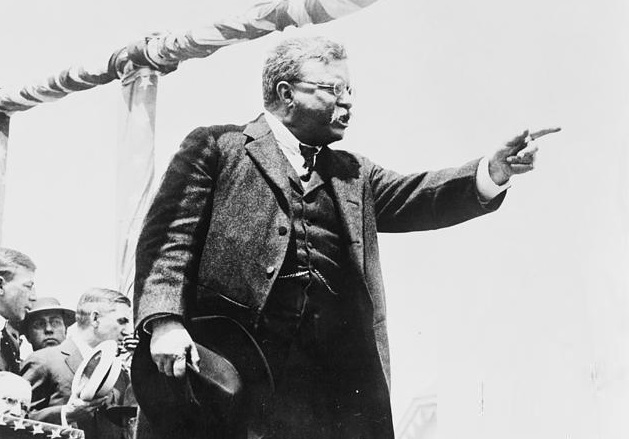
“The bully pulpit is not a pulpit to bully.”
—-The attorneys for Missouri and Louisiana in their U.S. Supreme Court opposition to staying the unanimous three-judge panel of the U.S. Court of Appeals for the Fifth Circuit order declaring that officials from the White House, the surgeon general’s office, the Centers for Disease Control and Prevention, and the F.B.I. had violated the First Amendment by secretly pressuring social media platforms to take down posts as “misinformation.”
What a great line! I’m amazed it has never been used before: an instant classic and useful quote.
Today the U.S. Supreme Court will hear the oral arguments in a case to determine whether the Biden administration violated the First Amendment in combating that endlessly useful word to progressive and Democratic censors, “misinformation,” on social media platforms. There are four case before SCOTUS on this topic, which, among other expressions of alarm, was the target of the so-called “Twitter Files” posts organized by Elon Musk in 2022.
The case being argued today, like the other ones, arose from revealed communications from administration officials urging/ persuading/ threatening social media platforms to take down Left-unfriendly posts on the Wuhan virus vaccines, the 2020 election and Hunter Biden’s laptop and other matters. Last year, the Fifth Circuit hit the Biden administration with an injunction that severely limited this tactic. The three judge panel wrote,
Defendants, and their employees and agents, shall take no
actions, formal or informal, directly or indirectly, to coerce or
significantly encourage social-media companies to remove,
delete, suppress, or reduce, including through altering their
algorithms, posted social-media content containing protected
free speech. That includes, but is not limited to, compelling the
platforms to act, such as by intimating that some form of
punishment will follow a failure to comply with any request, or
supervising, directing, or otherwise meaningfully controlling
the social-media companies’ decision-making processes.
And the Biden administration opposed that language. Let me repeat that for emphasis: the Biden administration opposed that language. This is, you will recall, the administration and the party that has based its campaign against Republicans before the election this year on the premise that it is the Republicans and their presumptive Presidential candidate, Donald Trump, who pose an existential threat to democracy. Yet these are the same aspiring totalitarians who used the power of the government—“Nice little business you have here…be a shame if anything were to happen to it!”—to secretly coerce, pressure, and infiltrate (read the whole order linked above) social media and Big Tech platforms to do their bidding regarding what opinions and assertions could be communicated by citizens.
The public almost certainly doesn’t comprehend this, in part because the media reporting on the issue has deliberately failed to explain it, in part because a large portion of the public doesn’t agree with the First Amendment due to ignorance, poor critical thinking skills, and indoctrination by our rotten educational system, and in part because Americans are dangerously apathetic, and will sit in the water being boiled around them like the proverbial frog fat, dumb and happy. These are crucial cases, and anyone genuinely concerned about American democracy should fall on their knees and thank their favorite deity—and the GOP, and Donald Trump– that there is a conservative majority on the U.S. Supreme Court likely to use these four cases to stop the Left’s attack on the crucial First Amendment.
The Ethics Quote of the Month came up in the battle of submissions to the Court in Murthy v. Missouri, No. 23-411. brought by the attorneys general of Missouri and Louisiana, both Republicans, along with individual citizens who said their speech had been censored. They agreed that the platforms were entitled to make independent decisions about what to feature on their sites, but that government officials using the heavy hand of looming government power to persuade them to take down “misinformation” violates the First Amendment.
Which it does. In her brief on behalf of the Biden Administration, Solicitor General Elizabeth B. Prelogar wrote, “A central dimension of presidential power is the use of the office’s bully pulpit to seek to persuade Americans — and American companies — to act in ways that the president believes would advance the public interest.”
Prelogar is doing her job of zealous representation, and legal arguments are often deceitful and manipulative, but this is perilously close to a lie. Teddy Roosevelt must be spinning in his grave. As Ann Althouse, who is obsessed with precise used of words, neatly explains in her post about today’s SCOTUS argument,
[L]et’s take a moment to consider what the “bully” in “bully pulpit” means. In 1909, President Theodore Roosevelt exclaimed: “I suppose my critics will call that preaching, but I have got such a bully pulpit!” First, clearly, he was using “bully” — as he often did — to mean very good or excellent. And he used the word “pulpit,” because he knew he was preaching, that is, proclaiming righteous opinions in public.Pressuring people behind the scenes is not preaching. You’re not in a metaphorical pulpit. You’re in the metaphorical backroom. And you’re not proclaiming righteous opinions, you’re exerting power, intimidating people. It’s not “bully” in the sense of excellent.The OED entry for “bully pulpit” is clear that “bully pulpit” originates with Theodore Roosevelt. It explained “his personal view of the presidency.” It is — as the OED puts it — “A public office or position of authority that provides its occupant with the opportunity to speak out and be listened to on any issue.”We’re also told: “In later use sometimes understood as showing bully n.1 II.3a.” That meaning of “bully” is:
Originally: a man given to or characterized by riotous, thuggish, and threatening behaviour; one who behaves in a blustering, swaggering, and aggressive manner. Now: a person who habitually seeks to harm, coerce, or intimidate those whom they perceive as vulnerable; a person who engages in bullying.
Ann continues, If “bully pulpit” is sometimes understood that way, it’s risky to argue “A central dimension of presidential power is the use of the office’s bully pulpit….” She concludes,
I want to add that what is said behind the scenes is not from the pulpit at all. A pulpit is an elevated and conspicuous platform. One thing about social media posts is that they are out there, in public, and perfectly conspicuous. If the President (or the shadowy people behind him) want to use the”central dimension of presidential power” that is the “bully pulpit,” let them step up onto a conspicuous platform and proclaim opinions they intend us to find righteous.
In this case, the opinion that was conveyed behind the scenes was that social media platforms ought to take down posts on various political topics — coronavirus vaccines, claims of election fraud, and Hunter Biden’s laptop — that people wanted to debate. If it’s pulpit-worthy, express that opinion outright and clearly to all of us. Don’t go behind our back and intimidate the social media giants upon whom we, the little people, depend on to slightly amplify our tiny voices.
Bingo. Exactly. Brava!
The “bully pulpit” is a public, open, transparent expression of what the President believes and wants the public to know he believes. The unconstitutional coercion of the social media platforms was deliberately hidden from the public by both the government, because it knew it was crossing into totalitarian territory, and the platforms, because they were intimidated (or, as in the case of Twitter, were partisans sympathetic to the government’s position.) The Biden administration’s warped view of the “bully pulpit” is not a pulpit, but a back alley, clandestine menace, and its use of “bully” means a dangerous thug determined to bend others to his will. In defending its indefensible conduct, the Biden Administration and Democrats are admitting their opposition to core democratic principles for all to see, if only that “all” had the wit and perception to understand the peril this portends
 Ethics Alarms
I’m sorry, but the courts and Congress have set up this situation on purpose. They have intentionally stifled the ability of common people to express their opinions by taking an illogical approach to online speech and internet platforms.
Reasonable Approach: I am going to publish a printed newsletter, so I rent some office space and I rent some printing equipment. Now, the landlords and the owners of the printing equipment are not liable for what I print. That would be stupid. Also, if the owners of the printing equipment and the owners of the office space started to censor my newsletter or the company repossesses my printing equipment because they don’t like my opinions, that would seem insane. What if Staples or Weyerhauser started to restrict my speech because I buy my paper from them? That would be insane, right? Now, I want to publish online opinions. I open an account with a provider… it should be the same thing, right? These are completely analogous.
Evil Approach: We are going to constrain people’s speech online because, unlike the physical example, common people can afford it. With the physical approach, you need to have some significant capital to do that. We can’t let ‘little people’ have a voice. We need some ‘reasonable restrictions’ on their speech. Even if they pay for the hosting, they still need to be restricted by the powers-that-be. I’m almost positive people like Ann Althouse would have been completely on board with this 10-20 years ago, when this approach was implemented.
The evil approach has taken hold to the point that the first example is in jeopardy. If I wanted to publish a printed newsletter, I am restricted by the banks and credit card companies. If they don’t like what I print, they can put me out of business. T-Mobile has started scanning text messages and some accounts can be cancelled if they support gun rights. It always starts with ‘reasonable restrictions’.
Michael,
I am a T-Mobile customer, and I think I will test that out.
The devolution of language. “Bully for you!”( I’m on your side, i support you) has devolved to ” I will bully you!” (I will force you to be on my side, You WILL support me or else!)
From yesterday’s Supreme Court arguments emerged a nomination for Unethical Quote of the (fill in the appropriate timeframe). Ethical violation: Extreme Incompetence.
Supreme Court Justice Ketanji Brown Jackson: “My biggest concern is that your view has the First Amendment hamstringing the federal government in significant ways … “
The correct response: Yes, Justice Brown, that is the defined purpose of the First Amendment (as it is for all the others).
In Justice Brown’s defense, she admits that she doesn’t know the definition of a Woman, either.
That is what I find scary: she knows what it is doing, but does not appear to know that it is doing what it is SUPPOSED to do.
-Jut
Posted on this while you were writing your replay!
As much as I’ve read about TR, I’d never put together the connection between the term bully pulpit and his use of the word “bully” as a synonym for “Splendid”. I learn a lot from this blog. Thanks.
So do I.