Philip Galanes’ stultifyingly woke advice column in the New York Times has been off my metaphorical radar screen since I dumped the print version of the paper, but somehow (I don’t recall why) this recent inquiry is an exception. Here was the inquirer’s question:
My wife and I attended my nephew’s wedding 18 months ago. He and his wife are now expecting a baby, and I was looking forward to meeting my newest relative. The problem: At their wedding, group pictures of our extended family were taken before my wife and I realized it. When we asked the photographer why we had been overlooked, he only reiterated that pictures had already been taken. My wife, a woman of color, believes that racism may be the reason for our exclusion. She wants nothing to do with my nephew or his family again. I understand her feelings, but I’d like to restart these relationships. My wife doesn’t want me to broach the subject. Thoughts?
Yecchh.
Yeah, I have thoughts: this poor guy’s wife sees racial discrimination and ”’microaggressions” everywhere. She distrusts white people instinctively, including her spouse’s family, and doesn’t embrace the concept of “the benefit of the doubt” in this systemically racist society, as she has apparently been taught to perceive it. Nice! My reflex answer: “Dear Husband: Your wife is a jerk. Good luck!”
Being woke beyond weason as usual, Gallanes begins, “I would probably defer to your wife’s assessment. (In all likelihood, she has more experience with racist episodes than you do.)” In other words, be a weenie. At least Phil questions the inquirer’s “investigation” into the circumstances around the imagined racist snub. which he feels was a bit perfunctory, especially after 18 months.
Aside: You won’t see any of my uncles, aunts, nephews or nieces in the photos of our wedding and reception, first, because none of them deigned to come; second, because I wouldn’t have particularly wanted to have any of them in the photos anyway, and third, because we left it to the photographer to decide what to shoot, since the last thing we wanted to think about on that wonderful, messy day was photographs. Grace ultimately decided that our photographer did a lousy job. He probably hated Greeks…
Even Gallanes has to wonder whether it’s fair to write off a part of “Husband’s” family based on “a single conversation with a busy service provider to determine the future of family relationships.” Gee, ya think? Never mind, though: the columnist ultimately holds that the wife knows best, since she may “be may be better equipped” to detect racism, and may have sniffed it out already (“microaggressions,” you know) if “your wife’s experience with your family make it seem likely that they would engineer her exclusion because of race.”
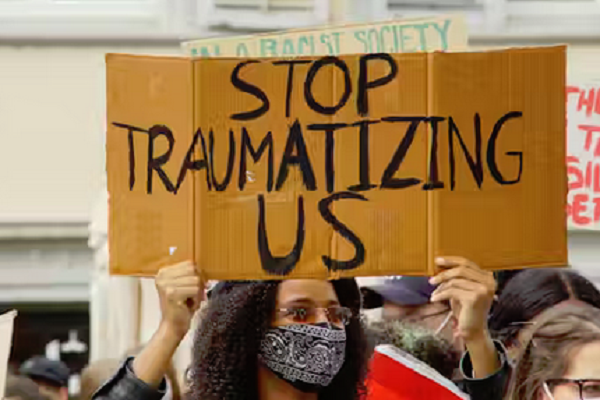
This installment of “Social Qs” depressed me even more than usual. Too many, far too many, black adults in our society grow up being inculcated with the presumption that all whites hate them and are racists at heart, and any episode that can possibly be attributed to racial bias, is. The process guarantees confirmation bias.
I don’t see how the U.S. can ever have healthy race relations as long as so many blacks see life in America that way. Among other things, blacks who think and act line Husband’s wife provoke legitimate bias against them, not because of their color, but because of their obvious bigotry. The wife sure seems to be a narcissistic, judgmental jerk….but then, the advice columnist keeps telling us, her skin color ensures that she knows best.
 Ethics Alarms
It wouldn’t surprise me. I had a secretary once who told me point blank that “y’all are all racists, just some of you cover it up better. One day you gonna slip, though, and I’ll be there to get you.” She thought she had me when I used the Britishism “brass monkey weather” for cold weather (which is a naval reference, not anything racist), and said she was going to have me fired, but when she looked it up, she found it wasn’t racist, so she had no basis. If that represents typical thinking for black women, then this is no surprise.
You must have been very careful not to let her overhear your sprinkler joke.
Hahaha – not dumb enough to tell THAT one in the office.
The Niggardly Principles in action!
Based on what I’ve seen all across the country since Israel didn’t applaud the Hamas atrocities, apologize, and give Israel to the Iranians, too many, far too many, white, college educated, young adults in our society grow up being inculcated with the presumption that all whites hate black people and members of any other oppressed, marginalized group, and are racists at heart, and any episode that can possibly be attributed to racial bias, is. The process guarantees confirmation bias.
We ahve reached the point in our societal norms to assert racisism is whatever you wanto to call it. I recall the “pornography debate” when Supreme Court Justice Potter Sewart said,
“I shall not today attempt further to define the kinds of material I understand to be embraced within that shorthand description [“hard-core pornography”], and perhaps I could never succeed in intelligibly doing so. But I know it when I see it, and the motion picture involved in this case is not that.” (to avoid the charge of plagarism N.B. this quote was foun on Wikipedia.)
Just make a few edits and you have:
I shall not today attempt further to define the kinds of material I understand to be embraced within that shorthand description [raacism], and perhaps I could never succeed in intelligibly doing so. But I know it when I see it, and this wedding incident in this is not that.”
Alright, let’s break this down. Dealing with people acting unreasonable is what led me to learn deconstruction mindset. We can’t always take the easy way out by pretending people don’t exist. Sometimes we have to get constructive.
My values:
Others’ values:
Framing the situation constructively:
Terrific analysis, EC. Obvious COTD.
Is the writer Bill Burr? This seems like the kind of scenarios he continually has with his wife.
Except his are funny…
“At their wedding, group pictures of our extended family were taken before my wife and I realized it. When we asked the photographer why we had been overlooked, he only reiterated that pictures had already been taken.”
So the photographer asked everyone to gather around for the photos. But one couple didn’t line up for the photos straight away because for whatever reason they were late. Maybe she were gossiping, or powdering her nose or whatever. So when they arrive late for their photos to be taken, the photographer had reached his quota of photos that he had been contracted to shoot. So don’t be late then blame it on racism.
Maybe the photographer is the racist. I wonder if the wife considered that possibility before arbitrarily cutting off the family.
I typed that early this morning during a bout of insomnia. There were more thoughts ransacking my brain at 2am, but I can’t type on a phone.
The Good Book has a lot of practical things to say about love, and many of its attributes are encapsulated into one very concise section. One of the attributes is that love “believes the best.” This goes straight to Jack’s mention of “the benefit of the doubt.” There are times I am faced with discerning the intent behind the words/actions/inactions of someone else. It happens to you, too. I wrestle with two choices: 1) did that person do/say that thing with intentional malice, or 2) did that person do/say that thing not realizing how I would perceive it. The notion of “believing the best” means I assume Option 2…I simply assume it, because that option puts the offending party in the best possible light. I am able to continue in good relationship with that party with no worries on my part.
Now, imagine that a short time later, I uncover proof that the offending party acted in the realm of Option 1…intentional malice. In the subject example, I was intentionally overlooked for the photo shoot because my skin color is radically different from that of my spouse. That’s bad…and my feelings are hurt and I’m likely both frustrated at angry at the discovery. That’s where the next attribute of love comes in…it “hopes the best”. Like believing the best, I have a choice here as well. I can 1) hope the person pays dearly for their offense, beginning with the loss of my love and friendship and in the worst case, burning in Hell, or 2) I hope for a change of heart from the other person and a change of attitude. When “hoping the best” I again choose Option 2, because it’s best for the offending party. This is not a denial of the wrong done or how it affected me, but it is the realization that people can change, their attitudes can change, and that is my desired outcome (my hope) for the person that acted against me. It will probably require conversations with that person, but it can be done, not with the “anger of the offense” first and foremost in my mind (which tends to make those interactions fruitless), but with the desire that an attitude be changed and a heart be softened. I can still love that person despite the fracture because I am focusing more on the hope that change occurs and the relationship is fully restored.
“Hoping the best” is hard to do, because we are so prone to retaliation.
People smarter than I could add a lot of nuance to what I typed…and some could pretty easily ridicule it as the arcane ramblings of a mind long separated from the realities of modern conflict-resolution. But I also believe that the woman in the original post could probably have spared herself, her husband, and her extended family a lot of grief, bitterness, resentment, and hard feelings by believing the best and hoping the best in her situation.