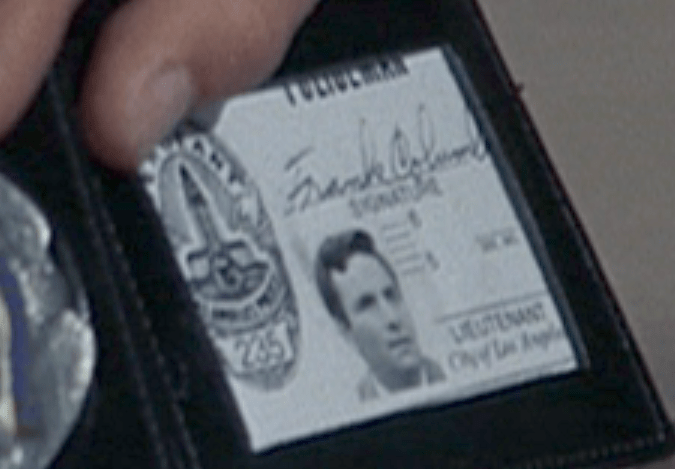
This goes into the Maslow’s Hammer file, as in “If the only tool you have is a hammer, every problem looks like a nail.”
I have been watching all the original “Columbo” episodes, first because they’re still worth watching, second because Grace and I used to watch them when picking something else was too much trouble and we couldn’t agree, third because Spuds likes Columbo’s dog (a Basset Hound), and fourth, because they usually distract me from stuff I don’t want to think about and leave me relaxed for a while, unlike, say, watching the Red Sox. As I finished the seven seasons, I wondered if I had ever heard Peter Falk’s character called anything but “Columbo” or “Lieutenant” on the show. My research revealed that I had not: the character’s creators Richard Levinson and William Link deliberately kept the eccentric sleuth’s first name a secret as one of the show’s quirks, and were adamant: nobody should ever speak his first name.
This raises the question of whether a character who only exists in television episodes where his first name is never mentioned has a first name, but that’s not an ethical question. However, the saga of Columbo’s first name did tick a few ethics boxes.
For example, above you see a blow-up of the badge Columbo presented in the very first episode of the series, “Dead Weight.” A police detective needs an ID, and an enterprising props professional would take pride in making one that was accurate to the last detail, which meant that it had to list the owner’s first name. As you can see, the name used was “Frank.”
Can we call that incompetence, or worse, insubordination? Apparently the decision to keep Columbo’s name out of the series was decided in producing that first episode: a first name was deleted from the script by Levinson and Link. Did anyone tell the props designer about their edict? That ID might have been made from the script before Columbo was de-named. In that case, the props designer is blameless, and everyone else failed their obligations, including Peter Falk, who should have been the guardian of his namelessness if anyone was. Or as an actor, did he have to believe he had a name, and use it to develop his character?
There is also an example here of a failure to anticipate technology. The writing on Columbo’s identification isn’t visible until you stop the video and zoom in on it, something no TV viewer could do in 1971. Should someone have anticipated it? Ironically, that’s exactly the kind of technological mistake that traps several of the murderers in the series.
However, my favorite episode in this teeny-weeny ethics train wreck occurred because Fred L. Worth, who wrote trivia encyclopedias, used to include fake trivia to trap unauthorized users of the information in his books. His plan was to then sue those trivia thieves for copyright infringement once his made-up facts were used by another author. The plan was unethical and his legal theory was ridiculous: you can’t copyright facts. Moreover, placing false facts in a reference book is obviously wrongful: its a breach of trust and dishonest.
In 1984, Worth thought one of his traps had snapped shut: a new edition of Trivial Pursuit included a question about Columbo’s first name, and gave the answer as “Phillip.” That was one of Worth’s fake answers, so he sued the game company for “stealing” his trivia. He demanded damages of 300 million dollars. Only an incompetent and unethical lawyer would take such a case: it was promptly thrown out of court.
Phillip, I must say, is a terrible first name for Columbo.
There is one more bit of evidence in this mystery. The author of the Columbophile blog, David Koenig, found another visual reference, “Lieutenant Frank Columbo” written on a plastic evidence bag in “Grand Deceptions” from Columbo’s reboot season in 1989. He dismissed it as a deliberate “meta” inside joke for the “Columbo” fans like him who had been obsessing over the first name question. It also could have been another props goof that nobody picked up on, or it could mean that Columbo’s name really was Frank.
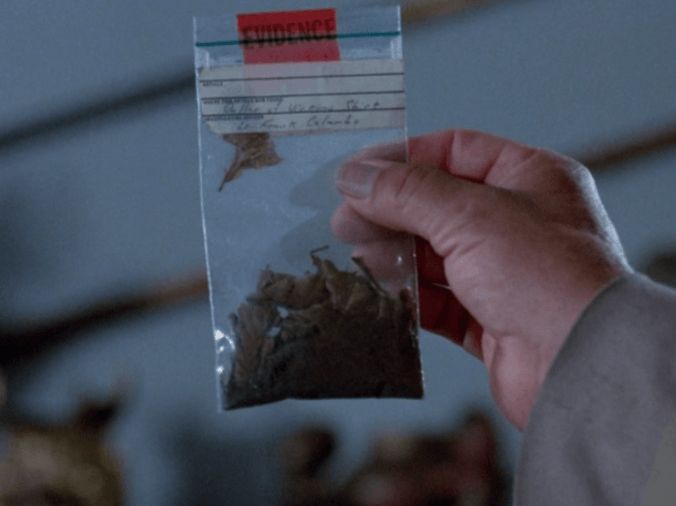
I discount that bag because the “Columbos” subsequent to the original series were inferior, and bringing back the character in diminished form was disrespectful to a classic, motivated by greed, and, yes, unethical.
 Ethics Alarms
The evidence bag is rather clearly an easter egg. As to the prop in the pilot, there are exactly three option:
My guess is a mix of one and three. The prop was created before the decision, yet actor playing Columbo showed the director/producer found it who then kept it. It would interesting to know if they kept the same badge, but carefully kept the name out of frame going forward.
I knew right away at the beginning of this post that Columbo’s first name was Frank, like my grandad, dad and brother. I’ve known that for a very long time and I can honestly say that I can hear in my head the character’s full name and title being stated at some point in the original show. Maybe they stripped the statement out later. I have no idea how I could have known that first name without it being stated in the show or promotional advertisements.
P.S. I was a big fan of that show.
Well, the blogger, who is beyond a “Columbo” fan and whose research seems impeccable,,swears that it was never mentioned in the show, ever, but the “Frank” theory has been circulating for decades.
My head hears ringing within the confines of its grey matter Lieutenant Frank Columbo every time any reference to Columbo comes up, the same can be said for Inspector Jacques Clouseau ringing out in my head instead of just Inspector Clouseau.
Again, maybe they stripped the full name statement out of the first episode after it aired or maybe I heard it in an advertisement really early in the series and it stuck. I have no other explanation for why it’s hard imprinted in my brain.
I agree with Steve. I’ve probably seen only five or six Columbo episodes but when I read the headline of this post, “Frank” popped right into my head, no questions asked.
I think Peter Falk carried that show single-handedly. “And one more thing…” was such a great shtick.
Peter Falk is perhaps one of Hamilton College’s most famous former students; more so than Ezra Pound perhaps. And he had a great (thoroughly Jewish, of course) sense of humor. From his wiki page:
Falk’s right eye was surgically removed when he was three because of a retinoblastoma. He wore an artificial eye for most of his life. The artificial eye was the cause of his trademark squint. Despite this limitation, as a boy he participated in team sports, mainly baseball and basketball. In a 1997 interview in Cigar Aficionado magazine with Arthur Marx, Falk said:
“And one more thing…” came from the play that launched the character (but never got to Broadway). The writers said they had already made the detective exit, and didn’t want to recraft his whole scene. So they had him pop back in saying “And one more thing!” It got a big laugh, and they kept the bit in the subsequent TV show and episodes. “It was just laziness on our part,” they said in an interview.
But a very effective interrogation technique, or so it seems.
I’ve watched all of them. Never heard his name. Like you, the trivia answer of “Frank” as seen on the ID is all we have, although I believe a cable tv station that used to show the program used the name “Frank Columbo” in its ads.
They don’t make them like that anymore.
But, of course, the so-called spin-off of “Mrs. Columbo” (changed to “Kate Columbo” and then “Kate Loves a Mystery”) was also inferior, particularly since they couldn’t decide if she was Columbo’s wife or not.
Also inferior was “Murder She Wrote,” created by “Columbo” alum and frequent writer Peter Fischer, and inspired by the “Mrs. Melville Mysteries” at the center of one of the best “Columbo” episodes, starring Jack Cassidy as a mystery writer who kills his partner. It was written by Stephen Bochco and directed by a pre-“Jaws” Stephen Spielberg. In a later season, after SS was a big star, the series saluted him by having a boy genius in an episode named “Steven Seelberg.”
I remember the Jack Cassidy episode. The bad writer who came up with one good idea and that was the one he used when he killed his partner.
Jack Cassidy could play smug well, couldn’t he?
He was a villain on Columbo three times, all terrific episodes: he also played a murderous magician and a diabolical killer who frames himself so Columbo can discover the ruse and cross him off the list of suspects.
Yes, the Nazi war criminal magician who killed Nehemiah Persoff to keep his identity a secret!
Terrible magician, too. The way he walked from table to table and performed his sleight of hand with people watching from the back and the sides. A real magician would never get away with it.
No wonder Nehemiah was suspicious of him.
My favorite, I think, is the Robert Culp episode in which Culp, an advertising whize, uses subliminal suggestion in a promotional film to make the victim go out to get a drink of water where he can be shot dead. He’s trapped when Columbo uses the same technique to make Culp, watching his own film, suddenly get worried that Columbo has found a key piece of incriminating evidence in his office. So he leaves mid-film and checks where he had hidden the evidence; Columbo is waiting with a photographer. “We spliced in frames of me looking around your office,” “Frank” explains. And realizing that he was trapped using his own technique, Culp breaks out laughing.
I loved that episode. They always thought they were so much smarter and he used that to his advantage.
And those photos of Columbo looking under the lamp…
I’d give the prop maker a pass, even if he knew of the original intent to keep the name hidden. His job is to make a convincing artifact; it’s up to the actors and scriptwriters, etc. as to how that item is used. If they wanted to ensure the name was not revealed, they should have shot the scene differently, made sure that part was covered by a thumb, or otherwise dealt with it. I suppose it’s even possible that the reveal was deliberate and meant to be a future easter egg or the one clue to that “mystery”.
The variation on this theme was the first name of Inspector Morse, revealed in (I believe) the penultimate book by Colin Dexter and in similarly late in the TV series with John Thaw. It was very much a tease in the series; I don’t recall it being as much so in the books, but I read those a long time ago. Morse’s first name, Endeavour, subsequently became the title of the prequel TV series with Shaun Evans. Let’s just say that I thought Dexter was a better writer than the folks at ITV.
For some inexplicable reason, I too, have Frank in the recesses of distant memory. On another note I have started watching the “Monk” series and “Twilgiht Zone.” I wish I could get episodes of the “Dupont Show of the Week” or the “Philco Televison Playhouse.” All produced great programming that affected the human spirit.
Which The Twilight Zone? Because there’s really only one, right?
the original series produced, direced and often written by Rod Sterling, of course
You’ve restored my faith in my fellow man.
Many of the Alfred Hitchcok Presents episodes are superb, my favorite being a particularly warped one starring Steve McQueen and Peter Lorre, with a great kicker. A guilty pleasure: TZ rip-off “One Step Beyond.”
Not sure you can call One Step Beyond a TZ rip-off considering it predated TZ by about 8 months. It’s obviously inferior to TZ, but it was first.
Really! I had no idea. It still had some very creepy episodes. especially since they were supposed to be true. And John Newland was avery creepy host.