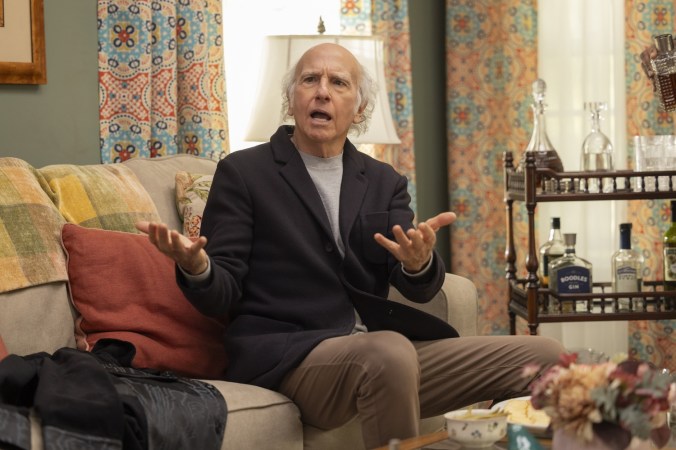
I must disclose as my initial bias in approaching this topic that I am not a fan of HBO’s “Curb Your Enthusiasm” (though I liked the use of the Gilbert and Sullivan “Three Little Maids from School” melody in its early seasons). Essentially the saga of an unrepentant wealthy asshole in Hollywood, which Larry David, the star and creator, actually seems to be and is apparently proud of it, the show is repetitious and shrill, made more so by David’s irritating voice and narrow range. Never mind: lots of people seem to think it’s hilarious, so I must rate the thing good because “it works.” Fine.
Now (FINALLY!) “Curb” is over, and it had to have an “eagerly awaited” final episode that wraps everything up. Ever since “The Fugitive” set Nielson ratings records by closing the series with David Janssen finally finding the elusive one-armed man and proving his innocence, popular TV series have striven for a boffo send-off, usually failing. “MASH” and “The Mary Tyler Moore Show” pulled it off; “Cheers” not so much. “Friends” finale was just okay. “St. Elsewhere” and “The Sopranos” last episodes are playing in a loop in Hell. ” Newhart’s” last episode, in contrast, was probably the pinnacle of the genre (“You should wear more sweaters.”)
One of the biggest letdowns was the final episode of “Seinfeld,” written by Larry David, who was the template for George Constanza, the worst sociopath in the group of four toxic (but funny!) narcissists who drove the “show about nothing.” It just wasn’t funny: the concept, which seemed to be to be one of those “Wouldn’t it be great if…” ideas someone raises in jest and it ends up being taken seriously, was that all the many victims of Jerry, George, Elaine and Kramer through the years testify against them in a criminal trial. Virtually everyone hated the episode; in fact, it’s infamous. Larry David, being the jerk he is, has insisted that his script was hilarious, and that he’s proud of it.
The rumors were true: “Curb Your Enthusiasm” ended exactly the same way on April 7, with a few wrinkles of course. For several episodes, Larry’s arrest for violating Georgia’s supposedly racist election law (David just had to signal his woke sympathies in the final season) by giving a voter a glass of water has been driving episode plots, so he finally faced trial in the grand finale, yada yada yada.
What’s going on here? There are several possible interpretations and ethical implications:
1. Larry, the real Larry, is saying “”Bite me!” to the critics who scorched the same formula in “Seinfeld.” There is some integrity and courage in this. It also would astoundingly arrogant, like Spielberg making a sequel to “1941.”
2. David is trying to make amends, convinced that his original idea was valid but that he botched it first time around and was determined to make things right. That would be admirable, if risky.
3. David doesn’t care what the audience thinks or likes. He thought the “Seinfeld” episode was hilarious, and that’s all that matters. That attitude isn’t as unethical as it sounds: I have saluted artists who insisted on creating what their muses dictated and not what the public and critics demanded, which is typically unimaginative and risk-free. Edward Albee comes to mind. The Beatles.
4. The repeat of the “Seinfeld” ending is brilliant meta self-mockery. Larry in the series is an asshole, the real Larry is also an asshole who enjoys portraying an even more horrible version of himself in the show. Repeating the maligned “Seinfeld” ending is a thumb in the metaphorical eyes of the audience that has made him rich and famous, which is exactly the kind of obnoxious thing the series’ Larry David would do.
And, of course, this time the ending may have worked (so thinks Variety), but that wouldn’t necessarily justify the decision to do it. That’s consequentialism.
You’ll have to tell me how it went. I wasn’t watching: sock drawer, you know.
 Ethics Alarms
Cannot help. My enthusiasm was alway curbed regarding the show because the real life asshole personality of Larry has always been irksome to me. Glad to hear it is ending, unfortunatley he will continue to make millions in residuals as a reward for being a jerk.
BTW-Seinfeld, Friends, MASH were also always annoying because of the in bred narcissim of its main characters and the reallife actors who played them.
I always looked at Seinfeld as a show celebrating what jerks New Yorkers are. The characters just seemed to be the embodiment of New York culture and values. I just assumed that New Yorkers and people who aspire to be part of that ‘cultured’ group watched the show and laughed because that is how THEY act and how they can abuse people left and right with impunity. That is why I don’t understand why everyone is so upset about how Donald Trump acts. He is just a New Yorker. He fits in perfectly as a Seinfeld character.
I’ve successfully avoided Larry David like The Plague. “Curb Your Enthusiasm” has always struck me as a cult phenomenon enthusiastically peopled by authentic hipsters. I’ve never seen the show and know next to nothing about it. There must be a Yiddish term for Larry David’s shtick. I had a Jewish tax partner friend who once referred to another lawyer as “a shit stirrer.” I’ve always assumed “shit stirrer” is translated from the Yiddish. Come to think of it, “shit stirrer” may describe Larry David and his appeal to the faithful, the core of which, I assume, is Jewish. I suppose the polite way of saying it, would be to call “Curb Your Enthusiasm,” “Seinfeld” et al. “an acquired taste.”
One Yiddish term for Larry’s character is “putz.” In the show, Jerry was the only explicitly Jewish member of the cast (“You made out during “Schindler’s List”????) but it was always recognized as a satire of NYC Jewish foibles. It was much, much MUCH funnier than CYE: I had a theory, which Grace, an Anglophile endorsed, that the show was a rip-off of PG Wodehouse, whose novels were also about “nothing”—except there was no “Jeeves,” a smart, focused fixer for the messes these idiots were getting into.
Of course, putz = dick.
Mrs. OB insists on saying someone is “putzing around” when I think she means to say, “puttering around.” I really don’t think she means to say, “dicking around.” But you never know. In any event, needless to say, she’s not big on corrections from the peanut gallery.
Wodehouse and Seinfeld would have never occurred to me. Despite all the buffoonery in Wodehouse, there’s a great deal of humanity and genuine comedic insight, bordering on compassion. He’s actually not a second-rate Waugh, he’s better. And perhaps better than Kingsley Amis in his “Lucky Jim” days, although that’s a great book. There’s no “Seinfeld” snark in Wodehouse. Plus, the narrative voice and word play in Wodehouse is so brilliant, there are at least three guffaws in every paragraph.
P.S. The George Costanza character is the one redeeming, completely believable, well-done element of “Seinfeld.”
And I don’t think Wodehouse is about nothing. It’s comedy of manners. He descends from Austen to George Meredith and parallels Waugh, down even to “Downton Abbey.” Marriages among the British upper class negotiated at and around their country houses or their town houses. So there is that in Seinfeld. It’s NYC comedy of manners. I’ll give Grace that, on further thought.
Remember the club Bertie Wooster belongs to in London? The Drones Club. I think drones pretty well describes the guys in Seinfeld.
And I would also say “Friends” is simply the gentile version of “Seinfeld.”
In the sense of narcissistic arrested adolescents, definitely.
Well, Seinfeld wasn’t literally about nothing either. But when an entire novel centers on the fate of a missing cow creamer, arguably the greatest of all Bertie Wooster books, I think “nothing” is close enough. As Wodehouse himself confessed, the world of Bertie Wooster never existed—it’s a fanciful as Oz.
Collectors are a breed apart. Anything’s possible.
Not sure the world of Noel Coward ever existed either, but I’m not sure it a requirement of good fiction.
“Putzing around” is an expression whose meaning is close to “puttering around,” but with an aimlessness. You might tell someone, “Stop putzing around; get in the shower; we need to be at the restaurant by noon.”
I’m Jewish. I hated the show; precisely because David is the embodiment of the stereotypically obnoxious, whiny, New York Jew. And it’s not funny.
COTD
And hilarious. Thank you Alicia.
to help raise the bar Fawlty Towers
I had a hard time with “Towers” because John Cleese wasn’t doing Monty Python scripts and he just didn’t seem sufficiently funny. He was very good and well-cast in “A Fish Called Wanda.” The woman who played his wife stole the show but never got credit for doing so.