Thinking about that last post and the issues it raises as I was walking Spuds in the rain just now took me to an epiphany, and an embarrassingly late one.
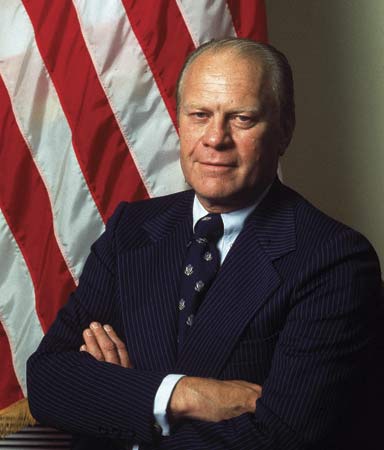
Gerald Ford’s pardon of Richard Nixon was more important and crucial than I realized then. It was only one gutsy and maybe prescient act in an otherwise short and undistinguished Presidency, but it delayed the current crisis for half a century.
The conventional wisdom is that Nixon would have been prosecuted for his Watergate involvement, and that the event would have been a divisive and traumatic spectacle that a nation just getting past the Vietnam debacle could ill afford. That wasn’t what was going to happen, though, I now realize. (And I have never read or heard anyone acknowledge this.)
Had he been charged with any crime, Nixon would have immediately claimed immunity just as Trump is now. For the rest of his life, Nixon routinely said that “if the President does it, it’s not illegal.” What would the Supreme Court have ruled in 1975? Here is the Court then:
Chief Justice Warren Burger
William J. Brennan
Potter Stewart
Byron White
Thurgood Marshall
Harry Blackmun
Lewis F. Powell
William H. Rehnquist
The only two reliable liberals on the Court were Marshall and Brennan, but the conservatives were more moderate and less doctrinaire than today’s SCOTUS majority. I have no idea what that group would have done with the immunity issue, and I’m glad we didn’t have to find out.
Thanks, Jerry.
 Ethics Alarms
I have no idea what that group would have done with the immunity issue, and I’m glad we didn’t have to find out.
We have the example of Nixon v. Fitzgerald, 457 U.S. 731 (1982). “In view of the special nature of the President’s constitutional office and functions, we think it appropriate to recognize absolute Presidential immunity from damages liability for acts within the “outer perimeter” of his official responsibility.” Nixon, 457 U.S. at 756.
Of course, it is not necessary for the Supreme Court to rule on absolute immunity. A way out of this zugzwang is to rule that qualified immunity holds, per Harlow v. Fitzgerald, 457 U.S. 800 (1982) We therefore hold that government officials performing discretionary functions, generally are shielded from liability for civil damages insofar as their conduct does not violate clearly established statutory or constitutional rights of which a reasonable person would have known. Harlow, 457 U.S. at 818. The rationale for the Harlow standard was that “If the law at that time was not clearly established, an official could not reasonably be expected to anticipate subsequent legal developments, nor could he fairly be said to “know” that the law forbade conduct not previously identified as unlawful.” id (emphasis added)
If anything, the Harlow rationale applies with even greater force with respect to all criminal prosecutions.
The only two reliable liberals on the Court were Marshall and Brennan, but the conservatives were more moderate and less doctrinaire than today’s SCOTUS majority.
So “less concerned with what the Constitution has to say”?