Res ipsa loquitur. There is no excuse for this. Of course some of the names would give anyone trouble. But Thomas (at Thomas Jefferson University)? Elizabeth?
This was so bad the school issued an apology, though its explanation doesn’t pass the giggle test:
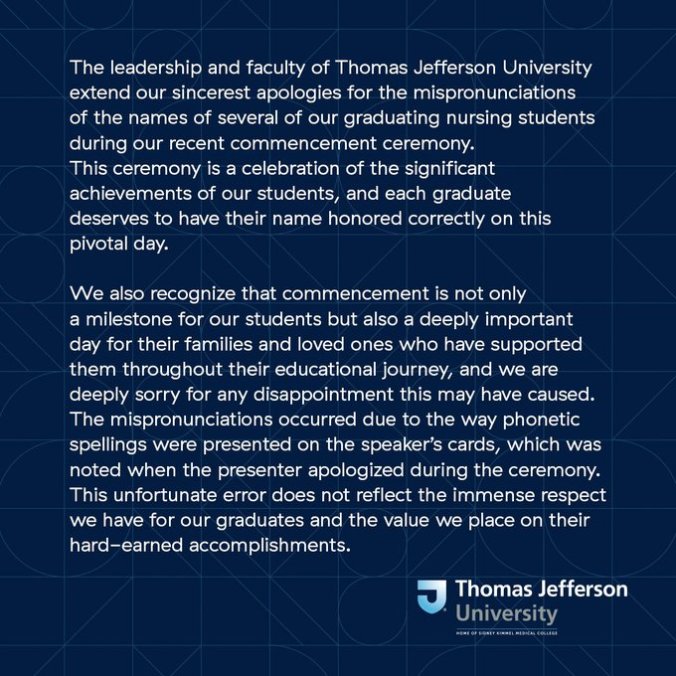
At a certain point, the DEI farce will reach an inevitable tipping point. Too many people are lazy, dumb, timid and gullible, but not enough are THAT lazy, dumb, timid and gullible to put up with clownish displays like the one Thomas Jefferson University inflicted on its nursing school graduates.
 Ethics Alarms
They actually did the Key and Peele bit
“Ya done messed up, A-Aron!”
jvb
These bad pronunciations are like my navsat device in my car which must have been programmed by an alien from Mars. Some of the towns and roads it says take me a while to figure out where I am going.
What is going on???
I wouldnt let her annouce a kindergarten graduation?
Higher education is now a misnomer.
“Higher education is now a misnomer.“
PWS
I don’t see how this is necessarily DEI related, although perhaps it is. It’s certainly bad preparation. The announcer has only one job: pronounce the names correctly. There are different ways of making sure this happens, but they all involve checking before you “go live.” This is the responsibility of both the announcer and the registrar.
I’ve had students with seven-syllable surnames. I once had a class in which three women’s first names were spelled the same but all pronounced differently. There are names that may have been Anglicized in pronunciation… or not… or sort of. I’ve had students whose names included diacritical marks that the average person wouldn’t see very often (anyone want to take a shot at “Sumarliði” or “Głowacki”?). No one is going to get them all correct on the first try, even with a cheat sheet. So it shouldn’t be the first try. Or even the second or third, if that’s what it takes.
I once had a student named Jonathan, pronounced Joe-Nathan. You’re not allowed to make a mistake even on that one at a graduation ceremony. Some of the commenters on the original post seem to think the name butchery was deliberate. I suspect a less nefarious cause. Either way, though, this is an embarrassment to the university. Heads should roll.
Well, I concede that the DEI label may be premature, except that at this point it seems like an Occam’s Razor conclusion. How hard could it be at an American university to find someone who can read off names like “Elizabeth” and “Thomas”? If the individual wasn’t chosen explicitly to add the flavor of a non-native English speaker’s inclusion in the ceremony, then why? Maybe this kind of fiasco has occurred before the landscape was teeming with debacles like a White House Press secretary who appears to possess no talent or skill for her job whatsoever except her “historic” genetic traits, but I’ve never heard of such a thing.
The only possible explanation that would make sense is if the announcer’s cards contained ONLY the phonetic pronunciations and not the graduates’ super-common-and-identifiable-and-easy-to-pronounce names.
If so, the announcer was, more or less, playing a high stakes version of the Mattel board game Mad Gab.
The ‘explanation’ is a transparent lie. There is no world in which the phonetic spelling of those names matches her pronunciation. Thomas is quite simply [TOM] + [UHS]; she made it a three-syllable word.
I agree.
I think the students may have done this purposefully.
I am familiar with the official policy of the registrar of a small private university for which I was conducting business analysis for some software deployment and integration.
It was explained to me that when the graduation applications are submitted by students, the students write the “graduation name” and phonetic pronunciation desired. A student could put down Honey Pot Boo Bear if desired and that would be the name read out loud in public.
Is it possible the students pranked the school?
“Is it possible the students pranked the school?”
PWS
The reason I believe this is not the case is because Elizabeth was mispronounced the same way several times. I find it highly unlikely that three people with Elizabeth as a middle name got together and planned this. If it was a first name, perhaps. How many of us know our classmates middle names?
I thought there was no way a sane and intelligent person could read them like that, but then I looked up phonetic spelling of names (which is what the school claims she was using). Maeve is shown as “may-v” which is exactly what she said. Sarah is shown as “sair-uh”, again something that could reasonably be read the way she read it.
It was stupid to rely on phonetic guides for common names, especially when she doesn’t know how to read them correctly. She should have reviewed the names in advance and made pronunciation notes for the ones she wasn’t familiar with.
Normally, at graduation, the key is to get a professor who has had all these students in class. It is better if they have had the students in multiple classes. THAT is how you get the pronunciations mostly right. You still have people from the ‘unique pronunciation club’ that you might never have gotten right, but they will be mostly right. When you insist Lara is pronounced ‘Laura’ and Laura is pronounced ‘Lara’ in the same class, there are bound to be problems.
SNL, when it was funny
https://youtu.be/n_NTHi24A3w?t=48
They must have hired Karine Jean-Pierre!
I watched part of the video. That was pathetic.
The school’s explanation could have been valid for a single mispronunciation based on a scrambled phonetic spelling. However, every single name was butchered beyond recognition.
I am reminded of a geometry instructor in Jonesboro Arkansas while in Junior High School who pronounced my last name as “Whoremaker”.
Junior high is bad; in high school that would make for a nickname that sticks forever; in the military, you wouldn’t have needed to earn a callsign.
Recently visited the Naval Aviation Museum in Pensacola. The callsign on the second seat of one fighter on display is “Timmeh”. That that got through made me wonder if maybe his commander had never seen episodes of South Park.
SIRI would have done a better job.
I would be hesitent to be under the care of these new nurses if their instructors could not do better. They will have to read and pronounce some big words in thier careers.
Phonetics is an elementry school level approach to learning to read. It should not be the methodolgy of a professional at a elite university whose tution is $38 000.