Why would TIME magazine print such self-evident junk? Oh, I know, I know…it’s about dogs and cats, so it is guaranteed clickbait, she’s written a book, so she must be an “expert” and if you can’t believe an ethicist, who can you believe? “The Case Against Pets” is intellectually dishonest, silly, and violates the Ethics Alarms principle that advocating an impossible course of action is unethical no matter how wonderful it would be if it could happen. (My favorite: pacifism.)
The author is Jessica Pierce, a bioethicist and the author of several books, including the one this thing is obviously meant to hype, “A Dog’s World: Imagining the Lives of Dogs in a World without Humans.” Boy, talk about a title signaling a dumb book! Next up: “Imagining the Lives of Dogs If They Could Graduate From Law School.”
Has this woman actually ever owned a dog? She says she has pets: I’m betting that it’s a hissing cockroach. Here are some of her assertions:
-
“The truth is that pet keeping often causes significant harm to animals. And as an ethicist, I am deeply alarmed about the continued growth in pet keeping around the world.” The exact same statement can be made about having children. Yes, there are irresponsible people who abuse or neglect their animals. There are far more people who are caring and kind to their pets. (And there are wackos who treat their pets like human babies.) Increasing numbers of people with pets means increasing numbers in all three groups. The argument that the unethical members in a category justifies eliminating the category is illogical, foolish, and unethical.
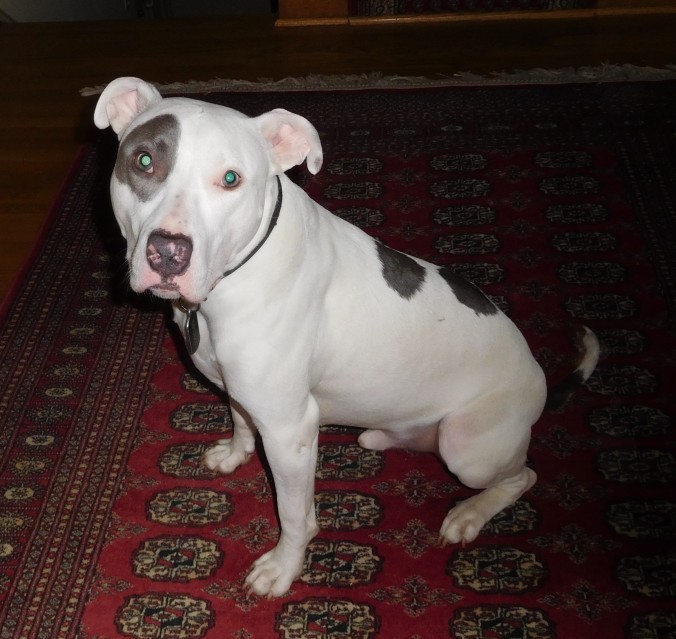
- “In buying and selling animals, and in using them for our own gratification—whether to provide amusement or emotional fulfillment, or to make a profit—we are treating them as objects, not subjects; as commodities and not as living beings with inherent value. When an animal is a product, it becomes difficult for us to appreciate the experiential world of the animal from their own perspective. We think about how our pets make us feel, not how our keeping them as pets makes them feel.” Oh great, the slavery analogy! Grace and I had to pay various parties thousands of dollars to adopt an orphan stuck in a run-down orphanage in Samara, Russia. Were we treating that infant as a commodity? We reimbursed the wonderful woman who saved Spuds’ life (that’s him above) for his medical bills, and gave him a loving home for the first time in his life. Was he a “commodity?” Bite me, Jessica.
-
“A robust scientific literature leaves no doubt about the anguish pets experience. Physical confinement, social isolation, and chronic exposure to stress—the hallmarks of captivity—can lead to measurable physiological damage, including loss of neural plasticity and a long-term activation of the fight-or-flight response, which can affect immune function, increase the risk of chronic disease, and shorten lifespans. The psychological anguish of captivity manifests in certain harmful behaviors called stereotypies, like a ferret pacing back and forth in her cage, a parrot plucking out all her feathers, or a dog “air-snapping” or obsessively chasing his tail.” Great: this expert recognizes no difference between gerbils and dogs. Animals experience stress just as everyone experiences stress. Good pet owners, and there are millions of them with healthy, happy dogs and cats, try to minimize the stress their animals suffer. Our 160 lb. English Mastiff, Patience, got upset if Grace and I had an argument and would hide in a corner in the bathroom. We had to go up to see her, holding hands, and reassure her that it wasn’t her fault and that we were fine and loved each other. Yeah, the Bidens’ dogs were under constant, excessive stress and the First Couple were lousy dog owners. Go nag them. Most pets don’t live in the White House.
- “At a systemic level, the industry accepts significant animal suffering and mortality as part of its business model. One 2014 investigation of a major exotic pet wholesaler in Texas found that 80% of some 26,400 animals representing 171 species were “grossly sick, injured, or dead.” Ethically, consuming pets is not so different from consuming meat: you have taken the life of an individual animal, and you have chosen to participate in an industry that imposes suffering on living beings.” Oh! Dogs and cats are snakes and lizards now! This is unethical, incompetent argumentation. The treatment of undomesticated creatures as household pets is indeed unethical and cruel. This “expert” didn’t have the guts to write specifically about that issue, because most people are much more interested in dogs and cats.
-
“..there are the climate impacts of pet keeping. A 2017 study, for example, estimated that the meat-heavy diet of dogs and cats in the U.S. is roughly equivalent, in terms of carbon emissions, to nearly 14 millions cars on the road. Like industrialized animal agriculture, industrialized pet keeping occurs at a scale that is ecologically unsustainable.” The woke ethicist hates capitalism and, predictably, is a happy passenger on the Climate Change Hysteria Ethics Train Wreck. Gee, what a surprise.
The article has many more howlers like the ones above: it has to be read to be sufficiently mocked. And what is her utopian solution to this “problem”? Hold on to your heads:
Is it possible to form companionable relationships with animals without causing them or the planet harm? Certainly. But it would look very different from our current practices. Human-animal ties would be mutual and freely chosen—friendships, not ownership. Captivity would no longer be the central mechanism holding animals within a human’s orbit…. But we need to consider the possibility that loving animals points us away from pet-keeping and toward different kinds of friendships with animals. Ones that don’t treat animals as commodities, don’t involve captivity, and don’t cause suffering.
I’m surprised that she didn’t propose giving dogs, cats and ferrets the right to vote.
_________________
[I really wanted to use Sidney Wang from “Murder by Death” to introduce this post (“Only one thing wrong with your theory…Is stupid!”) but I know I’ve been overworking the Ethics Alarms clip archive lately, and Spuds asked to weigh in.]
 Ethics Alarms
I just turned my 20 pound happy at home cat FREE, I put him out in the street to be himself and be the best that he will be, living in the wild, hunting his own food, being soooo happy! I feel so liberated, so woke, so wonderful, so kind!
Hooray! I’m sure he’s grateful, or will be for the brief period he’s still alive….
I wonder if she would prefer that dogs and cats roam wild, fighting over limited resources, many of them starving to death when the populations are too large for the natural resources to care for them, or dying from diseases that could have been noticed and treated before they became terminal? I wonder if she expects that humans would leave food out for all those dogs and cats, and let whoever makes it to the feeding trough win, leaving the weak, the runts, and the loners unable to share in the plenty?
I wonder what the life expectancy of cats and dogs are in the wild, compared to in a human household? The best I know is that indoor cats live much, much longer than either outdoor or indoor/outdoor cats. I also have it from some old books on owning rodents for pets that those rodents live far longer as pets than in the wild.
I wonder what the life expectancy of cats and dogs are in the wild, compared to in a human household?
Much, much, MUCH less. Of course. No medical care, danger from predators. But on the plus side, they aren’t “commodities!”
I have been helping to care for a cat colony for over three years. I cannot call them feral as they are quite accustomed to human interactions. Had it not been for humans caring for them – feeding them on a routine basis, getting them shots, spayed and other vet care these cats would have become vectors of disease and created problems for the general welfare of other animals in the area.
What the writer is suggesting is what causes these animals to be dumped off in the woods and left to their own ability to survive. I believe I have read the average lifespan for an abandoned cat is about three years in an urban environment and about seven in more rural settings. My cats average 18 years with two living into there twenties. The world is not a warm and fuzzy place for abandoned animals.
I suspect she’d endorse a PETA-style mass euthanasia of domesticated pets, then experience the thrill of watching racoons eat trash from afar as our new relationship with wildlife.
I suspect she would support a PETA-style mass euthanasia of the human race. That would solve the over-population and climate change crises in one fell swoop.
jvb
This strikes me as a “if we reduce the number of pets, stop eating meat (thereby reducing the number of domesticated animals), we can stop climate change” article. Although it, supposedly, focuses on the welfare of animals, it is really a call to reduce them and all of the nasty gases they produce, the need to process foods specifically for them, etc.
I am quite sure that my pitbull Cruz would be pissed if I forced him off of the couch and out into nature to fend for himself. He would probably be confused and depressed also.
What was part of the diet of wild dogs before domestication? people. We all know the dingo ate me baby.
I find the publication of obviously stupid analysis wasteful of resources and thus unethical.
We own a dog and a cat. As to the evils of the “meat-heavy diet” of dogs and cats, although dogs are omnivores and could theoretically live on a vegetarian diet (although it would be more difficult to make it nutritionally balanced), cats are carnivores, and absolutely require a “meat-heavy diet” to live. The difference in dry dog food vs. dry cat food is often demonstrated in our household when the dog gets into the cat’s food dish and has loose stools afterwards, because the “meat-heavy” content of the cat kibble is too rich for the dog’s digestion.
Domestication of dogs over the past 10-20 thousand years has given them multiple genes for digesting grain, based on dogs evolving to adapt to table scraps. Wolves, for comparison, have only one (or just a few) genes for grains. Domestication allows dogs to eat more human food, compared to their wild cousins.
Cats, despite a similar domestication timeframe, mostly ate rodents and birds until recently. They have only one gene for digesting grain, shared with modern wildcats.
I taste a strong flavor of the “Nature is Utopia, until humans come to spoil it all” persuasion. If people weren’t around, dogs and cats could just live together in peace, right? Cats could be vegetarians, birds would fly free, and dogs could cuddle together in caves like they were intended to!
I’ve come to accept it as an early warning sign that someone has little to no contact with reality, and their opinions should be humored, not listened to.
Ms. Pierce’s writing seems to closely mimic what many animal activists desire: don’t just end all animal husbandry, but end all pet ownership as well.
Her article is indeed coming from the view of an animal rights activist/environmentalist. Many dog trainers, in particular, positive reinforcement trainers, are very aware of the issues regarding captivity & its effects on behavior & happiness for the dog. Sadly, it sounds like this author couldn’t bother talking to any ethical trainers.
Remy does NOT approve of this author’s thesis. No, he does not.
jvb
Awesome. Has Remi been exposed to too many re-elect Joe Biden television commercials? It’s certainly how I look after they pop up during a soccer match.
Human-animal ties would be mutual and freely chosen—friendships, not ownership.
She sounds like one of those morons who would leave food out for coyotes or try to pet a bison. Aside from say, setting up bird feeders, you don’t WANT to befriend wildlife. You want to keep a respectful distance for your own safety and the animal’s.
Why are these people so intent on ruining everything that’s enjoyable? They must be clinically depressed, and there seems to be a bull market for what they’re peddling. Why don’t we see any more of the comics we used to see fairly regularly mocking in one way ro another an ill-kempt guy walking down the street sporting a “The End is Near!” sandwich board? Now, those people are dominating the opinion pages.