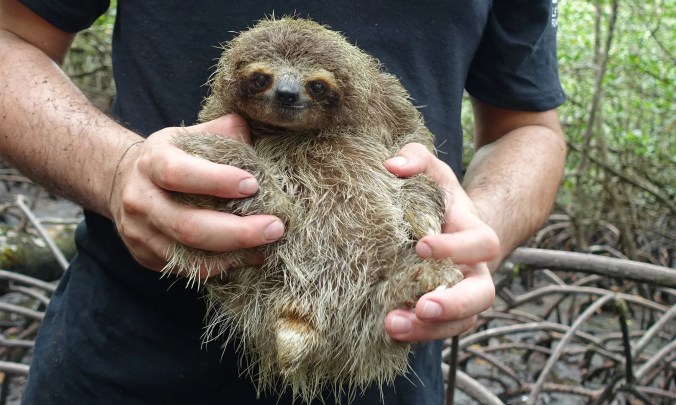
Apparently touching, holding and cuddling sloths has become a thing, along with, of course, posing with them for selfies, the refuge of the incurably narcissistic. The New York Times has a long, exhaustive feature on the problem, which is a problem because such close contact with the cute beasts is not healthy for the sloths and occasionally dangerous for the sloth-cuddler. From the article:
But lately sloths have been proliferating….far outside their arboreal habitats. They can be fed, cuddled and photographed at animal parks and pet shops, often despite unclear provenance and lax adherence to safety and health rules….star attractions in the growing range of venues where interactions with animals — the more exotic and up-close the better — underpin the business model. The number of those U.S.D.A.-licensed exhibitors almost doubled from 2019 to 2021, with over 1,000 sloths inspected annually in the last two years. According to federal data, the risk of animal deaths and disease outbreaks has increased. So have human injuries — and the concerns of experts and state agencies…
One company that has attracted outsize attention from regulators and animal advocates is SeaQuest, a national chain of interactive aquariums. It has seven locations, from Folsom, Calif., to Woodbridge, N.J., most of which exhibit sloths. And for an extra fee, visitors can handle flying squirrels, snorkel with stingrays or cavort with otters and wallabies. Whether the animals want that kind of communion is another question….Last year, the U.S.D.A. sought to strengthen regulations around the display and care of wild animals, and the Humane Society of the United States has advocated that encounters be curtailed altogether because they “subject wild animals to a lifetime of trauma, fear and chronic stress,” said Laura Hagen, its director of captive wildlife.
My recently departed wife Grace was an almost fanatic animal lover, and would launch into an angry rant when she read stories about idiots trying to pet bison, get close to bear cubs for photo ops or harass sea creatures stranded alive on beaches. I admit to being a sucker for cross-species videos showing polar bears frolicking with huskies and happy dogs letting ducklings crawl all over them. Those animals, however, have chosen to have that interaction. PETA members are nuts, but they are not always wrong. Human beings who feel it is their right to physically impose themselves on wild animals are abusing their power.
Grace’s obsession rubbed off on me over the years. As readers here probably have figured out, “Jurassic Park” is one of my favorite movies. (In the Ethics Alarms Hollywood Clip Archive, that film leads all others with three entries. It is an ethics movie, after all…), but one scene in the movie bothered me from the moment I saw the film the first time. It is the scene where Alan Grant, the paleontologist played by Sam Neill, encourages the two children he has rescued to reach out and pat a brachiosaurus. First of all, herbivore or not, that huge head could chomp on the children and cut them in half; it’s a ridiculously reckless thing to tell children to do. “Think of it as a big cow,” Dr. Grant says. Yeah, I wouldn’t recommend getting that close to a 60 foot long cow, either. Worse, who knows what human bacteria a dinosaur is susceptible to? This is a flaw in the whole movie, all six of them now, but the scientists in the films should know this.
“The desire for proximity — to touch, to feel the immediate presence of animals — is very old,” Nigel Rothfels, a historian who studies zoos, tells the Times. “Perhaps we are hard-wired for it.” Perhaps, but then we’re hard-wired to do a lot of foolish and unethical things. (I also dislike that scene because it’s one of the few in the film where the dinosaurs look fake.)
Keep off the grass, don’t feed the squirrels, and don’t pet the sloths.
Or, if the occasion should arise, the brachiosaurus.
 Ethics Alarms
“Keep your hands to yourself” was something we vehemently taught kindergarteners that as children aged, was already the foundation upon which larger ethical extrapolations could be built and learned.
Like “don’t mess with things unless there’s a compelling reason to do so”
Oops: we stopped teaching “keep your hands to yourself”
It’d be fun to do an article on “kid ethics basic manners and the things we’ve forgotten and why it matters now”
Excellent idea. Want to do it? If not, I’ll take a shot, but send me your notes…
Sure! I’ll spend some time brainstorming the basics.
“idiots trying to pet bison“
Is it unethical if someone derives a certain…um…satisfaction when these encounters don’t go as planned?
Asking for a friend…
PWS
Nelson has no comment.
I’ve patted a few unusual animals in my day, a manatee, a dolphin, a cockatoo, and I think a penguin once. However, for patting I think it’s better if we humans stick to the animals that seem to be meant to be our companions: dogs, cats, horses, farm animals, the occasional tame rabbit. It’s nice to make that physical connection with whatever or whoever you admire, but generally wild animals are called wild animals for a reason.
Everyone involved in the Jurassic Park scene had clearly never been around a cow with a calf. It is correct to say that a cow isn’t a predator, but it it is prey, and its offspring is prey for a much wider variety of species. Cows are NOT inherently docile. They’re only that way if they’re well trained. In their natural form, cows are very aggressive if they’re not able to flee.
The writers of that scene are cut from the same cloth as the morons who go to Yellowstone and attempt to pet the bison.
It is interesting that we have no problem with domesticated animals but draw the line on “wild” animals. Camels, water buffalo and Asian elephants are wild animals but have been domesticated for economic purposes in other areas of the world. Our dogs and cats were wild animals at one point in human evolution. There are very good reasons not to try to interact with non-domesticated animals just as there are good reasons to be cautious of domestic animals that are unfamiliar with you as well. I would suggest that ethical treatment of animals must be based on the fundamental respect of the golden rule. Allowing an animal to interact with a human is ethical while forcing to interact with a human is unethical.