Atheists and agnostics in the public sphere don’t have to be obnoxious, but an awful lot of them are. Their explanation for where the universe came from is no more persuasive that that of the faithful (The Big Bang? Come on.) but they just can’t restrain themselves. HBO’s Bill Maher is a prime example: along with mocking committed relationships (he hates the concept of marriage), extolling drugs and debauchery, and generally keeping his Axis of Unethical Conduct membership current, he ridicules Christianity at every opportunity.
The fact is, and it is a fact, that the United States of America had a much healthier and ethical culture before organized religion had discredited itself so thoroughly, driving whole generations away. Moral codes are especially essential for those who don’t have the time or ability to puzzle through ethics, and believing in God is the best catalyst for an ethical society that there is….and it has always been thus.
Heck, just look at what a jerk Maher is. That’s what atheism can do to you. But I digress.
My target here is more narrow. On last week’s “Real Time,” Maher sneered at the belief that God saved Donald Trump from being assassinated as stupid and “dangerous.” “People see signs because they want to see them. It’s why stalkers think Taylor Swift is blinking ‘marry me’ to them in Morse Code,” he explained. “It gets dangerous when the signs make someone think God is on their side,” Maher continued. “Republican Congressman Mike Collins said after the shooting, ‘God spared Ronald Reagan for a reason. God spared Donald Trump for a reason. God doesn’t miss.’ Really? Tell that to John Lennon, Lincoln, JFK, RFK, and Martin Luther King. Look, the asshole who shot at Trump was cowardly, unpatriotic, selfish, vile, and weak, and he should rot in hell, but thinking that God protects your heroes but not mine? That isn’t cool either.”
How do you know, Bill, that God doesn’t protect your heroes for a very good reason? I can think of several good reasons for that, as well as for squashing you like a bug. Of course the certitude that God is responsible for anything is confirmation bias: my wife, the daughter of a Methodist minister, frequently expressed contempt for the faithful who simultaneously said that “God works in mysterious ways” and “there are no coincidences” while conveniently asserting that they had figured out those mysterious ways. But if Bill knew as much about American history, leadership and the Presidency as he should, he would know that the belief that God has saved them for a reason motivated many of America’s greatest leaders. It could have been dangerous, I suppose, but so far, that belief had been overwhelmingly beneficial to our nation. Perhaps even its salvation.
Leadership requires special character traits, the right formative experiences and a lot of luck. National leadership arises out of an individual’s conviction that they are uniquely qualified to do a better job than anyone else, accompanied by the passion, conviction and charisma necessary to convince others of their abilities. That’s why so many of our Presidents have been narcissists, true, but the anti-American trope that our leaders only seek power, wealth and personal benefits is, based on my lifelong study of history, garbage.
Every President, the best and the worst of them, genuinely wanted to do the best job they could for their country and fellow Americans, and a remarkable number of them believed that God, or “Providence,” or the Fickle Finger of Fate had deliberately selected them for that purpose. This belief, in turn, motivated these men to endure levels of stress, conflict and hardship that most human beings can’t or won’t tolerate.
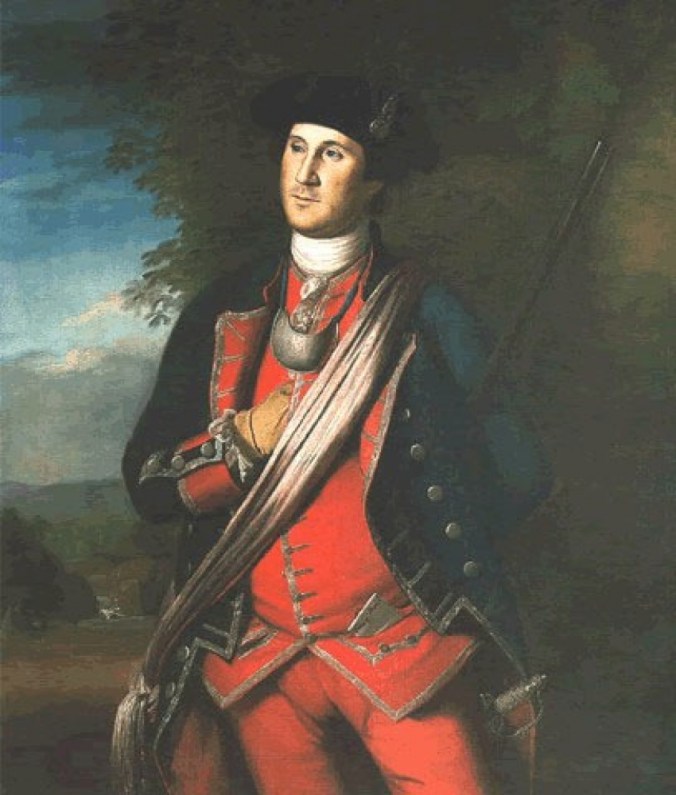
It doesn’t have to be an assassination attempt, but surviving a close brush with near certain death has convinced many of our Presidents at various stages of their lives that they were special and had an obligation to justify being plucked from the grasp of doom. The phenomenon has truly sculpted U.S. history, and overwhelmingly in a good way. One of the most famous and inexplicable examples was the President who created the template for all who followed him, George Washington.
Washington, 23, was a young Colonial officer in the French and Indian War. On July 9, 1755, he was part of a large British force that marched into an ambush with the French and Indians opening fire on them from both sides. Yes, just like in “The Last of the Mohicans.”
At the end of two horrible, bloody, hours, 714 of the 1300 British and American troops had been shot or killed, qualifying the battle as a massacre. Only one of 86 British and Colonial officers hadn’t been shot off his horse; almost all were dead or dying. The next day, Washington wrote to his family torelate a strange tale: after the battle was over, he found four bullet holes in the center of his jacket, but he had no wounds. Several horses had been shot out from under him too. George wrote, “By the all powerful dispensations of Providence, I have been protected beyond all human probability or expectation.” He was convinced that his life had been saved by God, and for a reason.
Fifteen years later, in 1770, Washington and a close personal friend, Dr. James Craik, returned to the Pennsylvania woods where the British army had been attacked. An old Indian chief made a point of tracking down Washington and insisted on speaking with him. The chief told George that he was the Native American leader in that battle, and that he had ordered his braves to kill all the officers, with Washington, as always the biggest and most physically impressive, a prime target.
The chief said that he personally had shot at Washington seventeen times. When Washington never fell, the chief said he became convinced that the Great Spirit was protecting this impressive young man. In his respect for a purpose he didn’t understand, the chief said he instructed his braves to aim their ginse elsewhere.
“I have traveled a long and weary path that I might see the young warrior of the great battle,” the chief told Washington. “I am come to pay homage to the man who is the particular favorite of Heaven, and who can never die in battle.”
Washington evidently believed him. During the Revolutionary War, George famously rode on his white horse in full uniform, wig and regalia, at the front of his troops, convinced that, first, his volunteer, untrained army wouldn’t fight if they didn’t see him defying the enemy, and second, that he wouldn’t be killed. Junior officers begged him to stop the practice, but Washington refused.
George frequently told associates and colleagues that he believed he had been chosen for some vital mission. It became pretty clear to him as time went on what that mission was.
Washington was the first, but he wasn’t alone. In my honors thesis on the American Presidential character, I wrote about the other Presidents who barely survived life-threatening ordeals and were changed by the experience. Among the most striking personal histories in this regard were those of Jackson, Polk (the most amazing), Lincoln, McKinley, Teddy Roosevelt, Franklin Roosevelt, Eisenhower and Kennedy—it’s a strong list. I have not investigated this feature of Presidential lives in the last 50 years, but that’s irrelevant: the point is that if Donald Trump decides that the bullet missed his brain by design rather than happenstance, his belief, based on our past, cannot be dismissed as “dangerous.” That kind of belief has served Americans well.
And who knows? Maybe he was saved to do great things.
I’ve seen Washington’s jacket, and so can you: it’s on exhibit in the Smithsonian. I am pretty sure there is a rational, non-mystical explanation for those bullet holes, but never mind: they helped make George Washington the transformational leader he was.
Thank God for that!
 Ethics Alarms
Washington did in fact lead from the front on several occasions, most notably at the Battle of Princeton, where he rode onto the field leaping over the body of the fallen General Hugh Mercer, rallying the colonials to fight on. It’s my understanding that he did not wear wigs, however. I remember reading somewhere that he powdered his hair and pulled it back in a ponytail as was common for wigs of the time, but did not actually wear a wig. Now, if you want to talk dentures…
All silliness aside, I don’t know if anyone has looked into the concept of presidential bravery and brushes with death, nor has anyone looked into the question of great leaders generally who had brushes with death. I know Mehmet Ali Agca tried to kill John Paul II, but failed. John Paul went on to become a transformational leader in the church and also a great moral force behind the victory in the cold war. Bush the elder survived when his plane was shot down when his two other crewmen did not, and he went on to do many great things. Churchill deliberately put himself in danger many times as a serving soldier of the empire, and somehow managed to avoid getting killed. Arguably he was one of the key men of the 20th century. We can also talk about Constantine’s vision and the Spanish Kings supposedly being told where to go by St James to catch the Moors unaware at Las Navas. Was the hand of God really involved in any of these things? I don’t know, and it’s probably not possible to know. That’s the thing with faith, if you have it no explanation is needed, if you don’t have it no explanation is possible.
Being completely truthful, I am not in love with the idea of atheism. However, I do not care if anyone else believes or does not believe, that’s his business. My problem is with people like Bill, or Madelyn O’Hair, or the jerks behind these groups that bring nonsensical suits like the ones regarding the Bladensburg cross. I wonder if these people are jerks who just happen to be atheists, or atheists who just happen to be jerks, or jerks who use atheism as a tool for jerkishness. It probably really doesn’t matter. Bill’s got his schtick and hatred of old fashioned values is part of it. Madelyn O’Hair i am convinced had a lot bigger problems than atheism, and that’s what got her murdered. I take no joy in her murder, but I don’t think the world lost anything by it either. I think after the chaos of 2020 we are done pulling down monuments for a while.
I think the worst thing for some of these people is if they get no attention. I am of the opinion that the best way to handle people like Bill Maher is just to ignore them. Beyond his core audience, really where is his appeal?
“Now, if you want to talk dentures…”
Washington(‘s) Bridge…
PWS
Honk! Honk! Wocka! Wocka! 🤣
Great thoughts, Jack, and one of the more balanced and thought-provoking treatises on this subject that I’ve read.
Though many of the Founders – and the subsequent Presidents – had widely-differing theological views, it’s say to say that a majority believed in a God or an Ultimate Judge, and many of those believed that He intervened in human affairs.
President Reagan believed God spared his life from Hinckley’s hand as well, and it had a profound effect on him. That’s the only actual assassination attempt on a President in my lifetime until a couple of weeks ago. If a person believes that God is sovereign over men and women, then Him controlling their lives and deaths is trivial. As a Christian, I believe God does have that power.
With regards to Bill Maher: for years, he has stated that God does not exist or that God is dead. Bill has written it. He has maintained that stance over and over again on his show, and in interviews…to anyone who will listen.
Someday, God will say that Bill Maher is dead…and He will only say it once.
Speaking of dead people, does anyone know if Joe Biden is alive? The Democrats are acting a lot like they are trying to cover up a death. Next, they are going to start using his credit card in Myrtle Beach and use his phone to send vague text messages to people to prove he is still with us.
Supposedly he will give a speech from the Oval Office tomorrow. The fact is that his legacy is shot and no speech or amount of ass-kissing from other democrats will rescue it now.
Jill will be Paris 2024 bound, not sitting him tomorrow.
jvb
I heard that many democrats were eager to abort Joe’s candidacy because it was approaching full term.
THAT’S gonna leave a mark!
PWS
And he wasn’t viable.
Of course, this phenomenon is relevant to the last fifty years of presidential history. Think of all the lamps and other various projectiles sent his way by his lovely wife that didn’t kill William Jefferson Clinton.
Mrs Clinton was famously pinned down by sniper fire herself! (Don’t forget, it’s Trump who constantly lies.)
Good article Jack.
You allude to a point a lot of my peers talk about. How does one define good/ethical when there is no standard for it? I think post-modernism is ruining the world, but why be good if there is no benefit?
Of course, I know its to the benefit of society, but it seems people just don’t care about that anymore.
Well, we do have “Be Kind” and “Imagine World Peace” bumper stickers!
Again, the question becomes why? Then again, why bother if, as some denominations teach, all are sinners and there is no reward for virtue? “For all have sinned and fallen short of the glory of God” is one of those passages I particularly dislike.
Why do you dislike the passage? It is an essential part of Christian theology that we are all sinners and Christ died to redeem us for our sins. Now, as repentant and redeemed sinners, it is our job to follow Christ’s example and do his will, not ours. If you are redeemed and repentant, you will do good, you will not lead an evil life. An evil life would be the sign of someone not redeemed or someone who has fallen away from God. Virtue doesn’t save you, but being unvirtuous is a sign of not being saved.
BTW, Being kind is not necessarily a virtue. World Peace is not necessarily a good thing if it is a pax of slavery.
Both bumper stickers are pablum. It’s what secularism has been reduced to. My favorite bumper sticker take on the latter one: “Imagine Whirled Peas.”
Because too often it’s used to shoot down achievements or tell you no matter what you do or how good it is, it’s still not good enough and you aren’t justified in being even a little proud of your own achievements. It’s just more of religion trying to control its adherents by making them feel like garbage and that only whatever the religious leaders say can lead them to a non-lousy eternity. It is an essential part of theology that we all have a part in the “original sin” where Eve was tricked by the serpent and ate of the forbidden fruit, then Adam did the same, and that can’t be washed away save by baptism. Once that’s done, presumably we are only sinners by what we do and say. Of course, as a Catholic, I was taught salvation comes through faith and works, not by faith alone, that’s a Protestant thing. Salvation isn’t supposed to be easy, but it’s also not supposed to be impossible. I dislike the idea that it’s somehow impossible and somehow, no matter what we do, we are all bad. Imperfect, sure, but not intrinsically bad.
Steve-O,
First, I’m sorry if your experience with religious figures has been one of putting down and trampling achievement. That is very unfortunate, and doesn’t do our Catholic faith justice. The very idea that we would ridicule achievement should be anathema, because at least Catholics do celebrate achievement in its veneration of the saints.
Second, the problem is that much of the world, and even I would guess most Christians, is that it views itself in competition with God. The Catholic viewpoint has always been a great “both/and”. Faith and works (though the Catholic Church does agree with “by faith alone” as formulated by the Lutherans, as they proclaimed in the joint declaration of faith with the World Lutheran Federation). Fully God and fully man. God and me.
We as creatures are incapable of creating ourselves. But God not only gives us freedom to discover ourselves in a myriad of ways, but he also invites us into his divine prerogatives. We build, learn, discover, invent, imagine. Most importantly, we participate in the creation of new life through begetting children (both physically begetting them, and begetting them spiritually) in such a way that we say that both God and we are fully did so.
Third, it is true that we cannot save ourselves. The wounding of original sin does not impute actual sin to us, but does mean we come into this world in a state deprived of original grace and confounded by concupiscence. And this is actually a great mercy. The sin of our ultimate ancestors is the sin of pride, of grasping for the divine prerogative apart from God. More specifically, to be God without God. And this is our great temptation, one way or another, every day: to be the one who arbitrates what is good and what is evil. If it were solely in our hands to save ourselves, where would we be? We would rise and fall individually, and that would be far more destructive to us as a populace, especially when we all settled into the inevitability of damnation because nothing we could do completely on our own could ever be a propitiation for even the slightest of our infractions.
Instead, we have the ability to work in God’s grace to such an extent that our good work is accredited to us as righteousness. Because of our ability to participate in Christ’s atonement, we also participate and effect (as a secondary cause, true, but truly a cause) salvation in others. Just think of Paul saying, “and in my flesh I fill up what is lacking in the atonements of Christ”. Think of Jesus saying, “Go out and make disciples of all nations, baptizing them in the name of the Father, and of the Son, and of the Holy Spirit.” Think of God telling Ezekiel that when he commands Ezekiel to warn a brother of his sins, if Ezekiel fails to warn, then Ezekiel is held culpable. And all this is possible because we were created in such a way that in one man all could sin, and in one man all could be made alive.
Finally, I personally always find Paul’s statement “all have sinned and fallen short of the glory of God” as one of hope. I’ve committed enough sins in my life to make me despair. I certainly know I’ve fallen short of the glory of God. To know that this is not just a remarkable failure on my part is something of a relief. Make no mistake: my sins are failures on my part. But know that I’m not alone, or some aberration, in this struggle leaves me hope.
Yes, I’ve seen those underwhelming slogans too. My friend Anna has “Kind people are my kind of people” on her hoodie, but as often as not she just comes off as naive. Let’s also not forget soft tyrant Jacinda in New Zealand and her “politics of kindness” that made instant criminals out of law-abiding gun owners.
As I expected, Trump’s convention “speech” (Stream of consciousness evocation of O’Neill’s “Strange Interlude”?) was, as I assumed it would be, another example of using virtue-signalling maudlin labels while not paying attention to the conduct that follows. It was supposedly about unity, except when Trump couldn’t resist taking swipe at those sons-of-bitches who are out to get him.
Big picture, nothing has benefited society and civilization than Judeo-Christian beliefs systems. Greater freedoms, rights (endowed by our Creator), stability, and education along with lower crime (among other positive factors) strongly correlate with these faith systems. Bill should be able to at least see this aspect, but I don’t think he wants to. A theologian who interacts with a lot of atheists asks them “if I could prove beyond a shadow of a doubt that God exists, would you believe in him?” And the vocal atheists generally say no, regardless of evidence. It’s a thought experiment to their openness to opposing viewpoints (many of these outspoken atheists claim to be “open thinkers” “just following evidence”), and I think Bill is in this same camp.
Some prominent atheist philosophers have written about this issue as well. The main problem is that the question assumes a coherent definition of God (which has many other baked-in assumptions), but an atheist doesn’t already have that assumed definition. Which god are you proving?
The atheist figures it’s a gotcha question, that the religious person is going to point to something someone wrote long ago, or something someone claims they saw or felt, or some weird mystery that scientists haven’t unraveled yet, and then claim that that means that everything in the Bible is true, and that the atheist committed to believing it because they don’t have an alternative hypothesis ready to go.
I have a simpler approach. Let’s assume for a moment that all the events in the Bible happened literally as written. Every empirical, physical, and observable occurrence really took place. People said and did everything the Bible says they did, and an intelligent force created the universe and interacted with humans exactly as claimed.
Even if I bought all that, I could not buy that such an entity would be worthy of human worship and obedience, because the observable events in both the Bible and the present day indicate that it abuses its position of power, neglects the people it is responsible for, and does virtually nothing to proactively educate and empower people or earn their trust. I would expect an omniscient, omnipotent being to design and maintain a better world than one I could come up with, let alone the one we actually live in. With such power, nothing, not even the preservation of human free will, would constrain the ability to make a world without permanent loss, or meaningless suffering, or unworthy authorities. If we’re assuming that miracles occur to protect important people, the excuse of protecting free will is already invalid anyway when it comes to justifying inaction against human suffering.
Simply put, the problem isn’t with the evidence or lack thereof, but with what it is you are trying to prove. The concept of “God” isn’t just empirical. It’s also normative, containing prescriptions for what people should and should not do, and no amount of evidence can prove an “ought”. Oughts must come from other oughts: our desires and choices and those of other people.
You might as well ask “would you believe that you should have your feet removed if I could prove it beyond a shadow of a doubt?” That’s not something you can prove, empirically or with logic. (This is perhaps the most common mistake in human persuasive rhetoric.) You can show me the consequences of living with and without feet, but I have to decide which of those collections of possible futures is the one I prefer.
I would not subscribe to Christianity even if the Bible were empirically true, because the toolbox of foundational concepts I’ve accumulated over the years promises to do more for building a virtuous civilization we can all be proud of than the Christian deity has done since humans first walked the Earth.
Does that work as an open-minded answer? (If this question comes off as sarcastic, I apologize. It’s an earnest question; I spent a few minutes trying to figure out a way to phrase it that wouldn’t sound sarcastic over text.)
I agree the question, “If I could prove beyond a shadow of a doubt that God exists, would you believe in him” is a poor one. It is a vacuous statement. First, if you could prove beyond a shadow of a doubt that God exists, you wouldn’t need to believe. You’d just know. Second, as you pointed out, that doesn’t force you to like God or worship him. Even the demons know God exists, and they shudder at him.
Do you think the question, “What evidence would convince you of X,” whatever X happens to be, is a better one? And if better, do you think it is an objectively good question?
One thing I will complain, though, is that your counter question falls prey to the same weakness as the “prove God beyond shadow of a doubt” question. You write, “Let’s assume for a moment that all the events in the Bible happened literally as written.” I can just as easily ask, “Which interpretation of ‘literally’ are you working with?” Or even better, which Bible are you referring to, given that most Protestants only acknowledge 66 books, Catholics have 73 books, and various Orthodox churches have 81 books? Do we look at Genesis literally in terms of what the author intended to convey, or literalistically (as some Christians do), and how do you pick between various methods of exegesis?
I also contest the “meaningless suffering” statement. I’ve listened to several debates between atheists and Christian apologists where this topic comes up, and I’ve never found this to be a strong argument. To say any suffering is meaningless has always struck me as a limit on our understanding, not a genuine argument against divine attributes. While I can’t come up with a meaning for the hypothetical deer dying slowly of burn wounds in a place where no one can reach and no one knows about, I don’t think there’s any logical contradiction in saying that a meaning could exist.
Finally, from what I’ve looked over of your methods, I do have one concern I hope you’re addressing. People are not reasonable. People do not always act in their best interests. People do not always act virtuously even when they have every reason to do so. The framework you’ve built up is great hypothetically, but still suffers the fact that people will still wreck it all. And I hope you do understand I have a great deal of respect for your tools, since I do try to utilize some and try to credit you from time to time (which I don’t do near as much as I should…).
I appreciate your use of the tools, Ryan! That’s the single most critical objective right now: making sure people are able to apply the foundational concepts to accomplish constructive outcomes. I’d love to hear about the results, and any questions or concerns you have. If you need my email address again, just let me know.
“What evidence would convince you of X?” is indeed a much better question, being open-ended and inviting people to think. To translate it into a normative situation, “What evidence would lead you to prefer X outcome?” or perhaps “…to choose X course of action?” The normative version depends not just on the evidence, but on a person’s own motivations, so it’s entirely possible that a person would never choose X under any circumstances. (Or at least, they don’t believe they ever would. People can change over time in ways they don’t anticipate.)
For the hypothetical scenario in which the events the Bible describes are literally true, it doesn’t matter which version of the Bible we use. The scenario was just to illustrate my point about the is/ought fallacy.
If Christians only claimed that the suffering we see in the world is a meaningful and vital part of existence, I might accept that as a coherent worldview, although I would still assert that I can imagine far preferable alternatives. However, Christians make additional claims about their deity that serve as predictions of (and therefore constraints on) its behavior, and they are quite certain of these claims. When someone says, “this person died in an accident because it was part of God’s plan,” and then turns around and says, “this other person was saved from an accident because God loves and protects us all,” or better yet, “I will be saved from this accident because God loves and protects us all,” there is something fundamentally inconsistent about their model of their deity. A single deity can’t have a plan that calls for people’s deaths and also be relied on for protection. It doesn’t matter what other traits you ascribe to it, up to and including “benevolent” and “mysterious”–there’s still an irreconcilable conflict of interest.
The fact that people doublethink their way around this conflict isn’t outright proof that the deity doesn’t exist, but it does call into question the level of reasoning they used to conclude that it does, since they’re obviously willing to remember and forget evidence as well as the deity’s purported traits depending on what is contextually convenient or inconvenient for what they want to believe.
As for dealing with people, part of the answer is the constructive principle of challenge. You can tell people that they are doing bad things and ought to be better. You may be right. But if your plan to make that happen is to just keep saying it and waiting for people to get the message, that’s much less effective than it could be. There’s a better way to get people to
Challenge means showing people a vision of a future with a place for them that they can accept, a version of themselves that they would be proud to become. They have to be able to identify with such a goal because it speaks to them, not just because it’s who we think they ought to be. (Inspiration mindset is particularly helpful for this purpose. It combines empathy and imagination.) Challenge also means supporting people as they make incremental progress towards that goal, giving them feedback and room to make mistakes.
In my experience, most people are eager to do better when they have a clear place to start and can make the journey their own. As more and more people make that journey, it becomes easier to inspire and support others, and it puts us in a much better position to handle the few who, for whatever reason, completely refuse to challenge themselves to practice virtues.
Does that all make sense?
It all makes a great deal of sense, and to a large extent, what you are saying are things that a lot of Catholic pastors have said over time, and that even includes Pope Francis. Too many Christians emphasize “if you sin, you’ll go to Hell,” and that isn’t the greatest message out there. It isn’t even exactly true. Sin separates us from God, and even if we don’t know that it is sin, it becomes an obstacle to coming to God. Eternal separation from God is Hell, and so the conclusion is not hard to follow, but it isn’t the greatest of evangelical tools, because it often turns people off or leads them to despair.
Christianity has a fantastic message, if Christians could learn it themselves and then share it. The first Christians knew it, and it drove them to the ends of the earth to proclaim how awesome the message is. And the message is this: God has in store for those who choose to love something so unimaginably great that it dwarfs the worst evils the world has ever known. God is so madly in love with us that he would not only give us guidelines, give us kings, give us prophets, and give us the freedom to choose, he also became one of us, walked among us, and allowed himself to suffer a brutal death so that we might be drawn to him. And what he has in store for us, if we choose to love him, is freedom, empowerment, joy, meaning, fullness of life, healing, and mission. Every desire of our hearts, he can and will fulfill, if we choose to love him. And it isn’t that he withholds that if we don’t love him; rather it is the opposite, that by not loving him, we deliberately and willfully cast aside all those great things.
Anyway, not exactly the point of the conversation, but it is to show that Christians could formulate the message just a little bit better.
More importantly is indeed walking with people. The Gospels repeatedly show Jesus walking with people who were reviled for their sins: tax collectors (who were often thieves worse than the IRS), adulterers, the ritually unclean, and so on. He came to them, drew them up from where they were, and while he did admonish them to sin no more, it was after he showed them mercy, forgiveness, and love. Christians need to act the same. The point of calling out sin is not to condemn, but to diagnose and help. Too many Christians either want to condemn, or at least come across as arrogant, holier-than-thou, when instead Jesus warns to such people, “Sinners and tax collectors are entering the kingdom of Heaven before you.”
In other words, Christians have known they ought to be doing what you’re describing, EC, but have been failing to do so.
Working backwards, I will agree that it can be frustrating when Christians attribute certain things to “God’s plan” but not others, or derive a particular conclusion that does not necessarily follow from their observations of God’s plan. But allow me a moment to defend the general notion of God’s plan.
Consider the attributes of God that Thomas Aquinas lays out. God is infinite, unchanging, outside of time, eternally active, devoid of any potential (which is another way of saying he can’t change). His creation of the universe is not winding up a machine and then letting it loose, but instead is eternally bringing forth the entirety of all that is from start to finish. He sustains the universe in being at every moment, and all things fall under his providence so that nothing happens except that God allows it to happen.
From this standpoint, we as creatures are called to trust God, that he does in fact have it all figured out, that while we can’t understand the fullness of his designs, we can trust that he does indeed work all things to the good. So when it comes to anything, it is almost trite to say it is part of God’s plan, because it is indeed all part of God’s plan. We can’t ever do anything that catches God by surprise. Moreover, this does mean that when something happens, we can and to an extent should search to see if we can find the meaning behind things that happened. Most of the time, though, we’re going to be baffled, and the meaning is not going to be obvious immediately, or even years for now, and maybe not until the final judgment when all is revealed and we get to see how God wove all the threads of our lives together in one great tapestry.
(Keep in mind that Catholics also believe, contra Calvinism and reformed theology, that man does indeed have free will, and that we have another both/and: God’s providence/predestination AND man’s freedom.)
What conclusions are we to draw when God spares one life but allows another to end? One Tuesday morning back in 2011, and drunk, high driver careened through the streets of downtown Casper, WY, at 80 mph and ultimately plowed into my father’s office building, right through my father’s office, through his chair and desk and the wall beyond. My dad, though, was off at a conference elsewhere in town. If he had been in his office at that time, he undoubtedly would have died. Did God arrange for him to be absent from his office to spare his life? That might be what God did. But this drunk, high driver also killed a young man who was walking down the street toward a new job. This young man had been in trouble, but had started to turn his life around and things were looking up. Now, what fairness is it that this young man died with so much potential still in front of him, whereas my father, who had seen all his children to adulthood and already had a decent retirement plan waiting for him, was spared? On the surface it seems unfair, if it were a choice between the two of them, but I certainly can’t see all ends, and I can’t see all alternatives, and I don’t know how the flapping of butterfly wings in Japan will impact weather patterns in New York. What I do know is that there is meaning behind what happened, and if I can’t understand that meaning, I’m at least called to trust that there is that meaning.
So did God save Donald Trump from a bullet? Absolutely. I also believe that when we get to see our entire lives played out in full, we’ll each seen a thousand times where God did save us, and in ways we never imagined. Does this mean that Donald Trump is God’s Anointed, a mashiach? That I can’t say. Does God have a purpose for Donald Trump? Absolutely, but he has a purpose for every one of us. Is Trump’s purpose to save the United States? I certainly can’t say, but I do know that scripture does make a few things plain. “Put not your trust in princes, in the sons of men in whom there is no salvation (Ps 146)”, and “Render under Caesar that which is Caesar’s, and to God that which is God’s.”
So it is consistent in the Christian worldview to seek meaning and to trust that everything falls within God’s providence. And it is also consistent that, when one thinks he’s found meaning, to seek evidence that such a meaning could be accurate. This can be taken too far, absolutely, but I don’t see any hypocrisy in all of this.
Does that make sense, or did I go off the rails somewhere?
Sorry for the delay; it’s been a busy few days. I appreciate the in-depth response. There are still concerns I have about this outlook.
Atheists who share my school of thought don’t have the trust that the world’s suffering is all for a good cause. We don’t see that any trust has been earned, assuming any entity exists that would try to earn it. We consider the events we have already observed to be inconsistent with the trust we are asked to extend. It is trust that was violated innumerable times before anyone living was even born. If I borrow the story of the frog and the scorpion from an earlier post, atheists see Christians as asking us to worship a giant scorpion whose actions are, if not indistinguishable from an undirected universe, still very much scorpion-like.
Theists hear, “I know this looks bad, but don’t worry, there’s a plan. Everything is under control,” and they’re comforted. Many people who become atheists are the ones who hear that and think, “Okay… but that’s worse. You do get how that’s worse, right?”
When a person claims that the ends justify the means, and that the means involve mass suffering death and the ends are left to the reader’s imagination, we’re understandably rather skeptical of the plan they present. When someone claims that the entity that designed this plan is all-knowing and all-powerful, we understandably wonder why it didn’t use that knowledge and power to design an equally great plan that didn’t involve mass suffering and death, because by definition it could have. We don’t trust that there’s a brilliant answer that we aren’t being told or cannot understand.
If the existence of an afterlife was meant to lower the stakes for suffering on Earth, as a deity I would make that absolutely clear to everyone. I’d give people the foundational concepts to learn from their mistakes. I’d teach them how to be constructive, and only then would I watch them respond to adversity and develop their virtues. I would not want anyone to ever experience permanent loss or insurmountable barriers. That is the world I intend to help people build.
Even assuming we trusted in the existence of a plan, we don’t actually know anything about that plan. How are we supposed to tell the difference between a death that’s supposed to happen and one that isn’t? Since we don’t understand the plan well enough to predict what we are meant to do, we might as well just live as though the plan doesn’t exist. That means that if we want to make the world a better place, we have to figure out what that outcome would look like using our own judgment, and build it ourselves without relying on any guidance or assistance from mysterious beings.
Alternatively, we could just follow any impulse that pops into our heads and assume that it must be part of the plan, because otherwise something would stop us. I find that to assume that everything that happens is part of a mysterious, divine plan is actually less conducive to living ethically than to assume that we’re on our own and are responsible for our own future.
Does that all make sense?
EC, it does make sense, to some degree, but from my perspective, when you ask, “You do get how that’s worse, right?” I have to disagree, and strongly.
One thing I think we agree upon is that there is pain and suffering. After that, I’m not sure how much common ground we have. The atheist looks at the pain and suffering and says, “that’s too much.” The theist looks at the pain and suffering and says, “wow, this could be so much worse.” But however you look at the amount of pain and suffering there is, at least we acknowledge that there is pain and suffering.
But here’s the problem I have. If there is no god, then all that pain and suffering is meaningless. All of it. It doesn’t matter if this pain makes me stronger, or that pain warns me of danger, or going through this suffering actually makes me a better person, because none of that matters. At some point in time I will die. At some point in time, everyone who knew me will die. At some point in time, everyone who knew them will die. Eventually, there will be no remembrance of me on the earth. Eventually there will be no earth. Eventually there will be the heat death of the universe, or the Big Crunch, which erases all information that the universe had acquired, so it is just as obliterating an experience as the heat death of the universe. If the material world is all there is, then all the eventual obliteration of everything we have tried to accomplish renders everything meaningless. There’s no point in building a better society. It will eventually die, one way or another. There’s no point in being virtuous. If I come to a shorter end because of it, well, that sucks, but so what? If I am the most diabolical person that ever existed, it doesn’t matter, because I will eventually die, and even if the memory of extends a billion years, eventually everything will be obliterated and there will be no more memory, and thus no meaning, behind any of it.
This is where I really struggled with the atheistic viewpoint. If one of our tools is to show others a better path, something that is attractive to them, something that will enliven them, then the atheistic viewpoint is the antithesis of that. There is nothing attractive about a meaningless world. There is nothing hopeful or better about a world where the only meaning to any event or action is what paltry, limited meaning we try to impose on what is ultimately an utterly futile existence.
Maybe I’m wrong; maybe you do have a vision that overcomes that existential nightmare. I haven’t seen it yet. Perhaps you can enlighten me.
From my standpoint, the Catholic viewpoint applies meaning in ways that no other worldview does. I know some atheistic arguments will state that I’m being weak for refusing to accept the nihilism that must come from the atheistic worldview, and that I’m just seeking solace in a fantasy as a sop to help me through each day. I beg to differ, because I think I am well-grounded in my trust in the Catholic viewpoint.
I could wax eloquent on Aquinas’ five proofs and other expositions on the existence of God and the qualities that God must possess: the uncaused cause, the unmoved mover, that which cannot fail to exist, that which nothing great can be imagined, and so forth. But let’s look back at suffering.
If there is no god, suffering is meaningless. It happens, it happens to no great purpose, and the unfortunate woman who is locked in a basement and raped for thirty years was just unfortunate and it sucks to be her. If there is a god, perhaps there is something better than can be said, but it depends upon the god we’re talking about. The “god” of Buddhism is not really a god, but just a state of oneness in which all self is annihilated. The “gods” of Hinduism are in conflict with humanity, as are the “gods” of many other pantheons. The God of Islam is a totalitarian that truly takes the ends-justify-the-means approach, in which every man is at best his slave, and any decree, no matter how awful, is good because he decrees it. The God of the Calvinists creates men just to damn them, which is abhorrent, because they never stood a chance of evading damnation. The God that the Catholics worship, though, is a God in which mercy and justice perfectly meet; in which love and judgment are not adversaries; in which man is fully free while being fully predestined, because God is just that powerful.
So if we take the Catholic God, what can we say about suffering? Is there too much suffering? How do we define too much? There are possible worlds in which there is much, much more suffering. There are possible worlds in which there is much less suffering. Why are we in this world? Because God is infinite and all powerful, we know that there is no maximally good universe that he can create. He can always create a universe with more good in it. If he is going to create a universe, he must create it with a certain amount of goodness. In his unbounded knowledge, we know he created this universe with its goodness and its suffering. We don’t know that this is all he created; there could be worlds with much more goodness and much less suffering than here; he might have also created worlds with much more suffering than we witness here. In any world he does create, we know from the definition of his unbounded goodness, that he would never allow any suffering that he cannot eventually redeem.
I don’t understand your term “permanent loss.” From my understanding, if the atheistic perspective is correct, any loss is permanent. Any suffering is loss that cannot be rectified. Every person who is murdered, every person who is tortured, every person who undergoes hardship and fails suffers what I would consider permanent loss, because there is nothing at all that can redeem their suffering. From the Catholic point of view, there is no amount of suffering that cannot be redeemed, cannot be compensated for. Which is the better vision to offer to people, one in which their suffering can have meaning and ultimately be overcome by greater grace, or one in which their suffering is meaningless, a result of bad luck, and ends badly?
Forgive me if this seems rambling, and please let me know if I’m making a straw man of any atheistic argument. But to me, the fundamental problem of suffering boils down to this: with God, there’s a chance the suffering means something, but without God, that suffering is meaningless. The suffering is there, regardless of which way you believe. To me, the world in which that suffering has a chance of being meaningful is far more preferable.
Thank you for the thoughtful answer, Ryan! These are serious questions that philosophers have struggled with for centuries, so naturally I have my own answers inspired by the efforts of those who came before. First, a clarification.
For me, it’s not so much that suffering cannot be redeemed, so much as that I wouldn’t consider certain levels of suffering necessary or acceptable if I were in the position of setting up Earth’s history myself. Discomfort and suffering are two distinct concepts for me, not just an arbitrary matter of degree. The suffering I object to, at least in the extreme cases, is the kind where people don’t learn anything from it. They become weaker instead of stronger, they break and fall into disrepair, and even if they were instead to learn and become stronger they wouldn’t be able to improve their situation. What I object to are the downward spirals that people can’t escape. Those aren’t educational and they don’t give anyone the opportunity to develop their character and realize their potential. I think we can do better than that.
My answer to your questions about meaningful mortality is twofold.
One answer is the anti-nihilist answer, the Nietzschean answer, which is that just because all memory of something is erased and its effects come to naught, that doesn’t mean it didn’t happen, nor that what happened didn’t matter. Our experiences and choices matter to us, and whatever happens to humanity in the future can’t detract from that. Complementary to how we can aspire to contribute towards humanity’s future instead of living only for our own selfish desires, human society can aspire to become an admirable civilization that people enjoy living in regardless of its ability to persist for eternity. Nietzsche’s concept of eternal recurrence is to live the life you would want to live if you had to live it the same way over and over–that is, to live authentically, without regrets.
People can bring joy to ourselves and others, and we can challenge ourselves to surpass our limits and become people we would be proud to be. We can build a civilization that enables us to support each other and make the most of the experiences and opportunities available to us. When the universe winds down in billions of years, we may not have exhausted all the possible ways to live a good life, but we will have put all our passion into being and doing our best. That is the minimum standard I’ll accept for a glorious future for humanity. What more reason to live do we need? There’s no one else but ourselves to satisfy.
The second answer is that I personally don’t believe in the end of all things. I have a somewhat Buddhist outlook on reality, except that I don’t think that the ideal response is to attempt to extinguish all our desires and leave the cycle of conscious existence. As far as I can figure, all possible internally-consistent universes exist, complete with people and the lives they live. Additionally, my concept of individual identity is a bit blurry. People are made of memories and knowledge, motivations and emotions, mindsets and skills, and those can change over time and overlap between people, meaning that people share parts of their identity with each other. Two different people might have more in common with each other in some ways than they do with their past selves.
What that adds up to is that reincarnation isn’t a mystical thing involving souls, but a thing that happens continuously, every moment, as the traits that make us up evolve and arise simultaneously in other people in this universe and others as well. It’s a step beyond “quantum immortality”, the idea that there’s always a version of your exact self that still exists somewhere in the multiverse. Quantum immortality may be true, but it’s also true that there are people substantially similar to you who exist in the past, present, future, and other possible universes, even if they grew up a bit differently. Discrepancies in memories can be smoothed over with a bit of imagination, as illustrated in Zhuangzi’s butterfly dream: Did we dream we were someone else, or are we someone else dreaming they are us? Our memories are only part of who we are. Even if we reach the temporal end of one of the branching bundles of universes that contains Earth as we know it, there remain infinite possible lives through which our identities can continue.
In this situation, my recommended approach is to accumulate and implement as much constructive wisdom and character as possible (and help others do the same) so that your own conscious experience is most strongly associated with lives that create upward spirals for themselves and others. If anything happens that disrupts your existence in this universe, you’ll find yourself in a similar position elsewhere, even if you don’t explicitly remember your current life. (That is, for some level of “you”.) Others might describe this approach as getting good karma to reincarnate into a good life, which I think is a simplification of the concepts so that other humans could more easily understand. With this approach, we will just keep getting more and more advanced, ratcheting forwards without too much backsliding. We may never run out of good lives to lead, or maybe we will spiral back into an eternal being of all consciousness outside of time. I’m fine with either. My identity is in large part motivated by intense idealization, and I fulfill that motivation using perception-related mindsets to find the pieces of the picture we’re missing. “We can learn to make things better.”
I still haven’t figured out the problem of qualia (uniquely subjective experience, like colors and smells), but one possibility is that consciousness is omnipresent and it just gets concentrated in or anchored to complex systems that model, navigate, and reflect on their environments. That may be something I or another perception-delver figures out in another life. Right now I’m all about the applied existentialism, and this is part of it. What do you think?
EC,
I’m slow to respond, and there’s a lot here to unpack. I’m working on a response. Would you mind terribly if posted it on the Friday Open Forum, and we continue the discussion there?
That’ll work just fine, no worries!
Bill has repeatedly talked about his experiences going through Catholic school, and his issues stems from a problem I have frequently noticed. Right now, the biggest case against Christianity are people calling themselves Christian. The clergy abuse scandal in the Catholic Church drove many people to lose faith, and I don’t think they can be blamed for that. That we have since discovered that the sexual abuse problem is a common thread through practically all organizations at this point is moot: Catholic clergy should have been better. They should have been the bulwark against those practices. This is especially true because this isn’t the first time blatant sexual sin has crept into the clergy in the Catholic Church’s history. Now, I’m not a Donatist to think that the truths of the faith or the efficacy of the sacraments depend on the holiness of the clergy. But it isn’t easy to see that if the person who hurt you is a member of the clergy, who is supposed to be someone who stands in persona Christi.
“the sexual abuse problem is a common thread through practically all organizations“
Public School Teachers 100 TIMES MORE LIKELY TO ABUSE KIDS Than Catholic Priests
PWS
Remember that statistics are cold, and to someone in pain they are no comfort at all. They are also little comfort to those whom are hurt despite the statistic. The chances of getting struck by lightning are incredibly small, but some people are still hit by lightning. And perceptions of statistics are dismal: just look at people by lottery tickets.
Also, do you know if school districts have been slammed by lawsuits the way the Catholic Church has been? This is an honest question, because I do not know one way or the other, and before I spend time digging on that, I’ll ask to see if anyone knows off the top of their head.
When I saw the assassination attempt on TV, I told my wife “I bet Trump had a good little talk with God while he was down there.”
There are no atheists during assassination attempts.
Thank you. Well written.
Part of the issue is that the atheists who stand for solid ethical principles are generally less vocal about their lack of belief than the ones who don’t. That’s because “don’t antagonize people” is often one of the ethical guidelines people derive from secular ethics. Religion has a similar problem, because it is often represented to outsiders by the most performatively religious people rather than the ones who live by the virtues their religion promotes. Most of the atheists that an average theist will meet live decent, respectful lives, and the theist may very well just assume they share the same religion because their day-to-day values are so similar. That’s because those day-to-day values are secular in nature, regardless of their source.
It’s definitely important that people stand up for principles larger than themselves, even to their own discomfort or at great personal risk. We can learn do that without assuming that someone or something is pulling the strings of Earth’s history. In my book, faith means committing to do the best thing one can think of even though there’s a chance it may not succeed, rather than being unshakably certain that it will.
The principles that people claim allow us to predict the will of fate have so many exceptions that they might as well not exist. Fate is just a word people use when they want to convince themselves or others that there are (or were) no other options. In other words, it’s bias.
To me the thought of a historical plan seems absurd, because there are so many points where the hand of fate could have interfered just a little more or a little less to create a much better world.
For example, do you know how many coincidences stacked up into the successful assassination of Archduke Franz Ferdinand? Or how many times Hitler survived assassination attempts by chance? To be sure, given the underlying social problems that drove WWI and WWII, it’s arguable whether Earth’s history would have turned out better had either of those particular individual’s lifespans been altered with no other intervention in the timeline. Quibbling aside, an entity that would go as far as to make George Washington bulletproof could just as easily cut short the lives of the corrupt on a larger scale, and protect more of the innocent, so that festering societal problems didn’t accumulate in the first place.
Do humans think that playing games with human lives is somehow okay if there’s an afterlife? Or if the entity doing it is more powerful and knowledgeable than humanity? Or if it forgives humans for being born impure? What kind of ethics is that? That’s how cults operate, getting people to abdicate their minds and wills at the behest of an idol. Just because the idol is invisible doesn’t make it better. Polytheists like the Ancient Greeks had a more realistic take on gods: gods are capricious and spare or kill on a whim. Unlike benevolent monotheism, this paradigm is consistent with natural disasters. That said, neither monotheism nor polytheism teach us how to build a healthy society.
Ethical principles and the other building blocks for a healthy society are compatible with many outlooks on life, because the building blocks themselves are secular. When people try to claim their religion’s assumptions about how the world works and how people ought to live provide additional foundational building blocks that everyone must abide by, that’s when they start causing unnecessary problems. The Founding Fathers knew this, which is why the First Amendment prohibits the government from endorsing any religion. At a certain point, it’s futile to argue about what policies your deity wants. It’s much more effective to argue about what policies build a world that’s better and healthier for people, as people learn to define that in ways that don’t appeal to the authority of a mysterious being.
Of all the possible cornerstones of society, obedience to a higher intelligence with communication issues is not nearly as good as we can do when we put our minds to it.
The principles that people claim allow us to predict the will of fate have so many exceptions that they might as well not exist. Fate is just a word people use when they want to convince themselves or others that there are (or were) no other options. In other words, it’s bias.
To me the thought of a historical plan seems absurd, because there are so many points where the hand of fate could have interfered just a little more or a little less to create a much better world.
For example, do you know how many coincidences stacked up into the successful assassination of Archduke Franz Ferdinand? Or how many times Hitler survived assassination attempts by chance? To be sure, given the underlying social problems that drove WWI and WWII, it’s arguable whether Earth’s history would have turned out better had either of those particular individual’s lifespans been altered with no other intervention in the timeline, but an entity that would go as far as to make George Washington bulletproof could just as easily cut short the lives of the corrupt on a larger scale so that festering societal problems didn’t accumulate in the first place.
Do people think that playing games with human lives is somehow okay if there’s an afterlife? Or if the entity doing it is more powerful and knowledgeable than humanity? Or if it forgives humans for being born impure? What kind of ethics is that? That’s how cults operate, getting people to abdicate their minds and wills at the behest of an idol. Just because the idol is invisible doesn’t make it better.
Ethical principles and the other building blocks for a healthy society are compatible with many outlooks on life, because the building blocks themselves are secular. When people try to claim their religion’s assumptions about how the world works and how people ought to live provide additional foundational building blocks that everyone must abide by, that’s when they start causing unnecessary problems. The Founding Fathers knew this, which is why the First Amendment prohibits the government from endorsing a religion. At a certain point, it’s futile to argue about what policies your deity wants. It’s much more effective to argue about what policies build a world that’s better and healthier for people, as people learn to define that in ways that don’t appeal to the authority of a mysterious being.
Of all the possible cornerstones of society, obedience to a higher intelligence with communication issues is not even close to the best we can do, when we put our minds to it.
I will stipulate I am not religious but believe in some thing that exists beyond our comprehension that has the power to create life and affect events.
I would like to ask all those who want to “trust the science” please explain how the first law of thermodynamics can exist if energy can be neither created nor destroyed, what caused the Big Bang, and when has science been able to create life from non-living matter.
When science can replicate the creation of energy, matter and life from nothing in a laboratory setting then I will forego any belief that a supreme being exists
Even as a kid I was perplexed by the Big Bang. Where did that thing that went “bang” come from? What made it blow up? I always found that it was the lamest of bad science, essentially a miracle that had to be accepted on faith by people who didn’t have faith in any religious explanation.”but…but… the universe is expanding, so that proves there was a Big Bang!” OK. Maybe. It still doesn’t explain it.
The science behind the Big Bang is actually pretty fascinating. It stemmed from the observation that pretty much everywhere we look in the universe we see red shift — objects moving away from us — and not only that, but that the red shift was accelerating. This greatly challenged the static cosmos model.
A Belgium priest (you know, Catholics do science, believe it or not) by the name of Georges Lemaitre postulated that space-time itself was expanding, and his model did a very good job of explaining the accelerating red-shift. Think of taking an uninflated balloon and cover it with black dots. As you then inflate the balloon, all the black dots move away from each other as the surface of the balloon expands. If we then look at what what this model requires, we would follow it back in time… and space… until everything condenses to essentially a singularity in which all physical laws break down and nothing further can be deduced experimentally about what came before because there’s no information to extract from that singularity.
Mathematically, it is a brilliant model. Einstein found it repulsive, though he agreed the mathematics was sound. Then some people working for Bell labs discovered the cosmic background radiation (because they couldn’t eliminate all noise in radio signals no matter what they did), and physicists discovered this background radiation is what you’d expect from the Big Bang model. To explain, take peanut butter and spread it over the surface of that uninflated balloon from before, and assume the peanut butter spreads nicely as the balloon inflates so you always have an even coating all around. As the balloon gets bigger, the peanut butter gets thinner and thinner. Such is the background radiation that was discovered. All that heat and energy of the first trillionth of a second of time gets spread out across the universe. So from this we have more confirmation that the Big Bang model is a good one.
A constant was proposed that governed this universal expansion, and later Edwin Hubble refined it, so it is known as the Hubble constant. The name Big Bang was originally intended as a pejorative, but the name stuck around. The theory has been fairly robust, as it has survived experimentation and has made predictions that were confirmed. So the science here is pretty good.
What made it blow up? That we don’t know. As I said, that singularity into which all space, time, and energy were crammed has no information that we could extract from it. Our most powerful telescopes and our best models can only take us within a few moments after that initial outward burst. Mathematical models have been proposed to offer a variety of possibilities, but again, because all information is essentially erased that close to the beginning of the universe, there is no way to experiment or observe, and any further predictions are simply beyond our ability to confirm or deny. One common model is the bouncing universe, where the universe expands to a point, then contracts back down to a singularity, and the condensing of all time, space, and energy effectively ignites the new explosion. However, that model struggles with the second law of thermodynamics.
Part of the philosophy of science is that when it encounters a question it hasn’t figured out yet, like what caused the Big Bang, it says “I don’t know” rather than arbitrarily asserting a hypothesis about a supreme being, which would only raise the question of what created the supreme being.
Both spiritually- and scientifically-minded people often forget that science is a process rather than a body of canon knowledge. People sometimes use “science” as shorthand to refer to the knowledge we have obtained through scientific processes, but just because there are gaps in that knowledge (or because it’s subject to changes and updates) doesn’t invalidate what we’ve already discovered.
However, it is certainly possible for people to use scientific processes poorly and claim that anyone skeptical of the conclusions they draw, including other scientists, is opposed to science.
On a separate note, I think the question of why there is something rather than nothing is a philosophical one by necessity, rather than a scientific or empirical one.
The last statement is puzzling. Something exits for a reason. There is an explanation. elusive though it may be. The answer must be scientific and empirical.
If we assume everything that has a cause, and that causes precede their effects, then we are forced to conclude there is an infinite regress of causes further and further back into the past, with no original cause. This seems absurd.
Otherwise, either there is an original cause, or effects can precede their causes and our universe somehow does something that caused itself to come into existence in the past. In either of those cases, we have to wonder about the metacausality: Why did the original cause happen the specific way it did instead of another way, or why did this specific stable time loop happen instead of a different one? My answer to those would be that there is no “instead”: all consistent universes happen and we just live in one of them. What happens isn’t arbitrary; it’s part of “every possible universe happening.”
The question remains, though: why does anything exist at all?
It might be that a being of infinite consciousness split itself into reality and the people living in it, or such a being is imagining what it’s like to live all possible lives.
That’s what I mean when I say that the question of why anything exists is in the domain of philosophy rather than science. Anything that science finds, there’s still that existential question behind it, until we arrive at some explanation for why existence fundamentally can’t not happen. Does that answer your question?
Absurd, but unavoidable. If there is a Supreme Being, I’m sure HE/SHE/IT wonders where HE/SHE/IT came from. And that Super-Supreme Being thinks that a Super-Duper Supreme Being may have created HE/SHE/IT.
This is where the philosophical enters in. To terminate an infinite regress, there must be something that exists in which existence itself is part of its being. It is something which cannot fail to exist. The fancy term is “Necessary”, where as anything else that could fail to exist is “contingent.” A Necessary being would not wonder where it came from, because it would, in theory, know it was Necessary. It could not come from another being, because then it would be contingent on that other being.
EC
I am aware that science is a process and real scientists do not automatically rule out a “god”. My statement was directed at those who use the religion of science to scoff at those who believe in an entity greater than themselves. Our first scientists were the priests. They explained the unexplainable. The only difference between then and now is time and study coupled with enhanced measuring instruments. That is all.
I believe you are conflating theology ( pick your poison) with a general belief in a deity of some sort. Secular humanism is often purported to be somehow superior to the belief in some form of divinity because it provides answers to questions once answered by theologians. However, science has yet to answer the three questions I raised. Therefore, we cannot rule out a supreme being.
My belief lies outside the idea that there is one true dogma. I do believe that humans do need guidance so that societies can flourish. Theology creates a framework for that guidance and I think you will agree that people who tend to be following scripture tend to be less hostile toward their fellow man than those whose focus on immediate personal gratification. Theology, be it atheism, Buddhism, Christianity or any of the others becomes toxic when any use force to impose its belief on others.
Nonetheless, religion helps people order their lives and serve as the foundation for making ethical principles understood by the masses. It was the original rabbis who understood that for a society to succeed ethical guidelines for life needed to be established. You don’t have to believe God spoke to Moses and gave him the commandments. But, had he come down from the mount and said “listen to me I have made up ten rules we will all live by” I don’t think it would have carried the same weight as telling them God spoke to him through a burning bush.
Given the masses were illiterate and science of the day had few if any answers the masses relied on those “experts” the priests who observed natural phenomena and made accurate predictions.
To ridicule anyone for a belief in a deity and their preferred theology and its rules for a sense of purpose and wellbeing suggests that because their teachings are not 100% accurate or provable their entire theory must be wrong. This is what people like Maher do.
I’m not completely ruling out a superior being, and certainly wouldn’t do so on merely empirical grounds. I’m ruling out a superior being that has any sort of plan for humanity, the way monotheists say it does. If such a being were truly superior it would do a better job of educating humanity than what I’ve seen.
As for your three questions:
I’m not criticizing people’s beliefs just because they’re empirically wrong or unprovable. I’m criticizing them because as far as helping people develop purpose, wellbeing, and flourishing societies goes, humans can do so much better than their current religions. I’m here to show how, because I realize that people have been missing effective alternatives.
Does that address your concerns?
My entire premise is that no one holds all the answers and to ridicule one over another is presumptuous at best and bigoted at worst.
You wrote:
“I’m ruling out a superior being that has any sort of plan for humanity, the way monotheists say it does. If such a being were truly superior it would do a better job of educating humanity than what I’ve seen.”
Your position is the same as mine on the first point but as for the second line you are assuming that if a supreme entity exists it would educate humanity better than what you have seen assumes that learning occurs best in a model of telling and not experiencing.
Why do we have to believe that a God will provide for every Tom, Dick and Harriet on the planet. Bad things happen to good people and good things happen to bad people all the time. Without god and bad events we will never have an opportunity to learn anything nor will we need to. If there is some grand plan for humans to maximize their potential as a species then it would be necessary to create an environment that allows if not promotes conflict. When I use the term conflict I mean it in the broadest sense of the word. Conflict means you have to make choices. Some conflicts are easy to deal with while others are often intractable. Babies initiate conflict in parents from conception to death and as they grow they too suffer the vicissitudes of conflict from having to choose. In not to learn to resolve conflict what would be the purpose of human beings? Without conflict, your toolkit would be unnecessary and you would have been effectively prevented from creating value for others. You have a purpose. Humans without a higher purpose are merely food.
I, for one do not believe that some supernatural being has a prearranged plan for humans because human beings are naturally free willed but as I said above if there is one it would be best if it required humans to experience failure as well was success. If they were not permitted that ability we would not have so many differing beliefs or interpretations. We would not have dozens of different – even contradictory – studies going on to prove life began in deep water volcanic vents or amino acids preserved in glacial ice, among others.
As for your answers to my three questions:
Entropy requires a closed universe and while that may happen within the atmospheric confines of planets, those closed systems exist in an unbounded universe or a universe whose boundaries are so far removed we lack the measuring devices to identify them.
Once again, even taking the idea that some super dense atom eventually exploded creating the heavens the question of what created the atom is no different than asking what created the omnipotent being. And, if we did prove the existence of such a being why should we stop asking questions especially if experiential learning was the initial plan anyway.
On the third point, I don’t know how close the scientists actually are on this. While we have decoded the human genome no one has successfully created life in vitro from non-biological compounds. Even if we assume that life was created in a chaotic environment over billions of years what is the probability that all those conditions were met here.
(We assume the universe is 6 billion years old because that is the distance measurement of the light we are seeing now with our best telescopes. That age could change with better measuring instruments)
In sum, I will not begrudge anyone who claims that “God” intervened in their near death experience. In cases like these where another uses his free will inappropriately that alone does not condemn the target to death. We will never know if divine intervention occurred or not nor can we say that because this “God” did not intervene in other cases where good men died at the hands of another divine intervention never happens.
What I can say is that eliminating the potential for a omnipotent being and an afterlife will create a tremendous amount of self-serving behavior among human being far more than what we already have witnessed. In general, I believe we share more in common in these matters than not.
Just because no one knows the right answer doesn’t mean we can’t recognize a wrong answer, one that’s either inconsistent with observation or internally inconsistent.
Not quite. I know that experiencing is very important for learning. However, experiencing without any telling can result in endless frustration. If a person doesn’t already have some knowledge of or natural affinity for the concepts that would allow them to learn from a negative experience, they often won’t learn anything. There’s no reason to make people figure everything out for themselves from scratch if they keep suffering and failing to learn from it.
For example, if a person lacks social skills and everyone else shuns them for it, how are they supposed to learn how to treat people with respect? They’re more likely to “learn” from their experience being shunned that everyone hates them for no reason, because they won’t have an opportunity to observe people interacting with each other. Someone would have to take their requests for help seriously and tell them how etiquette works. If they don’t know how to ask for help, then someone would have to proactively reach out and offer assistance and explanations.
If there is a deity, its communication methods are so weak that many people mistake their own thoughts and desires for the deity’s answers to their questions, and other people hear nothing and are limited by what they and those around them can figure out on their own. That’s incredibly unhelpful for a supreme being that’s a guardian of humanity.
Conflict/choice is indeed one of the fundamental aspects of conscious existence as we know it. Healthy competition and tough decisions are all well and good.
I agree with almost everything in your paragraph about entropy, with the pedantic exception that a planet is not a closed system, as it receives energy from its star(s). The solar system is not closed either, as even if we ignore starlight, the sun’s light radiates away into deep space.
I confess I don’t know what the status is on recreating the origin of life on Earth. Based on articles I read a while back, I was under the impression that it was making measurable progress and was more straightforward to answer than the other two questions. I may be mistaken about how close it is to discovering something conclusive. The other questions might also be easier to answer than I expect.
If divine intervention takes the form of events within the laws of physics as we know them, and cannot be predicted by the goals it is claimed to accomplish–that is, if we can’t rely on it to protect good people or afflict bad people at a rate greater than random chance–then it is functionally, for all intents and purposes, nonexistent, and there is no reason to claim it exists except for wishful thinking. It’s okay if people believe they were saved for a purpose and act on that belief, but they shouldn’t get mad if I don’t decide to play along.
I intend to help people learn to contribute to a better world, and my methods do not require belief in an omnipotent being that rewards and punishes our behavior. Plenty of atheists already make an effort to leave the world better than they found it.
I subscribe a concept of reincarnation that is similar to the Buddhist version, but with less mysticism and a broader multiverse. However, I think it would be great if humans took it upon themselves to build the afterlife they would want for themselves.
How does that sound?
Amen.