by Curmie
[This is Jack: With this welcome column by the indefatigable Curmie, I think I can safely say that Ethics Alarms has finally put all of the ethics controversies arising from the 2024 Paris Olympic Games to bed, yes?
I sure hope so. Let’s see: we had the Opening Ceremony “Last Supper” thing, the “don’t photograph beautiful and sexy female athletes so they look beautiful and sexy” silliness, the announcer who was sacked for evoking a mild female stereotype that is sort-of accurate, the intersex boxer thing, the Australian breakdancer, and now Curmie examines the bitter women’s gymnastics scoring controversy over mini-points that are completely subjective anyway.
I am truly grateful, because I was going to have to post on this if he didn’t. And if I needed any more validation of my position that the Olympics are a bad, corrupt joke and not worth my time (I don’t), Curmie just supplied it.]
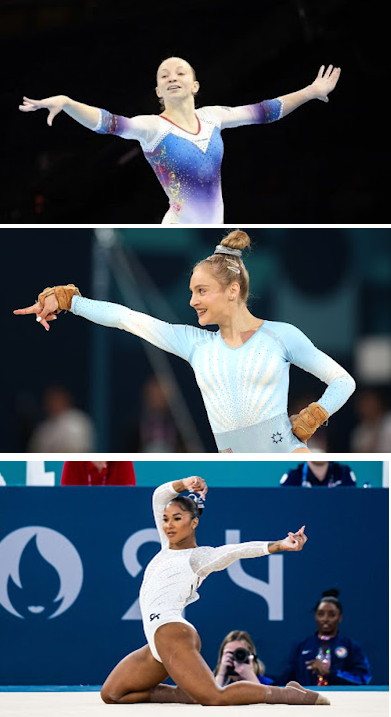
The three women you see pictured at the top of the page currently stand in the third (i.e., bronze medal), fourth, and fifth positions in the Olympics final in the women’s floor exercise. You see them from top to bottom in their relative positions as I write this; whether those will be the final final rankings remains to be seen.
Anyway, from the top down we see Romania’s Ana Bărbosu and Sabrina Maneca-Voinea, and the US’s Jordan Chiles. Each of them has reason to believe that she—and she alone—should be the bronze medalist. But a series of judges’ fuck-ups (apologies for the language, but there is no other adequate term) have resulted in a brouhaha that makes clear that whatever the NCAA or FIFA may do, the IOC isn’t going to give up its title as Most Corrupt and Incompetent Sports Organization without a fight. But wait! Who’s that coming up on the outside? It’s the Tribunal Arbitral du Sport (Court of Arbitration for Sport), or TAS, staking their claim, and they’re backing it up with hubristic posturing! It’s coming down to the wire, and it’s anybody’s race!
I have already made clear my distaste for sports which rely on the subjective opinions of judges rather than on some objective criterion. Yes, referees can make mistakes, but at least we know that the team that scores the most points will win, as will the swimmer who touches the wall first or whoever throws the thing the farthest. In these events, it’s clear: the US won a gold medal in the 100m sprint because a photograph made it clear that Noah Lyles’s torso crossed the finish line .005 seconds before Kishane Thompson’s did. The US women’s basketball team also narrowly won gold, beating the French team by a single point because on the last play of the game the home team’s player had her toe on the three-point line instead of just outside it.
Those close finishes seem more arbitrary when there’s no objective way of distinguishing between the performances. It’s also true that gymnastics is second only to figure skating in terms of judges giving credit to established stars just because they’re established.
But let’s assume for the moment that the judges’ votes in the floor exercise, though subjective, were both informed and honest. If you were to ask a dozen experts which of the three women discussed here was the “best,” I’m betting that all three would get at least two votes apiece, but ultimately that’s irrelevant to the current situation.
OK, so what happened? By the time Chiles, the last to do her routine, hit the floor, the gold and silver medals were de facto wrapped up by Rebecca Andrade and Simone Biles, but the bronze was very much up in the air. Bărbosu and Maneca-Voinea were tied on points, with the former placed third because her execution score was higher. Chiles performed well, but came up just short, with a score of 13.666, behind the two Romanian women’s 13.700. But American coach Cecile Landi submitted an inquiry about Chiles’s difficulty score. Less than a minute after Chiles’s score was posted, the appeal was granted, her score was raised by a tenth of a point, and she catapulted from fifth to third.
By this time, Bărbosu had already draped a Romanian flag over her shoulders to celebrate the first of her country’s Olympic medals in gymnastics in a dozen years: this in a sport once dominated by the likes of Nadia Comăneci. Indeed, from the time Comăneci appeared on the scene in 1976 through 2012, six different Romanian women won Olympic gold in the floor exercise, and ten earned a medal or some color, averaging more than one competitor per Olympics on the podium. Even a bronze in 2024 would be big for the individual gymnast, but perhaps even more so for her country.
Needless to say, Bărbosu was devastated by the change in Chiles’s score. It’s completely understandable that she felt frustrated, betrayed, and, yes, bitter. Her initial response garnered her a substantial amount of harassment on social media. Of course, Chiles suffered that fate, as well, being accused of cheating, as if she had anything to do with the judges’ decisions. Chiles received the bronze at the medal ceremony, and initiated one of the iconic images of the Games, as she and Biles bowed to Andrade in a gesture of respect and friendship to their Brazilian rival.
But the story doesn’t end there. The Romanian team submitted a challenge, claiming that the inquiry about Chiles’s score came after the allotted one-minute window for such appeals. It is, perhaps, a stupid rule, but even stupid rules need to be followed. The TAS ruled that Landi’s challenge did indeed come in four seconds too late, and was therefore disallowed. That meant Chiles’s score reverted to 13.666. The TAS kicked the subject of what should happen to the medal back to the FIG (the Fédération International de Gymnastique) who punted the decision back to the IOC, who predictably ignored the Romanian team’s suggestion that all three women should receive bronze medals. The IOC decided that, having already awarded Chiles the medal, they wanted it back, despite no wrongdoing on Chiles’s part.
But, as they say in the late night infomercials, “Wait! That’s not all!” Notice that the Romanians suggested that not merely Chiles and Bărbosu should receive medals, but so should Maneca-Voinea. Why? Well, the Romanian team sought to change her score because she suffered a tenth of a point reduction for stepping out of bounds… which replay showed she did not do. But that appeal was denied, without explanation (!). There is, or at least should be, someone or something whose sole function is to see if a gymnast steps out of bounds.
As the ubiquitous expression goes: “You. Had. One. Job.”
In other words, if the judges had done their job in the first place, Maneca-Voinea would have had a score of 13.800 and would have won the bronze medal. Even with the extra tenth of a point she received for doing a more difficult routine than she was initially given credit for, Chiles would have finished behind her. The US inquiry, even if it was late, was still submitted before Chiles’s score was posted (the one minute timetable is from the end of the routine), so it would have gone forward, but there’d be no reason for the Romanians to quibble about the timing, because it wouldn’t have affected the medals. No one cares who was fourth as opposed to fifth.
Who precipitated the kerfuffle? Not Chiles or Landi. Not Bărbosu or Maneca-Voinea or their coaches. This is all on the judges, the IOC, the FIG, and the TAS. And not because somebody thinks Gymnast A was “better” than Gymnast B. No, this is all about getting things objectively wrong.
Let’s not forget that getting Maneca-Voinea’s score correct in objective terms would have prevented all this. But competent judges would have prevented the Chiles/Bărbosu controversy, as well. They could have noticed that Landi’s inquiry came too late (assuming it did), and said, right then and there, “we’re sorry, this request came outside the time limit, and we therefore can’t review the situation.” Or, knowing there was an appeal in process, they could have waited an extra 30 seconds or so before posting Chiles’s score, announcing only the upwardly-revised total, placing her directly into third place, and not giving Bărbosu the impression that she’d won a medal, only to snatch it away moments later.
The US team subsequently submitted time-stamped evidence that Landi’s inquiry was submitted after 47 seconds, not 64. The TAS, of course, refuses to re-examine the case in the light of new evidence (they’d made their divinely-inspired decision, after all), and Chiles has been ordered to return her medal. After all, it’s her fault that the governing bodies apparently believed false information, right?
The two teams are, of course, looking after their own, but the Romanian suggestion that the three women each receive a medal is easily the closest we could get to a judicious and ethical conclusion. Bărbosu has gone on social media commiserating with Chiles (she knows what it feels like, after all), and hoping that the three of them will share a podium in Los Angeles in 2028. The athletes, the eldest of whom is Chiles at 23, are showing a lot more maturity and a lot more humility than the constipated and flat-out stupid narcissists at the IOC and TAS.
But we’re still not done! After the ruling, two pieces of information came to light. First, the TAS notified the wrong US officials of the hearing (!). Oh, and ever so coincidentally, it turns out that Dr. Hamid G. Gharavi, the head of the hearing board which handed down the TAS decision, has represented Romanian interests in such cases on numerous occasions. That doesn’t mean that he’s incapable of objectivity, of course, but TAS rules stipulate that judges should recuse themselves if there is even the appearance of a conflict of interest. The judges are merely inept; the IOC and TAS are certainly that, and quite possibly corrupt, as well. Ah, the Olympic Spirit!
The US team vows to pursue legal remedies to allow Chiles to keep the medal they believe is her due. I make no prediction what will happen down the road. What I do know is that if I were either Jordan Chiles or Ana Bărbosu and they came for my medal, I’d be sorely tempted to tell them to perform an exercise best suited to extremely limber hermaphrodites. And I’d know, or at least suspect, that Sabrina Maneca-Voinea might just have a better case than I do.
 Ethics Alarms
Curmie’s article gave me a mild headache. The most important point is this- if you can’t clock it, weigh it, count it or measure it- it ought not be part of the game-The original Olympic motto, Citius, Altius, Fortius, a Latin phrase that translates to “Faster, Higher, Stronger” is the standard. I note this year they added “community” a rather woke desriptive. Until they return to the original my interest in the Olympics will remain naught.
As I have observed previously, “community” is the most toxic term in the lefty parlance. It is used to identify and separate one group from all the others and elevate that group for some illegitimate reason. It’s completely passive-aggressive. Any time you see someone using it, hold on to your wallet and just be on guard.
My Olympic question is what happened to the women’s track shorts or lack of shorts. I confess, being raised in rural Midwest during the 90’s flannel grunge fashion age, my idea of attire is modest. They were basically in a bathing suit. While we’re at it, I just want to point out the monopoly Nike has on athletic gear. Yes there are other options, but very, very few for basketball shoes, and they seem to be the “official sponsor” for everything.
https://www.thedailybeast.com/nike-ripped-for-risque-womens-track-olympic-uniforms
“But wait! There’s more!”
The girl in pic #2 has wrist supports – she should be eliminated from contention.
But I don’t care – (as Jack wrote) “the Olympics are a bad, corrupt joke and not worth my time“
BTW, I always enjoy reading Curmie’s guest posts.
I suspect that the scoring ‘rubric’ has become so involved that it is almost impossible to do it correctly (at least for Olympic-level judges). This is common in education fields today. They want meaurements, then they want finer and finer-grained data. At some point, it becomes useless and at some point, you spend so much time measuring the data that nothing else gets done. They may need a simpler scoring system if they want this to work. Likely, the same errors would be found in the scores of every competitor, not just places 3-5.
My favorite example of this are ‘anonymous’ surveys that are ‘anonymous’ because they don’t record a name, but require such fine-grained demographic information that it doesn’t matter “An east Asian female lesbian Oboe Associate Professor, between 50 and 55 years of age, with a Ph.D. from an in-state university and who is married with 3 children and lives within 5 miles of campus said …”. Yes, that is anonymous with an 80 person faculty.