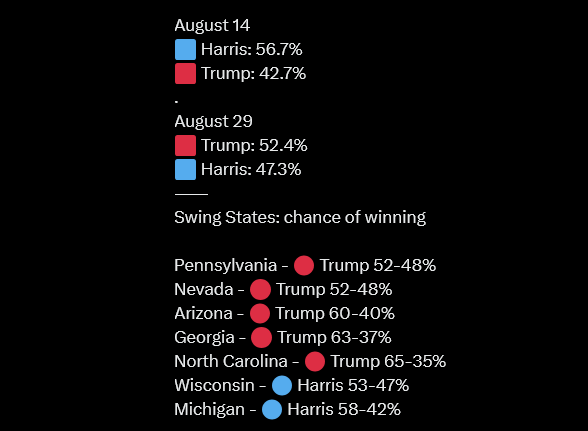
Nate Silver announced today that his famous election projection model shows Trump leading again, representing a nearly ten-point swing in Trump’s favor within two weeks. Remember, those aren’t poll percentages. They are the odds of each candidate winning the Presidency based on Nate’s mysterious weighting of polls and pollsters.
What is significant is that Silver detects movement in Trump’s direction now even after the mainstream media’s all-in efforts to promote Harris and assist her in the historically unethical “She isn’t what she is” campaign, the worst attempt at voter deception since 1840, when the Whigs sold Virginia squire William Henry Harrison as a back-woods rustic. Even after..
- …a Democratic National Convention that was virtually all Trump-bashing throughout while painting Harris as the candidate of “joy.” Even after…
- …Pundits and talking heads unconscionably morphed into Harris campaign surrogates, defending Tim Walz combat lies and twisting themselves into metaphorical pretzels to deny that Harris was handed the responsibility of dealing with the border crisis. Even after…
- …Harris successfully avoided having to answer questions about her policy positions even once since Joe Biden was ousted from the presumed ticket.
Ethics Observations:
- Again, I think Lincoln is being proved right: you can’t fool all of the people all of the time, or perhaps enough of the people enough of the time. Most of the public had paid little attention to Harris, as they pay little attention to most Vice-Presidents. Now, slowly, gradually, they are getting a sense of what an empty suit she is, and how unimpressive she is as a potential leader.
- Trump has little or nothing to do with his resurgence. A lot of people hate the idea of voting for him (as do I), but have to be given something positive to vote for instead. The Democrats have nothing positive to sell except killing more unborn children, socialism/Marxism, a Politburo-style leadership model, and discrimination against those evil white males, if you view those things as desirable. Most people, even a lot of Trump-hating people, don’t, and they shouldn’t. They are all unethical.
- The reality of Walz’s infatuation with Chinese Communism and his career-long problems with the truth have to be hurting Harris, at least a little bit.
- Nobody has had the guts to examine this, but there is some strong evidence that black, even sort-of black, politicians who marry white spouses alienate a significant segment of the black voter base. Most voters didn’t know Harris had a white husband, or had forgotten about him. It’s an unethical reason not to like Harris—and there are so many better ones!—but I think it’s a genuine problem for her.
- The odd Harris strategy of pretending that Trump is the incumbent President and she is the challenger when she should have inherited all of the baggage of the failed Biden Presidency which is, after all, still ongoing, again shows reliance on public stupidity that might be backfiring. Trying to defend her shared administration with Biden while simultaneously denying him as the cock crows three times requires a far more deft politician than Harris is.
- I find Baby Bobby a blight on the political landscape, but he can speak clearly and persuasively. His endorsement of Trump seems to be hurting the Democrats, who deserve this condign justice for their antidemocratic efforts to block Kennedy from running for President.
- Silver’s model shows a strong likelihood that Harris could win the popular vote while Trump takes the electoral college. California warps the totals (California ruins everything), but never mind the blame: another 2000/2016 result will send progressives into madness and, I fear, coast-to-coast violence.
 Ethics Alarms
CNN’s “joint” press conference is designed to have Walz step in when Harris starts a “word salad.” Should be interesting to see.
Especially if she responds with “I’m speaking.”
California warps the totals (California ruins everything), but never mind the blame: another 2000/2016 result will send progressives into madness and, I fear, coast-to-coast violence.
I truly hate to say this, but part of me earnestly hopes so. The way things are right now, violence on a wide scale is millimeters away anyway, and it would take very little to precipitate it from both sides.
A part of me believes it’s better to just rip the band-aid off and get the pain over with. The republic will likely survive, but I am reminded of Peter Clemeza’s remark: “These things gotta happen every 5 years or so, 10 years. Helps to get rid of the bad blood.“
Maybe for us it is every 250 years or so, and there is quite a bit of bad blood to be purged.
Ah, yes. Wars, especially civil wars, reliably result in national unity with no lingering resentment or distrust. Afterward, everyone shakes hands and sets aside whatever differences caused the war, with no hard feelings. The more people die painfully, the easier it is to make friends afterward. By contrast, constructive communication is too high a price to pay for peace.
I realize it’s a pretty loaded and heavy subject, but I’m interested in your thoughts:
I’ve read enough of your comments to anticipate that you likely believe that the answer to #2 is yes because we can still approach people from the perspective of understanding their fears and desires, communicating in a way that respects them, and showing that it’s very possible that our own desires and methods of operating are not incompatible with their own desires. I guess I want to hear whether you think that’s possible between a hardcore libertarian and someone who truly believes that the worlds ills–hunger, inequality, racism, etc., can be mitigated or even solved via government interference.
Delving a bit philosophical here, but I personally believe that what we’re witnessing is a natural result of the technological progress of humankind–we’ve reached the point of peak technology and its inevitable peak weakness–humans as a group have, psychologically, emotionally, and physically, reached a state of dysfunction enabled by technology and that we will soon lack the strength to function as we know it. Something will happen, whether it’s war, famine, mass societal breakdown, or something sufficiently destructive that we relearn how to be mentally tough, accept life for what it is, and stop trying to fix the unfixable parts of humanity.
We need as much communication and good will as we can muster. It may be that we can postpone the civil war for another generation. It might be we can postpone it long enough for the Marxist/progressive/woke crowd to eat itself alive and spare the rest of us.
I am not optimistic, however. One of the reasons that we’re in the bind we’re in at the moment is the thirst for power in our political parties. Traditionally there have been 4 major categories of temptation/addiction: pleasure, money, honor, and power. One of the biggest problems dealing with people in the throes of these addictions is that what they fear is losing what they are addicted to, and there’s practically no room for negotiation or using reason to bring them around. Particularly with power, an addict will see any sort of compromise as a threat to his power, and refuse to budge from his stance. And it is true: any compromise would have to mean releasing at least some power, and for an addict, the vast majority of the time, that has to come by force. Our ruling party, that deep state which spans both parties, is addicted to power, and they will go to any length to hold onto it. It will require force to remove them, unless they die off on their own with no one to replace them.
It is true, though, that many through history have believed that war keeps a nation strong. Many European intellectuals in 1913 thought that Europeans were growing too soft, that they hadn’t see a major conflict in over 40 years, and that perhaps a good blood-letting would stiffen people up. The Russian Empire, the Austro-Hungarian Empire, the Ottoman Empire, and the German Empire were broken to pieces in the following war, and even the victors were shocked and jaded by the loss of an entire generation to the trenches.
That’s probably the best case scenario. And I think the best way to accomplish that is, quoting our host’s favorite poem, keeping our heads while others are losing theres. If the Republicans can find it in themselves to sit back and let the Democrats be the party of corruption, tribal politics, and lawlessness, while keeping their own noses as clean and rational as possible, then the radical progressives will self-destruct, with the moderates seeing them for the toxic, mentally unsound people they are.
Well, I understand you said that sarcastically, but actually in our history as a country, yes, we did have a civil war and we did end up unified as a nation. It didn’t happen overnight and I won’t say there was no resentment or distrust — but it did happen.
The 1850’s were as raucous and divisive and violent an era as we’ve had the past 9 years. Politics then and after were not sunshine and roses, they were fought earnestly, they were nasty and vicious at times.
I won’t make predictions as to what would happen — the past is no guarantee of future results — but we have had times like this before and survived.
I considered that. The last two sentences I added to imply that reunification after the Civil War, or the U.S.’s relationships with former enemies like Great Britain, Germany, Japan, Spain, et cetera exist despite the wars and because of the bridge-building skills that people have employed. Without bridge-building, you get feudal societies, warlords, and tribal conflict, and those can go on for centuries. That’s what most of human history looks like–pick a continent (not Antarctica). All those wars between Britain and France didn’t seem to build any sort of friendship until… what, the Triple Entente in the late 19th Century? Whatever changed, it wasn’t the wars that did it.
I was surprised. I didn’t know that they had sarcasm on EC’s planet. Maybe Earth has been a bad influence on him.
Heh. Constructive communication indeed. Lots of that going around these days.
Hope is not a plan.
Ugh, not another electoral college upset.
I disagree with the notion of an “upset”. I lean more towards “just how the Founders designed it.”
“The candidate with the most popular votes doesn’t always win” is a outstanding protection against the most sinister part of a pure democracy: the tyranny of the majority.
Exactly!
Without the Electoral College, California would elect the President every four years.
For instance – In 2016, Hilary lost the majority vote in the combined other 49 states total [not counting California.]
Yeah, I think the EC is brilliant, and was a necessary feature in a country where all the states had to agree to abide with a federal union. But the Founders didn’t anticipate true universal voting for President, didn’t foresee such mega-states as California and Texas, and knew that whatever they came up with would be a big improvement over what they were leaving.
Most of the public doesn’t get the EC, and never will. As long as the fluke EC wins in a popular vote loss were infrequent—and three (arguably only two) in over 200 years is infrequent enough—it was tolerable. Three in 24 years is not going to be tolerable, and I doubt that the fail-safe device will survive it.
“Trying to defend her shared administration with Biden while simultaneously denying him as the cock crows three times…”
This is a metaphor that people get wrong more often than not. Both Matthew 25:36 and Luke 22:33 relate that on the way to the Garden of Gethsemane, Jesus revealed that Peter would deny Him three times before the rooster crowed. Peter declared his loyalty, promising never to do so. Following the arrest of Jesus, Peter denied knowing him three times, but after the third denial heard the rooster crow and recalled Jesus’ prediction. So there were three denials, but only one rooster crow, not the other way around.
Wait, that happened to Peter too?
Ha! Now that’s hilarious!
Formula gag, but always fun.
I suspect you may need to change “even after” to “because of”. Certain levels of obvious manipulation cause resentment. It’s a reaction that seems to be much stronger in the US, but I have my own biases there. I’d suggest that reaction is a large part of Trump’s support in fact. The establishment has become more controlling over time, and his election really seemed like a way to tell mainstream politicians to GFY.