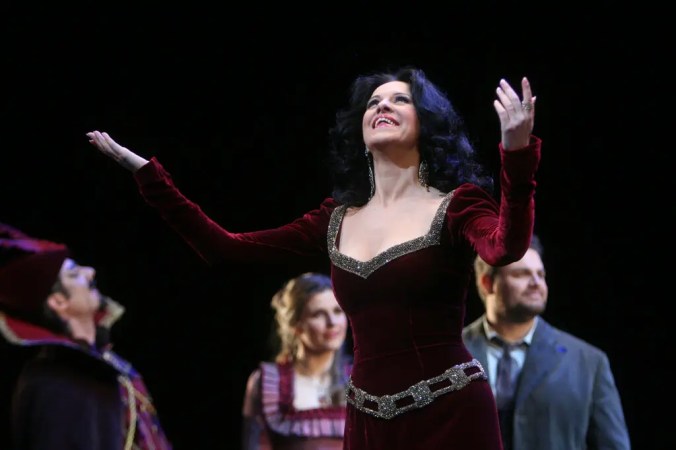
Yikes. A performer who did this in one of my shows would have to enter the witness protection program, because I would be hunting her down. With a crossbow.
South Korean tenor Alfred Kim, responding to uproarious applause, was performing an encore of “E lucevan le stelle,” a famous aria in the third act of Puccini’s “Tosca” at an opera house in Seoul. His co-star, celebrated soprano Angela Gheorghiu who was singing the title role, marched onstage and demanded that he stop.
“Excuse me,” she said as she gestured to the orchestra to stop playing, according to local media reports and audience member accounts. “It’s a performance; it’s not a recital,” Gheorghiu said, reprimanding her colleague. “Respect the audience. Respect me!”
I’ve heard tales of opera divas, read about them, performed with these unique characters and even directed some of them, or tried. This behavior is off the charts. Gheorghiu, 59, is renowned for both her voice and her ego. She was booed at the performance’s curtain call, defiantly blowing a kiss to the angry Tosca fans as she walked off the stage. The Sejong Center for the Performing Arts, which was the site of her antics, demanded an apology. None has been forthcoming.
The soprano refuses to back down, and her managers issued a statement saying that “Ms. Gheorghiu believes firmly that encores outside of a concert performance setting disrupt the narrative flow of opera.” They also said had been assured by the conductor, Jee Joong-bae, and the production team in Seoul that there would be no encores.
Tough! The decision whether to have encores in any production of an opera, operetta (Gilbert and Sullivan wrote them into their shows, and I love them) or musical is entirely an artistic decision that rests with the director and conductor and no one else. Audiences call for them, and giving an audience what it wants during a performance known as “entertainment,” “show business” and “common sense.” A cast member disrupting a performance to object is such a breach of professional ethics that I can’t even come up with an analogy that properly conveys how indefensible Gheorghiu’s conduct is. Maybe a flight attendant breaking into a passenger plane cockpit and objecting to the pilot’s cruising speed is close.
She doesn’t like encores? So what? That’s not her call. When she directs “Tosca,” she can ban them in her own production. Nothing, literally nothing, gives this maniac the right or privilege to attempt to veto an artistic decision by the production team mid-performance. The incident should end her career—it won’t, but it should. I certainly wouldn’t ratify her despicable conduct by paying money to hear or see her after that display.
What an asshole.
 Ethics Alarms
The individuals that keep kneeling to her whims make her believe she can keep getting away with such rude and sickening whims./behavior. One strong method of correcting is not attend her events or purchase any of products.
Interesting. I’m an opera neophyte. I’ve probably only been to twenty or so, but I’ve never seen an aria repeated during a performance. Hilarious. I think seeing her storm onto the stage and interrupt the proceedings might have been worth the price of admission in and of itself. “That’s entertainment!” might be the appropriate response. Hah.
I know it’s a “It’s not the worst thing,” but at least no one came to blows. Unlike this situation:
Moment lead singer of iconic rock band Jane’s Addiction explodes onstage, punches guitarist mid-song | Daily Mail Online
Hah!
I’ve played both rhythm and lead electric guitar in a few rock bands over the last 50 years and that’s NOT what a professional front man does! If a lead guitarist wanders off the edge of the sheet music and stretches out a solo to infinity, the rest of the instrumentalists enthusiastically support it, and the front man sells it to the audience. That front man allowed some kind of personal conflict to completely destroy his professionalism, what an asshole!
Speaking of electric guitar, here’s my practice room setup…
I don’t get to show off my gear very often.
Steve, the picture reminds me of the old saying – “How many guitars does a guitarist need?…Just one more.
Love your setup.
FYI; the one on the right in this picture isn’t in that photo, so there really was “just one more”.
It was on the setup bench getting new strings and missed the group photo. 😉
Whoa.
Lovely children!
Apparently this is not the first time Farrell and Navarro have had onstage difficulties. There is reporting that Farrell drank an entire bottle of red wine during the show, so he was probably drunk.
My friend and I saw them three weeks ago in Houston and then show was great. However, other shows have been spotty, mostly because Farrell hasn’t been able to hit the notes like he used to.
jvb
Fuck Gheorghiu and the horse she rode in on, she has absolutely no respect for her follow performers or the audience. She should be shunned for life in the opera community and never get another onstage role, ever!
I’m just not so sure, Steve. There is that “willing suspension of disbelief” thingy that a mid-performance encore kind of tramples. And after all, divas gotta diva.
OB wrote, “There is that “willing suspension of disbelief” thingy that a mid-performance encore kind of tramples.”
In my opinion; that’s something that the directors, producers and stage manager can address after the fact out of sight of the audience. I don’t care how much of a diva a diva is, no one walks onstage in the middle of a performance, in front of an audience, disrespecting fellow performers, and stops a performance unless there is an unsafe condition that requires everyone to be immediately evacuated.
But the encore already interrupted the performance. As does Althouse, I wonder whether it was a publicity stunt. Operas, like rock bands, are always on the edge of chaos.
OB wrote, “But the encore already interrupted the performance.”
So what. I didn’t say or imply that doing an audience inspired spontaneous encore was the right thing to do, what I’m saying is that the diva’s reaction to the encore in front of the audience was wrong, unprofessional, disrespectful, etc.
OB wrote, “As does Althouse, I wonder whether it was a publicity stunt.”
That kind of publicity might work for somethings, but it’s counter productive for this kind of professional show.
OB wrote, “Operas, like rock bands, are always on the edge of chaos.”
Being on the edge of chaos is fine as long as the audience doesn’t see it break into actual chaos.
Bulletin: Althouse is a distinguished law professor and often an astute commentator, but she’s a cultural tyro, and her opinion isn’t worth much on this topic. Opera’s are concerts/recitals with sets and costumes—they have no dramatic or narrative integrity. First of all, everyone knows the plots in advance; second, if drama mattered (or suspension of disbelief) they wouldn’t cast 300 pound 50-year-old mezzos in “Carmen,” (or the middle-aged diva in question in “Toaca”) which is a story set in Spain sung in French. Opera fans come first, second and third for the music, and if a popular aria is nailed, they want to hear it again, which is what encore means. It was the first kind of interactive theater. In the American musical genre, Irving Berlin, Cole Porter and even Sondheim wrote encores into their shows, because audiences enjoy them, and always have. Musical theater has always had strong links to burlesque, vaudeville, and their foreign equivalents—encores are legitimate parts of that tradition.
I thought this kind of garbage stopped after Joseph Volpe tersely (and deservedly) sacked Kathleen Battle from the Met in 1994 for a stream of unprofessional actions. Just because you are good at what you do and have a following doesn’t mean you are better than other people or that the rules don’t apply to you. Some people think these stories of Enrico Caruso’s scandalous affairs or Maria Callas acting like she was royalty are funny or just part of their story. I don’t. Angelina needs to get the Kathleen Battle treatment.
From the Wiki entry on encores:
Opera performances
Beginning in the 18th century, if an aria was strongly applauded, it might be repeated. For example, at the premiere of Mozart’s Marriage of Figaro, 1 May 1786, and other early performances, “many pieces were encored, almost doubling the length of each performance”.
Restrictions on encores
For “Figaro”, on 9 May 1786 Emperor Joseph II of Austria issued an order limiting encores.
By tradition, some world-class opera houses, such as La Scala and the Metropolitan Opera, officially discourage encores, especially for vocal solos, as encores were associated with less serious performances.
In the mid-19th century, encores were officially banned in northern Italy, since the Austrian-Italian authorities felt they would lead to public disorder. In1921, encores were forbidden at la Scala (in northern Italy), because the conductor Toscanini felt they would interrupt the pace of the opera and drew attention to individual singers as opposed to the work. Toscanini had, in 1887, been challenged to a duel after stubbornly refusing an aria’s encore. Wagner was similarly against encores.
The ban at the Metropolitan was explicit in the printed programs at the beginning of the 20th century, but was nevertheless often broken at the insistence of the audience. Encores at the Met became rarer later in the century.
It’s snobbery, basically.
Come on, Jack. You despise opera.
Yes, I suspect she assumed she was discharging her duty to try to civilize the Asian Horde.
Would you be in favor of a “Hamlet” audience demanding a repeat or two of “To be, or not to be” just because it was particularly well done? Shakespeare hasn’t become a collection of set pieces over the centuries?
What would give you that impression? I’ve directed operas—they are fun to direct, and I don’t direct shows I despise unless I can fix what’s wrong with them. As a genre, I think opera is elitist and archaic, and one of the things I enjoy about Gilbert and Sullivan is that both the composer and the librettist were making fun of operas, which are, in almost all cases, great music accompanying terrible acting. Opera fans don’t care, which is why if they want to hear some of that great music again, let them.
“As a genre, I think opera is elitist and archaic.”
As Jack McCoy would say, “I can live with that.”
I think an argument can be made that opera is the height of vocal and instrumental music and drama and one of the great treasures and accomplishments of Western culture. And by the way, new operas are being written, composed and performed every year. (Not that I find them watchable.)
Nobody finds them watchable, or listenable. Opera is like classical music in that respect. The closest things to “new” popular operas are the “sung-thru” musicals like “Les Miz” and “Phantom”…and that fad appears to have petered out.
Actually, I know of one person who listens to and enjoys contemporary classical orchestral music and opera: my Expat American piano teacher who’s lived in Amsterdam, The Netherlands for the last fifty years. He’s an outlier.
I like the history context. While not wanting encores in opera is understandable given the context you describe, Gheorghiu’s reaction was a cure worse than the disease. And calling for an encore of a Shakespeare monologue would only make sense if it was a standalone performance, not as part of an ongoing play.
My sympathies on this curious little matter are with Wagner and Toscanini, GR.
And Gheorghiu!
So you think it was actually worth stopping the performance?
She’s NOT. The singer is welcome to her opinion on such matters, but she lacks standing to do anything about it short of making her preference a contract provision, which it wasn’t.
Wagner (who wrote his operas—and who also didn’t like applause during them) and Toscanini, a conductor, are squarely within the category of artists who have every right and reason to forbid encores if that’s their choice.
Perhaps an equivalent metaphor would be a baseball catcher disapproving of the way the pitcher is pitching, so instead of going through the proper channels, he decides to just telling the batters what sorts of pitches to expect. Just as unprofessional, just as out of line with the player’s role on the field, and just as injurious to the game, individually and as a whole.
See? Some of us read your baseball posts!
Also, I happen to think shows like Les Mis and Chess work better in concert than as performed whole. Saw a concert version of Carousel which worked rather nicely to sidestep the whole icky plot problem once, too. Hope you’re feeling a bit better today.
Thank you. I am, but not enough better to get the work done that absolutely has to get done this weekend. “Chess” should absolutely ONLY be done in concert. The same could be said of Evita. I really like the giant turntable in “Les Miz”…
Opera in a concert setting leaves me cold. Also, I can’t listen to recordings of opera or, gasp, yuck, radio broadcasts. I need the surtitles and the action in front of me. Just the music, without translation is beyond me. And by the way, surtitles make opera comprehensible and enjoyable. It WAS effete beyond belief when you were expected to memorize or translate the lyrics and decode the plot on the go without any assistance.
And I’ll tell you something that’s unethical in the classical music world: Alec Baldwin hosting a weekly radio show for the New York Philharmonic. Caramba! What a weird sell out.
A friend of Chopin’s once wrote,”Every theater is a lunatic asylum, but opera is the ward for the incurables.”
While it’s purely an unproveable hypothetical – I wonder how consistent with her own protest she’d be if the encore the audience demanded would have been one of her songs…?
Is this principled “loyalty” to the artform or professional jealousy?
Sopranos are frequently opposed to doing encores of their big solos, because it is potentially perilous to their voices. The biggest back-stage fight I ever witnessed was when a conductor made the show’s soprano sing her big aria again after she killed with it the first time. The director and the singer were both furious.
Understood. Thanks!