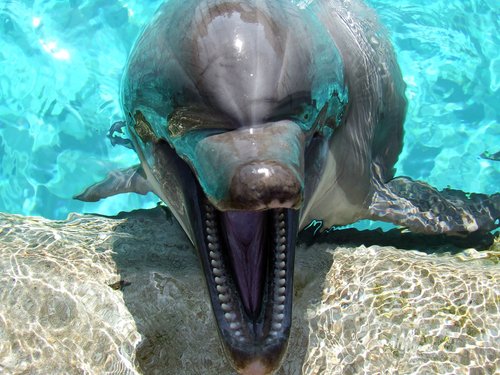
Off the shores of Fukui, Japan, a rogue dolphin appears to have attacked at least 53 bathers over the past three years, leaving them with bite wounds and sometimes broken bones. Most of the victims were bitten on their arms and hands, but seven were rammed. That’s how dolphins fight sharks.
Authorities believe that even more people have been injured because some victims did not report the attacks. In each reported incident, only one dolphin was involved: an aquatic mammal with an injured dorsal fin.
And a grudge.
Flipper the Ripper.
 Ethics Alarms
Have they tried swatting it on the nose with a newspaper?
You are so bad…
I didn’t even know dolphins read newspapers.
Sometimes a grudge is justified…😱
Dolphin Slaughter.flv (youtube.com)
I am waiting for someone to photoshop the dolphin with 53 little swimmer icons tattooed on it.
Michael R,
I have no idea what you mean. Care to explain?
Holy Air Force pilots, Batman!!!
Michael’s referring to fighter jets on which pilots have their kills stenciled…just below the cockpit.
Okay understood. I thought his comment was in response to mine.
Carry on…🤠
https://en.wikipedia.org/wiki/Victory_marking
Ha hahaha!
Reminds me of Scar in The Lion King.
I blame global warming.
The oceans around Japan are over 30C, far warmer than normal, far later in the season than usual. In a usual year, there’s a clear drop in air temperatures by the end of August, and ‘both heat and cold are until the equinox’ was a long-standing saying. We should be around 17-18C at night and 25C in the daytime, but we’re still experiencing 35-36C in the daytime, 28C overnight. It’s been close to 100 almost all summer, with 75-81% humidity. We were just up to Fukui, a two-hour drive, and we were looking forward to stepping into the (usually) chilly Japan Sea waters, but it was like bathwater.
Fruits, vegetables, eggs, and seafood have all been affected. The soil never cools down at night,and crops are damaged. Once picked, vegetables rot before they reach the market, or within 2-3 days of purchase. Fish shops I frequent have been closed 2-3 days a week as next to nothing’s coming in. Conger eel, Shirasu, and sanma (Pacific saury, staple fish, are scarce and not appearing at the usual seasonal times. A long-winded way of saying that the lone dolphin is likely hungry!
Ooh, I like “The Lone Dolphin”!
That was supposed to be ‘hangry’ but autocorrect got me.
It does have a ring to it, doesn’t it? The Looooone Dolphin!’
Revenge of the dolphins!
As Batman noted above, they still hunt and eat dolphins in Japan, though it’s not very popular anymore, and maybe a health hazard due to mercury content:
The Japanese are gonna need a smaller boat.
–Dwayne
Don’t imagine you’re safe just because you don’t swim near Japan. The cows are in on it, too: https://www.theguardian.com/world/2024/sep/12/the-hell-and-horror-of-cow-attacks-i-told-my-husband-to-leave-me-to-die
(The left will blame Chick-fil-A)