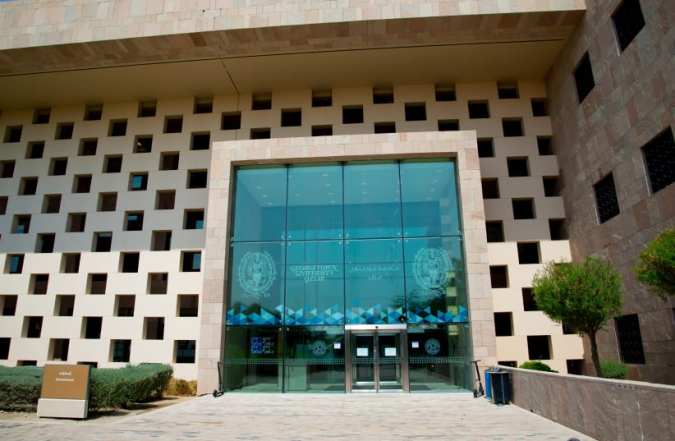
The Jerusalem Post reports in part:
[Georgetown University] is hosting a Hamas-affiliated media personality as a keynote speaker at a conference, in addition to other officials from designated terror organizations…..titled “Reimagining Palestine,” [concluding today] in Qatar. One of the main speakers was Wadah Khanfar, a former official at Qatar’s mouthpiece Al Jazeera whose relationship with Hamas has been well-documented throughout the years. Khanfar was named as an early leader of Hamas’s office in Sudan by multiple Arabic-speaking outlets, including the Palestinian Raya Media Network, the Yemen-based Mareb Press, and the British Al-Arab website. Likewise, according to Mohamed Fahmy, a former Al Jazeera English Egypt bureau chief, the Muslim Brotherhood described Khanfar in 2007 as “one of the most prominent leaders in the Hamas office in Sudan.” Khanfar was also reportedly connected to the al-Aqsa Foundation in South Africa, which the US Treasury Department designated “a critical part of Hamas terrorist support infrastructure.” ….Other speakers at the conference included Shawan Jabarin, who is closely affiliated with the Popular Front for the Liberation of Palestine, another designated terror organization, and Issam Younis, who in the past supported Hamas’s oppressive rule in Gaza…
The Washington Free Beacon, the conservative publication, adds (because the mainstream news media doesn’t think this is newsworthy]:
The speakers at the “Reimagining Palestine” event will discuss the “ideological shifts” of Zionism, “art as resistance,” and “anti-colonial struggles,” and will engage in “dialogue that challenges the status quo,” according to the Doha event’s website.
Your Ethics Alarms Ethics Quiz of the Day is….
Is it ethical for an American institution of higher learning to do this in the midst of the Israel-Hamas War?
Georgetown, allegedly a Jesuit school, sold its soul when it began accepting roughly $1,000,000,000 in donations from Qatar, which is openly anti-Israel and pro-Hamas, since 2005. Qatar’s Georgetown campus (above) is part of the university’s Edmund A. Walsh School of Foreign Service (SFS), the world’s top foreign policy school.
That little problem aside, academic institutions are supposed to add perspective and depth while examoning complex issues, which the seemingly endless Israel-Palestinian conflict certainly is, though the Gazan War is not. Neither is terrorism, which arguably is validated when an attack on civilians like the one Hamas launched on October 7 results in sympathetic prestige events like today’s conference, not to mention the pro-Hamas and anti-Semitic demonstrations on U.S. college campuses and a U.S. Presidential candidate who advocates a permanent ceasefire in the region that will further imperil Israel while moving Hamas closer to its goals.
On the other hand, as Captain Hook would say, aren’t even slanted and biased conferences covered by the ideal of “academic freedom”?
 Ethics Alarms
I don’t know about unethical, but it’s surely tone-deaf, in bad taste, and divisive in light of the current situation and in light of what this symposium seems to cover. A discussion about the now almost 80-year-old Arab-Israeli conflict is certainly possible, assuming it were a balanced one. A discussion of terrorism through the last two centuries which would include the difference between political (in support of a political goal) and millennial terrorism (where the violence is the goal), changes in viability with technology, counterterror tactics and their evolution, and so on could be very interesting. However, this sounds like a pity party for Palestine and a hate-fest for Israel. It’s allowable, just barely, under free speech and academic freedom, as long as it sticks to discussion, although I think it’s going to generate a lot of heat and very little light. If it’s going to be a seeding place for violent demonstrations, forget it.
Truth be told, trying to nail down any kind of ethical framework around terrorism is like trying to staple water to a wall. Some deliberately try to separate the two by saying things like “one man’s terrorist is another man’s freedom fighter.” Frankly that’s the lazy way out, although it IS true that our biases are going to color how we view one cause vs. another cause and what kind of tactics we can justify. Rebellions of one kind or another have been around almost as long as mankind has organized itself into this group vs. that group, and certainly since the days when mankind had empires. The Romans were often able to stymie that by making the conquered peoples into junior partners, but some peoples, like the Jews, the Britons, and so on, wanted no part of that kind of arrangement, and had to be essentially destroyed to the point where organized resistance was no longer viable. In a time when both sides had essentially the same weapons, it was all about numbers. Certain tactics like ambushes and targeted eliminations, proto-terrorism if you will, worked to some degree, but usually couldn’t win. If the rebel side had insufficient numbers or was dispersed to the point where it couldn’t get sufficient numbers together, violent resistance wasn’t viable. Rebels or bandits could give the other side a very hard time (Hereward the Wake, the Knights of St. John at Rhodes), but in the end causes like that were usually either doomed, or only went anywhere when they COULD amass numbers enough to wage something like a real civil war. That said, if you defeated a cause but didn’t stamp it out completely, sometimes you’d come to regret it, like the Moors did when they didn’t pursue Pelayo, the last leader of the Spanish, after the battle of Covadonga. It took 700 years, but eventually the Moorish rule in Spain was pushed out.
Terrorism really only started to be viable as a tactic with the advent of firearms and explosives, and even then, at least among the major powers, was considered the province of savages and brigands, not legitimate causes. France and Spain only decided to support the American Revolution after Saratoga, when the Americans proved that they could actually win a stand-up battle and were a legitimate force. Guerilla tactics continued to be used throughout the 19th century, of course, and sometimes worked (like in the Peninsular War), sometimes not (the Boers succeeded in giving the British a rough time and committing huge numbers, but finally lost). Terrorism gained steam after the European revolutions of 1848, but it still could rarely overthrow existing governments.
It’s only with the beginning of the 20th century, with the Russian revolution, the Anglo-Irish war, and so on, that terrorism really came into its own. It still could rarely overthrow a government by itself, but what it could do was make the government and the people so weary and so fearful that they gave up and gave the terrorists what they wanted, or made an occupying power decide that this occupation wasn’t worth it. Like it or not, sometimes terrorism pays off, like in the formation of the Irish Free State and like in Israel becoming an independent state. Also like it or not, sometimes terrorism reaches its limits and has to accept it won’t reach its goals, like Northern Ireland and like El Salvador. It’s hope that it can win that race between a defeat or an unbreakable wall and the other side losing the will to fight on that keeps terrorism as something people keep turning to. If this symposium keeps some people willing to run that race, then maybe in that sense it is unethical, since it keeps people willing to take chances that often result in a great deal of harm and damage, often to those who are innocent or want no part of the conflict.
I might also add that ethical leaders of any cause owe those they lead a duty to realize when the conflict has become unwinnable and then seek an end to the conflict. It should have been obvious to the German high command after Verdun that they’d spilled so much of their field leadership’s blood that they were not going to win the war. It should have been obvious to the Japanese after Midway that their chances of winning the Pacific war had sunk with their carrier fleet and their best pilots. What’s left of the Hamas leadership needs to pull up and think now. Most of their fighting forces are dead or captured. Most of their best leaders are dead. Hezbollah isn’t going to successfully open a second front. All of Gaza save Rafah is taken. It’s unlikely that Israel is going to agree to any kind of ceasefire. The question is do they end this and try to save what can be saved, or do they fight until there is no one left on their side? The answer should be obvious.
P.S. It may be time for Zelensky and his council of autocrats in Kyiv to think about this also. Yes, they succeeded in giving the Russians a VERY hard time, and the Russians didn’t get to treat Ukraine like a speed bump. However, it’s going on three years, the summer offensive last year achieved very little, the Russian army is bigger today than it was at the start of the war, and Putin is not anywhere near losing the support of his own people. What is more, Putin may be a bullying, swaggering tyrant, but he isn’t an idiot, and he’s not going to overreach to the point where NATO is going to have no choice but to get involved. What is more than that, the leaders of the NATO nations aren’t idiots, and won’t put themselves in Russia’s nuclear crosshairs for some oligarch in a t-shirt who keeps asking for more and more and can give no return on the investment.
There are some murmurs of people not happy with Putin. Since we are blowing up apartment building in Moscow suburbs, they want an expansion to NATO countries. If Putin were overthrown, it would be very bad for Ukraine, Europe, and the US.
Joe Biden DID want to give the Ukrainians long range missiles even though Putin said that would be the line that resulted in NATO being targeted. It is strongly rumored that our military defied Biden and told him no, that they are in charge now. That is being rumored as the cause of Biden’s meltdown fit in his meeting with Keir Starmer.
I am a free speech absolutist. (threats and calls to violence are not protected by law)
Georgetown is a private institution and as such has the right to engage whomever it wants to speak. That said, if they are to remain a private non profit academic institution the administration should allow opposing perspective conferences for the purpose of promoting the search for truth.
Events like these should be allowed and even those most strident in their opposition should attend peacefully and listen. At that point, the opposition should develop its own reimagining Palestine and demand the same courtesies from its opponents.
Stopping speech because we vehemently disagree with the other’s perspective is what Walz means when he says misinformation and hate speech is not protected speech. He is a moron.
I doubt if the Qater campus would be willing to have such an event. Given that Georgetown is operating in Qatar we must be willing to allow a greater degree of latitude for Georgetown than had the conference been held in the U.S. If we are to demand persons from other countries adapt to our culture – like not eating cats (snark) – then we must accept the fact that when we operate there, their customs and culture takes precedence.
It is therefore necessary for Georgetown to host a countervailing program should one develop anywhere the university operates . Georgetown itself is not obligated to create the counter program unless it created the Qatar program to reimagine Palestine.
Personally, I am tired of conservative rationalizations that protests cannot be done or programs to advance their causes cannot be created because conservatives have jobs and other responsibilities to attend to. The primary cause of success is just showing up.
Keep this in mind, reimagining Palestine that “. . . challenges the status quo” could very well include acceptance of Israel as a legitimate state. Doubtful, but the status quo for Hamas means Israel’s elimination.
It is not unethical to host such a conference, whether in the midst of a war or not. In fact, in the midst of a war the need for understanding is heightened, even among Georgetown students.
The implication here is that the conference is pro-Hamas; that may or may not be the case. This conference is one of a series of seven conferences, The Hiwaraat Series, launched in the 2023-2024 Academic Year. Per Georgetown, the conferences are intended to offer “insights from top practitioners, scholars, and activists.” Other conference topics included The Invasion of Iraq, Islamophobia, Afghanistan, Water Security, Energy, and Gender in Foreign Policy.
Obviously, when Israel and Palestine are featured, panelists will necessarily include persons who have been castigated by one side or the other, some who truly are guilty (of something), and some who are guilty by association. Those who have the time and the inclination (I don’t) can research the entire list of panelists and characterize them. But, media characterizations should not be simply accepted. For example, The Jerusalem Post identifies Khanfar as a “keynote speaker”, yet the program for the event does not list any keynote speaker at all and shows that Khanfar is one of five panelists (plus a moderator) for the topic of “The World is watching: Who Shapes the Story?” Khanfar certainly would have some valuable insights on that topic. That is far different from having him as a ‘keynote’ speaker.