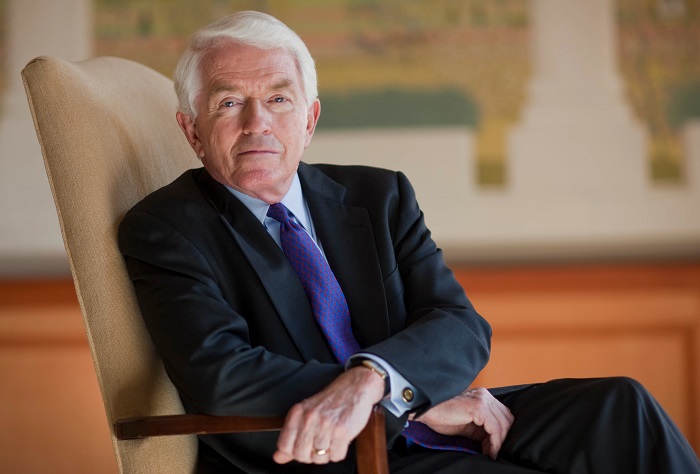
I just returned from the funeral of my former boss, mentor, role-model, Most Unforgettable Character (well, one of them) and freind, Tom Donohue. He died earlier this month at 86. Consider this a prelude: as soon as I’m emotionally up to it, I’m going to compose and post his entry into the Ethics Alarms Hall of Heroes as an Ethics Hero Emeritus. Tom deserves the honor unquestionably as you will see; this isn’t a matter of me boosting my personal friends.
In fact, my first observation on this funeral—which, you will recall, I attended a week early, spawning this rueful post—is that Tom Donohue is an excellent example of how many great people move through American life without being sufficiently noticed, appreciated, and remembered. Tom had a wonderful life, as Clarence the Angel would have said, and it was a productive, important, consequential life that touched many hundred of lives in a positive way including mine. A movie about his life would be inspiring and entertaining. Tom walked among the powerful and famous: one of his weaknesses (that I had the guts to point out to him, I’m proud to say) was that he was, at least when I worked with him, excessively deferential and almost obsequious to celebrities, a sign, I believe, of his usually well-hidden insecurities. Maybe this flaw diminished once he landed his dream job, running the U.S. Chamber of Commerce, a role that gave him real power and periodic national visibility. I remember finally snapping when I saw Tom fawning over Ed Meese, Ronald Reagan’s long-time consiglieri and eventual Attorney General. “Jesus, Tom, Ed Meese isn’t fit to carry your laundry,” I remember saying. “You should stop treating him like he’s royalty.” (Tom’s response: “I’ll think about that!”)
Tom’s death rated an obituary in the Times and the Post among other publications, but few Americans know who he was. Heck, few Americans know what the U.S. Chamber of Commerce is: they think it’s a government agency. It is, in fact, a huge and influential national organization created by the business community (at the behest of President Taft) to serve as the yin to organized labor’s yang, and to advise Congress and the White House regarding the private sector’s interests in policy, national and international. The President of the Chamber has more power ( if he knows how to use it, and Tom certainly did) than most members of the U.S. President’s cabinet. Tom held that job for more than two decades.
Revisiting the remarkable details of Tom’s career, achievements, and most of all, character was particularly bittersweet so close to the election. Neither Donald Trump nor Kamala Harris are fit to carry Tom’s laundry either. He would have been a marvelous President: Tom had all the tools, he was able to work with the Left and Right with equal facility, and his leadership abilities were dazzling.
Why don’t our best and brightest people end up in the White House any more? They did once, at least with more frequency. In Tom Donohue’s case, he got on the track of organization management and never got off. I wish I had asked him why he never considered elected office.
That leads to my second observation: personal regret and remorse. At one point, between jobs in my thirties, Tom and I worked briefly on a management and leadership how-to book that I was going to ghost-write for him. Tom was dyslexic. He was an oral communicator (a brilliant one), but he wrote as little as possible. We abandoned the project for a variety of reasons; I don’t recall the details, but I’m sure it was my fault. What a loss. He had so much to teach, well, everybody. I did not manage the project as well as I could, and didn’t appreciate its importance until it was too late. Just another one of my failures, and I regret it more after today than ever.
My third observation, one that has been hitting me hard routinely of late, is how quickly time passes, and how poorly we, or at least I, manage our lives in that reality. The funeral took place in a huge Catholic church in D.C. and hundreds were present. I recognized exactly one person. Many I never knew, of course, but many I did, once. What struck me especially was that Tom’s oldest son spoke movingly about his father, and the last time I saw him was when he was a burly teenager, 40 years ago. Now he looks like an old man: Good lord, what must I look like to him? Sunrise, sunset…where did the time go? Why don’t we make better use of it?
My fourth observation is prompted by a development I didn’t expect: not just one but two of Tom’s three sons are now trans females. Tom was an old school Irish Catholic, but he must have been supportive. Both of his now daughters spoke, and it seemed clear that they had a strong and loving relationship with their dad. But what’s going on here? The number of adults who are deciding to swap sexes is staggering. I have two trans females in my family; my best friend’s daughter’s, now son’s, wife just birthed his first grandchild; another good friend has a granddaughter who is “transitioning.” I am inclined to believe this is a cultural fad, and a destructive one that will eventually be seen as a huge societal misstep. We will eventually find out.
Meanwhile, there has to be some kind of consensus on how we handle such matters as how to refer to a man’s sons when they are no longer behaving, appearing and living as sons. In the funeral program, the two ex-men were referred to as Tom’s sons with their female names in parentheses after their original male names. The priest and all the speakers referred to them as Tom’s sons and his “boys.” Then they both got up to speak, in dresses, looking womanly, and speaking in very feminine voices. If this phenomenon is going to continue (I fevently hope it does not) , there have to be some conventions.
My fifth observation is that families should require funeral attendees to check their damn phones at the door. The woman next to me, I’d guess that she was in her forties, kept texting and looking at her phone periodically throughout the service. (I was impressed though: she could text without looking at the keypad.) I tried to talk to the woman, but got the impression that I was interfering with her social media interaction, or something.
This is addicted behavior, anti-social behavior. It’s a funeral; the event and what it signifies should fully occupy one’s thoughts and attention. During the magnificent service (there was a choir, an organ and an orchestra), I heard at least three text message “pings!” among the crowd, and there were probably more. Cell phone addiction is turning people inattentive, rude, and disrespectful. We are making a big mistake as a society if we just shrug that off as “how we live now.” It is no way to live and no way to nurture human relationships and a healthy society. We can put social norms in place that minimize the damage, but we had better act quickly.
My final observation, #6, is to mention one of Tom’s favorite mottos, which I had forgotten was a mantra for him in part because it was something my father believed as well and that I try to live by, in part because of Tom and my dad but also because it’s just how I’ve always been wired. Tom Donohue liked to say, “If you can[fix something, do the right thing, help somebody, take a stand], you must.”
Bingo.
 Ethics Alarms
Nice post. Too often we neglect remembering those who taught us valuable lessons. Thanks for sharing.
A fine preliminary tribute, Jack; looking forward to the epilogue.
I’s abundantly clear that he had a profound effect on your life, and you on his; these are things that matter.
“Cell phone addiction is turning people inattentive, rude, and disrespectful.”
Recognizing this early on, I’ve always had a flip phone (which is rarely even turned on), and neither send nor receive texts.
During any of the (IMO) very infrequent occasions that I’m inattentive, rude, and disrespectful, you’ll get it in real time.
PWS
My final observation, #6, is to mention one of Tom’s favorite mottos, which I had forgotten was a mantra for him in part because it was something my father believed as well and that I try to live by, in part because of Tom and my dad but also because it’s just how I’ve always been wired. Tom Donohue liked to say, “If you can[fix something, do the right thing, help somebody, take a stand], you must.”
Bingo.
That is actually not only standard Roman Catholic teaching, but also one of its fundamental points of disagreement with the Church of England – it argues that charity is an outright obligation, rather than a priority. The key lies in that word “must”, as opposed to the “ought” found in (say) the 38th Article of Religion of the Church of England. I have even had a Catholic tell me that that “ought” really means “must”, despite that reading rendering that entire article vacuous.
Makes sense, since Tom was Catholic (though he never mentioned religion at all or even alluded to he faith when I was with him.) My father was a grudging Methodist. Me…well, long story.
The must vs ought conflict is critical in legal ethics, where rules have been changed from “shall” (must) to “should” (ought) and sometimes back a again.
Great tribute to Mr. Donohue. I recognized his picture immediately.
re: fourth observation
A study of the distribution of this trend by geography and demographics in the US might produce some interesting information.