
Judge S. Kato Crews, a progressive appointee by President Biden to the U.S. District Court in Colorado, refused to allow an injunction against the San Jose State women’s volleyball team from including a biologically male “transwoman” (above) to compete with the team in a women’s volleyball conference tournament this week. He ruled that appellate and Supreme Court precedents clearly establish that the protections of Title IX and the 14th Amendment apply to transgender individuals.
A key factor in the decision seems to be that the plaintiffs, which are the other colleges in San Jose State’s conference, a current co-captain of the San Jose team, other former players and the recently-suspended assistant coach, should have filed the suit earlier. The conference’s transgender participation policy has been in effect since 2022 and four conference opponents and one non-conference opponent forfeited games against San Jose State beginning in September.
“The rush to litigate these complex issues now over a mandatory injunction,” Crews ruled, “places too a heavy burden on the defendants”—the Mountain West Conference and its commissioner, two administrators at San Jose State, the school’s head volleyball coach and the board of trustees of the California State University System. That’s a reasonable judicial call under most circumstances, but the judge and the entire pro-trans movement in the U.S. is now at the mercy of moral luck. That is the annoying life reality that random occurrences out of the control of decision-makers have a way of retroactively defining a decision as either prudent and wise or reckless and wrong. Crews’ decision neatly tees up the perfect conditions for moral luck to settle the trans athletes in women’s sports controversy
For if, at some point in the tournament, a spiked volleyball from the ex-male San Jose player seriously injured one of the female players on another team, it will all be over. The Barn Door Fallacy, in which authorities over-react after a preventable disaster and install draconian measures as if they could prevent what already occurred, will kick in with a vengeance.
The most vivid example of this sequence is perhaps the Hindenburg explosion,
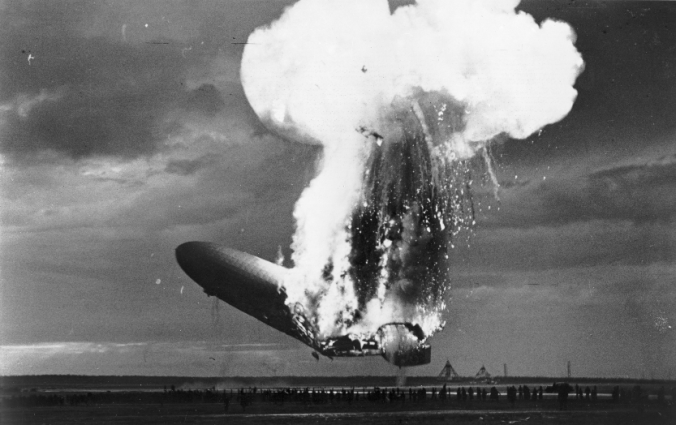
which was so spectacular that it killed airship travel permanently. The dangers of using hydrogen in dirigibles was well-known, just as the dangers of having trans athletes who have gone through puberty as males competing against women in strength-requiring sports is well-known. All it took was a dramatic explosion caught on film (that caused relatively few casualties compared to passenger airplane crashes) to turn public opinion worldwide against airships, even those using helium.
Now all it will take is a hard spike from the trans player that breaks a woman’s nose on the other side of the net, causing a gouting blood. and a gory image to be watched over and over again on YouTube to turn public opinion against trans athletes. Such unlucky incidents are tipping points, and it is certain that one is coming that will settle the transsexuals in women’s sports problem based on emotion rather than a sound consideration of the factors.
I guarantee it.
 Ethics Alarms
There is a lot of complexity to the eligibility business. I do note that if teammates were actually caught by surprise by the revelation that their teammate was trans, then, post-game showers being what they are, she must be pretty far along in the transitioning process. She meets the criteria established by the sport’s governing body. Is that enough? I don’t know, either legally or ethically–and those two perspectives do not always align.
I also find it interesting that everyone knows who the player is–you even provide a photo of her with her team number on her shirt, so it’s pretty easy to look up–but news outlets seem unwilling to identify her by name. You, too, Jack, declined to do so. I’ll respect that decision, but wonder about it…
In my case, it’s simple: her name and identity are irrelevant to the issue, which is the moral luck problem and how that, rather than law or even careful balancing of issues, rights and consequences, will likely determine the cultural positioning.
Pardon my naivete, but I don’t see any complexity in this. To “turn public opinion against the transsexuals” and “settle the transgender issues in sports” doesn’t need moral luck. It was settled by the recent election process of the people. Except of course in California and other blue conclaves.
A 1.5 point victory in the popular vote does not a consensus make.
60% of the Electoral College vote is a pretty solid consensus. An any-point-win in the popular vote is great, but matters little.
That 1.5% is fascinating in so many ways.
“The Barn Door Fallacy, in which authorities over-react after a preventable disaster and install draconian measures as if they could prevent what already occurred, will kick in with a vengeance.”
I don’t see how this fallacy applies to this situation. If Blair Fleming seriously injures another player at this tournament, the measures that will be installed can’t fairly be termed draconian, and that reaction can’t fairly be termed an over-reaction.
For safety and fairness reasons, males don’t belong in the women’s sports category. Resetting the eligibility rules to what they always should have been will be the fair/safe/rational/logical thing to do.
The way the fallacy will come into play is banning trans women from ALL women’s sports—golf, archery, downhill skiing, gymnastics, etc, because of a single incident.
They don’t belong in ANY of them, so good.
Even if it were possible to find a sport where including males in the women’s category posed absolutely no safety or fairness issues, that fact wouldn’t support the inclusion of transwomen in the women’s category. Instead, it would support the abolition of sex-based categories for that particular sport.
The first question to ask is, “Are sex-based categories indicated for this sport?” If the answer is no, then the divisions should be dissolved and that particular sport should become co-ed.
But if the answer is yes, then the divisions should continue and should be enforced according to an athlete’s sex.
I agree with most of your post, though I don’t see how strength comes into play in pool or chess. This, I think, is spot on: “Instead, it would support the abolition of sex-based categories for that particular sport.”
Pool is more about manipulating angles than physical capabilities or strength and chess (and card games such as poker) are more about strategy and thinking than physics. I am not sure I can see a real distinction or difference in abilities between male and female chess players, and I would think that the top male player has no real advantage over the top female player.
I diverge on bowling: Bowling is not, under any circumstances a sport – in fact, it should be banned from the entire known universe. Forever. I have a visceral loathing of the activity, which I realize is a bias, but I embrace my bias and stand firmly behind it.
Frankly, I am not sure if there is a, tangible, real advantage in musical instruments, either, with the exception of percussion instruments such as drummers where physical demands might play into the mix. For example, does the current top male drummer* [say, Mike Portnoy or Gavin Harrison or Danny Carey] have a physical advantage over the top female drummer [Pauline Villarreal or Sheila E or Meytal Cohen]? Possibly.
jvb
*Ed. Note: The named drummers is only a short list by way of example but, clearly, is not exclusive and only refers to current, living drummers. I did not include The Professor (Neil Peart) or John Bonham, well, because the list would be too long. I also did not list some rather obvious ones such as Ringo Starr, Carl Palmer, or Karen Carpenter, along with Buddy Rich, etc., which is not intended to slight any of them as they are all phenomenal.
As for women drummers, there is a young UK musician named Nandi Bushell who is making quite a name for herself – and she is very young in her teens, but she has not reached the level of some of her peers, yet, but she is exciting to watch. She is quite impressive.
Well, we need one of the following: “Penis and no-penis” divisions; unisex sports; women’s sports with hormone, size and strength divisions,or trans athletic competitions. Gratuitous male-female divisions in things like chess, bowling and pool need to go.
In bowling, men average 10-15 pins higher than women. For pool, men’s height, strength, and fast-twitch muscles make it easier to execute many shots, esp. power shots like the break and power draw. For chess, men consistently perform better than women, often by a large margin. There’s never been a female world chess champion, and only one woman has ever been in the top ten.
Based on the results for each of your examples, male advantage (physical, cognitive, or a combo) is presumably present. Even with less-obvious “sports” like bowling/pool/chess, understanding the reason behind the male advantage is less important than
-recognizing that there’s clearly something there; and then
-acting accordingly.
There is still equestrian sports where not only do men compete against women but stallions compete against mares and geldings.