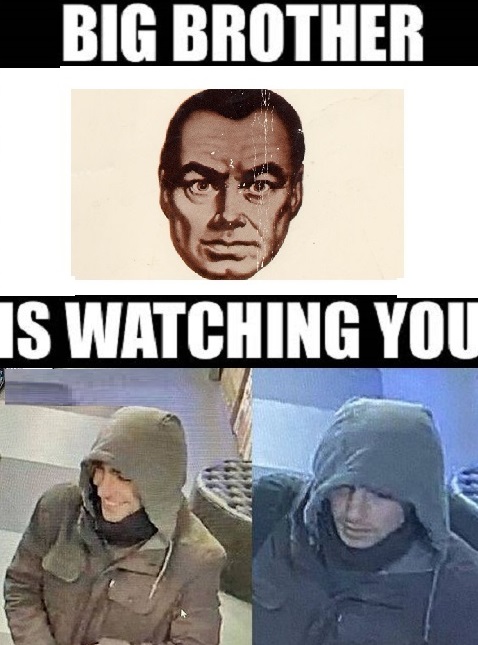
Above we see that there are now photographs of the face belonging to the man who assassinated UnitedHealthcare CEO Brian Thompson yesterday. Those images will doubtlessly be subjected to facial recognition software that will make use of Big Data containing the images of millions of Americans who have allowed photos of themselves to be posted on social media.
My wife loved British procedurals, and frequently expressed her opinion that it seemed creepy and Big Brotherish that everywhere and everyone in Great Britain seemed to be under surveillance by CCTV, which was the key to solving the crimes in those shows with boring consistency. It is evident that the United States is rapidly getting to the same point. In cases like yesterday’s brazen daylight hit job, this development seems like a means justified by the desired end, but what guarantees do we have that the government and law enforcement will stop at that end?
In “Minority Report,” the film version of Phillip K. Dick’s dystopian future (well, one of them) showed everyone’s retinas being scanned constantly for both government and commercial purposes as they walked along the streets of D.C. In the latter case, the technology allowed street advertising to speak directly to individuals as they passed by: “Mr Williams! You have a cold! Come on in, CVS has just what you need to make you comfortable!” If this is science fiction, it is just barely so.
Like my late wife, I find this creepy and ominous. So…
Your Ethics Alarms Ethics Quiz of the Day is…
Is it ethical for the government to subject citizens to complete and constant video surveillance in public places?
I had a chilling discussion with my sister, a moderate though Trump-Dearnged liberal, in which I posed this question. Her reply: “Yes, absolutely, losing any sense of privacy in public places for greater safety is an ethical and necessary trade-off.” She shrugged away Ben Franklin’s quote, which I luckily had ready in my mental files and was able to extract: “Those who would give up essential Liberty, to purchase a little temporary Safety, deserve neither Liberty nor Safety.”
Isn’t the slippery slope in this area throbbingly obvious? What happens when all of our conversations in public can be recorded and analyzed?
I also recognize that this particular problem may be beyond fixing, especially when virtually everyone is carrying with them a video camera, making the pronouncement of impossible limitations a useless exercise. Realistically, there is no reasonable expectation of privacy outside of one’s own home today Be it ick, creepy, an infringement on our basic rights or allowing a tool of totalitarianism to be embedded in our culture, the surveillance society is something we need to think about and not just allow to happen by default.
 Ethics Alarms
In addition, privacy within your own home is “hackable” now. Cell phones, baby monitors, security cameras, etc. can be hacked and unintended people can get in and listen or watch what you’re doing in the privacy of your own home.
Now that’s creepy!
If CCTV allows the police to capture this particular criminal, I’d be happy for that outcome. I don’t think anyone has the expectation of privacy in a public place. Having said that, I’m also very concerned with the government gathering data and video unscrupulously. I doubt any of us are under the illusion that the government conducts itself in a way that’s admirable or ethical when it comes to those it pretends to represent.
To go a step further, I am appalled at the reactions I’ve read related to this incident. The comments are mean, spiteful, and ignorant. If this man did not have CEO in front of his name, and this was just a story about a man assassinated as he headed to work, I suspect the comments would have been vastly different.
I work for UHC. I have had occasion to interact with Mr. Thompson. He was always kind, funny, and thoughtful in his approach to peers and subordinates. He was also someone’s son, husband, father, etc. I cannot imagine the pain his family will feel when they read comments gloating about his death, or praising the gunman. It’s a testament to how truly low society has fallen.
Nobody’s blaming the gun for this shooting, they’re blaming the victim. Apparently, being employed and making good money is nothing but greed, and deserves this outcome. The minds and sympathies of thousands of Americans are so twisted, they’re literally blaming the man shot in the back for his own death.
I’m not sure there’s anything left of us to worry about saving anymore.
Hear, hear! Absolutely. Columbia professors and WaPo journalists saying he deserved it. Despicable. And yes, where’s the outcry about the need for more gun controls? And no blaming systemic racism?
Ditto to everything you wrote. I am appalled at the vicious bloodlust that comprise a significant number of comments on every article I’ve read.
Almost every person has more money than someone else does. Almost every company has its ups and downs with room for improvement. If we justify the murder of a someone because another person thinks that someone makes too much money or just doesn’t like the company that someone works for, no one is safe.
That’s a problem more security cameras don’t solve.
Excellent points, Michelle.
I am perplexed by his murder. Has anyone figurer out or theorized a motive? Was it a random act of violence, a robbing that went terribly wrong? When I read reports, I see “assassination” and “murder” which lead me to conclude that he was targeted. Why? Because UHC denied a claim or wouldn’t pay for a medical procedure? I don’t get the vitriol heaped on him, either.
jvb
The bullet casings had words on them that evoked a book condemning the insurance industry. The guess is that he’s someone whose loved one was screwed over by typical insurance company ruthlessness. There have been too many procedurals based on that plot to count.
People like to blame the health insurance industry for rising costs, large deductibles, denied claims, corporate greed, and whatever other things they can think to help on the pile. They use insurance companies as the scapegoat for all that is wrong in health care and as a driver for universal health care.
I think they’re forgetting 20 years ago, when health care wasn’t perfect, but it was more affordable. Deductibles were around 500 bucks, some companies paid the entire cost of the health plan, and hospitals and doctors competed for patients.
Then came the ACA. The health care model that was so convoluted, we had to pass it to know what was in it. It had one group paying for another, it was mandated as a “tax”, and oversight was at the IRS. Things were never going to work out, but it was sold as a golden goose. Now here we are, and as it’s all falling apart, people need someone to blame.
So, blame the insurance companies and corporate greed. Specifically, UHC and Brian Thompson. Based on their comments, he deserved to die for denied claims he never saw and prior authorizations he never denied. That’ll really teach insurance companies to lower costs. Even though costs aren’t driven by insurance companies any more, and Brian Thompson was a very strong advocate of lower costs and improving health care.
Based on the video I saw, the shooter is someone extremely familiar with handguns. The way he cleared the jam after the misfire was fast and efficient. Obviously it’s all speculation at this point, but I would not be surprised if we learned this was more than a payback for a denied claim.
Michelle – what is the ACA’s role, if any, in UHC’s 16 billion profit in 2023 along with a 32% (reportedly) claim denial rate?
While the vitriol heaped on one man is grossly misplaced, I agree, I empathize with the rage and utter helplessness people feel toward their insurance companies; a pleasure for which they individually pay thousands in premiums.
Alicia – The denial rate of claims contains many factors. Taking one report conducted by who knows who and with no context isn’t a sound arguing point. But, for the sake of argument, let’s look at some factors in denials.
What causes a claim to deny? Incorrect coding, multiple claims for the same service, incorrect provider related to the claim, no prior authorization, fraudulent billing are just some reasons a claim might be denied. Imagine what health care would cost if claims that should be denied were paid?
I find it interesting that profits are always mentioned when discussing corporations. Businesses are in business to make money. It’s literally the point of having and running a business. The real question seems to be whether there should be a cap on allowable profits. If so, what is that number, and who makes that decision? I support capitalism, so I don’t feel a need to defend profits for any individual or business.
Thank you for taking the time Michelle. I appreciate it. I’m sure some of the examples you gave play into that 32%. None of those examples have played into my personal experience with denied claims and my doctor spent quite a bit of time arguing with my insurer (over something that should have been obvious to a 12 year old, but I digress.) Doctors spending time arguing with insurance companies also raises the cost of care. What would the costs of health care be if fewer claims were denied? UHC would have made less than $16B, I imagine.
I, too, am a firm believer in capitalism. What differentiates insurance companies from a pizza joint is that insurance companies are selling a “maybe”. If I pay for a pizza, I get a pizza. Insurance, however, is a betting game. Policyholders are betting that something bad will happen. Insurers are betting it won’t. That’s where insurers make their money. It’s business. I understand that. But when policyholders pay their premiums and insurers don’t deliver, the game now feels rigged.
I wasn’t arguing as much as I was presenting (or playing devil’s advocate) what is the perception among many, and what fuels their rage and feelings of helplessness. When they have dutifully paid their premiums, and end up having their claims denied (for reasons they don’t understand, which feel completely arbitrary, and delivered to them by one of 440K employees) while they or their family members are ailing, expecting them to come up with a whole lot of compassion for a company that made $16B off those premiums is a big ask.
Also, the question was what role does the ACA play? That seemed to be your reason for the state of the insurance industry today – unless I misunderstood. And I would like to understand.
I think the most obvious answer is also the most complicated. The Affordable Care Act was sold to the populace as a means to insure everyone. Those who could paid more, and those who could not didn’t pay or paid much less. The problem with this model is that people do not want to pay more, so they declined. Insurance companies lost money, and many, including UHC, pulled out of the exchange market. Some have come back, including UHC in some states, but overall things did not go as planned.
As a result, in today’s world, the ACA isn’t very affordable. Premium costs increase, regulations drive costs up, and the complexities of the system are nearly crippling. Claims have mandates in how fast they must be processed, and approved or denied. There are Federal mandates for some plans, individual state mandates for others, and a combination of both for still other plans. The IRS is involved heavily, auditing the ACA. The complexity involved in the system is not only difficult to understand and navigate, it’s extremely expensive.
I’m not claiming that any insurance company is perfect, or that we get it right every time. I am however defending Brian Thompson’s right to go to work without being shot in the back for any reason. I am defending any companies right to make money, in whatever amounts, because I don’t believe we should limit profits. Here’s a link that might be helpful in explaining why costs continue to rise, and why ACA wasn’t quit the boon we were promised. https://www.ehealthinsurance.com/resources/affordable-care-act/why-is-health-insurance-so-expensive#:~:text=There%20are%20a%20number%20of,in%20your%20control%2C%20others%20are.
Obamacare’s Winners And Losers In Bay Area
MONEY QUOTE: “Of course, I want people to have health care, I just didn’t realize I WOULD BE THE ONE WHO WAS GOING TO PAY FOR IT PERSONALLY.” Obama supporter Cindy Vinson (bolds/caps/italics mine.
Seems Vinson’s one of those “Raise Everyone’s Taxes But Mine” kinda Lefty.
Funniest thing; the Kumbayah Zeitgeist wilts like August Lettuce when Skin In The Game rears its ugly head…
PWS
Thank you so much, Michelle. Your input is greatly appreciated. Most of us don’t have an inside knowledge so this is very helpful.
One additional point, using your pizza analogy. When you buy health insurance, you get health insurance, just as when you buy a pizza, you get a pizza.
If you head into the local pizza place for the first time, and you spend 30 bucks on a pizza, you have no idea what that pizza will taste like. You have no guarantee the quality of the meat, cheese, or sauce. Maybe the kid making your pizza washed their hands, but maybe not too. Did the shop pass their last health inspection? Do they have safe food practices? Are the owners getting rich by charging for premium products, but delivering medicore pizza? So sure, you get a pizza, but are you getting a quality pizza?
Health insurance now provides options. Don’t like your current insurance? Head over to the Exchanges and shop around. Either way you have insurance, and choices, so if you don’t like what you have, you can get your insurance and your pizza from somewhere else. You might pay more for both, but your options are open.
I’ve also long thought that one of our biggest problems with the American health coverage system is that people fundamentally don’t understand what “insurance” is and instead are spending their money expecting to receive a subscription to healthcare coverage–that is, pay a monthly fee and get all the healthcare you want, as if it’s Netflix.
–Dwayne
The inevitable misuse or overuse is one unethical result. Does anyone imagine it won’t be long before they start using AI to proactively identify minor “crimes” (like, say, jaywalking), matching them to specific individuals, and triggering arrests or tickets. A similar procedure is already in place with red light cameras. ID mistakes will be made and have to be (expensively) defended against, and legal but embarrassing pictures will certainly be leaked. If that becomes standard, disrupter technology will be widely adopted, and serious crime-solving could well become more difficult.
There was a scifi story a while back (don’t remember where…maybe Twilight Zone?) about a protagonist’s efforts to escape over a miles-long wall to an unsurveilled zone, only to discover the “free” zone was only a few feet wide.
A minor point: Based on my watching way too many episodes of “The First 48,” the cops typically avail themselves of surveillance video captured by cameras placed and operated by private businesses (typically) and even, rarely, individuals. There are doubtless many government-placed and -operated systems as well, but I bet the vast majority are private.
So far.
Millions of Ring doorbell cameras may be privately owned and installed, but government had an open invitation to viewing them at any whim. (And still might… )
The question posed is, “Is it ethical for the government to subject citizens to complete and constant video surveillance in public places?”
The answer is YES, it’s unethical.
The next question is, what level of unethical interference into our liberty will we tolerate as citizens?
For me I don’t mind the cameras that catch people if they run a red light or traffic cameras that are used to help “government” access traffic problems or patterns or weather related road problems. It’s important for government to “assist” the public by keeping roadways safe and passable. However, in my opinion, anything outside of that narrow view is government intruding on our personal liberty.
LIBERTY
The state of being free within society from
oppressive restrictions imposed by authority on
one’s way of life, behavior, or political views.
The quality or state of being free.
Freedom from arbitrary or despotic control.
The positive enjoyment of various social, political,
or economic rights and privileges.
The power of choice.
Freedom from control, interference, obligation,
restriction, hampering conditions, etc.;
power or right of doing, thinking,
speaking, etc., according to choice.
The freedom to live as you wish or go where you want.
The concept of liberty first dies with a majority of society willingly setting it aside for the greater good then authorities finish it off with the practice of death by a thousand cuts.
We have already reached the point where a huge swath of society has set aside liberty for the “greater good” and they are using tried and true early 20th century tactics to intimidate society into submission. These people are using all kinds of rationalizations trying to justify their cultural destruction; I’m on the right side of history, it’s for a good cause, I’m just giving the people what they want, free speech confusion, it’s my duty, these are not ordinary times, the ends justifies the means, ethics is a luxury we can’t afford right now, we’re better than this, think of the children, if it saves just one life, it’s the right thing to do, we’re all in this together just to name a few. Anything that opposes their push towards the “greater good” and their end goal is considered evil.
Is this an over the edge conspiracy theory? Most definitely not. It’s already happening right under our nose.
As for this particular incident, I think the photos of this murder and the murderer are all taken by cameras owned by a private business and that is NOT government surveillance. Even if the government can gain access to video or photos after an incident happens, this is not the government intruding on our personal liberty.
Privacy in large cities these days is almost as impossible as it’s always been in a small country town!
I believe that the slope became exceptionally slippery after the Patriot Act was enacted, and there’s no bottom to that slope. Once you put something like that in place, it’s never going to go away. Habeas corpus? What’s that?
“Habeas corpus? What’s that?” is a little recalled Abe Lincoln quote.
A point that hasn’t been made yet is the huge risk of misidentification that the AI will inevitably find. If the AI finds a similar looking person, it will have done its “job” and indeed find someone who looks similar. Humans will be inclined to say “yeah, that’s the guy” on only appearance, ignoring the risk that it may merely be someone with a similar appearance.
The police are likely to be quite heavy handed in responding to anyone they think might be the assassin. They’re going to go in full SWAT mode on any suspect, with the “best” outcome being someone terrified and physically manhandled by the police and the worst outcome being killed by the police. The government has a monopoly on authorized violence, and any reprocussions for the mistreatment for the hapless innocent person will not be there.
I don’t know if I got word-pressed again, or the comment went into the spam eater. I’ll try again…
Something insidious about the use of AI enabled surveillance is that it can produce similar looking matches in a way that human never could. If they run these pictures through AI, there is a really good chance they’ll flag completely innocent people. If the AI does its “job” these matches will indeed look very similar to the surveillance photos. It would be people who look similar, and the danger is that the police could run with bringing their full weight onto some unsuspecting individual(s).
This is made far worse with the “hut hut” militarized nature of American policing. The government’s monopoly on legalized violence will be applied for the crime of looking similar. Unfortunate people ended up being “SWATed” by the police for nothing more than looking similar to a dangerous criminal. The police will aggressively smash down doors dressed in full military gear, point weapons at people, throw them to the ground and tie them up… if they’re “lucky”. The worse case here is the non-zero chance the innocent mis-identified person gets shot dead in the confusion. When the police finally figure out it is the wrong person, the police won’t even have to issue apologies because for some reason we don’t even demand that from our police. Even worse is when the prosecutor runs with the case for a while so they may also spend time in jail.
WordPressed…your comment was spammed along with this trenchant comment:”780067 637120It�s really a nice and helpful piece of info. I�m glad that you just shared this helpful info with us. Please keep us informed like this. Thanks for sharing. 147938″
You get a nice comparison on how my comments are when one is pecked out on my phone vs typed out at work while on break.
I’m sorry, but that’s almost comically naive.
It’s possible to use constant real-time surveillance of limited, sensitive areas to secure those areas, particularly those areas that aren’t supposed to have anyone in them. However, the larger the area surveilled, the larger the number of people in them, the more varied their activities, the harder and less effective it becomes. Widespread surveillance of all public spaces is just about useless for purposes of real-time safety. The “attack surface” is just too large.
It’s an order of magnitude more useful for investigating crimes after the fact, but even then, it’s not the magic bullet it’s often imagined to be. They still haven’t identified the shooter, have they? What about the mysterious stranger who left pipe bombs outside party offices in DC before Jan 6th 2021?
So what is constant mass surveillance actually good for? Kompromat. Name the person, and you can go through their lives with a fine-toothed comb until you find a crime, or an embarrassing secret, or something that can be made to look like either one. Mass surveillance is pure gold for this stuff.
Setting up mass surveillance for public safety is kind of like subscribing to Playboy for the articles.