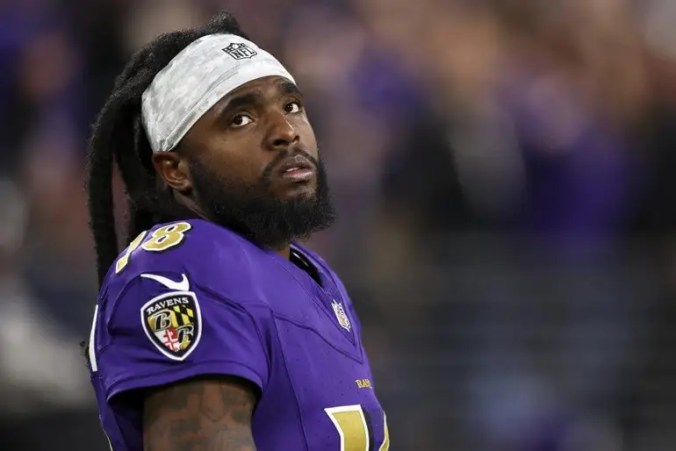
It is sad but probably to be expected that so many professional athletes don’t get the ethics thingy. The latest incident: Diontae Johnson, a wide reciever for the NFL’s Baltimore Ravens, for refused when his coach ordered him to take the field late in the team’s Week 13 game against the Philadelphia Eagles. The Ravens are still trying to make the play-offs, but it wouldn’t matter if the game had no importance to the Ravens’ fortunes at all. Johnson is a member of the team; he draws a salary. Apparently he was angry and frustrated over his lack of playing time since the Ravens acquired him, and had been complaining to teammates for weeks. “Tough noogies,” as they used to say when I was a kid in Arlington, Mass. (An alternative was “tough bunnies.” I never understood that, any more than I knew what a “hosey” was.)
Johnson was immediately suspended.
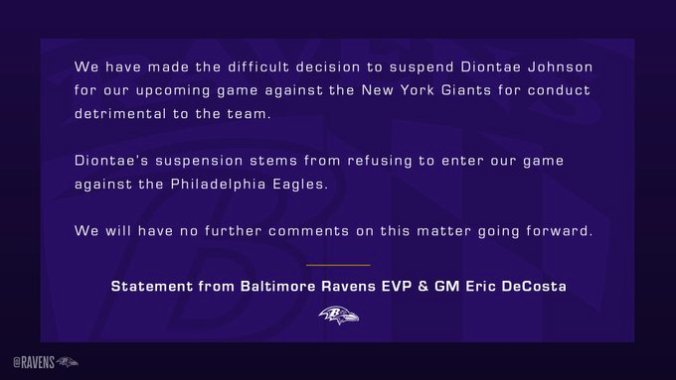
Wait…why was this a difficult decision? It was an obvious decision. This week the Ravens announced that Johnson was told to stay away from the team as a likely disruptive influence. There was some question why the Ravens didn’t just release him, but apparently that is because they don’t want any other teams strengthening themselves during the play-off run portion of the season.
It is sad but also to be expected that NFL teams also don’t get that ethics thingy, but we all knew that, didn’t we? Pro football is the most unethical sport there is. In an ethical league, no player who betrays his team and defies his coach as Johnson did would ever be allowed to play again.
He shouldn’t be. In World War II, a U.S. soldier who defied a direct order in combat could be shot, though usually wasn’t. I once had a director walk out on his own show in a snit on opening night after a dispute with the producer, and I made sure that every other professional theater in the region knew about it: he had to move to another city before he could get a job.
Unfortunately, the King’s Pass (or Star Principle) usually applies in such cases. An NFL star who refused to play might not be released, and would be given a second (and third) chance to betray his team mates. I remember that Manny Ramirez, the great but ethically-challenged baseball slugger who played for the Red Sox, Indians and Dodgers, once refused to pinch-hit because he had been told that he would have the day off, and on another occasion went to the plate and deliberately struck out. He should have been fired and his contract cancelled, but the Red Sox tried to mollify him before eventually trading him at a discounted rate to Los Angeles. After all, the man could hit. Eventually Manny alienated the Dodgers too and finally quit the game after he was caught using banned performance-enhancing drugs.
This has to be a cultural norm that is reinforced in every part of society. If an individual has a duty to follow the orders of a superior and refuses to do so, that individual has branded himself as untrustworthy. Until he or she somehow demonstrates that they have reformed, they are unemployable. The exception is when the refusal is based on a principled objection to the order, and the dissenter makes the objection clear and is willing to accept the consequences of his or her defiance.
That does not apply to Diontae Johnson, who is was behaving like a spoiled child and throwing a tantrum.
 Ethics Alarms
I am sure you have addressed this before, but pretty much any story like this should, at least, address Sandy Koufax.
-Jut
I assume you are referring to Sandy’s refusal to start Game #1 of the ’65 Series because of Yom Kippur, and not his famous jold-out with Don Drydale. Regarding the first: refusing to play on a matter of religious faith is certainly excusable, especially since a starting pitcher then only pitched once every four days and the Dodgers had other good options. The impact of the stand was that Koufax pitched in Game #2 rather than Game #1, and that it MIGHT have meant that Koufax couldn’t pitch Game #7 if there was one. There WAS one, as it turned out, but Koufax started it anyway on short rest and pitched a shutout, so in effect his sitting out Game 1 had no adverse effects at all. That was moral luck, of course. If the Dodgers had lost the Series, I think Koufax would have received far more criticism.
“There was some question why the Ravens didn’t just release him“
I think suspending him allows the Ravens to keep his paycheck, whereas a release would obligate them to honor the duration of his contract until he signed with another team.
Paging 77Zoomie, who would know.
Similar incident with the ‘Niner’s DeVondre Campbell
PWS
I don’t know the details of his contract, but the general rule is that cutting a player instantly accelerates any deferred compensation under the collective bargaining agreement into the current team year for salary cap purposes. So if the Ravens paid this loser a signing bonus of, say $3M for a three year deal, the $3M bonus, even though fully paid when he signed, only counts as $1M towards the team’s salary cap for each of the years of the contract. The team has $2M of extra salary cap room under this arrangement in the first year. But if the Ravens cut the guy in year one, then immediately that $2m that was deferred over the life of the contract accelerates into the current year, and the Ravens have lost $2M of compensation cap room that they thought they had.
Moreover, by cutting him they forego any trade options that might be there. As an aside, I never met an NFL coach that thought another team’s player with an attitude problem was irredeemable in that coach’s system.
Thanks, but there remains a financial benefit to the team for suspension rather than release, no?
PWS
Yes. As I noted, the team doesn’t have the loss associated with accelerated salary cap payouts, which would cut into its ability to pay people this year. This is a bigger deal than many realize–a team that exceeds the NFL’s salary cap for the year can lose draft picks and face a hefty financial penalty, in addition to less flexibility in paying the guys who are actually willing to go on the field.
Forgot to add that (if memory serves) Campbell blamed all of his previous teams’ (Atlanta, AZ, and Green Bay [except for his 1st year there]) systems for his less-than-stellar production.
A pattern emerges.
PWS
In addition to not having to pay the player, suspending them means no other team can pick them up. With the mental deficiencies exhibited by many NFL GM’s, I have no doubt that if these 2 players were released or waived there would be a handful of teams that would actually try to sign them.
Of course should that ever happen and there most likely would be some physical locker room justice handed out.
I’d posit what I’ll call jock ethics are different. As Jack has noted, in baseball, there’s the whole “by the book” thing. Football is doubtless the most testosterone fueled sport going.
In my sophomore year of high school, our JV basketball coach was a crappy coach and a crappy person. In the locker room after a loss, he insulted on of the Paez brothers while complaining about how he had played, which caused the other Paez brother (they were identical twins and pretty big) to physically attack the coach such that we had to pull him off the coach.
One of the guys on the team was a very gifted athlete. Marty would go on to play wide receiver at the University of Cincinnati on scholarship. He was quick, had great, soft, large hands and was a better athlete than most of the starters, certainly the undersigned. But Marty was not terribly engaged. Maybe he was smarter than the rest of us who took high school basketball so seriously.
Anyway, we were playing a game against an inferior team one night and were up significantly with about two minutes or so remaining in the fourth quarter. It was garbage time. While emptying the bench, our idiot coach made the mistake shouting down the bench, “Red! You wanna go in?” (None of us called Marty anything other than “Marty,” except of course, our idiot coach.) Not even getting of his seat, Marty turned to the coach, shook his head, and said, “Nope.” The rest of us just about chewed our tongues off trying not to double over and laugh out loud.
But wait, there’s more.
In the locker room after the game was concluded, the idiot coach lunged at Martty and tried to punch him as Marty sat on a bench while the idiot coach gave us our post-game debrief. Marty adroitly and calmly ducked to his left, cool as a cucumber without even raising an arm in defense, avoiding the punch which landed firmly on a metal locker behind him.
Marty was plenty smart and took advantage of the idiot coach’s phrasing and avoided the humiliation of being put in for no apparent reason during garbage time.
A complete aside, having grown up south of Boston:
“Hosey” was used when you wanted to lay claim to something. “I hosey (insert whatever it was you wanted; the front seat, the window, the last cookie…)
The logic is astounding.