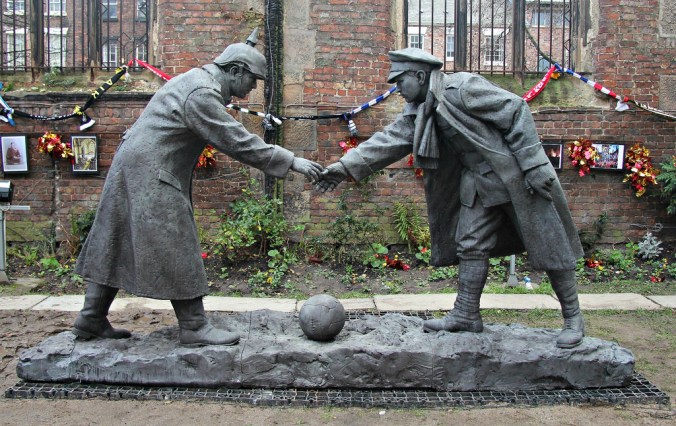
One of the weirdest events in world history took place on Christmas 1914, at the very beginning of the five year, pointless and stunningly destructive carnage of The Great War, what President Woodrow Wilson, right as usual, called “The War to End All Wars.”
World War I, as it was later called after the world war it caused succeeded it, led to the deaths of more than 25 million people, and if anything was accomplished by this carnage, I have yet to read about it.
The much sentimentalized event was a spontaneous Christmas truce, as soldiers on opposing sides on the Western Front, defying orders from superiors, pretended the war didn’t exist and left their trenches, put their weapons and animus aside, sang carols, shared food, buried their dead, and even played soccer against each other, as “The Christmas Truce” statue memorializes above.
The brass on both sides—this was a British and German phenomenon only—took steps to ensure that this would never happen again, and it never did.
It all began on Christmas Eve, when at 8:30 p.m. an officer of the Royal Irish Rifles reported to headquarters that “The Germans have illuminated their trenches, are singing songs and wishing us a Happy Xmas. Compliments are being exchanged but am nevertheless taking all military precautions.” The two sides progressed to serenading each other with Christmas carols, with the German combatants crooning “Silent Night,” and the British adversaries responding with “The First Noel.“ The war diary of the Scots Guards reported that a private “met a German Patrol and was given a glass of whisky and some cigars, and a message was sent back saying that if we didn’t fire at them, they would not fire at us.”
The same deal was struck spontaneously at other locales across the battlefield. Another British soldier reported that as Christmas Eve wound down into Christmas morning, “all down our line of trenches there came to our ears a greeting unique in war: ‘English soldier, English soldier, a merry Christmas, a merry Christmas!’” He wrote in a letter home that he heard,
“Come out, English soldier; come out here to us.” For some little time we were cautious, and did not even answer. Officers, fearing treachery, ordered the men to be silent. But up and down our line one heard the men answering that Christmas greeting from the enemy. How could we resist wishing each other a Merry Christmas, even though we might be at each other’s throats immediately afterwards? So we kept up a running conversation with the Germans, all the while our hands ready on our rifles. Blood and peace, enmity and fraternity—war’s most amazing paradox. The night wore on to dawn—a night made easier by songs from the German trenches, the pipings of piccolos and from our broad lines, laughter…“
A Smithsonian article opined that several factors worked together to produce the conditions for the strange spontaneous ceasefire:
“By December 1914, the men in the trenches were veterans, familiar enough with the realities of combat to have lost much of the idealism that they had carried into war in August, and most longed for an end to bloodshed. The war, they had believed, would be over by Christmas, yet there they were in Christmas week still muddied, cold and in battle. Then, on Christmas Eve itself, several weeks of mild but miserably soaking weather gave way to a sudden, hard frost, creating a dusting of ice and snow along the front that made the men on both sides feel that something spiritual was taking place.”
Fighting continued throughout Christmas in many places. It was the German troops, then regarded as “easy-going,” that made the first friendly overtures, shouting to their British adversaries, “We are Saxons, you are Anglo-Saxons! What is there for us to fight about?” That would not have worked during the next war. But then the trusting British were soon leaving their trenches, and as one British soldier wrote in a letter home—”literally hundreds of each side were out in no man’s land shaking hands.”
On the Eastern Front, the Russians, still using the old Julian calendar, believed Christmas was almost two weeks away. The French were in no mood to let bygones be bygones even for a day, since the Germans occupied a third of France.
In maybe two-thirds of the British-held trench line that ran across southern Belgium Christmas was the Most Wonderful Time of the Year. Both Germans and British soldiers reported that soccer games took place, mostly between pick-up teams of the same nationality, but in a few places, perhaps there were a few Krauts vs. Limeys contests.
The soldiers understood that the truce was only going to last through Christmas, and many officers on both sides were furious that it lasted that long. Most soldiers were determined to practice Peace on Earth at least until midnight. In one spot presents were even exchanged. That seems absurd to me, but there is documentation.On December 26, the fighting and killing resumed. There would be no further truce until the Armistice of November 1918.
I read one article that said that this bizarre event demonstrated “the importance of choosing to see past our momentary hatreds.” How does it demonstrate that? The “truce” saved no lives; it didn’t shorten the war, lead to more mercy and compassion or promote understanding. The victors in the First World War still enacted such punitive measures against the Germans that it seeded World War II.
Soldiers who operate under the delusion that warfare is a noble pursuit tempered with honor and mutual respect are deluding themselves. The idea is to kill people, and to end the war as quickly as possible. The “Christmas Truce” was incompetent and naive.
I should add that my attitude toward this famous tale was greatly influenced by an episode in my father’s World War II memoirs. He was relieving Allied troops that had taken a town, and was startled to see that the area appeared to be partitioned, with American soldiers on one side, and German soldiers going about their business on the other. “Oh, yeah,” he was told by the commanding officer he was relieving. “We made a deal to let Jerry alone on that side of the town, and they promised not to bother us. It’s great.”
My father had his troops march in and capture the peaceful Germans as soon as he took over. “The German commander was furious,” Dad wrote. “He said this proved you couldn’t trust Americans.”
 Ethics Alarms
Merry Christmas Jack!
I aagree that the truce makes no sense in the context of the war, but the stories still remind me that humans have some ethicalminstincts ingrained, and that gives me hope.
Merry Christmas Jack!
——
So how would you compare this one-time truce in WWI to the numerous accounts from our Civil War of the opposing troops fraternizing and trading with each other?
If the stories are to be believed, apparently just about any time the opposing armies were camped near each other, the pickets would engage in nocturnal greetings, chats, and trading. The most famous trades were rebel tobacco for union coffee, but I’m sure there were others.
You hear about soldiers trading notes and observations on their officers and generals versus the other side’s ones.
This sort of thing went on throughout the war, but never made a difference when it came to the fighting.
For me, I’ve always regarded this as a hopeful aspect to the war. The men actually doing the fighting and dying recognized that under it all, they were all Americans.
If I was a Civil War officer, I’d be concerned about this regular fraternizing being used as a cover for espionage shenanigans.
Different time, different kind of army. These were primarily volunteers (e.g. 20th Maine Volunteer Infantry Regiment), and I am sure they thought of themselves as citizen soldiers, in the army to do a job and then get on with their lives.
But at the same time they were veterans. By 1863/1864 you could argue that they were professional soldiers in all but name. In battle they fought hard, but I think they just didn’t feel that penny ante skirmishing between the armies camped nearby was worth it.
One of the incentives in 1864 to get Union soldiers to reenlist: If enough (75%) from a regiment reenlisted, that regiment could call itself ‘Veteran Volunteers’. Then and there it was a significant incentive.
If you ever have the chance, in the movie Gettysburg, the 20th Maine’s commander makes a speech to some men from another Maine regiment who had more or less mutinied. It’s a good speech on why they were there and why they fought. You can find it on You Tube – it’s worth a listen.
Men regularly traded and conversed across the lines in the Civil War. But the Civil War was a fundamentally different war from all others ethically speaking. It doesn’t even echo other countries’ civil wars.
Merry Christmas, Jack. Interesting story I had forgotten about. The part about your dad was new, though. 🙂
Merry Christmas!
Hope this doesn’t sound like nit-picking, but in the title you called the Christmas truce “strange but ethical”, but in the post you called it “incompetent and naive”. Seems contradictory.
Also, in the town your father took over, did the Americans at least confiscate the Germans’ vehicles and radios? If yes, then I can at least understand putting them under “house arrest”, (though still risky to allow freedom of movement). If no, then what were they thinking??
No, Dad said that they had everything and were acting as if they were in complete control.
As to the contradiction, yes, that’s a valid point. I usually don’t take both sides of a perception controversy simultaneously. The core question is: Is it ethical to stop trying to kill each other for a symbolic period to acknowledge shared humanity and the Christmas story? In a vacuum, sure. Can you evaluate it fairly in a vacuum? The apparent contradiction reflects my ambivalence, I guess.
Touching, but not ethical. The soldiers had a duty. And softening their resolve (especially the soldiers on the receiving end of the German’s unprovoked aggression) regarding their enemies reduces their ability to function in battle. Meaning other guys have to die filling the gap their laxity has created.
I wonder if the incident didn’t reflect the fact that the rank and file soldiers on either side has no idea what they were fighting about, and for good reason.