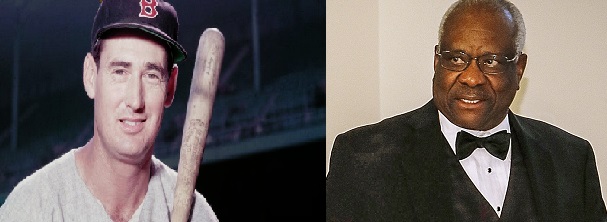
During the baseball off-season the MLB channel on DirecTV has a lot of dead time to fill between the periodic announcements of trades, free agent signings and post-season awards and honors. Lately it has been re-running an old Bob Castas show called “Studio 42” (that’s Jackie Robinson’s number) where the perpetually boyish-looking baseball commentator, who now really is Old Bob, interviews retired players and managers about significant games and moments in their careers.
In an episode I happened across this morning after my dog woke me up and then stole the bed as soon as I got out of it, Costas’s guest was the late, great manager Whitey Herzog, like so many successful baseball managers, a mediocre-to-poor player in his Major League career. Whitey told a story that is as good an example of the King’s Pass, #11 on the Rationalization List, as there is.
He said that in one game between the old Washington Senators (the first Senators, the team that moved to Minnesota and became the Twins) and the Red Sox in Boston, Ted Williams had drawn a walk on a 3-2 pitch right down the middle of the plate that the umpire had called a ball. Williams was famous for his plate discipline and above-average eyesight, and umpires frequently let him, opposing players complained, call his own balls and strikes because unpires acknowledged that he was better at it than they were. Herzog came to bat late in the same contest having walked four times and with a chance to set a record by getting five bases-on-balls in a single game. He told Costas that the umpire called him out on strikes on a 3-2 pitch in the dirt.
“I turned around and said to the ump, ‘You give Williams five strikes and give me only two. It should be the other way around!'”
This struck me particularly squarely because I had been thinking about the Judicial Conference declining to take any action against Supreme Court Justice Clarence Thomas, who has been the subject of a Senate Judiciary inquiry ever since ProPublica revealed that the Justice had neglected to report around half a million in luxury travel and gifts as legally required by the Ethics in Government Act of 1978.
In addition to Thomas enjoying lavish foreign vacations and lodging on the dime of a conservative billionaire, there is also evidence of donated tuition, housing, and and perhaps an RV. Democratic Congress members (their motivation was political, just as the failure of GOP members to do the same was) wrote the Judicial Conference asking it to follow Article III and refer Thomas’s violations to the Department of Justice.
Nah. In a letter \ to Senator Sheldon Whitehouse, Secretary of the Judicial Conference Judge Robert Conrad said that they had decided against referring the matter to DOJ because the Conference members had determined that Thomas’s violation was inadvertent and based on his misreading of the law, among other explanations and rationalizations.
The irony of excusing a sitting Supreme Court Justice, who should be an exemplar for other judges and the last government official to fail to obey conflict of interest laws, because he misread a statute is pretty extraordinary, even worse than giving the greatest hitter (okay, maybe second greatest) in baseball history the benefit of the doubt on strike calls.
In 2024, Ethics Alarms repeatedly pointed out that Thomas’s judicial ethics were unacceptable, and that he needed to resign. The throbbingly unethical nature of Thomas’s avoidance of accountability was only further rubbed in our metaphorical faces by Chief Justice Roberts’ 2024 Year-End Report, which began, annoyingly enough, by citing the attempts of King George to make the continuance of Colonial judgeships conditional upon ‘good behavior.’ The obvious potential for abuse with this standard was why, Roberts explains, the Founders insisted on lifetime tenure for federal judges as a means of ensuring their independence. However, that is not an excuse allowing a judge to engage in objectively bad behavior—that is, violating Federal law—like accepting oodles of valuable gifts and benefits from wealthy and politically active “friends” and not reporting it all as a statute requires.
But as Mel Brooks memorably said, “It’s good to be King!”
 Ethics Alarms
I’m ever hopeful that one of the first events of the second Trump Administration will be for Justice Thomas to announce his immediate retirement. One could make an argument that Thomas’ stance with regards to interpreting laws has never wavered (so outside influence hasn’t influenced him), but as you’ve written many times, the appearance is what matters. As much as I appreciate his service to the Court, his actions and appearances – far more than Justice Sotomayor’s infantile claims of crying after some decisions – are a blot on the body.
I will grudgingly grant you that Ted Williams was only the 2nd greatest hitter…after Ty Cobb. But Williams is probably my favorite hitter all-time.