…and their conduct in the Facebook matter is damaging to the profession of the law.
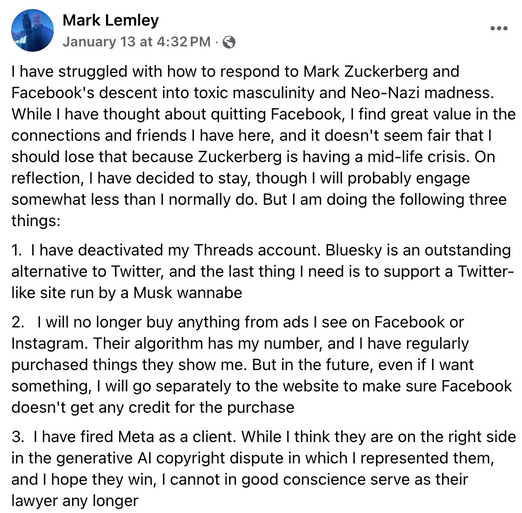
Intellectual property expert Mark Lemley, a professor at Stanford Law School and a partner at law firm Lex Lumina, represented Facebook in the copyright case brought on behalf of creators claiming the platform infringed their intellectual property. Yesterday he “fired” his client, despite believing that Meta’s case was strong. His stated reason was that he is outraged at Mark Zuckerberg and Meta’s “descent into toxic masculinity and Neo-Nazi madness.” His law firm then proceeded to back him up.
Here is Lemley’s Facebook post announcing his decision:
Meanwhile, the managing partner of his woke law firm followed with the statement that “Money can’t buy everyone. We’re proud to be a firm that doesn’t sell out our values. Sadly, it seems this is becoming a rarer and rarer quality in America today.” Another partner said, “When we started Lex Lumina, one of the things we committed to was only taking cases we felt good about, on the law and in terms of who we represented. Proud to be working with my friend and partner, Mark Lemley, who lived out our commitment today.”
This is labeling unethical lawyer conduct as ethical.
Lemley went on to post a reiteration of his decision on LinkedIn. It wasn’t “the right call.” If Lemley and his firm had refused to represent Meta in the case of Kadrey v. Meta Platforms initially, there would be no ethics foul: nothing in the Rules of Professional Conduct mandates that any lawyer accept any client, although the traditional ethos of the profession strongly encourages lawyers to do so. However, dropping a client because of what that client has done or said that has nothing to do with the case of the representation, while not a strict rules violation, is unprofessional and creates a dangerous slippery slope…one that many in the legal profession have been leaping down in recent years.
Noteworthy is the fact that Lemley is no legal ethics expert. His actions demonstrate that vividly, and his post is a flashing sign stating, “I am biased, Trump Deranged, a Democrat, and believe in good censorship.” Got it, Professor.
Naturally, the woke legal hacks at Above the Law love this, and ratioanalizes it with an argument that has been rife since the corrupted legal profession started behaving like the restaurants who won’t serve people wearing MAGA caps. Joe Patrice, the head ideologue at Above the Law writes,
A sanctimonious segment of the legal profession harps on the idea that “everyone is entitled an attorney.” Except no one is entitled to you as an attorney. Frankly, no one is entitled to anything in a civil case and to the extent society needs to extend more protections to indigent clients on the wrong end of life-altering civil actions — landlord-tenant cases for instance — there’s definitely no such entitlement for a multibillion-dollar company in a copyright dispute.
Representing a client is a business decision. Some lawyers thrive as counsel of last resort and model their business around the willingness to represent unpopular clients. Other lawyers build their business on crusading for good causes. A whole lot of lawyers exist somewhere between those poles. In fact, a lot of deep-pocketed clients also don’t want to work with firms associated with unpopular causes — that’s a business decision too.
There’s nothing wrong with any of these approaches. Lawyers should feel free to build their practice however they want.
What is wrong with that argument is that it violates Kant’s Rule of Universality, the “What if everybody did it” test that is part of the philosopher’s categorical imperative. Patrice’s standard, and accepting Lemley’s conduct, would mean that certain citizens and organizations could be left without legal representation entirely because they were regarded by a politicized legal profession (and an ethically addled public) as “bad.” While it is accurate to assert that the Sixth Amendment does not guarantee a citizen legal representation in a civil (as opposed to a criminal) case, the legal professional has long embraced the principle that the same ethical and practical justifications should apply. If we accept Patrice’s ethically ignorant (or deliberately misleading) argument that whether to accept a representation is purely a business decision, that allows lawyers and firms to avoid unpopular clients, leaving them potentially at the mercy of the polls and bias in a rigged legal system.
This is what the actions of Lemley and his firm are pointing to. It is the reason Donald Trump has had difficulty hiring lawyers and getting competent legal assistance. Firms and lawyers get threatened by clients, and in the constant tug-of-war between the profession of law and the business of law, business now prevails. Once, before the progressive bias in laws schools and among lawyers became the status quo, the mission of representing unpopular causes and clients, even when the attorneys for these clients personally disagreed with and even deplored their conduct was seen as part of the legal profession’s mission. Wall Street lawyers represented accused terrorists after the bombings of 9/11 after public figures called for their firms to be boycotted. When Coca-Cola virtually extorted their law firm into dropping its representation of the House Committee defending the Defense of Marriage Act before the Supreme Court, the partner handling the case, Paul Clement, wrote in his letter of resignation in protest of the decision, that “defending unpopular positions is what lawyers do.” Similarly defending unpopular clients is what lawyers must do and be honored for, or we have no longer have an equitable legal system.
The unethical principle Lemley is advocating is worse than opposing taking on an unpopular position: he seeks to justify abandoning a position he feels is valid because his client’s policies no longer please him. I have vowed to promote this section of the Rules of Professional Conduct because it is such a crucial one for maintaining the integrity of the profession and trust in its members:
“A lawyer’s representation of a client, including representation by appointment, does not constitute an endorsement of the client’s political, economic, social or moral views or activities.”
It should be obvious that if it becomes acceptable for lawyers and firms to refuse representations because they fear being regarded as endorsing a clients’ “political, economic, social or moral views or activities,” the legal profession will have nullified that critical standard in practice, and the public will be correct to assume that if a lawyer or firm represents an unpopular cause or individual, those lawyers agree with and endorse them. This is what ideologues like Joe Patrice want, a legal system as polarized as the political system, where one can tell the “good” lawyers from the “bad” lawyers by whom they choose to represent.
Dropping a client one has already accepted, which is what Lemley has done, is worse still. In his letter excoriating his former firm, Clement quoted Griffin Bell, a judge and former U.S. Attorney General, declaring that once a lawyer has accepted a case, it is the lawyer’s duty and ethical obligation to continue the representation. In 2011, when the DOMA controversy erupted, Clement’s position was almost unanimously praised within the profession. Theodore Olson, the late conservative attorney, praised Clement’s “abilities, integrity, and professionalism”.” Olson, who like Clement was a solicitor general during the George W. Bush administration and was a successful Supreme Court advocate, told the media, “I think it’s important for lawyers to be willing to represent unpopular and controversial clients and causes, and that when Paul agreed to do that, he was acting in the best tradition of the legal profession.” Seth Waxman, who served as solicitor general during the Bill Clinton administration, said, “I think it’s important for lawyers on the other side of the political divide from Paul, who’s a very fine lawyer, to reaffirm what Paul wrote. Paul is entirely correct that our adversary system depends on vigorous advocates being willing to take on even very unpopular positions.” In approving Clement’s stand, The Washingtonian observed, “There are countless examples of law firms taking on and standing by controversial clients, even at the risk of their public images.” There are fewer and fewer examples now, however. This is the dystopian legal landscape that Lemley and his firm are promoting, and it is an unethical one.
Legal ethics Rule 1.16 lays out the ethical justifications for “firing” a client:
“A lawyer may withdraw from representing a client if: (1) withdrawal can be accomplished without material adverse effect on the interests of the client; (2) the client persists in a course of action involving the lawyer’s services that the lawyer reasonably believes is criminal or fraudulent; (3) the client has used the lawyer’s services to perpetrate a crime or fraud; (4) the client insists upon taking action that the lawyer considers repugnant or with which the lawyer has a fundamental disagreement; (5) the client fails substantially to fulfill an obligation to the lawyer regarding the lawyer’s services and has been given reasonable warning that the lawyer will withdraw unless the obligation is fulfilled; (6) the representation will result in an unreasonable financial burden on the lawyer or has been rendered unreasonably difficult by the client; or (7) other good cause for withdrawal exists.”
Because Lemley and his firm can rely on the deliberately vague and broad provisions (4) and (6), the withdrawal is not a black letter ethical violation. However, as I often point out in my classes, the rules are the rock bottom of ethical mandates. Professionalism requires higher standards than barely minimal compliance.
Moreover, the manner in which Lemley fired Meta not only is likely to have adverse effects on his ex-client (prohibited by Rule 1.16 1 b (1) above) , but was intended to have adverse effects. In the District of Columbia, there is an admirable rule (1.3, Diligence and Zeal) that states in part, “A lawyer shall not intentionally….(2) Prejudice or damage a client during the course of the professional relationship.”
That is exactly what Lemley in his social media posts set out to do. The professor and his firm would argue that his conduct may be unethical in the District of Columbia, but he’s not practicing there. No, the conduct is an ethics rules violation in D.C., but a lawyer deliberately harming his client is unethical regardless of the rules.
You can quote me.
Jonathan Turley, a law professor who also doesn’t specialize in ethics but whose ethics alarms function well, reverted to wishy-washy rhetoric because he was criticizing a fellow academic, noting that “the media is aflame with stories of how even Zuckerberg’s own lawyer and law firm cannot abide him” and called Lemley’s statements “deeply problematic.” No, Professor, they are more than problematic; they are unethical, destructive to the profession of law and corrupting. The firing of Meta would be unethical if its actions having nothing to do with Lemley’s representation were genuinely “repugnant.” That what triggered Lemley and his firm’s public rebuke was a policy protecting free speech is especially damning.
 Ethics Alarms
I gguess the irony here is that anyone can hire a lawyer to force a business to do something the business owner feels violates tbeir religious beliefs but a lawyer can refuse to represent a client they feel somehow violates their ethical/moral POV.
They can, but they won’t have my respect.
I’m sure Joe Patrice similarly lauds bakeries when they refuse to make a cake that represents something they abhor…
I gguess the irony here is that anyone can hire a lawyer to force a business to do something the business owner feels violates tbeir religious beliefs but a lawyer can refuse to represent a client they feel somehow violates their ethical/moral POV.
Did Lemley happen to give any examples of Zuckerberg’s Neo-Nazism or “toxic masculinity?” Or are we meant to understand these are merely the generic slurs approved by Progressives for smearing any who disagree with them?
The latter, Dave. Zuck’s gotten into martial arts and permed his hair. Clearly toxic masculinity. And isn’t “toxic masculinity” inherently redundant? I mean, isn’t masculinity per se toxic?
That’s awful behavior. If you fire a client, just tell the client and otherwise keep your mouth shut. Jeeze, you’re not even supposed to tell anyone you represent a client without the client’s consent. This is the worst sort of virtue signaling imaginable. Cue, “What’s wrong with these people?”
Old Bill,
That was one of my points. As I read his post, I immediately thought about the Noisy Withdrawal.
https://abi.org/abi-journal/noisy-withdrawals-urban-bankruptcy-legend-or-invaluable-ethical-tool
From the link: “a noisy withdrawal is a withdrawal from the representation of a client accomplished by a disavow of work product provided by the attorney. The ABA Committee on Ethics and Professional Responsibility concluded that an attorney could only make a “noisy withdrawal” if the attorney’s work product was being used or was intended to be used in a future fraud or criminal activity. Opinion 92-366 stated that a noisy withdrawal was a permissive step the attorney could take, not a required step. In fact, the ABA Committee further held that if a fraud had already been completed, or if the attorney did not know or reasonably believe that the client would continue the fraud or commit a future fraud through the use of the attorney services or work product, the attorney could not make a noisy withdrawal.”
It was completely uncalled for (even unethical) for him to bad-mouth Zuckerberg on his way out the door. Though I do not believe for an instant that Zuckerberg is a Neo-Nazi, the claim that he has descended into Neo-Nazi madness could suggest that the lawyer is disclosing things to the public that the public might not know. In the industry, we call such information “confidential information.”
I think it is fair to ask what information this lawyer has acquired in the course and scope of his representation of Zuckerberg that warrants the neo-Nazi label
He should be disciplined not only for withdrawing, but for the way he did it.
-Jut
“I think it is fair to ask what information this lawyer has acquired in the course and scope of his representation of Zuckerberg that warrants the neo-Nazi label.”
Jut, you are a lawyer’s lawyer. So thorough and fair minded. Me, as stated above, I assume the guy is just virtue signaling. You’ll make a great judge if you ever want to go onto the bench.
Exactly what I wondered.
Presuming there aren’t any — what does the Lawyer Code of Ethics have to say about defaming a client?
Well, Zuckerberg has recently spoken favorably of the concept of free speech and against censorship. That is he real reason for dropping him as a client. From what I can see, the legal profession hates individuals who insist that they have rights (see below).
As for a case where a client can’t find a lawyer, in Young v. Hawaii, Young couldn’t find a single attorney in the entire state to represent him. He won before a 3 member appeals court in the 9th district representing himself demanding the right to possess and carry a firearm in public. Of course, the entire 9th Circuit was horrified that someone might get firearms rights, so the whole 9th Circuit heard the appeal of the appeal and defeated it (Young had legal representation which may have been responsible for the defeat). This was overruled by a Supreme Court decision, which was overruled by the Hawaii State Supreme Court. The Hawaii Supreme Court surprisingly ruled that the “Spirit of Aloha” overrules the Constitution and the Supreme Court. The Second Amendment does not apply to Hawaii because of the “Spirit of Aloha”. I think Texas should have just started deporting illegal aliens and voided all federal firearms and environmental regulations because they violate ‘Don’t Mess with Texas’.
I really think that at this point, we need to demand a separate bar association and law schools for Republicans. Since lawyers want to be partisan, the law needs to recognize the partisan nature of the legal profession and allow the 50% of the population currently excluded from the full legal system to have equal access. This should apply to state supported colleges and K-12 schools as well (which have a similar situation).
“We’re proud to be a firm that doesn’t sell out our values.”
My first cynical thought was: what values? We don’t have values. We give voice to the values of our clients, as base and self-serving as those values typically are.
When topics like this come up, I just have to remind myself: I represent criminals. Criminal activity is not one of my values.
If anything: the profession should state what appears in courthouses across the country: Equal Justice Under the Law. A lawyer’s personal values should not enter into the equation.
What would we (or the AVMA) think if Zuckerberg’s veterinarian posted something stating that he would no longer treat Zuckerberg’s Lhasa Apso puppy because of Zuckerberg’s descent into Neo-Nazi madness? I think such a veterinarian would roundly (and rightly) be criticized as an asshole. (Blondi, Adolf Hitler’s dog, wouldn’t stand a chance with this sort of mindset.)
That may not be the perfect analogy, the better one being Zuckerberg’s own physician. Or, a specialist. “yes, I am one of three neurosurgeons that could successfully remove Zuckerberg’s brain tumor, but I don’t like his toxic masculinity, so the other two doctors can help him. After all, he is not entitled to MY medical care.”
-Jut
I think this is a big deal, and, naturally, nobody on the networks bother to talk to people like me about it (or you). And the legal ethics listserv is largely choosing to ignore it.
I’ve long thought the demise of the American academy into Marxism over the last fifty or so years was the greatest tragedy of my lifetime. I’m thinking the demise of the legal profession and law schools in the last twenty or so years is right up there and possibly worse. What ever happened to having a sense of professionalism? When I was practicing, I sure felt there were all kinds of guardrails and rules to which people deferred even as they represented their clients aggressively and to the extent possible. And when people crossed the line, they were nailed by the bar or the judiciary and would be fired if they were in firms (even partners) or otherwise employed. There were consequences and everyone knew there were. I guess now it’s “Meh. Not so much.” Grrr.