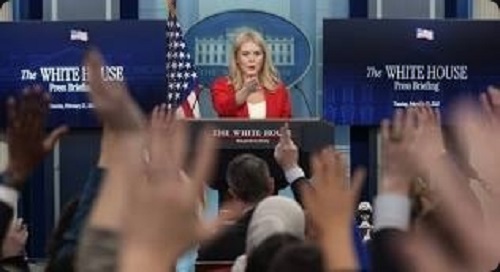
The Trump administration announced today that it would choose which media outlets participates in the Presidential press pool.
Good!
“In announcing plans to hand-select the reporters who can ask the president questions at many events,” the New York Times intoned darkly, “the White House is breaking decades of precedent.” Oh NO! Another “democratic norm” breached!
Naturally, the White House Correspondents’ Association, which was delegated the job back when the entire journalism establishment wasn’t allied with a single party and dedicated to bringing down the administration of any elected President who didn’t embrace their policy preferences, attacked the change in the manner of a proverbial stuck pig. “This move tears at the independence of a free press in the United States,” wrote Eugene Daniels, a Politico reporter and the president of the association. “It suggests the government will choose the journalists who cover the President. In a free country, leaders must not be able to choose their own press corps.”
In a functioning democracy, journalists exist to inform the public, not to bend elections to the will of the news outlets. Calling the current news media independent insults the intelligence of anyone who has been paying attention to the deterioration of journalism ethics, aka. honesty, fairness, transparency, objectivity, competence and independence, over the past two decades.
Also, any Politico reporters should be hiding his head under a bag after the revelations about how it accepted “subscriptions” from the Biden Administration while covering it, and mostly positively at that. Here’s the unbiased Politico headline of today’s announcement: “White House seizes control of press pool, will decide which outlets cover events with President.” Oooh, “seizes!” Scary! Sounds awfully Hitler-y doesn’t it? The White House didn’t “seize” anything: it has always had the power to decide who attends press briefings, and it is asserting it.
The Times goes on to say, “The pool is most often made up of journalists from organizations like CNN (anti-Trump biased), Reuters(anti-Trump biased) , The Associated Press(anti-Trump biased) , ABC News (anti-Trump biased), Fox News (pro-Trump biased) and The New York Times (spectacularly anti-Trump biased).
Those parenthetical comments are mine. And absolutely accurate.
Proving the wisdom of the new policy, the Times news report includes such partisan editorializing as “the pool format ensures that the public is provided with an accurate record of a President’s comments and actions” (No it doesn’t, not when determined partisans like Jim Acosta are asking questions); “Tuesday’s announcement was the latest in a string of aggressive efforts by the Trump administration to erode the access and influence of major news organizations that cover the White House” (When those organizations are seeking to undermine a Presidency rather than accurately inform the public about it, their influence ought to be eroded); and “It is a sharp break from generations of Republican and Democratic presidents who abided by the White House press corps’ deciding on its own which reporters were granted more access” (Yes, because for the decades until Trump became President, the media, while often biased, did not make obstructing a President its mission).
The Times also quotes a First Amendment advocacy group, the Reporters Committee for Freedom of the Press, which complained that the move represented “a drastic change in how the public obtains information about its government.” Again: that change became cricial when the press began being a government lackey when Democrats were in power. The decisive rebuttal is obvious: If the system as it was worked so well, why didn’t any of those “legacy media organizations” inform the American public for four years that their President was cognitively disabled, and that unelected aides and relatives were doing his job?
The group’s president, Bruce D. Brown, continued, “The White House press pool exists to serve the public, not the Presidency.” Fine. But it hasn’t been serving the public for a very long time. This change was overdue.
 Ethics Alarms
You’re right. The decimation of the press over the last thirty years has been worse than the destruction of the American academy. You’re right to cover it. But the latter is very close.
No one is stopping any of these news outlets from reporting on the President. Plenty of articles are published by news sources without a reporter in the briefing room.
The tremendous irony here is that the press writ large, regardless of the orientation of individual outlets, has access to Trump himself several orders of magnitude greater than that which was offered by Biden. Or Obama, for that matter.
Trump genuinely enjoys sparring with them. The Oval Office is littered with reporters when he’s signing EOs, and reporters who aren’t in the room can easily cover those events simply by watching Fox (which usually airs them live). If he’s walking ‘twixt the house and Marine 1, there’s invariably a phalanx and Trump will take questions from anyone within earshot.
That mainstream outlets are howling about this change, in light of the fact that they actually have true access, is all the proof we need that they’re not actually in the business of gathering news. They’re in the business of creating it.
Furthermore, it is not unprecedented for a President to set terms and conditions for reporters to have access to him.
https://www.jstor.org/stable/20024820?seq=1
In a nutshell, Theodore Roosevelt made it clear from the get-go (Please read the whole thing, but the relevant part is below).
” According to one source, he put Keen to the test right away by using the meeting to deliver a scathing indictment of the old guard in his party. “If you even hint where you got it,” Roosevelt warned when he had finished, “I’ll say you are a damned liar.” He would do more than that. Roosevelt told the wire representatives that a reporter who violated his trust would be mercilessly cut off from further access to news. He would even take
steps to deny legitimate news to the paper or agency that employed the offending reporter. The ground rules could not have been made more clear. “All right, gentlemen, now we understand each other,” the president said in adjourning the meeting.
Roosevelt proved to be as good as his word over the next seven years. He
divided newsmen into distinct groups of insiders and outsiders, and was
unforgiving in banishing those that he felt, justifiably or not, had betrayed him.
The order went out consigning them to the Ananias Club, named after the New
Testament character who, having lied about holding back part of a gift to the
Church, was rebuked by Peter and fell dead. Members of the club -and their numbers grew by the years – were dead in the eyes of the White House.”
In his first press conference after becoming President, FDR echoed his famous cousin (and wife’s uncle) by warning journalists, “Then there are two other matters we will talk about: The first is “background information”, which means material which can be used by all of you on your own authority and responsibility, not to be attributed to the White House, because I do not want to have to revive the Ananias Club.”
“Then the second thing is the “off the record” information which means, of course, confidential information which is given only to those who attend the conference. Now there is one thing I want to say right now about which I think you will go along with me. I want to ask you not to repeat this “off the record” confidential information either to your own editors or to your associates who are not here; because there is always the danger that, while you people may not violate the rule, somebody may forget to say, “This is off the record and confidential,” and the other party may use it in a story. That is to say, it is not to be used and not to be told to those fellows who happen not to come around to the conference. In other words, it is only for those present.”
Source: https://www.presidency.ucsb.edu/documents/press-conference-25
We can debate whether or not it is right or ethical for a President to set terms for favored press outlets, to give information to one over the other, etc. But President Trump is hardly the first Chief Executive to limit access to him or even the first to limit access based on what they write about him. These are just two relatively modern examples, including both a Republican and a Democratic icon.
Of course, a modern, technologically-astute press with an interest in informing the public would be able explain this; however, much of the modern press is bent on turning President Trump into The Other. Letting readers know about this easily available Presidential history conflicts with their narrative.
Comment of the Day, and one that fills a gap that I shouldn’t have ignored.
Thanks. This topic has been churning around in my head for a couple of days. I knew I’d read about TR doing something like this (and that FDR had threatened the same), but he did so many things and a lot of the negatives are dwarfed by the positives so you don’t read too much about his attitude toward the press. I was wracking my brain to remember which book I’d read about it in because my sister and some of her hysterical friends are viewing this whole issue as a sign of the apocalypse (possibly The Bully Pulpit: Theodore Roosevelt and the Golden Age of Journalism, by Doris Kearns Goodwin? Don’t quote me on that).
I finally decided to Google the thing and got the results in the links above in about 30 seconds. Any competent journalist can do the same.
Comment in moderation, probably due to a couple of links.
“the pool format ensures that the public is provided with an accurate record of a President’s comments and actions”
Did they actually type that with a straight face?
Especially in light of the aforementioned first press conference by FDR which also included this gem, “Then, in regard to news announcements, Steve (Early, Assistant Secretary to the President) and I thought that it would be best that straight news for use from this office should always be without direct quotations. In other words, I do not want to be directly quoted, unless direct quotations are given out by Steve in writing. That makes that perfectly clear.”
The truth of the matter is that the press corps will gladly kow-tow to a President they like or perceive has the power to shut them out. It isn’t about an accurate record to provide the public at all.