Aleysha Ortiz, 19, has sued the Hartford Board of Education and city officials alleging that she cannot read or write even though she graduated with honors from Hartford Public High School in 2024. Her suit accuses defendants of negligence by failing to provide adequate special education services. She told CNN that she was promoted all the way through 12 years in Hartford public school despite never acquiring fundamental literacy skills; in a May 2024 city council meeting, she testified that she was unable to read or write, yet was awarded an honors diploma.
Ortiz is now enrolled at the University of Connecticut: yes, she was accepted and got a scholarship despite being, in her own assessment, illiterate. She explains this by her adeptness in using technology such as speech-to-text and text-to-speech programs.
Says Newsweek, amusingly, “The case has drawn attention to how academic achievement is measured and whether special education students are truly receiving the skills they need to succeed beyond high school.”
Ya think??? Also, “Additionally, it raises questions about how colleges assess applicants, especially those facing severe academic challenges.” Why yes, I suppose it does prompt such considerations.
But what’s the question? When I worked in the administration of Georgetown Law center decades ago, we dealt with law school admittees showing up unable to read above a sixth grade level and not being able to write at all. This is not a new phenomenon, except the suing part. (Georgetown got sued by one of its illiterate first year students, but on the grounds that making him take remedial courses in reading and writing subjected him to a “stigma.”) I have related the story here before about an intern I was assigned at the U.S. Chamber of Commerce who had all As from the University of Michigan, but couldn’t write a coherent sentence. Come to think of it, I told her that she should sue.
UConn explained that Aleysha was admitted because it uses a “holistic application process.” UConn doesn’t require SAT scores because they are discriminatory: for example, they put students who are illiterate like Aleysha at a disadvantage. The school explains that its admissions department evaluates applications based on GPA, coursework, extracurricular activities and essays.
Ms. Ortiz found that technology was sufficient to get her through high school, but not college. Hartford Public Schools said in a statement to CNN: “While Hartford Public Schools cannot comment on pending litigation, we remain deeply committed to meeting the full range of needs our students bring with them when they enter our schools—and helping them reach their full potential.” That statement reads like it was written by ChatBot GPT.
Aleysha Ortiz essentially cheated her way through school, and now is suing because her schools let her cheat. The old joke about the man who killed his parents asking for mercy because he was orphan comes to mind. What did she expect to be the outcome if she avoided learning how to read and write using technological crutches?
I hope this lawsuit is laughed out of court. Besides, as long as Aleysha learned about systemic racism, the evils of capitalism, intersectionality and the fluid nature of gender, her education was a success….
 Ethics Alarms
“as long as Aleysha learned about systemic racism, the evils of capitalism, intersectionality and the fluid nature of gender, her education was a success“
One’s left to ponder her familiarity with the BLM Manifesto and chapter and verse of the 1619 Project.
PWS
Life imitating art?
https://en.wikipedia.org/wiki/Teachers_(film)
-Jut
Jack,
I would like to respectfully disagree that this is a frivolous lawsuit, or that Aleysha Ortiz “cheated” to get through high school. My daughter is a special needs student, and all of the school officials I have spoken to, along with the educational psychologists that I have worked with outside of the official school framework (I am a homeschooling parent) emphasize the usage of technology for students who have trouble reading and writing. The amount of times that I have been told that my daughter needs to use Speech-to-Text and Text-to-Speech technology is nearly uncountable. If a student is dyslexic, these are the go-to answers. If a student is behind in reading or writing, this is still the go-to answer.
A student who relies only on these highly recommended technologies will not perform as well as a student who is encouraged to use those to HELP overcome the disability, but still have to learn to read and write on their own. I use the technology, but only as an aid. My experience with special education professionals is that a majority seem to view technology as the solution, not an aid. I have been told many times that my daughter will never read or write. I have decided not to believe that, and my daughter, while definitely behind, is making progress in both reading and writing. However, she got a dyslexia diagnosis about two years before the average student in a public school, and an ADHD diagnosis about 4- 6 years before the average student in a public school. We are making progress, but it requires a lot of work, more than most public schools can give kids.
I got into homeschooling because I have been tutoring honors students who go to college and fail, knowing nothing of rudimentary reading, writing, or arithmetic. It is very common to push kids forward, in my experience, without proving that they are adequately educated. If they are good kids who don’t misbehave, they often get the “honor’s student” title. I have seen a salutatorian who could not do fifth grade math, but knew how to use a calculator to get by, as long as the teachers allowed the calculator. The school decided that he had a learning disability in math, was incapable of learning math and so granted him permission to use a calculator for every math assignment. With a calculator and an aide, he got through high school math without being able to do something as simple as multiply 7×8. He was not incapable of learning math, but he had been told that so long that he couldn’t believe anything else and it was a long hard slog to get him through a remedial math course with a barely passing grade.
To make things worse, students are increasingly getting labeled as special needs. 25% of the 2024-2025 1st grade class in my local grade school is labeled as special education. Autism diagnoses have exploded. Some of these kids are suffering from parents who don’t care. Others really are autistic. Some of them lost any sense of dealing with other human beings normally since they were in daycares, preschool, and kindergarten with no bare faces available, only masked ones. No one knows if there are dyslexics or ADHD kids, just autism at this point. Special Education teachers are overwhelmed. One woman I know has a special education class of 25 students. She previously has been responsible for a maximum of eight, which she says is a very high number for a single professional to handle. She has no time to give kids what they need, only the bare minimum.
I don’t know what makes a lawsuit frivolous, but I do think that we have a real problem that is not frivolous. Teachers and administrators tell kids that they have a learning disability (many but not all probably do) and that they MUST use technology to get by. There is only so much that is done to remediate them, and if they can stay out of trouble, they can get through school with accolades, whether or not they understand the material. They are encouraged to only do the bare minimum by the people who are supposed to be helping them, and when the real world catches up to them, what can they do? Perhaps lawsuits will fix the broken education system in this country, as I’m not sure what else can fix our problem.
Great comment (do you ever post a weak one?)as usual.
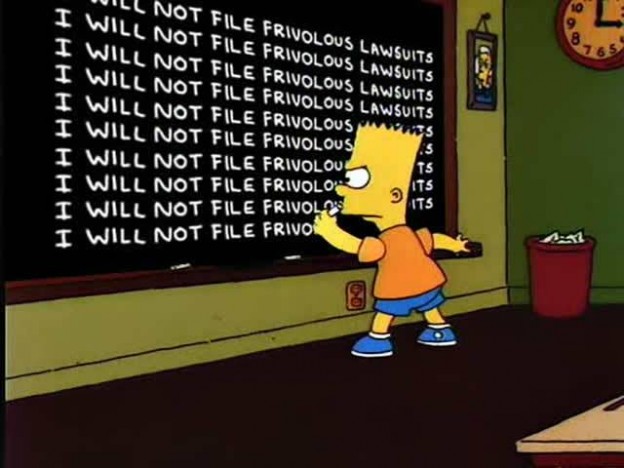
In my defense, I don’t think that law suit is frivolous, but I had to use that shot from The Simpsons anyway because it hit so many of the points. I do think it’s a BAD lawsuit, and will get thrown out. I was frustrated because none of the accounts detailed what kind of special needs this woman has and what the school’s role was in having her use the technology. If her problems, whatever they were, were as serious as the ones you describe, then I don’t understand why she wasn’t in a special school or program. Ultimately, her parents were responsible for saying, “Wait a minute, all this assistance isn’t helping her learn to read or write.”
I take your point on “cheating,” but reluctantly. I view these issues like the English language controversy: I’m sorry a student has this challenge to overcome, but the individual needs to overcome. I know and have worked with a lot of dyslexics and ADD people (you’d be amazed at how many actors are dyslexic). When I taught ethics in law school, I had students who were given extra time on exams because of “special needs.” I object to it; it’s unfair to the other students. In court, no judge is going to give extra time to a lawyer whatever his or her problem might be.
if you look up interviews she has done, you will find that this technology was not sanctioned or encouraged by her IEP or disability services, was not an accommodation, but rather was explicitly cheating that she got away with because COVID 19 made her classes online. Per her own testimony she would fake connectivity or technology issues and then use these apps in secret on exams, assignments, and classwork, then pass the work off as her own. She alludes to the possibility of dyslexia, but the department that did the comprehensive testing said she did not meet criteria for it, and she failed to demonstrate proficiency in any field. Her results were reflective of someone who had never been to school. She wanted a diagnosis of dyslexia so she could keep pulling the same con in college and it didn’t work. Now she is cosplaying as having dyslexia, pretending to be a disabled student who tried in earnest to succeed but fell through the cracks, when in reality…between the dangerous classroom behavior, accusations against anyone who tried to help her, and rampant academic dishonesty the person she should be suing is herself. It is indeed a frivolous lawsuit. This lawsuit is horse suing rider because she is still thirsty after standing at the water’s edge all day, hoping people will assume it’s just another horse that was never led to water.
I could do a whole book on this topic but only have time for a couple of thoughts.
Students who can’t read/write beyond grade school level get promoted all the time. Repeating a grade due to poor performance is almost extinct due to various social/political reasons, so regardless of ability, they move on with the rest of the herd.
Districts have benchmarks to meet for graduation and test passage rates. Failing to pass and graduate a student affects the scores. If a student has an IEP or is still within the ESL system, they often are exempt from needing to pass certain tests to graduate. Because of this, they often cannot perform at grade level (or even close) but there’s no repercussion.
Education is downstream of culture and technology. Removing phones from school (current trend) won’t fix the issue. Using any electronic device, which is pretty much mandatory, allows the use of AI and, at minimum copy/paste, to cheat. We see it all the time. There is typically little or no consequence for cheating, even when students are taking college credit classes in HS.
Much of education comes from home, if there’s no respect/time/ability for education in the household, it is nearly impossible to instill that ethic into a student. Without support from home and from higher up in the system, things won’t change.