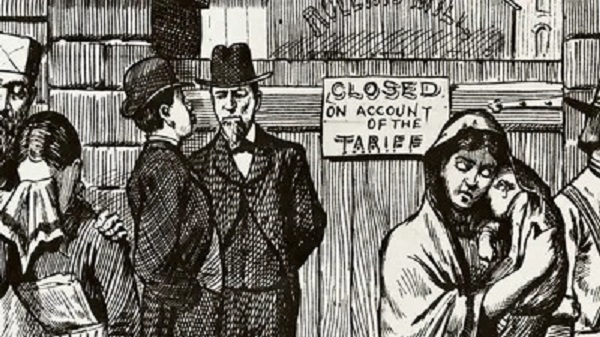
I meant to post this retort to Steve Witherspoon’s guest column yesterday (as it was “Tariffs Monday” at Ethics Alarms, but was waylaid by life. Canadian EA correspondent Humble Talent began a long and lively debate thread with his Comment of the Day, and I encourage you to read it all, here. Meanwhile, here’s Humble…
Oh! I almost forgot: I read another anti-tariff piece today titled “I Shot the Tariff.” I should have thought of that. Phooey.
…
I’m always disappointed when there’s something that I’m actually familiar with in the media, because a lot of the media smudging that happens around the areas that they’re familiar with stand out like a sore thumb.
Tariffs have been one of those things. And this attack on Free Trade is another.
You want to know what’s bullshit? The idea that any nation can pull of autarky (“a system where a country or region aims for self-sufficiency, minimizing or eliminating international trade and relying primarily on its own resources and production.”) No one can pull off autarky and maintain efficiency, product diversity, and quality of life. You will eventually need to trade for something.
You want an example for America? Potash. There are exactly three active potash mines in America, because the resource effectively does not exist in America. You import 96% of potash used for crop fertilizer. Without potash imports, you would be unable to add phosphorus to your crop input chemistry, and your yields would suffer. Which would then impact your already insufficient food production system. Your people would literally starve. Which means there will be trade.
Once you pass the hurdle that you’re going to trade, the question becomes how you trade, and the freer trade is, generally, the better off your people are. What Steve whistled past the graveyard on is how America was out-competed. Why those jobs were lost. It’s not good enough to say that American workers are losing their jobs, and therefore Americans are worse off. Because your personal experience is not indicative of the experience of the average American. Steve said:
“Canada has been undermining aluminum and stainless steel manufacturing in the USA for over twenty years, as they practiced their unfair “free trade” with us unabated.”
What exactly do you think Canadians were doing that was so bad? Producing rocket-grade aluminum cheaper than you were able to? The absolute, unmitigated horror!
If American steel is expensive because American regulations and laws make American steel a premium product (and you’ll get no argument from me: Americans make great steel), the price comparison against your competitors price may cause consumers to decide to go with less premium product, particularly for uses that don’t require a premium product…. And in those cases, what’s happened is that you’ve been out-competed. Someone else was able to offer a more right-sized product at a right-sized price, and yeah… Sucks for the guys in the factory… But do you know who wins? The American consumer. Because the inputs for the products they buy are less expensive, the products they buy will be less expensive. As markets find efficiencies, they naturally deliver to the consumer a market-driven balance of function and price.
This is the entire basis for the increase in quality of life over the last hundred years: Even as wealth disparity increases, the amount of things we own, the luxuries we enjoy, have ramped up exponentially across all income brackets. You have families with multiple cars, phones in their pockets, personal computers, and TVs, dishwashers, clothes washers, power tools, vacuum cleaners, basically universal interior plumbing and 24/7 electricity, these are things that your ancestors did not have and could not have dreamed of, and they are by and large the products of free trade.
But there are stopping points. Like Steve said, if you’re out-competed to the point where you have no domestic production, and all of a sudden your competitor ramps down production like Canada did with stainless steel, then you’re in a pretty shitty situation. It would be fair in situations like that if a country decided that as a matter of national security, certain trade barriers or subsidies could be enacted in order to protect markets that aren’t particularly competitive in the national market, so that in the case of emergencies you’d have domestic production to fall back on.
Kind of like what Canada has done with dairy.
Canadian dairy producers aren’t competitive, and I make no bones about it. Our winters are colder, our logistical lines are longer, and our markets are more niche, this leads to a reality where our prices should be much higher than they are in America, and a reality where they are still slightly higher than in America. In theory, we should give up on local dairy production and import everything from America…. Except I’m old enough to remember the BSE outbreak that meant that we couldn’t import American beef products for a while, and if there were ever a reason that America couldn’t (or wouldn’t) supply Canada with dairy, we’d be in a rough place. So we subsidize our market and enforce an import quota.
And so while the base premise of “We want to have a certain amount of protectionism because sometimes national security is more important than delivering the maximum efficiency to the market” is sound, you have to do it eyes wide open: You are enforcing a higher price regimen on your people in order to achieve a goal. Trump is trying to ramp up American metal production. Great. Good. Fine. I understand the logic behind that. But make no bones about it: Things you buy made with that metal are going to get more expensive, and while that might benefit Steve’s buddies in the factory, that’s probably a net negative for the American pocketbook.
 Ethics Alarms
I think we need to actually listen to what he’s said though. Trump is using this to get them to the bargaining table. He wants these things home but he’s a realist also. Mostly he wants to negotiate a deal. These tariffs likely won’t last. They might hit our pockets, (particularly mine because we raise wheat which is one of the very few major exports we have), but we import everything and they also depend on us to do exactly that.
What deal though? What do you think he’s looking for?
Because the problem isn’t really international tariffs. Some of the Nations that Trump is targeting the hardest effectively don’t have tariffs on American goods…. Canada, Mexico, Japan, Israel, these nations all have long standing free trade agreements with effective tariff rates of less than 2%. America’s effective tariffs on their goods tends to be higher. If you wanted to make the argument that tariffs should all be 0%, I could have that conversation… I’m not that big of a free trade purist, like I said, there are non-economic considerations sometimes, but we’re darn close to that anyway.
What he’s trying to do, I think, is rehome production… And that makes some sense, except that he’s also aimed at markets where domestic production is impossible… I mentioned potash, but in the other thread, we were also talking about coffee. You can’t grow coffee in the continental US, the nations selling you coffee are poor, they have no demand for American exports, so they have trade surpluses with you, and are all going to be tariffed at least 10%. That just means the price of your morning coffee is about to go up. And for what? Can anyone articulate what America is trying to coax out of Nicaragua?
He said he wants Canada and Mexico to help with the border. He said he wants the EU to pay their part of the budget for whatever we work together to do. He said he wants Iran to stop building nuclear weapons. Consider the tariffs a fee that they can’t ignore. Other than that, I have no idea. I am no international affairs expert by any means and know little about it minus in the ag sector. Your example is legit though. Mexico undersells fruit and vegetable growers consistently to the point where most have quit raising things like strawberries. Is that a matter of National Security? Perhaps. There’s only about 1.5 million farmers left at this point losing more farms may be concerning. It’s not like we can import all of that easily.
I appreciate my fellow Canadian’s rebuttal. I couldn’t be arsed to do it and that’s on me.
Aluminum is not an inherently Canadian thing. We don’t have any important amounts of bauxite or other constituents. We import it. We do have lots of cheap energy necessary for smelting. For several reasons, the United States encouraged inexpensive AL from Canada. It was good for business and the consumer. Hell, for along time, several Canadian smelters have been U.S. owned via Alcoa Canada, a sub. of U.S. giant Alcoa, the Aluminium company of America.
What regularly goes undiscussed in this tariff debate is where is the money going in these trade surpluses/deficits? Isn’t Canadian car production chiefly U.S. owned by the big three with a few Japanese companies in the mix?
Isn’t much of Canadian resource production foreign owned, specifically U.S. owned?
Canada has long been open for business and, unlike China or Russia, has regularly limited its oversight of foreign buyer M&A transactions allowing (to our collective detriment some say) Canada to be bought and sold over and over again.
A focus on trade deficits is misleading.
I found a fella who explains the math on the “reciprocal tariff” numbers probably better tahn
What I could caution on is watching the whole thing. He talks about “mathiness”, which is something I’ve thought of before, but never articulated. And it was particularly interesting to watch him deconstruct ε*φ*M. Basically, the administration made the equation look more complicated than it is by multiplying M(imports) by ε(elasticity of price imports) and φ(price passthrough). They assigned the values of .25 and 4 to ε and φ and because 4 * .25 = 1, it ends up being M*1. Fancy that. Why even include them?
HT points are well taken but if I recall he made the comment that if I purchase something from Safeway and they buy nothing from me they they have a trade surplus but that argument fails because we traded fairly because I used money for which I have no other better opportunity for its use at that moment than what Safeway offered.
We trade for products and value derived from those products. Thus if potash sourced from Canada generates 100 utils (utils are a fictional unit of account) then it stands to reason that we should only give something we value less less than what we trade for the potash. However, ultimately the trade must equilibrate so that both sides each obtain the equivalent of 100 utils. So if I trade my roof shingles for their potash then every one is satisfied because of differential valuations of the “utils” received and the value given.
If however, we create trade agreements that protect one parts of the economy in which the host country does not have comparative advantage while keeping free trade within industry segments that have domestic comparative advantage the ability to trade fairly is hampered.
Keeping with the potash example, the US has no desire to impose a quota or tariff on something it needs for critical operations if it has no source of its own. It can and should however create new suppliers for that commodity who will offer more favorable overall trade terms than the original source. The determination of whether or not to put an excise tax on any given product is a function of it demand elasticity. If Canada knows that we need their aluminum then they can price it as needed. We pay for it with Canadian dollars.
In 2024 Canadian imports of items of which we have an abundance dropped.
Canadian importers spent the most on the following 10 subcategories of mineral fuels-related products.
They bought our cheap coal but reduced demand for cleaner fossil fuels for industry but they are shifting demand to other forms related to energy production and storage , Canadian purchases of electric storage batteries (up 39.6%), electrical or optical circuit boards and panels (up 6.8%) then electrical converters and power units (up 4.5%) grew at the fastest pace from 2023 to 2024.
What it appears from my perspective is that Canada is using cheap coal to generate power for smelting pots while increasing demand for products for which comparative advantage lies with China because they have very lax labor an environmental regulations. Battery manufacturing is extremely dirty because it mining leaves toxic tailings that neither the US nor Canada wish to expose their own environments.
The point of all this is that global trade is not merely that which one nation trades what they make to another but it is a series of complex transactions in which arbitrage can take place and some nations put up road blocks to imports to effectively make the case that their people put less value on what we have to offer. These road blocks create economic inefficiencies using the rationale of protecting fledgling or critical infrastructure. Some are true and some are contrived.
Without being someone who lives and breathes global trade and economic geography all we are able to do is look at how one country affects another.
To answer the question about strategy. If we can effectively negotiate a deal we another potash supplier we are less beholden to our current producer. When all players play without barriers then maximum efficiency gains can be realized through international trade.
America has allowed other nations to protect their developing economies at our expense. I am unaware of any other nation that has the express desire to protect the interests of other nations economically for the purpose of expanding long term global economic activity. There are some nations that can benefit from our protection of their fledgling industries but when other nations seek to undercut our value offerings to those nations by virtue of currency manipulation or government subsidies the US will not see any long term payoff for its willingness to not to employ its demand dominance (monopsony power) to hold small countries economically hostage to us.
This was very hard to parse. Some of it seem directly lifted from an econ textbook (I mean, really… “utils”? “Thus”?), other parts just don’t make a whole lot of sense, particularly in context, and others seem cut and pasted from other sources. At the end of the day, I’m really not sure what you’re trying to say, and I’m honestly wondering if AI wrote some of it. I don’t know what to do with this…. I can kind of squint and see the point that you’re ultimately trying to make, but most of your post is jargony gibberish, irrelevant, or factually incorrect, I can’t respond to it because we don’t seem to be speaking the same language.
Take this for example:
“Keeping with the potash example, the US has no desire to impose a quota or tariff on something it needs for critical operations if it has no source of its own(1). It can and should however create new suppliers(2a) for that commodity who will offer more favorable overall trade terms than the original source(2b). The determination of whether or not to put an excise tax(3a) on any given product is a function of it demand elasticity(3b). If Canada knows that we need their aluminum then they can price it as needed(4). We pay for it with Canadian dollars(5).”
1 – And yet it has. Potash might not be the best example, because Russia managed to somehow stay off the list of countries receiving a reciprocal tariff (and I’m choosing not to comment on the optics of that), so you could technically get untariffed Potash from Russia… But it wouldn’t be cheaper than what you got from Canada, otherwise American chemical companies would have already been buying Russian potash.
2a – You’re talking about “the US” as if it was the corporation actually buying the product, as opposed to the government putting their thumb on the scale. “The US” doesn’t find new suppliers, never mind create them.
2b – If that’s the goal, why meddle?
3a – Excises are the kind of tax that look relevant to this conversation, but really aren’t. Tariffs on goods that are going to be universally tariffed kind of act like an excise tax, but excise taxes are put on products at the point of sale, regardless of their point of origin.
3b – Absurd. It absolutely is not. The determination on whether to excise something changes based on what the taxing government wants to do, but generally, they’re trying to discourage a behavior. The amount of the excise could fluctuate based on demand elasticity, but a government is never going to excise something they want to encourage, no matter how relatively elastic the demand.
4 – “Canada”, like “The US”, isn’t a corporation. It doesn’t set aluminum prices. Something like half of the aluminum producing companies in Canada are owned by Americans.
5 – It would be irrelevant if true, but it’s interesting that you’re wrong. Paid in Canadian? Says who? International trade tends to be done in American. People could choose to accept payment in yuan if they wanted to.
I could spend the rest of my day like this. What are you looking for here?
Yup, Utils is lifted from what those of us who taught the subject use to denote a common unit of satisfaction. Theoretically, in the end an equilibrium require that my last marginal subjective unit of satisfaction must the the same as my trading or just slightly higher. If it does not I stop trading. That’s all.
I will agree that what I wrote was not my best work. In large measure I agree with your points.
On your point 5, I will quibble that trade is denominated in US dollars. All currencies must be converted to the domestic currency otherwise the US dollar would the universal currency. If we buy Canadian aluminum then the plant is paid in Canadian dollars or if it accepts US dollars in trade it must convert those US dollars into Canadian ones. This is why there are currency traders. Do Canadian manufacturers pay employees or its Canadian suppliers with US dollars? I doubt it. Crude petroleum is one of the only internationally traded goods denominated in dollars.
RE: Your comment about 2a and 4. When I say the US needs aluminum I am talking about aggregate demand for that commodity. When I said that Canada will price it according to our demand of course it does. I do not mean the government will do so the market for Canadian aluminum will. That should have been obvious. Finding new suppliers means our trade representatives identify potential trading partners for various commodities and negotiate favorable terms upon which trade CAN occur between their suppliers and our suppliers. The whole concept of trade negotiations centers on government efforts to hammer out the framework that each nations suppliers can do business. Business firms do not designate Most Favored Nation status. All those lists of goods upon which differential tariffs are identified are as a result of trade negotiations by governments.
You said in 3b – Absurd. It absolutely is not. The determination on whether to excise something changes based on what the taxing government wants to do, but generally, they’re trying to discourage a behavior. The amount of the excise could fluctuate based on demand elasticity, but a government is never going to excise something they want to encourage, no matter how relatively elastic the demand.
You are splitting hairs on terms. A tariff is a form of excise tax designed to discourage an import.
“Excises are often associated with customs duties, which are levied on pre-existing goods when they cross a designated border in a specific direction; customs are levied on goods that become taxable items at the border, while excise is levied on goods that came into existence inland.” In short, an internal excise tax is not a customs duty or tariff but an international tariff can be an excise tax because it serves the same consumer behavioral purpose.
The taxing authority is the government whether it is a tariff or a sin tax. If product in question is highly inelastic then the economic incidence of the tax is borne by the consumer. The user then decides whether the value with the tax exceeds the next best alternative value obtainable. In such circumstances the user will pay the tax because it has few or no substitutes or the tax is De minimis relative the the budget. The legal incidence (who remits the taxes to the government) of a tariff is no different than the excise tax on cigarettes or liquor. The middleman pays the tax and passes it on. A tariff on a highly elastic imported product will result in far fewer of that imported item being purchased because untaxed substantial substitutes exist or it is a significant budget item.
Each time I have written something on this issue I always felt that I never made myself clear regarding my position which is simply:
Evaluating one country to another without an understanding of the intricacies of the trade agreements or other domestic and foreign policies that affect choices will lead us all into making ill informed decisions.
A major element that needs to be considered in dealing with the tariff issue is that by focusing our discussion on Canada, Trump’s arguments will fall on deaf ears because the real cheat(s) is not Canada. The target is China and putting up obstacles to the Belt and Road strategy that is occurring in Southeast Asia and Africa.
TD Economics – Setting the Record Straight on Canada-U.S. Trade
Based on my interpretation of the information in the report above it appears that US energy policy from 2020 to 2024 created the Canadian surplus in Canada’s merchandise trade account. By limiting our own production of crude and the onerous environmental rules that precluded building or expanding refining our sweet crude and having to process Canada’s sour crude our trade deficit came to be. We run a services surplus that helps balance out the transactions. There is however a shortfall in what Canada provides to the NATO budget of about 45 billion. But that is far short of the 200 billion figure mentioned
That said, one of the principal drivers of our trade deficits is our debt. In the end, all US domestically produced goods must be purchased in dollars and all goods from other nations must be paid for in their currency. If a the US buys more goods and services for country x than they buy from us then there will be an excess amount of dollars in the currency markets. If there is no demand for those dollars for our goods then the value of the dollar will fall but it does not because other governments buy up dollars to drive the value of their currencies down to make their exports less expensive. Because the dollar is used as the currency in which oil is priced nations hoard dollars artificially propping up the dollar. That helps fuel merchandise imbalances. So a country may hoard dollars to ensure their currency value overseas is lower and any excess dollars can be invested in US debt. The US uses its debt to prop up the dollar because we want the price of oil to be denominated in dollars and not subject to currency manipulating nations.
Much of our trade imbalances are a function of American economic strength relative to the rest of the world meaning that we are able to buy more stuff than they can buy from us. Some of this is attributable to significantly higher tax rates in neighboring and European countries which results in lower discretionary incomes available for consumption. Government’s spend a smaller portion of their budgets on imported goods.
I have no difficulty with the imposition of tariffs because the economic incidence of the tax will fall on the consumer who chooses to by foreign made goods that are produced in sweatshops and the country that uses sweatshops or manipulates its currency to gain an advantage. Canada does not fall in either category but Mexico does.
I wrote most of this post, and then brought this response up to the top, because I realized it was getting long and if anyone only reads so far, they need to see this, because it colors everything else:
“You are splitting hairs on terms. A tariff is a form of excise tax designed to discourage an import.”
No, and fuck you. Words mean things. Why ad lib in “excise” when we’re talking about tariffs, particularly when excise is incorrect? You’re padding your posts with economic jargon to make it sound like you know what you’re talking about, but you’re writing things that are objectively incorrect and misinforming people by doing so. If you’re going to pretend to be an expert, the burden is on you to be correct and precise.
Take this for example:
“The legal incidence (who remits the taxes to the government) of a tariff is no different than the excise tax on cigarettes or liquor.”
Again… Both irrelevant and wrong. I have no idea what your point is, seriously… Even if what you’re saying was correct, how does it interact with whatever your argument it? But worse is that by your logic, the experience of remitting the tax determines what something is, and therefore all sales taxes are excises, which are also tariffs.
If you’re describing a square, calling it a “square” is more correct than calling it a “rectangle”, even though you’d be technically correct. But you’re not even doing that, you’re calling a square a trapezoid, and justifying it by saying that both shapes have four sides, the differences matter.
“If we buy Canadian aluminum then the plant is paid in Canadian dollars or if it accepts US dollars in trade it must convert those US dollars into Canadian ones. This is why there are currency traders. Do Canadian manufacturers pay employees or its Canadian suppliers with US dollars? I doubt it.”
I promise you that this isn’t true. I’m not going to open my books for you, but I’m telling you that my company has Canadian and American dollar bank accounts, and we both accept and issue payment in US funds when dealing with international companies. We do that to avoid currency conversion fees. While we theoretically might have to convert American into Canadian if we had a liquidity problem, we haven’t had to.
“RE: Your comment about 2a and 4. When I say the US needs aluminum I am talking about aggregate demand for that commodity. When I said that Canada will price it according to our demand of course it does. I do not mean the government will do so the market for Canadian aluminum will. That should have been obvious.”
But why do you think that matters? This fails because “Canada” isn’t setting the price even if you want to contend that Canadians are agents of Canada. The companies set the price, and again… half the companies are owned by Americans. Which means that Americans are setting the Aluminum price for Americans, and you’re saying that somehow this is Canada’s fault. The only benefits “Canada” sees are in tax revenue and operational benefits, the profits are American. Commodity prices would not decrease if the companies were physically located in America under the current circumstances. America needs to compete better, and that’s not an externality for them.
A major element that needs to be considered in dealing with the tariff issue is that by focusing our discussion on Canada, Trump’s arguments will fall on deaf ears because the real cheat(s) is not Canada. The target is China and putting up obstacles to the Belt and Road strategy that is occurring in Southeast Asia and Africa.
You aren’t wrong here, but this is a self-enforced error. Why are we focusing on Canada? Maybe it’s because Trump has been focusing on Canada? Maybe it’s because the tariff Trump originally put on Canada was larger than what he put on China? Maybe it’s because we’re America’s second largest trading partner, behind Mexico?
I have no difficulty with the imposition of tariffs because the economic incidence of the tax will fall on the consumer who chooses to by foreign made goods that are produced in sweatshops and the country that uses sweatshops or manipulates its currency to gain an advantage. Canada does not fall in either category but Mexico does.
Then you’re an idiot.
Sorry, but blanket minimum 10% tariffs on most of the globe means that Americans will be forced to pay those tariffs because there are an awful lot of commodities that America does not, and can not, produce. There is no choice there, you just pay more.
More, the tariffs weren’t targeted at sweatshop using or currency manipulating nations, they were targeted based on trade deficits. Which means that if a sweatshop-having or currency manipulating nation happened to have a trade deficit lower than a country that does not use sweatshops or currency manipulation, American customers could actually be incentivized by these tariffs to purchase goods from sweatshops and currency manipulators.
Trump has started up again about Japanese cars, and says he’ll slap a 25% tariff on vehicles imported from Japan, because Japan doesn’t buy US cars. In his first term, he pressed Japan to phase out kei cars (light vehicles, maximum 11.1ft long, 4.8 feet wide). He does not understand the Japanese vehicle market. He focuses solely on the minuscule number of US cars sold in Japan, but never considers the ‘why’.
It’s not that the Japanese hate foreign vehicles. Mercedes Benz has captured a 21% market share. BMW (and Mini Cooper, under the BMW umbrella) are doing very well. Why? Reliability, fuel efficiency, sizes that favor Japanese road parameters, and the fact that every successful foreign automaker in Japan offers right-hand drive as standard. US automakers have staunchly refused for decades to manufacture right-hand drive vehicles, instead trying to ram left-hand drive vehicles down people’s throats. You do see them once in a while, a direct-import Mercedes or a classic muscle car (I see an occasional classic Mustang or Charger) but in daily life it’s far too inconvenient to have an opposite-drive vehicle, especially if you use parking garages on the regular. They’re toys of the wealthy. Very few places offer left-drive pay, usually luxury hotels. Four US automakers offer conversion to right-hand drive, through third parties, they don’t manufacture them directly. That’s a big minus.
Roads are narrow here. Outside well-planned major to mid-size cities, roads can be paved cow paths. The countryside and outlying islands (Awaji, some Okinawan locations) are the prime markets for the kei cars and mini trucks. 300-500 year-old villages can’t expand the roads within the individual groupings of houses, surrounding cemeteries and temples, although local connecting roads have all been widened in recent decades. Some roads where we live are simply not passable by anything larger than a kei or a Mini 2-door, with the mirrors folded! Kei cars are also the chosen vehicle of the elderly, students and young families. They’re fuel efficient, maneuverable in tight spaces, the taxes on them are about $40 annually, and the requisite biennial government inspections are much cheaper than a full-sized vehicle. Trump pressing for a phase-out of kei vehicles in his first term went over like a lead balloon here. The US seems to be always griping about sales, and seems to be unwilling to adapt to regional markets.
Excellent points on the auto trade issue. We cannot however focus on singular products we must look at aggregate trade. Japan may not buy our cars but we do sell other products.
I would recommend the article in the Motley Fool which touches on many of the issues on a superficial level. What is does not do however is to explain what factors caused the precipitous drop in US export trade relative to our imports of their goods in the EU, Asia Mexico and India. The U.S. Trade Balance with Every Country | The Motley Fool. My opinion is much of the imbalance is caused by us spending more than we produce which is driven in large measure by outsized government spending that create structural deficits.
Japan’s Top 10 Imports 2024 is another that illustrates a decline in US produced goods versus Chinese suppliers. It appears that Japan imports large volumes of low cost/value commodity from the US while purchasing high value added goods from China. It could be in Trumps mind that because we protect Japan from China they owe us something in the form of more trade in higher value items. That is conjecture on my part but it fits the narrative of being “ripped off”
For the life of me I cannot understand how we have run a trade deficit with Estonia. I was there in 2008 and 2009 and they were considered a developing economy. Much of their tech economy was in apps and I saw very little heavy industry.
I’m very late getting back to this discussion, but I wanted to thank you for your perspective, and the links. The car issue seems indicative to me of Trump’s ham-fisted approach, he doesn’t seem to dig very deeply as to root causes. Sometimes you need to ‘build a better mouse trap ‘.
This discussion as a whole has been enlightening, thank you, everyone.
So uh…. Trump suspended his tariffs for 90 days. It must be because he didn’t like the stock markets being at the lowest point they’d been in two years.
Would anyone like to articulate what he got out of that? Everyone who’s been balls to the walls on tariffs, how’s this make ya’ll feel?
And can we all take a moment to revel in the sheer mendacity of how the media is portraying this? “markets roar”, “biggest single day gain since 2001″… Following the single worst day in decades, and still not recovered to what they were in January.
I suppose a part of me should be relieved that he wasn’t stupid enough to let this fester longer than he did… But this is all a giant unforced error. The markets don’t like uncertainty.
He has so much important shit to do, why jeopardize it like this?
Thom Tillis, a contrarian Republican senator, spoke yesterday. I’ll paraphrase what he said:
“I’m hearing from all my colleagues that you want me to let this man cook, but what I need to ask you is that if we let him do his thing and it fails, who do I get to choke?”
That last part is actually pretty close to what he said, and he’s right: If this fails, and Americans end up with higher grocery prices and lower pension fund holdings, who do you think they’re going to hold accountable?
A generally astute X pundit wrote, “Anyone who believes that Trump’s 90-day tariff suspension was a knee jerk reaction to the drop in the capital markets must necessarily also believe that Trump was totally surprised by that drop and did not fully anticipate it. If you believe Trump did not know how the capital markets would respond, you are as stupid as you falsely imagine Trump is.”
I’m inclined to believe there is much wisdom in that, and that, still, people are inclined to underestimate this POTUS.
The fundamental first principle of TDS is that no matter what, Trump is a complete imbecile and the world is a wholly new and exciting place to him when he wakes up each day.
Nah. I think that Trump is an amazing communicator, probably the best marketer in our lifetime, and he generally surrounds himself with people that get results, and that means that he generally gets results.
But every now and again he surrounds himself with morons, and they’re morons he trusts (See: The lawyers in his election interference suits.), so there’s this uncomfortable phase where we go through some very stupid policy. This is still on Trump, because it’s his administration. He’s picking these idiots. He’s trusting them. The one silver lining is that Trump isn’t rigid… He’s all about what you can do for him today, so if someone starts to provide bad results, he tends to correct relatively quickly.
My suspicion is that his team had some variation of green-yellow-red zones, if the markets were in green: mazel tov. If the markets were in yellow, adjust. If the markets were in red: abandon. A 90 day hold on everything feels like “abandon”. He couldn’t actually just drop everything because he’s concerned about how that makes him look.
And again…. If he had better people, this was entirely predictable.
Trump signaled quite clearly before any of the tariffs that his goal was to renegotiate whatever it is he wants to renegotiate. You were sent into vapors on the one condition that tariffs are bad for free trade (you aren’t wrong that they negatively affect free trade).
Then the tariffed countries all said “ok, let’s talk”. Which was Trump’s *stated* goal. Trump then paused the tariffs.
And now you’re here insisting “It was the stock market!!”.
Maybe. Maybe not. Maybe the countries he paused tariffs only actually did come calling. That seems like something we’ll find out soon enough.
Maybe, this isn’t just about *free trade* and that, believe it or not, all actions on the world stage/foreign policy/geopolitics are about far more than just individual trade relations. And that’s all I hope at some point you’ll stop being myopic about.
Given the disproportionate tariffs on EU nations and the increase versus China, it’s more apparent than ever this isn’t *only* about individual trade relations.
And you’re insistence on knowing the coach’s play book and game plan is remarkably odd. We’ve *never* expected Presidents (or any world leader) on the world stage to surrender the precise details of a plan they’re enacting. We’ve always accepted vague generalities and stated actions.
*ALL* executives of *EVERY* nation have, since world civilization began, spoken in ways that are obviously a dichotomy of direct and indirect. There’s what they say, and then there’s what they “say”.
But Trump is different for some people. And I don’t know why. (Well, I do, but I just want people to realize it themselves).
I don’t know what to tell you, I don’t think the market response surprised him too much, but I do think it’s what’s holding him back, and I think the degree of backlash was probably more than he expected (it was more than I expected). Do you really think that if the markets responded positively, he would have paused? Why do you think that?
Again… I can squint and see how a certain tariff regime would make sense. And not everything America does has to benefit Canada. And not everything America does with trade has to be economic.
I’ve said all these words before. And I think that you keep pretending that I haven’t said them, because if I was the caricature you’re portraying me to be, it becomes easier to ignore what I’m saying. And I assume that you’re trying to ignore what I’m saying because if you actually interacted with it, you’d have to admit that the reality is kind of rough. You’re ignoring the damage he’s doing both domestically and internationally, demonstrating a blind trust in him.
I’m not the one that’s being myopic here.
And while, sure, to some extent you have to let your leaders perform some amount of their job outside direct scrutiny, since when are Americans happy about that? If Trump told you to jump, would you ask him “how high”?
There is no universe where you do this without hurting your own people. Taxing imports of things America can not ever produce from every country that produces it is just dumb. And you didn’t have to do it. You want to pressure Mexico on immigration? Sure. Why tax Nicaragua? You want Canada to care deeply about fentanyl? Sure. Why tax Australia? You think China is manipulating their currency? Why tax the penguins? This is an economic discussion first and foremost. Trump made promises during his campaign. He talked about food prices. And now he’s taxing staples that you can’t produce domestically. He’s taxing inputs that will increase food costs for years to come. If you’re going to tell me that there was no way he could pressure Canada on border security without increasing domestic coffee prices 10%, then again: I’m not the myopic one.
I understand and empathize with that point of view, particularly if one is inclined to be in the tank for Trump, but I think the people saying things like this need to articulate what it is that Trump got out of this. And if you’re able to articulate that, then you have to do a balancing exercise between what you got out of the exercise, and what it cost you.
Because it doesn’t seem like he got much for alienating a whole lot of America’s trade partners, contributing to American food inflation, temporarily erasing about 10% of American wealth, and setting the markets back about six months.
All these underwater 4D chess strategies people are talking about… What’s the goal? I’ll echo Tillis: You want to let the man cook? Fine. There’s not much I can do regardless. But what does success look like? What does failure look like? And if we get to the fail condition before the win condition, who do I get to choke?
And don’t forget Trump causing huge uncertainty in the investment world. I think that was also a huge mistake. Why would I open up a new plant in America if the tariffs aren’t permanent? He needed a solid, sensible plan and it seems like he didn’t have one? I honestly don’t know what he was thinking.