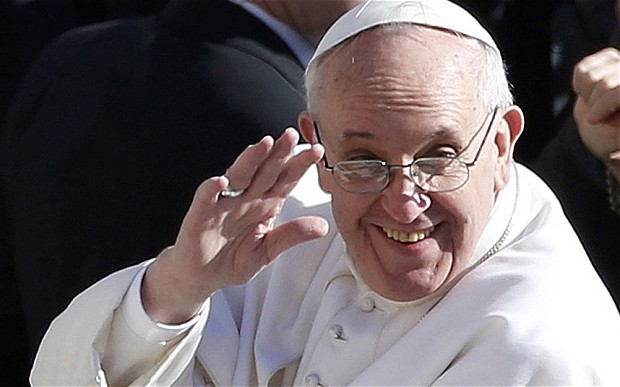
I confess (and it has been many months since my last confession): I was hoping to trigger this Comment of the Day or its equivalent with my criticism of the late Pope and the degree of influence and respect the position is still accorded by the news media and world leaders. Had I thought about it, esteemed commenter proe32754 would have probably been my top candidate for providing it too.
I will only point out by way of rebuttal is that Pope Francis’s Ethics Alarms dossier is a long as other prominent individuals who I have, fairly and correctly, designated Ethics Villains. Let’s see: he had four official Ethics Dunce awards and a couple more that I chose to frame differently. He has many Unethical Quotes on his record. He repeatedly presumed to meddle in the policies and politics of the United States (but his Holy predecessor during World War II refused to ever condemn Hitler’s Third Reich by name.) I have so many favorite outrages to choose from, but I think my favorite was when he dared to address Congress to pimp for the Democrats’ dream of open borders, despite severely limiting who is allowed to live in his own domain, The Vatican. Normally, anyone with a record like Pope Francis would be the star of a funeral no world leaders would dare to attend, lest they enter Cognitive Dissonance Hell with public opinion.
Yes, I suppose my remarks about the late Pope were “snide,” but I stand by them (and I do believe they were “called for.”) They were even mild compared to what I have written before; for example, here was my introduction to a post after the Pope’s visit in 2015:
I have been touched by the passionate defenses of the Pope during his visit here, by sincere believers who desperately wanted not to see what was going on. If only Pope Francis respected his supporters enough to live up to the ideals they projected on him, which included insisting, against all evidence, that he was merely talking in broad, moral generalities to Congress rather than lobbying for progressive policies, like making illegal immigration legal.
He was, we were told, only showing us where “true North” was according to the Church. I guess he just forgot to bring up abortion, which the Church regards as murder (and Joe Biden too, when he’s not playing politics) as he was lecturing our legislators about “human rights.”
The second he returned home, the Pope threw gay couples under the Popemobile, stating that Kim Davis’s position as a government official refusing to obey the law was a “right.” Again, his defenders insisted that this was just an abstraction. Now we hear from Davis’s lawyers that she had a secret meeting with Pope Francis. Davis says that he hugged her, gave her a rosary, and told her to “stay strong.”
“That was a great encouragement. Just knowing that the pope is on track with what we’re doing, it kind of validates everything to have someone of that stature,” Davis said.
Naturally, those who can’t handle the truth will say she is lying. There is no evidence that Kim Davis is untruthful, and her lawyer would be facing discipline if they falsely reported what did not occur. This really happened.
Got that, Popophiles? While a guest in this country, while progressives were tripping all over their usually Christian-mocking selves to proclaim him as a moral exemplar for setting U.S. policy, while he was being honored by the President and treated with more deference by the news media than any foreign leader, Pope Francis was surreptitiously encouraging an anti-gay zealot to defy the U.S. Supreme Court and the rule of law, while withholding the human right to be married from gay Americans.
I have already pointed out that the Pope is a hypocrite and a coward. With this conduct, he showed that he is a sneak as well, and blatantly disrespectful of the laws of the nation in which he was an honored guest. This was a breach of manners, protocol and a betrayal of trust on a massive scale.
I understand that religious faith by its very nature is an exercise in “My mind’s made up, don’t confuse me with facts,” and also that organized religion has a traditional and important role to play in maintaining civilization in a world where the vast majority of human beings won’t be civilized on their own. Thus I am not only sympathetic but in some respects encouraged by the passion and the passion and the loyalty of Catholic Church defenders like proe32754, who is obviously more articulate and capable than most.
Here is the Comment of the Day on: “Oh-Oh! President Trump Violated Another Norm!”…
***
Your snide remarks about Pope Francis were really uncalled for, uninformed, and just plain nasty. Your article was about Trump and his stupid blue suit, but you just couldn’t keep from a dig at the end about a man whom most people are “not worthy to loosen the thongs of his sandals.” (as spoken by John the Baptist about Jesus in the Bible, Luke 3:16).
Pope Francis, like all popes throughout history, had a unique status as a world leader. As the head of state of the Vatican, he had a secular role to play. But as leader of the world’s 1.3 billion Roman Catholics and respected by many non-Roman Catholics, his role as spiritual and moral leader was more important. And his responsibility and concern crossed all political borders and spanned cultural and even religious differences. Some would find these two roles to be incompatible, but no human enterprise, even a religion, can totally avoid the political ramifications of their works nor the implications thereof. Further, for the Pope and for all who follow the morally reasonable teachings of Jesus and the Church, his and our concerns go beyond the borders of Vatican City and the doors of our churches.
It is folly to have expected the Vicar of Jesus Christ to avoid speaking out against anything that adversely affected any human being. Pope Francis, indeed I daresay all popes, upheld the dignity of each individual human, and that stance required the wisdom to speak in the defense of all marginalized people, especially immigrants and refugees.
In his February 10, 2025 letter to the U.S. Bishops, he states, with proper respect for national security motives:
“I have followed closely the major crisis that is taking place in the United States with the initiation of a program of mass deportations. The rightly formed conscience cannot fail to make a critical judgment and express its disagreement with any measure that tacitly or explicitly identifies the illegal status of some migrants with criminality. At the same time, one must recognize the right of a nation to defend itself and keep communities safe from those who have committed violent or serious crimes while in the country or prior to arrival. That said, the act of deporting people who in many cases have left their own land for reasons of extreme poverty, insecurity, exploitation, persecution or serious deterioration of the environment, damages the dignity of many men and women, and of entire families, and places them in a state of particular vulnerability and defenselessness.” (Letter of the Holy Father to the Bishops of the United States of America (10 February 2025) | Francis) (The entire letter is worth reading to understand Pope Francis’ reasoning.)
These are not the words of a man “with influence far beyond his wisdom.” The “wisdom” of anyone who de-values the dignity of any one human being isn’t worth attending to, ever. The “wisdom” of anyone who equates desperate “illegal” immigration with criminality isn’t worth attending to, ever. And if you, or any of this commentariat, thinks that Pope Francis was a communist (wrong term, I believe; socialist probably), then so was Jesus and all of Catholic social teaching (Seven Themes of Catholic Social Teaching | USCCB). I know that there are Christians, even other Catholics, who disagree with this, but I believe that they are the ones who have ignored or perverted the teachings that are clear in the Gospels (e,g., Matthew 25:31-46).
Of course, none of this will mean anything to anyone who has no spirituality (and I don’t mean just Catholic or just Christian), but to those who do, it should mean everything.
 Ethics Alarms
This perspective appears to be another form of the ends justifying the means, which is a spiritual principle doomed to fail. The unstated assumption is that people who cross borders to flee a perceived threat have a right to impose their burdens on others who may then in turn be burdened.
Which burdened group should have the ability to decline carrying the others perceived burdens?
The Pope, instead of focusing on the issues that caused the population of a country to flee, criticizes the country that decides not to burden it’s citizens with the care and feeding of a population that got the spiritual result of poor choices.
America burdened? Punching down. I recommend going to New York and taking a ride on the ferry boat out to Liberty Island and reading the poem on the base of the statue — you know, tired, poor, huddled masses yearning to breathe free, wretched refuse, homeless, tempest tossed — send [them] to me. If this is no longer true, get rid of Lady Liberty and put a golden calf in her place.
Liberty means being free. Requiring others to provide for you makes you less free because you are always beholden to those giving you something.
When that poem was written migrants survived on a subsistence level without government resources and still worked and saved to build a future. Furthermore, migrants then sought to become Americans and not merely some nationality residing in the US. Those migrants waved our flag not a Somali, Mexican or Palestinian flag.
As Jack has mentioned many times, that poem is not a statement of official policy or part of our founding documents at all. It’s feel good poetry. You can’t set functional policies that way. Open borders are not compatible with control of territory, which is a defining characteristic of government. I’m mostly libertarian, but borders are one of the points where most people claiming to be libertarian reveal themselves to be anarchists who only pay lip service to the concept of limited government.
Jack already addressed this.
If you truly believe that America’s policies are draconian, how do you justify the Vatican’s?
There’s scripture about bits of wood in people’s eyes that comes to mind.
I feel it’s worth pointing out that Jesus was occasionally asked to weigh in on political issues, and he generally side-stepped them. Indeed, many were expecting the Messiah to take political control and lead a glorious revolution against Rome, but the change Jesus sought to inspire was spiritual, not political.
In the case of the woman taken in adultery, the question of “Stone or don’t stone” was designed as a trap. If Jesus simply said “Stone her”, they could’ve accused him before Pilate right then, since only the Romans and their vassal rulers could sanction capital punishment. If he said “Don’t stone her”, then how could He call Himself the Messiah? Instead Jesus dared whoever was without sin to cast the first stone, and they all left.
The question “Is it lawful to give tribute to Caesar” was a similar trap, and like the previous one, it had already been settled anyway. Whose face was on the coin they traded with? Caesar’s. Hence, “Give unto Caesar the things that are Caesar’s”. There’s also the “go the extra mile’ proverb, which it’s been argued applied directly to dealing with Roman soldiers, who could supposedly compel civilians to carry their baggage one mile but no more.
Also, as much as Jesus criticized the Jewish elite, he still said they “sit in Moses’ seat” and urge obedience to what they decreed, but not to follow after their works “for they say, and do not.”
So I believe that religious leaders who can’t resist weighing in on current political topics aren’t actually following Christ’s example. I believe religious leaders should focus more on general principles and leave it to their congregations how best to apply them in the political sphere.
Jesus wasn’t a world leader. The Pope is both a world leader and a spiritual leader. World leaders speak out about political things. If the Pope didn’t speak out, he would be accused of hiding in his ivory tower, oblivious to the concerns of the people. After Jesus asked Peter if he loved him, he said, “Feed my sheep.” Granted, that can be interpreted as “spiritual food,” but Jesus was in the habit of actually feeding people, too.
Even though Jesus wasn’t known to the whole world during His mortal ministry, he hypothetically could have been become king of Israel at least. But when the Galileans wanted to make Him king He declined. At one point He even refused to mediate a private inheritance dispute (Luke 12:13-15). My takeaway is that religious leaders shouldn’t be political leaders. The scope may be broader in the modern day but the principle is the same. Religious leaders stepping outside their lane is hie you get religious wars, witchcraft trials, and things like the Satanic Panic of the 80s.
Gamereg,
One quibble I have with your conclusion “that religious leaders who can’t resist weighing in on current political topics aren’t actually following Christ’s example” is that I would push back on what you said Jesus did in response to the challenges brought to him. It wasn’t that he sidestepped the issues, but rather, he brought into light what the issues at hand truly were. The woman caught in adultery could have been stoned under the law, yes, but balanced against that is the numerous accounts of God’s mercy, his patience with his people, his forgiveness of sins, and his desire for his people emulate his care for the poor, the widowed, the stranger. The stoning would be, essentially, a maximum penalty. Jesus refuses to play the game of quibbling over the interpretation of the law when he knew that first, this was a trap (which meant the religious leaders had no genuine concern for this women, either for her sins or for her as a person), and second, the hearts of the religious leaders were hard and unforgiving, the exact opposite of what God wants from his people.
In the matter of “render unto to Caesar”, the finer point is that Jesus is calling the religious leaders to account for their failure to render unto God what belongs to God. This comes from Jesus asking, “whose image and likeness” is on the coin. Since the coin has Caesar’s image and likeness, it belongs to Caesar. But what then belongs to God? That which bears his image and likeness. And what bears God’s image and likeness? We’re told that in Genesis: “God created man in his image. In the divine image he created him. Male and female he created them.” So Jesus is going to the heart of the matter, that the scribes and the Pharisees are not rendering to God what belongs to God, namely themselves.
If religious leaders are going to delve into political matters, this has to be the template to follow. (So my quibble is that I disagree that religious leaders shouldn’t get involved in politics.) Jesus pointed out that the dysfunction that underlaid the issues brought before him. The real matter is what is hiding in our heart, and that has to be addressed. Certainly, then, religious leaders have to make sure they remove any logs in their own eyes before trying to remove the speck in anyone else’s eyes, but if the religious leaders can see clearly to the heart of what is going on, then they should certainly be willing to speak out. Religion cannot be separated from politics. If you do see an evil being committed, you have an obligation to speak out against it. Where many people go wrong is mistaking a difference in opinion for a moral evil.
The general principles approach is very good when one is not fully abreast on all the details of the political issue at hand. And that is generally where most religious figures land. They have a great deal of training in theology, a significant amount of training in pastoral work, but maybe not the detailed training in all the different laws around the world nor the geopolitical situation. Of course, the general principles approach is good not just for religious leaders, but for pretty much everyone. If you don’t know the full details, if you don’t have piercing insight into the situation, then falling back on general principles and letting those in the know do the heavy lifting is probably the most prudential course of action.
How does Pope Francis fit into this framework? I think we tend to give him far too little credit for his experience among the poor, keeping in mind that Argentina has gone through some extensive periods of very corrupt governance, terrible economics, and a fair amount of poverty. His work was very much involved in the care of people in dire straights. If I recall correctly, he worked hands-on with many people, and from that developed a deep compassion for the poor. Does this give him the best understanding of the United States? I would say no, but that does not prevent him from analyzing the situation of the United States and being very concerned about the dehumanizing attitudes coming from its people.
While I disagree with Pope Francis on a number of aspects of the immigration issue (which I’ve commented on before, though finding those comments is a challenge, I admit), I would estimate that about half of the furor raised against Pope Francis here comes from American unwillingness to self-examine and discover there really are deficiencies in our morals regarding the illegal immigrants. And I do believe that if we really, truly, honestly appraised ourselves, we would find that we Americans as a whole are committing worse unethical acts than crossing borders illegally. The hot-potato aspect of immigration laws, the political jockeying without actually trying to resolve the issue, the willingness to endure (and even applaud, as we’ve seen recently) the use of illegals as effectively slave labor (either in the fields or as sexual chattel), and the whiplash of turning a blind eye to illegal entry to cracking down on illegal immigrants has bred a humanitarian crisis. We didn’t force people to enter the country illegally, but we’ve done a great deal of making the United States an enticing place for migrants to enter illegally. And we can’t simply point to “Democrats made this problem, and Republicans now have to fix the mess!” when Republicans have had the chance in the past to make meaningful strides to the immigration problem and simply couldn’t get the work done.
Was Pope Francis estoppeled from commenting on American immigration policy due to the Vatican’s immigration policy? I would argue in the contrary. The Vatican, although its own political entity, is nonetheless a tiny parcel of land (109 acres) with tiny population (around 900), that is fully encircled by the city of Rome. Comparing Vatican City immigration policies with American policies is not apples to apples by any stretch. A more apt comparison would be how the Catholic Church handles immigrants across all its properties globally. Or even how the Catholic Church handles immigrants in Italy. Frankly, criticizing the Catholic Church for its immigration policy for Vatican City would be like accusing the Denver Mayor of hypocrisy if he didn’t allow illegal immigrants to enter and stay permanently at the Denver Zoo.
There is one other aspect for why I think it is not unreasonable for Pope Francis to have commented on the United States’ immigration issues. That is is because of the prominence the United States has in the world. Thus it is all the more imperative that the United States be a morally upright nation, and her smaller flaws are more serious (in some regards) than the greater flaws of powerless nations. You see this principle at play when Moses, who was so close to God that his face shone with God’s radiance, was forbidden from entering the promised land because of what seemed to be a very minor infraction (hitting the rock with his staff instead of speaking to the rock). Leaders are (or should be) held to a much higher standard. That applies to the United States. Whether we appreciate Pope Francis for calling our motives into question, it is still true that we should be living up to a higher moral standard, and that if we aren’t, we should be called out for it.
Point taken about Jesus’ true message in those instances. I chose to focus on the politics involved since that was the main topic, but the spiritual component and broader teachings therein certainly shouldn’t be ignored.
Going back to the immigration issue, yes both parties are to blame, and I wish we had a more intelligent, considerate, and articulate president who still had Trump’s zeal to get it tackled, but Trump is what we got (for what it’s worth, I didn’t vote for him in either election). But even if we had the “ideal” president and Congress to tackle this, we’ve kicked the can down the road so long fixing it is going to be painful no matter what, as another blogger we both follow explains:
Pretty sobering, but we can’t afford to keep stalling. There’s absolutely a conversation worth having about who counts as a refugee, asylum seeker, and how many of those plus green card holders and full citizen aspirants to let in at a time. But that conversation needs to be had amongst American citizens, and between our government and those of our southern neighbors, not religious leaders an ocean away.
As a tangent, what do you propose for solutions to the immigration problem? I think we need the following:
This is a brief list, and I would love to hear feedback, additions, criticism, etc.
No major disagreements, though I think any path to citizenship plan should come with a time limit, which is what I think was missing from Obama’s DREAM Act. Those still undocumented after the border is reasonably secure should have just a year or two to come forward, after which the window closes and it should be assumed that any left don’t want to play by the rules.
And by “relocated to a different community” are you suggesting putting all who take part in this program into groups where they be closely monitored? Good idea, but I’m leftists moaning about sanctuary cities turning into house arrest cities.
Gamereg,
You ask, “And by ‘relocated to a different community’ are you suggesting putting all who take part in this program into groups where they be closely monitored?”
Actually what I am proposing has two components. Part of this is a penalty; if you are an illegal, you should not simply get to return to the work you were doing. Forcing you to leave the community that sheltered you uproots you from the community and deprives that community of you. The second part is diffusing the illegal immigrants throughout the US. I’m taking this from the policies of the Roman Empire, which when it encountered Germanic tribes that wanted to enter the empire, they were spread out through the Empire so they would not be one solid bulk that did not Romanize and might later become a threat (which then did happen with, for example, the Goths in twilight years of the Western Empire). To better facilitate assimilation into American culture, we’ll distance the illegals from each other so they are forced to interact with their new communities.
There would have to be a time limit on this relocation, where maybe after two or three or five years you could then move freely through the country. And maybe there would be a probation aspect to that, though Probation & Parole would probably squeal at taking on the additional burden of monitoring newly legalized illegals, to ensure that participants don’t simply disappear and return to their former communities.
Congratulations on the COTD.
There is no person who is NOT worthy to loosen the thongs of the Pope’s sandals. In fact, the Pope is as worthy of removing my sandals as I am of removing his. Applying those words spoken by John the Baptist about Jesus (the second member of a triune God, the omnipotent creator of all things, and the ultimate judge of all people) to the Pope (a fallible, sinful man like me who happens to lead a religious system, who created nothing, and will judge no one) is a comparison at which even the Pope would cringe…or should cringe. That characterization of the Pope is every bit as uninformed as you claim the host to be in his original piece.
Illegal immigration in this country IS criminality, whether anyone likes it or not. And if a government – put in place by God – writes laws against it and then punishes it, no one – including the Pope – has reason to complain. The Pope could gain much by spending more time examining his own righteousness before God and less time opining on the rightness of U.S. law.
And I believe it’s theologically precarious to use Matthew 25 as even an oblique defense of illegal immigration.
“And I believe it’s theologically precarious to use Matthew 25 as even an oblique defense of illegal immigration.”
Please enlighten me. Seriously. I can’t figure out this one.
Regarding your interpretation of Matthew 25 and your characterization of Jesus as a socialist or communist… It is clear that Jesus is teaching that people should share with the poor and needy. Do you think that he would have supported governments compelling citizens to share of their property? Do you think that if someone shared primarily because of compulsion that would save them from being judged as a goat?
” a man whom most people are “not worthy to loosen the thongs of his sandals.” (as spoken by John the Baptist about Jesus in the Bible, Luke 3:16).”
Hyperbole. Used for dramatic, if heretical, emphasis. I was, as Jack so kindly put it, triggered.
Re your 2nd paragraph — please see my comment to Gamereg, which actually was incomplete. We all know all too well that the immigration system in this country is broken. Those who are legitimately seeking asylum can not always rely on this broken system to try to immigrate, or on the now seemingly mythological mercy of American democracy. I have never been as desperate as some of those “criminal” immigrants, and I hope neither one of us ever is.
Even so, referring to desperate immigrants as criminals when their only crime is being too desperate to wait for asylum, seems to me to be, as I said to Gamereg, punching down.
Sorry, wrong attribution. Not Gamereg but RWE.
I keep hearing our immigration system is broken. Please tell me what parts are broken and why. Limits on numbers does not make a system broken. If there is a failure of our immigration system it is because we have to focus on dealing with floods of people who are incentivized by past policies that rewarded people coming here with vast amounts of public dollars.
The refugee aspect is obviously broken, because it creates a loophole that “migrants” exploit. Garcia, for example, claimed refugee status because gangs in his native country were out to get him because he (“allegedly”) belonged to a rival gang, and to the extent that his own country posed a threat to him, it was because, at least in part, of his illegal activities. Why should such dicey individuals be let into the country at all? The US takes these “refugees” at their word. The guest worker program is similarly loused up.
My son predicted that I’d regret making that comment (which astonishingly became a COTD), and he was right, as usual.
I allowed myself to be, as Jack SO nicely put it, triggered. (I am such a sap.) Thus I committed one of the mortal sins of this blog — allowing emotions to dictate my response.
However, in response to Jack’s assertion that “I understand that religious faith by its very nature is an exercise in “My mind’s made up, don’t confuse me with facts…” — I hope that wasn’t aimed at me, because Jack knows better than that about me.
On the original post, Jack complains about the Pope not making it explicitly clear when he was speaking as a mere human and when he was speaking ex cathedra, or “from the chair” of Peter and thus infallible. There is famously no actual list of infallible teachings but there have only been two actual ex cathedra statements in history, and both were about Mary. If anyone is going to worry about whether anything a pope says is infallible, just pay attention because that pope will definitely write it across the sky “I am speaking infallibly.” (Wouldn’t you?) If it matters that much to someone, they should check it out rather than worry about it.
One last remark to Jack — I was never surprised when you criticized Pope Francis. Sometimes he deserved it, but more often my lack of surprise stemmed from his agreement with so much of what you denounce, like the kinds of things that the Church lists as Social Teachings.
One last last remark — Fool me (trigger me) once, shame on you. Fool me twice…
Proe, I would ask you not to regret your comment. I offer my thanks that you were willing to take a stand for Pope Francis and the Catholic Church. I’ve had my efforts from time to time addressing unfair spin on Pope Francis (though I have offered my criticism, as well), and have worked to defend the Catholic Church as the occasions arise. I know we differ on a number of issues, but the great thing about EA is that Jack encourages us to discuss and debate the issues and our differences on them. And one of the things I would add is that the best commentary comes from reasoned responses that are backed by zeal for the subject matter. If we didn’t care very much about an issue, we tend not to get very involved in the discussion.
I agree. Even comments with which we might disagree are profitable.
The Pope is no more infallible than I am…ever. Has he the mind of God?…of Christ? Absolutely not! I’m going to get in a lot of trouble with some responders here for writing that, but I stand on it.
To give a man – and the Pope is a man – any platform from which he/she can speak “ex cathedra” is again, perilous. I would go so far as to say this dips into the realm of blasphemy (assigning to oneself rights and privileges ascribed to another). Contrast what you’ve written with how Luke characterized the Bereans in Acts. They were described as “more noble”…why?…because they tested what Paul said against the Scriptures to be sure he was speaking truth, not simply taking it as “from the Lord.”
But now I am curious about the two historical statements made about Mary.
Papal infallibility was defined in the first Vatican Council in 1870. The notion had been around in the Catholic Church since the beginning, and you can see that from the conflicts between the East and West in the Church, before the Orthodox Churches decided they had to split from Rome. You can also see it in the battles with the Conciliar Movement in the Church, which tried to argue that Church ecumenical councils could override the Pope, and the Church ultimately rejected that novelty.
The two Marian doctrines that came about from papal decree, binding upon all the faithful, were the Immaculate Conception, in 1854, and the Assumption in 1950. The Immaculate Conception formalized the belief that Mary was preserved sinless from the moment she was conceived by a special grace (if you well, the retroactive application of Christ’s redemption). You’ll find references to Mary’s sinlessness all the way back in the third or fourth centuries, but again, it was not dogmatically defined until much later. The doctrine is alluded to in Gabriel’s greeting to Mary, “kaire, kecharitomene,” which refers to Mary as “you who have been fully graced”.
The doctrine of the Assumption holds that at the end Mary’s life, she was assumed bodily into Heaven, leaving no mortal remains on earth. It does not define whether Mary died and was assumed, like Moses, or was assumed living into heaven, like Enoch or Elijah. You can find Church “little-t” traditions on either side of that issue, so it is still debated in the Catholic Church whether Mary actually died. A common defense of the Assumption comes from the fact that Catholics venerate relics, and there are no first-class relics of the Blessed Virgin anywhere in Church history.
Theologically, Mary’s immaculate conception is about the special treatment of holy things. Mary was to be God the Son’s vessel, and so deserved to be pure. This was, to be clear, entirely due to Jesus, not anything Mary deserved in and of herself. She was still saved (and in need of a savior), but the salvation she received was, as the analogy goes, from falling into the pit, instead of being rescued from the pit. It also is fitting that Mary, who would be the ground from which the Second Adam was formed, was a pure an unspoiled as the ground from which the First Adam was formed. It is also fitting that as Jesus was the perfect savior, there would be someone whom he perfectly saved.
Regarding the Assumption, that doctrine affirms the ultimate destination of man, which is not just Heaven, but in Heaven as the body/soul composite that we were made to be. It is also a prefiguring of the entire Church being brought whole (body and spirit) into Heaven, since Mary (among other things) symbolizes the Church.
I’m going to disagree with Pope’s ability to declare Mary sinless from conception. If the Pope can do that, he can declare anyone sinless, and you know there none who is righteous…no not one. The Psalmist wrote that “I was born in sin, and in sin did my mother conceive me.” The sin nature passed through men, so if Mary had a father, and the Bible lists one for her, then she was not born without sin, or God is a liar. If Mary was sinless, then Christ did not have to “die for all, because all sinned.” There is no logical impossibility with Mary needing a Savior while simultaneously carrying that Savior in her womb.
The Assumption, based on your description, is another non-biblical construct. The Bible explicitly lays out what happened with Moses and Elijah and Enoch. Moses was not assumed, he died and was buried by the Lord in an unmarked grave within site of the Promised land. The Bible is silent on Mary’s death, so her Assumption is exactly that…an assumption not based on any scriptural account, though maybe in extra-biblical narratives.
These are not doctrines, they are heresies, and I’ll probably get in even more trouble with some responders here for writing that!
Joel,
I’m having a problem with how you’re phrasing this. From the Catholic perspective, the pope could no more declare random Joe to be sinless as he could declare me to be sinless, for two reasons. First, Catholic doctrine of original sin would hold that everyone, as David says in Psalm 51, is conceived in guilt, and second, we have no indication that God has done otherwise with random Joe. For the pope to declare Mary sinless, he is not absolving her from sins as though this were confession, but is stating a historical fact, that God through a special grace preserved Mary from sin. And we have evidence from Scripture and from what has been handed down from the Apostles that Mary was preserved by a special grace at the moment of conception from the stain of original sin.
In short, Mary is not sinless because the pope declares she is; the pope declares she is sinless because that’s what she was. I hope I clarified this well enough. The statement that it seems the pope could declare anyone sinless mistakes just how papal infallibility works.
To resolve your apparent difficulty with Psalm 51, I just want to reiterate that Mary was saved from sin. Without that special intervention, she would have contracted the stain of original sin like any other human person. She did indeed need a savior, as she states in her Magnifcat. Her being preserved from sin was itself the application of Christ’s merits, and so he did indeed die for her.
As for Moses’ assumption, I may be playing a little fast and loose with that one, since the record of his assumption is an apocryphal work. However, since Jude cites that work, there was at least a first century belief that Moses’ body was taken up to heaven, and that fits well with the Transfiguration, in which both Moses and Elijah appear to Jesus. (It fits, I’m not saying that’s the case.) But as for Mary’s assumption, you are mostly correct that this is extra-biblical, since no one records her death explicitly. But just because something is not recorded explicitly in the Bible doesn’t mean it didn’t happen. And there is allusion to her assumption in Scripture. If you look a Revelation 11:19-12:2, we have
The woman in Revelation 12 has been understood to be Mary, the Church, and/or Israel, but for this discussion the important point is that the Church has equated Mary with the Ark of the Covenant from the earliest days. After all Mary held within her the Word of God, the High Priest, and the Bread from Heaven. So there has been an understanding from early centuries that when John sees the ark in God’s temple, this sign of the woman is the fulfillment of that vision, i.e. this woman in labor pains is the ark that John saw. So this is an allusion to the Assumption, though I will readily admit it is not even proof-text. My point, though, is that the Assumption was not invented in 1950, but had been believed and defended by the Church at least as early as the sixth century.
As for heresy… I could same the same to you, heretic! However, throwing around the term heresy and heretic is not very helpful when trying to understand what our differences actually are, and where we might find we have common ground.
Back to papal infallibility, I will state one thing that I find very important. The pope, contrary to Jack’s position, is not an outdated position. He stands as the source of unity in the Church, and the final court of appeal (if you will), because we he is able to speak infallibly, the matter is settled. From my Catholic perspective, the lack of the pope among Protestants, and even among the Orthodox Churches, has led to innumerable divisions, confusion, and stagnation. If you look at all the Protestant branches and groups that have cropped up over time, you can practically find contradictory opinions on every single doctrinal point. Among the Orthodox, their churches have calcified into national churches, and the dissent among them is such that they haven’t held an ecumenical council since parting ways with Rome. Because of the pope, Catholics have a focus of unity that keeps the church one, even when there are numerous liturgical traditions and myriad theological disputes that have not yet been resolved. But as I said, that is what I personally find important about the papacy.
I always love to dialogue with you, Joel!
Ryan,
Thanks so much for the kind response and let me also say I appreciate your wisdom…on this and so many other issues. While we might disagree to some degree (and I did use the fairly strong “h” word in my previous response which usually raises the temperature some), my intent is to argue truth without becoming argumentative.
I would love for you to send me scriptural references the Bible makes for Mary being preserved from sin…at conception. I see zero evidence of that, but plenty to the contrary. The Bible is not a systematic theology, but the book of Romans is as close to that as we come. The first five chapters have Paul seeking one end – bringing all men and women under the condemnation of sin’s curse. There are numerous uses of superlative words for those under the curse (“all”, “every”) and for those exempt (“none”, “no one”, “not even one”).
I see no exception made for anyone, and Paul spent enough time with at least some of the apostles still in Jerusalem (Acts 15 as one instance) in between his journeys – and well before he wrote Romans – to be informed of any special dispensation for Jesus’ mother. It’s probable that Mary was still living there, and could have confirmed it with Paul personally. He never mentions it.
You are correct: Mary was saved from sin. But Mary needed the same grace you and I do, and she needed the same faith and repentance you and I needed. She was under the Old Testament covenant, so her saving grace was credited – like Abraham – by believing God and trusting in the Savior to come. But unlike Abraham, she lived to see the Savior, see him die and rise again, and then place her trust in his “finished work” on that tree as well.
I still see the idea of Mary’s “sinlessness at conception” as a completely human construct and (excepting scriptural references you can provide) a non-biblical fabrication that has resulted in Mary being elevated, in some aspects, to a level equal with Christ.
One final note: Since this is an ethics site and not expressly for theological discussion, I would be happy to continue this discussion away from EA, should our host prefer that. If that’s cool, let me know and I’ll get you my email address.
Joel,
We could certainly take this offline if others are seeing the discussion as too far afield. You could reach me (and if anyone else wishes to do so) at november alpha romeo alpha november delta uniform sierra at hotmail.
I was trying to tie this back to somewhat on topic with my assertion that the papacy is not an outdated institution, but that was, admittedly, a tiny portion tacked onto the end.
As for keeping more towards ethical topics, one of the aspects that would be worth discussing more, maybe in the Open Forum, is how ethics change depending on whether the traditional Christian view of man and original sin is correct, or if the more secular notion of man entering the world tabula rasa is correct, or other versions are correct.
I’ll keep my eyes peeled on my e-mail, looking for you! If you get a bounceback, let me know.
“Fool me (trigger me)”
How does that compute? If a fact or analysis “triggers” an emotional rather than a rational response, then that experience is useful, or should be. It should prompt us to examine the basis of the beliefs and opinions involved. Prompting readers to do this is why Ethics Alarms exists. inspiring epiphany and self-analysis is the opposite of “fooling” someone. That characterization is self-deception.
Proe,
I, too, have written things from an emotional perspective, some worthy and others, well . . . let’s just say the spelling was pretty good. Yet, ethics is not a discipline devoid of emotion in favor of cold, rational analysis. Sometimes, the emotional response is the right and proper response. Case in point: James Byrd, a guy walking down the street was brutally, savagely, murdered by three monsters, chained and dragged to his death behind pickup truck.
The community revulsion was appropriate – that man suffered and died simply because he was on the wrong road at the wrong time. My response was profound – it made rethink my position on the death penalty. I had to grapple with the idea that the state should not execute people. It took a while for me to come to the conclusion that some people simply are not worth saving and should not burden society with their presence because the crimes they were/are convicted of are so heinous they have forfeited their rights to live in an organized, civil society.
As for Pope Francis, I had my issues with his positions because, like it or not, the Holy See is a political entity wrapped up in faith and religious tradition. I thought it was easy to criticize US immigration policy from Rome where the Vatican’s pronouncements could have little political or legal impact on Church policy. However, those positions carried the weight or imprimatur of official doctrine of the Catholic Church, with a flock of 1.3 billion Catholics. It was more than calling on countries to be more welcoming and tolerant, almost to the point of saying that the host country has a moral obligation to take in anyone and everyone. And, it fed into the “Open Borders” narrative that has overwhelmed many organized societies.
So, Proe, don’t fret or regret posting controversial comments. This blog is a great source of debate. Not everyone will agree and that is the way it should be because, otherwise, there is little point in having any sort of discussion.
jvb
Comment of the Day author here. I’ve been chastised for not acknowledging each and every one of the responses to my truly, now, TRULY regrettable comment, that I owe you all “the courtesy of an acknowledgement of a rebuttal.” Right. Sorry, I was up all night writing the replies I DID write and then went to work all day. Sorry that I just don’t get the rules of this game. One very polite responder thanked me for trying to defend Pope Francis, and I thank that person. Another one kindly suggested that I shouldn’t regret my comment, and I thank that person. Several did write rather extensive and thoughtful rebuttals, and I did appreciate them. There may be others but I just can’t. I never asked to have my comment elevated to COTD, and I just can’t respond to everyone. Nor do I want to respond to the really rude ones. I have finally accepted that I don’t belong here, even as an opposing voice.
Just a tad petulant, don’t you think?
Proe, there’s no obligation to respond to every comment made to you, and failing to respond to every comment is hardly indicative of belonging or not belonging. Getting flack from the local commentariat is likewise a poor gauge of belonging. On the other hand, if commenting is emotionally challenging (and I know firsthand that it can be), then certainly you’re not obligated to participate. But you have offered a dissenting opinion, which is very welcome here, even if it is challenged. Thank you.
“But you have offered a dissenting opinion, which is very welcome here, even if it is challenged.”
Especially without the arrogant “you dumb @$$ rubes” brio.
“Thank you.”
Second!
PWS
Proe,
Ryan is absolutely correct. You are under no obligation to respond or acknowledge comments to your comments or those posts our Esteemed Ethicist elevates to COTD status. Your participation and commentary are wonderful and add terrific angles to the discussions.
The discussion between Ryan and Joel above is a perfect example of this blog’s success. Your disagreement with the efficacy of the papacy led, in turn, to an informative discussion of Marian Doctrine and the role of papacy. As you can see, commenters are serious, well-versed, and diverse in their perspectives. Most are respectful and courteous, though at times, a stern cybersmackdown may be warranted and well-deserved.
Thanks again and post away to your heart’s content.
jvb