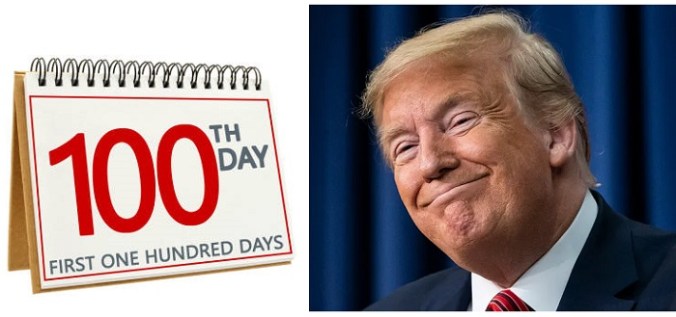
Yesterday several sources, citing polls, felt that it was significant that “President Trump’s approval rating after 100 days is the lowest of any President after that period since the beginning of the polling era.”
This is deceit. The distinction is significant indeed, but not for the reasons the news media wants the public to believe.
Every elected President except for Donald Trump in his first term begins with a substantial so-called “halo effect” where a strong majority of the public approves of him because they approve of the institution of the Presidency, its earlier, greatest occupants, and the system of government that put him, and them, in the White House. In his first term, Trump was unethically robbed of this “norm” (Hey, I thought it was Trump who shattered democratic norms?!) by the coordinated attack on his legitimacy and the Electoral College along with the false “Russian collusion” narrative promoted by the Axis of Unethical Conduct.
The President after the 2024 election had something approaching the halo—call it a half-halo—because the public was so disgusted with Joe Biden and because Trump won the popular vote. Nevertheless, his favorability was greatly diminished compared to past POTUSes because the despicable Democratic Party smear that he was a new Hitler-on-the-hoof had a large proportion of the public tainted with hate and fear.
Trump is almost alone among Presidents in that his first hundred days were occupied with substantive action, much of it bold and transformative. As soon as a new President does something, anything, he will likely lose support. Trump has done more in his first hundred days, by far, than any previous Chief Executive with the arguable exception of Franklin Roosevelt, who had the benefit of taking over a catastrophic situation in which doing anything was deemed an improvement over the Depression policies of Herbert Hoover, which could be fairly described as “Be patient, it will all get better soon.”
FDR, therefore, is a distinguishable exception. Other than him, Trump is unique. His Hundred Days have been unusually bold and productive. Of course that loses him polling points.
One of those partisan-biased Presidential historians like Douglass Brinkley could explain this, and if they had any integrity, they would. But they don’t.
 Ethics Alarms
Nevertheless, his favorability was greatly diminished compared to past POTUSes because the despicable Democratic Party smear that he was a new Hitler-on-the-hoof had a large proportion of the public tainted with hate and fear.
Meh I dont agree with this. I think Trumps approval is so low because of his actual policy decisions and things happening in his administration. The tariffs, stock market, how he treated Ukraine, how he treats Putin, Signal leak, etc. The tariffs and Signal leak really being the main things here.
You didn’t read the whole post or don’t understand it.
All of those are major moves unusual for a first Hundred days. Everything you cite are matters that the people who hated Trump already object to. 10% of the public depends on the stock market. Most of the public doesn’t know what tariffs are, and it’s too early for any price increases because of the tariffs to appear. The Signal leak is inside baseball that most of the public doesn’t care about. It’s the left that cares so much about Trump and Vance correctly telling Z to know his place. “How he treats Putin” is more Axis narrative junk. You’re in line with the Axis propagandists who are pushing the “Trump is failing” myth. You’re not qualified to be objective. I said that Trump’s approval has fallen because he did stuff in the first 100 days, when almost all Presidents don’t. I gave two reasons for the dropping approval: you said you disagreed with #1, then cite #2…which was what the post was primarily about—as your reason.
of those are major moves unusual for a first Hundred days. Everything you cite are matters that the people who hated Trump already object to.
I don’t agree with this. Everyone including people who love Trump want a good economy, low prices, and not have our important information leaked by someone who knows better.
10% of the public depends on the stock market. Most of the public doesn’t know what tariffs are, and it’s too early for any price increases because of the tariffs to appear.
I think most of the public know what tariffs are, and can read about them after Trump’s announcement. They’ve been a disaster, no matter what side of the political aisle you’re on.
Also, millions of Americans have 401ks and retirement funds which took a major nose dive. Trump’s flip flopping is also creating uncertainty in investments. Which, anyone paying attention would know about.
The Signal leak is inside baseball that most of the public doesn’t care about.
I dont agree that most of the public doesn’t care about important information like flight times and enemy targets being leaked by Hegseth. I think most Americans care about this actually. See Hillary’s emails.
It’s the left that cares so much about Trump and Vance correctly telling Z to know his place. “How he treats Putin” is more Axis narrative junk.
You’re in line with the Axis propagandists who are pushing the “Trump is failing” myth.
Don’t agree. Trump’s first 100 days have been a disaster.
You’re not qualified to be objective.
I am.
I said that Trump’s approval has fallen because he did stuff in the first 100 days, when almost all Presidents don’t.
Thats an interesting take but I dont agree with it. The stuff Trump did During his first 100 days would be judged differently if they were successful. The reason his approval rating is so low isn’t because he “did stuff” it’s because the things he did, were not good.
You don’t agree you don’t agree you don’t agree. You cite no evidence, and your assertions are laughable: tariffs are a long term tactic, so saying they are a disaster this soon, again, just shows bias. People can ‘read about them,” but they don’t. Same with the economy. Whether Trump’s policies will help the economy or hurt is impossible to measure at this point. YOU don’t even understand the Signal mess; nobody “leaked” anything.
I’m sorry: I’m beginning to fear you’re just not smart, informed or open-minded enough to argue with. This post is just a millimeter from triggering the Stupidity Rule. I’m giving it a pass.
But thanks for serving out your suspension. I appreciate that.
Woop! Woop! Woop! Paid DNC troll alert!
I’m glad this has come up. I was struck by how coordinated the effort over the weekend by all the usual suspects was to hype Trump’s “approval ratings” per the usual suspects’ polling. This entire thing is the current news cycle’s orchestrated “Get Trump!” effort.
And, lo and behold, a commenter shows up spouting talking points. I guess the lefties are getting their act together and funding all sorts of baloney again.
If she’s getting paid, the DNC is wasting its cash.
Stringing talking points together doesn’t take much thought and never looks good.
Take a drink!
“Whether Trump’s policies will help the economy or hurt is impossible to measure at this point.”
Even though we can’t know for certain, I would hope that the Trump administration has some reason to expect that the policies will help the economy. Otherwise it’s less of a strategy and more “let’s dial these numbers up and see what happens to people’s money.”
Meanwhile, people do have some reasons to expect that tariffs will hurt the economy in the long term, as companies nowadays have a greater ability to automate jobs instead of bringing them back to the United States. (Or at least, they think they have a greater ability. I’m not sure they really know what they’re doing, but the effect on the domestic economy is the same.)
There’s also the issue of the short-term effects. If people can’t survive the transition, they won’t care about the long-term benefits that the economy may or may not get.
Finally, there’s the issue of wage negotiation. Yes, making foreign labor more expensive gives domestic workers a better bargaining position, but if they aren’t organized enough to take advantage of it, then that won’t result in higher wages. All that will happen is the higher cost of labor will be passed on to the consumer. Meanwhile large American companies will face less competition from foreign equivalents, so they’ll be able to get away with higher prices and lower quality.
I don’t think tariffs are a good start for putting the American people in a better position economically, or at least we need additional policy changes and maybe some new companies that prove more options and model a different way of doing things.
People don’t like Trump because he seems almost actively hostile to the idea of demonstrating foresight and conscientiousness, even when it would work out better for his actual goals and his public image.
As far as his ethos goes, I do acknowledge that he makes an effort to compliment people he disagrees with sometimes. However, if he’s going for the respectable “tough but fair” approach, he’s not putting enough effort into the “fair” aspect for people to see things his way. He’s not defining any principles that guide his actions other than his own personal feelings. That does not inspire trust.
Jack, do you see some legitimate reasons why well-informed people actually don’t think that Trump is doing helpful things as president?
Sure. But people who are predisposed to assume that he is a fool, that he doesn’t care about the country, and has evil ulterior motives cannot be presumed to be exercising independent judgment. Similarly, people who are themselves hurt or inconvenienced by various policies can’t be assumed to be looking at the matter objectively. I have several friends who have lost jobs because of DOGE cuts. They cannot be expected to see the big picture, but neither can I take their complaints as more than based on narrow self-interest.
The fact is that if the dangerous national debt is going to be addressed, there will be short-term pain. If the unfair trade conditions that have ruined a lot of American industries are going to be addressed, then that will also cause short term hardship. If the dangerous political slant of higher education, the legal profession and journalism is going to be addressed, there will have to be some negative reinforcement, which some people think is icky and ugly. They are naive and misguided. This President is trying to fix a lot of long-standing problems that nobody has had the guts or will to tackle for a long, long, time. He deserves credit and respect for that: instead he gets attacked for the color of his suits and the fact that he doesn’t use a poem on a statute to guide his immigration policy.
Very aptly put Jack. I was going to respond to EC by saying that Americans in general have become spoiled. They do not seem to want to look beyond what is best for the nation in the long term.
Marrissa said “Everyone including people who love Trump want a good economy, low prices, and not have our important information leaked by someone who knows better.”
The question is at what cost? Low prices come at a cost to someone. Every dollar we give to China is one more they use to advance their Belt and Road strategy of global dominance. We fought a war here over the issue of slavery because it was at our doorstep but today we turn a blind eye to factory farms of China on which people are virtually imprisoned so we can get low prices on all sorts of products. I suppose it is not that we are against slavery we just don’t want to see it.
Just ten years ago the MXN Peso was worth about a dime and it is now worth less than a Nickel which means goods produced there cost half as much in terms of dollars. How is that possible if the US trade deficit with Mexico has exploded in that time frame? Demand for Mexican goods drive the value of a countries currency. The answer is foreign government manipulation.
What exactly does a good economy look like? Does it mean full employment even if that employment means part time work in multiple jobs or does it mean a balance between temporal value creation in service work and long term value creation in manufacturing. I say it means the latter even if it requires periodic realignments of resources between industrial production.
EC stated “People don’t like Trump because he seems almost actively hostile to the idea of demonstrating foresight and conscientiousness, even when it would work out better for his actual goals and his public image.”
How can he say this. Is EC privy to the President’s deliberations? Trump had four years to develop a strategy and the say that he is hostile to demonstrating foresight and conscientiousness comes only from what he is able to glean from news reports. The exact same argument can be turned around on Trump’s critics because they are only looking toward the next election and not the impact on future generations.
EC questions the use of tariffs but there are few other tools in a presidential arsenal to limit the amount of American wealth being transferred to the CCP. How effective would moral suasion work on the American people with a fireside chat by Trump explaining the need to buy American products to protect our industries? It wouldn’t. Every country believes its consumers are an economic asset. Every dollar they spend on domestic goods and services directly benefits the domestic economy. Imports are treated as wealth leakages. We try to offset our wealth leakages with our exports that brings new wealth to our economy.
Much ink has been spilled condemning the tariffs but very little on some of the positive effects.
U.S.-based investments in President Trump’s second term:
Source: TRUMP EFFECT: A Running List of New U.S. Investment in President Trump’s Second Term – The White House
That doesn’t even include the U.S. investments pledged by foreign countries:
I don’t recall the media making much about this at all.
I challenge those who believe that Trump is leading us down a road to ruin with tariffs to put forth an alternative. If we would have recommended that all goods imported into the United States meet our stricter environmental and workplace safety standards in lieu of tariffs it would mean that virtually no Chinese goods could enter our consumption stream. Electric vehicles would become impossible to produce because the costs of extracting the raw materials would be prohibitively expensive without the child labor employed. Global workers would have to be paid in accordance to our minimum wage laws. We can’t have that either because we all want more stuff at the lowest possible price. Our grandkids be damned. Let them pay the bill.
A Comment of the Day, Chris. Money quote: “Much ink has been spilled condemning the tariffs but very little on some of the positive effects.”
Another tour-de-force Chris!! You’re probably running out of mics to drop.
Thanks for providing that information on investments in the U.S. economy, Chris! That’s good to know. I hope that a significant portion of that money makes its way to the workers who make the economy possible.
As far as demonstrating conscientiousness and foresight goes, all I mean by that is providing a bit of insight into the plan and reasoning process. “I’m going to take drastic action because we’re going to win in the global economy!” seems like an impulsive thing to do. Describing what Trump expects the effects to be, good and bad, and explaining that it should be worth it overall, would demonstrate conscientiousness and foresight. Leaders earn my trust by breaking down the anticipated consequences and contingencies of their plans, unless doing so would somehow thwart the plan. Does that make more sense?
People need to understand that tariffs are merely a short term tool to get bilateral negotiations started. There is no reason for India or any of the BRIC nations to want to open up talks when they have been given trade advantages. China has used Mexico as a conduit to the US marketplace to avoid existing tariffs so putting added tariffs on Mexico make sense to either get them to stop being a conduit or recover what should have been paid. The same is true for southeast Asian nations through which China funnels goods to the US to circumvent sanctions and tariffs.
It is expected that India will drop its barriers to US autos in coming days